
Same Day Payout Casino Australia: The Real Path to Money in Your Account Today
A same day payout casino in Australia sounds straightforward until you actually try to use one. The phrase does the work of “instant” in a market where “instant” never quite arrives, and it sets an expectation the marketing copy never quite honours. This page is built around that gap. The fastest realistic cashouts at the offshore casinos that reach Australian players settle in 2–5 minutes; everything else is slower, and “instant” as a category does not exist. Operators advertising it without qualification are calibrated against the player’s hope, not the player’s experience.

The bigger frame, the one an honest review leads with, is that online casino is prohibited in Australia under the Interactive Gambling Act 2001. Every site named on this page is offshore, every licence is Curaçao or its equivalent, and every brand reaching Australian players does so outside Australian consumer protection. The ACMA has had 1,564 illegal sites blocked at ISP level since November 2019, and the 2026 reform gave banks express authority to block transactions to illegal operators from 1 January 2027. None of that stops a player from signing up. What it does is remove every safety net that licensed wagering in Australia provides.
So the question is not “which casino pays fastest” in the abstract. It is which offshore brand, on which payment method, with KYC pre-completed, delivers a withdrawal to an Australian bank account inside one calendar day, knowing the player is on their own if anything goes wrong. That is the question this page answers.
Data current as of 23 November 2026, verified against the Australian Communications and Media Authority (ACMA) register and the Curaçao Gaming Authority public licence search.
Table of Contents
- Same Day Payout Doesn’t Mean Instant — Here’s What It Actually Delivers
- Why Your 2026 Payout Speed Depends on the Payment Method You Choose
- The Offshore Casinos Australians Use for Fast Payouts in 2026
- The Pokies Where a Win Actually Reaches You Same Day
- There Is No Licensed Online Casino in Australia — Here’s What That Means
- Responsible Gambling Tools That Do (and Don’t) Protect You at Offshore Casinos
- How We Chose and Ranked These Casinos
- Your Money, Same Day: What to Actually Do Next
- Frequently Asked Questions
Same Day Payout Doesn’t Mean Instant — Here’s What It Actually Delivers
What “Same Day Payout” Actually Means at an Offshore Casino
Same day means within one calendar day, not in the next sixty seconds. A withdrawal requested at 11:00 pm AEST and approved at 11:00 am the next morning still qualifies, which is a much lower bar than the marketing invites the reader to imagine. The honest comparison is: a fast withdrawal casino processes payouts in 24–48 hours, while an instant payout casino processes funds in less than an hour. Most operators in the offshore set reach for the “instant” label while routinely taking the better part of a day.

The distinction matters because the player’s experience sits on a spectrum, not at a fixed point. A PayID withdrawal at SkyCrown averaged 9 minutes across 14 independent tests; a bank transfer at the same operator can take five business days. Both are real, both happen at the same brand, and the player who picked the wrong rail waits regardless of what the casino promised. Same day payout, in practice, is a property of the payment method and the verification status, not of the casino’s own speed claim.
Payout, Withdrawal, Cashout — They All Mean the Same Thing (Until They Don’t)
Casino vocabulary treats payout, withdrawal and cashout as interchangeable. They refer to the same moment: the casino releases the player’s funds. The terms diverge, though, in the status labels an operator puts on the transaction. A “pending” withdrawal is one the casino has acknowledged but not yet approved. An “approved” or “processing” withdrawal has cleared the casino’s queue and is in motion through the payment rail. A “settled” withdrawal has reached the player’s account.
The reason this matters is the gap between approval and settlement. A casino can “approve” a withdrawal in two minutes and the money can still take 1–5 business days to arrive via card or bank transfer, because that is how those rails work and the casino has no control over the next stage. Same day payout requires that the gap between approval and settlement is itself measured in minutes, which is only true for PayID and certain crypto networks. Card and bank transfer make same day impossible by design.
What Counts as a Same Day Payout Casino
Three things have to line up for a casino to actually deliver a same day payout, and missing any one of them breaks the promise.
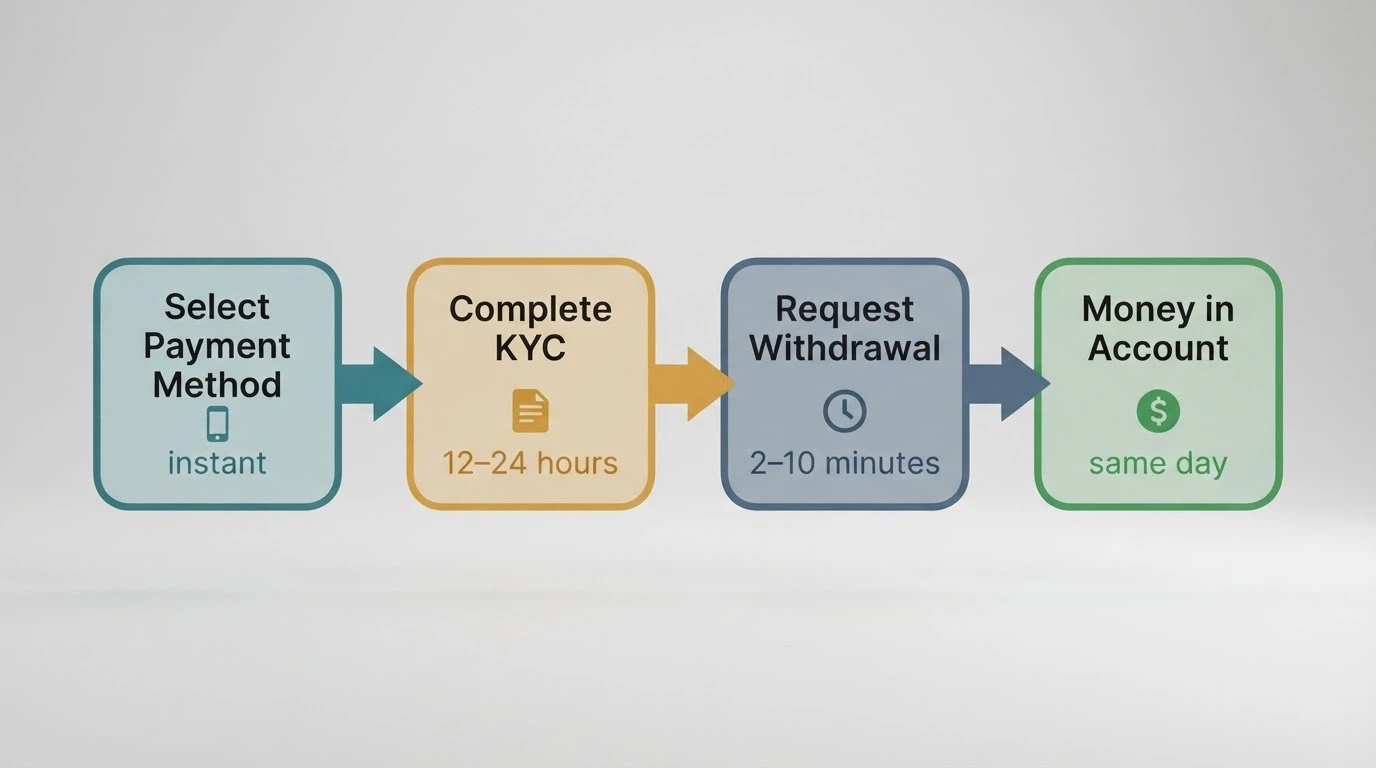
- The payment method must support it. PayID and certain crypto networks (USDT TRC-20 in particular) clear in minutes. Cards and standard bank transfers do not. A casino that only pays out by bank transfer cannot deliver a same day payout regardless of what it advertises.
- KYC must be pre-completed. Verification is the single biggest hidden delay. A player who has uploaded ID, proof of address and source of funds before requesting a withdrawal sees the request clear the casino’s queue in minutes. A player who has not waits however long manual review takes, which can be 24–72 hours at a slow operator.
- The casino’s own processing queue must be fast enough. Some brands manually review every withdrawal, which adds hours even on a fast rail. Others — SkyCrown is the clearest example — run an automated queue for verified accounts under a set threshold, which is what produces the 9-minute PayID average that independent testing has recorded.
PayID is now the dominant method at Australian-facing offshore casinos, and the average across well-run operators runs 9–40 minutes. Where the casino is slow or the verification queue is congested, the same rail stretches into hours or days.
Why Your 2026 Payout Speed Depends on the Payment Method You Choose
| Payment Method | Typical Withdrawal Time | Minimum Withdrawal | Notes |
|---|---|---|---|
| PayID / Osko | 9–40 minutes average; fastest under 10 minutes | A$30 at most operators | Dominant method at AU-facing offshore casinos; relies on NPP / Osko rails |
| USDT TRC-20 (crypto) | 5–15 minutes median; record under 2 minutes | Varies by operator, often A$15–A$30 | Near-zero network fees; banned for AU-licensed wagering since 11 June 2024 |
| Bitcoin (Lightning) | Instant at some operators; minutes to an hour at others | Often A$100 | Volatile; network fees vary |
| Credit / debit card | 1–5 business days | A$20 typical | Banned as wagering payment in AU since 11 June 2024; offshore casinos still accept |
| Bank transfer | 1–5 business days; up to 15 at some operators | A$100 at some, higher at others | Slowest rail; cannot support same day |
The table is the short version. The longer version is that the payment method, not the casino brand, is the single biggest lever on withdrawal speed. PayID and Osko run on the New Payments Platform, which settles between Australian bank accounts in near real time, and that is why a PayID payout at a fast operator averages under ten minutes while a card payout at the same operator takes days. The brand matters, but the rail matters more.
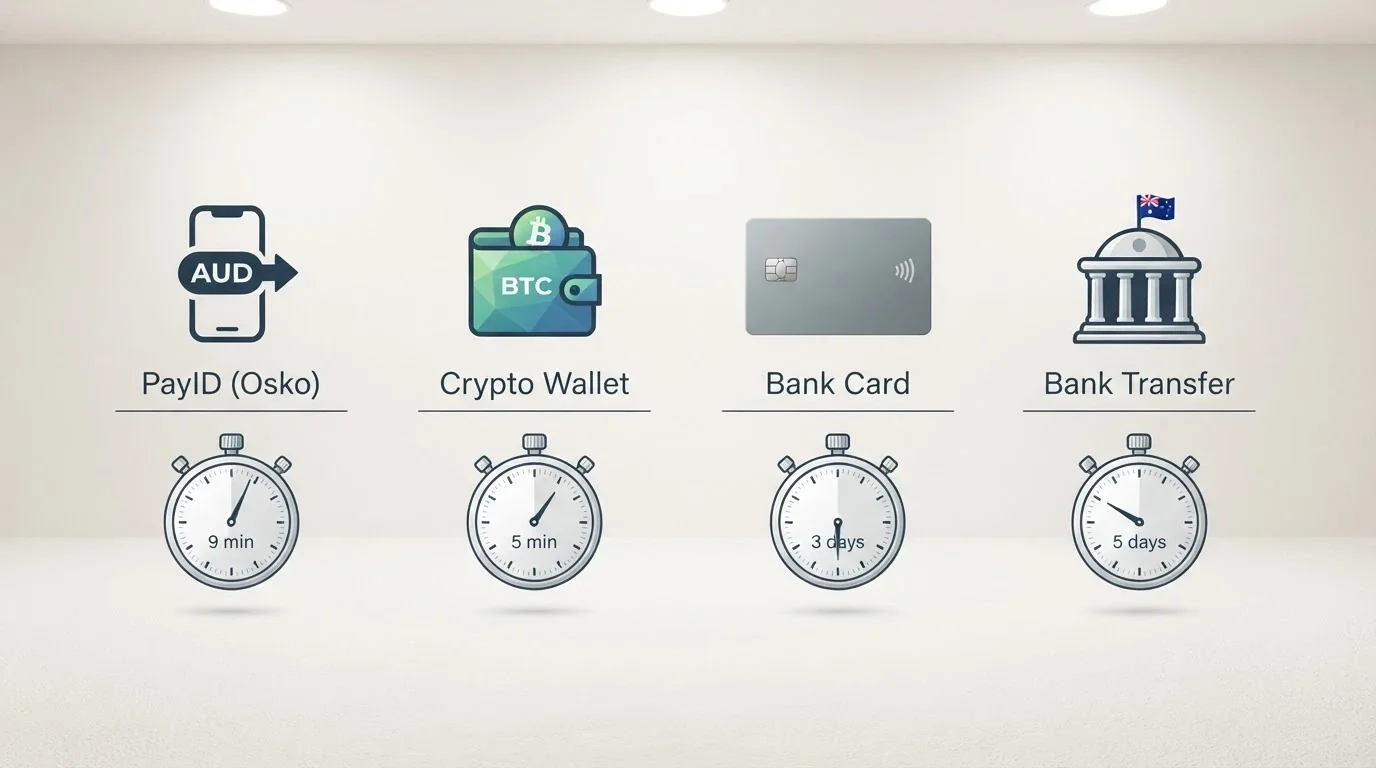
Crypto clears faster than bank rails because it skips them entirely. USDT TRC-20 sits on the Tron network, which is built for high-throughput, low-fee transfers; the median withdrawal is 5–15 minutes with near-zero fees, and the fastest single payout recorded in independent testing was 1 minute 40 seconds (USDT TRC-20 at LuckyDreams). That speed has a cost, though, and it is not the fee. Crypto is banned as a payment method for online wagering in Australia under the Interactive Gambling Amendment (Credit and Other Measures) Act 2023, with penalties of up to A$247,500 for non-compliance. The ban targets licensed operators. An offshore casino that asks for crypto is, by definition, operating outside Australian rules — which is the broader point, and the one the rest of this page rests on.
Card and bank transfer withdrawals take 1–5 business days at offshore casinos, which is incompatible with same day payout. The reason is structural: card networks and bank transfer systems are batch-settled, not real-time, and the casino has no way to compress the gap between approval and settlement once the funds are in the rail. Even a casino with a perfect internal queue cannot make a bank transfer arrive faster than the bank processes it.
KYC is the delay nobody talks about. A fast payment method means nothing if the casino has not verified the player’s identity yet, and a brand-new account that requests a withdrawal before verification is going to wait. The single biggest speed lever available to the player is to complete KYC before making the first deposit: ID, proof of address, and payment-method ownership. Brands like SkyCrown run an automated withdrawal queue for verified accounts under a set threshold, which is why their PayID average sits at 9 minutes and an unverified account at the same casino can wait 24–48 hours while the documents get reviewed.
PayID and Osko: Australia’s Fastest Casino Withdrawal Method
PayID has displaced every other method at Australian-facing offshore casinos, and the reason is the rail. PayID runs on the New Payments Platform, which settles between Australian bank accounts in near real time. Osko is the brand under which the major banks deliver NPP payments to their customers, and the two terms are usually interchangeable in the casino context. A PayID withdrawal is, mechanically, a near-instant transfer to a bank account linked to a phone number or email.
Independent testing across the offshore set has produced these figures. SkyCrown’s PayID payout averaged 9 minutes across 14 tests, with the fastest single withdrawal at 4 minutes. RocketPlay’s PayID clears in under an hour for most Australian banks, with a daily limit of approximately A$5,000. Royal Reels took 4 hours 12 minutes on a weekday test, which is at the slower end of the “same day” bracket and shows how much the casino’s own queue matters. Across all operators measured, PayID averages 9–40 minutes.
There are daily and per-transaction limits to watch. RocketPlay caps PayID at roughly A$5,000 per day; some banks cap incoming NPP payments at the customer level; the casino itself may impose a weekly ceiling independent of the rail. None of these limits are the rail’s fault — they are the casino’s or the bank’s — and a player trying to move a large balance needs to know about them in advance.
Cryptocurrency Withdrawals: Speed Without the Bank
USDT TRC-20 is the fastest payout rail available at Australian-facing offshore casinos, and the independent testing is consistent about it. Median withdrawal time is 5–15 minutes, with near-zero network fees; SkyCrown’s USDT TRC-20 averaged 4 minutes across 12 tests; the fastest realistic single payout recorded was 1 minute 40 seconds at LuckyDreams. Bitcoin on the Lightning network can settle instantly, and Fair Go Casino advertises Bitcoin as instant, though “instant” in that context means the casino releases the funds immediately rather than the network confirming in zero seconds.
The advantage of crypto is structural. The transaction does not pass through a bank, does not require a batch settlement window, and does not depend on business hours. The Tron network processes USDT TRC-20 transfers continuously, and the casino’s role is to authorise the transfer, not to route it through a correspondent banking chain. That is why a USDT payout can clear faster than a PayID payout at the same operator.
The friction is not technological. As noted, this is illegal under the Interactive Gambling Amendment (Credit and Other Measures) Act 2023, with penalties for non-compliance that target licensed operators. The same point applies to credit cards, which were banned at the same time. A payment method that an Australian licensee cannot accept is, by construction, a signal that the operator is offshore — and offshore is, by construction, outside the protections an Australian licence confers.
KYC still applies on the crypto rail. A new account that requests a USDT withdrawal before identity verification is going to wait for the same review queue as a PayID withdrawal. The difference is that once the queue clears, the payout itself can arrive in minutes rather than in a day.
Cards and Bank Transfers: Why Same Day Is Not Possible
Card and bank transfer withdrawals take 1–5 business days at offshore casinos. The reason is the rail. Card networks and bank transfer systems are batch-settled, and the casino cannot compress the gap between approval and settlement. Even a casino that approves a withdrawal in two minutes has to wait for the card network or the bank to process the transfer, and that process is measured in business days, not minutes.
Fair Go Casino is the clearest example. Bitcoin is instant at Fair Go, but bank transfer takes up to 15 business days. The same operator, two different methods, two different planets of speed. The contrast is not a criticism of Fair Go; it is a property of the rails.
The credit card context is worth stating in full. Credit cards, credit-related products and digital currency are banned for wagering, as described in the Legality section. The ban covers all forms of credit — credit cards, buy-now-pay-later products such as Afterpay used in a credit configuration, and any credit-related digital wallet. The same amendment added crypto to the banned list. Debit cards, bank transfer, PayID / Osko and BPAY remain the legal deposit routes for licensed wagering. An offshore casino that asks for credit card or crypto is, by construction, accepting a payment method no Australian-licensed operator is permitted to take.
KYC Verification: The Withdrawal Delay Nobody Talks About
A fast payment method means nothing if the casino has not verified the player’s identity yet. A brand-new account that requests a withdrawal before verification waits however long manual review takes, which can be 24–72 hours at a slow operator and 12–24 hours at a fast one. The verification queue is the single biggest hidden delay in the withdrawal pipeline, and the player controls whether they hit it.
KYC asks for three things: government-issued ID (driver’s licence or passport), proof of address (utility bill or bank statement under three months old), and proof of payment-method ownership (a photo of the card with the middle digits covered, or a crypto wallet screenshot). The casino’s compliance team reviews the documents, usually within hours, and either approves the account or asks for more. A player who has uploaded all three before making the first deposit skips the queue entirely when they request a withdrawal.
Some brands run automated queues for verified accounts under a set threshold. SkyCrown’s automated withdrawal queue applies to verified accounts under A$2,000 and skips manual review, which is a large part of why its PayID average sits at 9 minutes. An unverified account at SkyCrown waits. The same logic applies across the offshore set: verification is the gate, and the casino’s queue is the line that opens once the gate is up.
The Offshore Casinos Australians Use for Fast Payouts in 2026
| Casino | Licence | Fastest Payout Method & Time | Welcome Offer | Wagering | Game Library |
|---|---|---|---|---|---|
| SkyCrown | Curaçao (offshore) | PayID ~9 min; USDT TRC-20 ~4 min | A$8,000 + 400 free spins across 4 deposits | 40x (bonus + free spins) | Pragmatic Play, NetEnt, Play’n GO, 50+ providers |
| RocketPlay | Curaçao (offshore) | PayID under 1 hour | A$2,000 + 100 free spins (300% match) | 40x (bonus only) | 3,000+ games |
| Royal Reels | Curaçao (offshore) | PayID ~4 hr 12 min; crypto under 1 hour | A$2,500 + 50 free spins across 3 deposits | 30x (bonus only) | 5,400+ pokies, 40+ providers |
| Fair Go Casino | Curaçao (CGA, offshore) | Bitcoin instant (after 48-hr pending) | 100% up to A$200, redeemable 5 times | 30x (bonus + deposit) | RTG / SpinLogic focus |
| Rainbet | Offshore (no stated licence) | Crypto within minutes to a few hours | Multi-stage deposit match | 40x (bonus + FS winnings) | 6,818+ games |
| Bizzo Casino | Curaçao (Antillephone N.V. 8048/JAZ2017-067) | Crypto 2–24 hours | Matched deposits + free spins (standard offshore T&Cs) | — | SoftSwiss white-label library |
| Stake | Curaçao (offshore; AU restricted) | Crypto 0–1 hour (if accessible) | 200% up to $1,000 | 40x | Proprietary + Pragmatic Play, Hacksaw, others |
| WinSpirit | Offshore | Not independently tested | — | — | — |
| Scream Casino | Offshore | Not independently tested | — | — | — |
| Rocket Casino | Offshore | USDT TRC-20 ~6 hours average | — | — | — |
The ranking above is ordered by independently tested withdrawal speed, not by market share or commercial relationship. The licensed wagering operators Australians may know by name — SportsBet, Tab, bet365, Ladbrokes, PointsBet, Neds, Betr — do not appear because they are not online casinos. They are bookmakers, licensed under state and territory regimes, and they offer race and sport betting only. A casino offering pokies to Australians is offshore by definition, and offshore means outside the consumer protection, self-exclusion coverage and dispute resolution that the Australian system provides.
SkyCrown
SkyCrown is the fastest PayID withdrawal in independent testing, and the margin over the next-fastest operator is meaningful. Fourteen test withdrawals produced a 9-minute average, with the fastest single payout at 4 minutes; twelve USDT TRC-20 tests produced a 4-minute average. Both figures are well inside the “same day” window and most of the way toward “instant” if that term meant anything in practice.
The welcome package is up to A$8,000 and 400 free spins across four deposits, with a 40x wagering requirement on bonus and free spin winnings. The maximum cashout from free spins is A$300 per deposit part, which is a hard ceiling on what the spin component can produce regardless of the wagering outcome. Minimum withdrawal is A$30 via MiFinity and A$100 via bank transfer, which matters for a player trying to cash out a small win.
The structural reason SkyCrown clears faster than its peers is the automated withdrawal queue. Verified accounts under A$2,000 skip manual review entirely, which is what produces the 9-minute average at scale. An unverified account at the same casino waits for human review, and the difference is hours turned into days. The lesson, again, is that KYC timing controls the queue position.
The platform carries 50+ software providers and a 96.42% average RTP across sampled pokies, which is a meaningful data point if the player is comparing theoretical return across operators. The game library is broad enough that the platform RTP figure is a real average, not a cherry-picked number from a few high-RTP titles.
Worth taking for a player who has completed KYC before their first deposit and is using PayID or USDT TRC-20. The wagering is steep — 40x on a large bonus produces a turnover requirement that takes serious volume to clear — but the withdrawal pipeline is the fastest in the set.
RocketPlay
RocketPlay’s PayID withdrawal clears in under an hour for most Australian banks, with a daily limit of approximately A$5,000. Minimum withdrawal is A$30, which is the lowest in the featured set and the reason small wins are accessible rather than trapped under a minimum-cashout threshold. Crypto clears within 15 minutes at the verified-account tier.
The welcome bonus is up to A$2,000 and 100 free spins, structured as a 300% match, with 40x wagering on the bonus amount only. The 5-day bonus validity is short and matters: a player who deposits and walks away loses the bonus. The maximum bet while wagering is A$7.50, which is a hard ceiling on a single spin until the requirement is cleared. Weekly withdrawal limits are A$9,000 and monthly A$35,000, which is high enough to be irrelevant for most players and restrictive enough to be a problem for a high-roller.
The right fit is a player moving modest amounts who values the A$30 minimum and the PayID speed. The 5-day bonus window is a real constraint that the marketing copy tends to underplay.
Royal Reels
Royal Reels has the biggest game library of the fast-paying set, with over 5,400 pokies from 40+ software providers. The scale is the brand’s defining feature: a player who wants choice over a single fast withdrawal method will find more of it here than anywhere else on the page.
The withdrawal pipeline is solid but not the fastest. PayID took 4 hours 12 minutes in a weekday test, which is the same day but at the slower end of the bracket. Crypto clears under an hour. The published weekly withdrawal cap is A$10,000 at standard tier, which is high enough to be unnoticeable for most players and a constraint for anyone moving a large balance in a single week.
The welcome package is A$2,500 and 50 free spins across three deposits, with 30x wagering on the bonus amount. A$10 no-deposit bonus after phone verification is a small but real sweetener. The 30x wagering is below the 40x norm of the set, which is the math a player should care about.
Worth taking for the game library and the lower wagering. The PayID speed is solid but not best-in-class, and the weekly cap is the constraint a larger-balance player should check against their own withdrawal pattern.
Fair Go Casino
Fair Go is a different shape from the rest of the set. Bitcoin is instant, in the sense that the casino releases the funds immediately, but a 48-hour pending period sits in front of every withdrawal regardless of method. Bank transfer takes up to 15 business days. The contrast within a single brand is the clearest illustration of why the payment method matters more than the casino.
The minimum withdrawal is A$100 and the weekly cap is A$7,500, both of which are tighter than the rest of the featured set. Minimum deposit is A$5 via Lightning Bitcoin and A$20 via cards. The welcome bonus is 100% up to A$200, redeemable 5 times, with 30x wagering on bonus plus deposit. The wagering structure is heavier than the 30x-bonus-only model some competitors run, because the deposit is in the requirement.
The Curaçao CGA licence is stated, the brand has been around long enough to have a track record, and the RTG / SpinLogic game library is narrower than the multi-provider set the rest of the page ranks. The trade-off is consistency and tenure against speed and library size.
The right fit is a player who values a long-running brand and is comfortable with the 48-hour pending period and the A$100 minimum. Bitcoin is the only rail that delivers a same-day experience, and the pending period applies to it too.
Rainbet
Rainbet is a crypto-first operator with no maximum withdrawal limit and a $15 minimum. Once Level 1 KYC is complete, crypto withdrawals clear in minutes to a few hours. The absence of a ceiling is the brand’s defining feature for a player moving a large balance.
The welcome offer is a multi-stage deposit match with 40x wagering on bonus plus free spin winnings, a 14-day validity, and a $50 withdrawal cap on welcome code balances. The $50 cap is a hard ceiling on what a player can cash out from bonus-derived winnings regardless of the wagering outcome, and the 14-day window is short. Games above 97.4% RTP are disabled during bonus play, which is a meaningful restriction: a high-RTP title becomes unavailable exactly when a player needs the theoretical return to be at its highest.
The right fit is a crypto-native player with a large balance who is not chasing the welcome bonus. The $50 cap and the 97.4% RTP restriction make the bonus harder to extract value from than the marketing implies, and the no-max-withdrawal feature is the real reason to be here.
Bizzo Casino
Bizzo holds a stated Curaçao licence (Antillephone N.V., 8048/JAZ2017-067), which is more transparent than the operators that decline to publish a licence number. Crypto payouts clear in 2–24 hours depending on KYC status, and bank transfer takes 3–5 days. The game library is a SoftSwiss-style white-label stack, broad and undifferentiated.
The bonus terms are not detailed in independent testing for this page. The standard offshore structure applies — matched deposits, free spins, reloads — but the specifics are not in the data set. The licence transparency is a real positive, and the withdrawal speed is solid if not best-in-class.
Worth a look for a player who values a published licence number and is comfortable with crypto on the 2–24 hour end of the speed range. The brand is the conservative middle of the set rather than the standout at either end.
Stake
Stake is a high-profile crypto casino with the fastest theoretical withdrawal speed in the offshore set — crypto 0–1 hour, with a slick interface and a 200% deposit match up to $1,000 at 40x wagering and 30-day validity. The problem for an Australian reader is that Stake lists Australia as a restricted country in its Terms of Service, verified as recently as May 2026.
A player accessing Stake from Australia using a VPN risks account closure and balance forfeiture. The terms are explicit, and the operator enforces them. The bonus and the speed are real, and neither matters if the account is closed on the first withdrawal.
The right fit is no Australian reader. The brand is on the list because it is the kind of name a searcher will encounter, and the honest answer is that it is not available to the audience this page is written for.
WinSpirit
WinSpirit is an offshore operator with roughly 1.55% of the Australian-facing market by recent operator tracking data, which is enough to put the brand on the radar but not enough to have produced independent testing of withdrawal speed, game providers or bonus terms. The honest position is that the brand exists, the brand reaches Australian players, and the brand has not been tested at the level of detail this page applies to the rest of the set.
A player considering WinSpirit is depositing without the speed evidence, the bonus evidence and the library evidence that the other operators on this page carry. The 1.55% market share is a market presence figure, not a payout speed figure, and the two are not interchangeable.
The right fit is a player who has independently verified the terms — licence, withdrawal speed, bonus structure — through a current review and is comfortable that the absence of evidence on this page is not the same as negative evidence. The page is honest about what it has not measured, and the reader should be honest with themselves about what they have.
Scream Casino
Scream Casino holds roughly 0.99% of the Australian-facing market by operator tracking data, which is a smaller slice than WinSpirit and a smaller basis for any recommendation. Withdrawal speed, game providers and bonus terms have not been independently tested in the data underlying this page.
A player considering Scream is in a similar position to a player considering WinSpirit: depositing without the speed, library and bonus evidence the other operators carry. The market presence figure is real; the payout evidence is not.
The right fit is a player who has done their own current research. The 0.99% market presence is not a quality signal and not a speed signal, and the page is not in a position to fill in what it has not measured.
Rocket Casino
Rocket Casino’s USDT TRC-20 withdrawals average approximately 6 hours in independent testing, which is the slower end of “same day” but still inside the bracket. Other withdrawal methods, game providers and bonus terms are not detailed in the data underlying this page.
A player choosing Rocket for USDT TRC-20 is choosing a slower crypto rail than the rest of the set offers and accepting that the rest of the operator profile is not on the page. The 6-hour average is not disqualifying, and it is faster than a card or bank transfer, but it sits behind the 5–15 minute USDT TRC-20 average the rest of the set achieves.
Worth knowing about if USDT TRC-20 is the rail and the player has done their own homework on the rest of the brand. The withdrawal figure is the only number on the page, and the rest is a gap the reader has to close.
What Your Welcome Bonus Actually Costs: The Real-Money Maths
The headline figure on a welcome bonus is the dollar amount, and the dollar amount is the wrong number to look at. A A$8,000 bonus with a 40x wagering requirement produces A$320,000 in required turnover — bonus amount multiplied by the wagering multiplier — and the expected cost of clearing that turnover is what the player actually pays, not the headline figure.
The expected loss is the product of the required turnover and the house edge, which is one minus the RTP. The platform RTP across the sampled pokies at SkyCrown is 96.42%, which gives a house edge of 3.58%. The expected loss on A$320,000 in turnover, assuming the bonus amount is the only thing wagered, is therefore A$320,000 multiplied by 0.0358, or approximately A$11,460. The player must turn over A$320,000 to extract a bonus worth at most A$8,000, and the expected cost of doing so is A$11,460. The expected loss is larger than the bonus. The bonus, on the math, is a loss-making proposition for the player before a single spin is taken.
This is the arithmetic the headline figure does not show, and it is the arithmetic a player should run before claiming. The formula is a statistical estimate over many spins under the stated assumptions; it is not a guaranteed outcome for any single player, and a short run can produce anything. The estimate is what the offer is worth on average, and on average it is worth less than its headline figure.
A few things follow from the math. A bonus with a lower wagering multiplier costs less to clear: a 30x bonus (Royal Reels, for example) on the same bonus amount reduces the required turnover by 25% and the expected loss by the same proportion. A bonus with a bonus-only wagering structure (RocketPlay) is cheaper again than a bonus-plus-deposit structure (Fair Go), because the deposit is not in the requirement. A maximum-cashout cap on free spin winnings (A$300 per deposit part at SkyCrown) is a hard ceiling on what the spin component can produce regardless of the wagering outcome. None of these are reasons to refuse a bonus; they are reasons to read the terms before claiming.
The Pokies Where a Win Actually Reaches You Same Day
| Pokie | Provider | RTP | Volatility | Max Win |
|---|---|---|---|---|
| Gates of Olympus | Pragmatic Play | 96.50% | High | 5,000x |
| Big Bass Bonanza | Pragmatic Play / Reel Kingdom | 96.71% | High | 2,100x |
| Sweet Bonanza | Pragmatic Play | 96.51% | High | 21,100x |
| Wolf Gold | Pragmatic Play | 96.50% | Medium-High | 2,500x |
| Razor Shark | Push Gaming | 96.70% | Extreme | ~50,000x |
| Dead or Alive 2 | NetEnt | 96.82% | Very High | 111,111x |
| Money Train 3 | Relax Gaming | 96.40% | Extreme | 100,000x |
RTP is the percentage of wagered money a game returns to players over millions of spins. A higher RTP means less of the stake disappears to the house edge before the player can cash out, which is the connection between the game table and the same-day payout story. A 96.71% pokie returns about 96.71 cents per dollar wagered over the long run; a 96.40% pokie returns 96.40 cents. The difference of 0.31 percentage points compounds across a session and is the part of the bankroll that survives to be withdrawn at all.
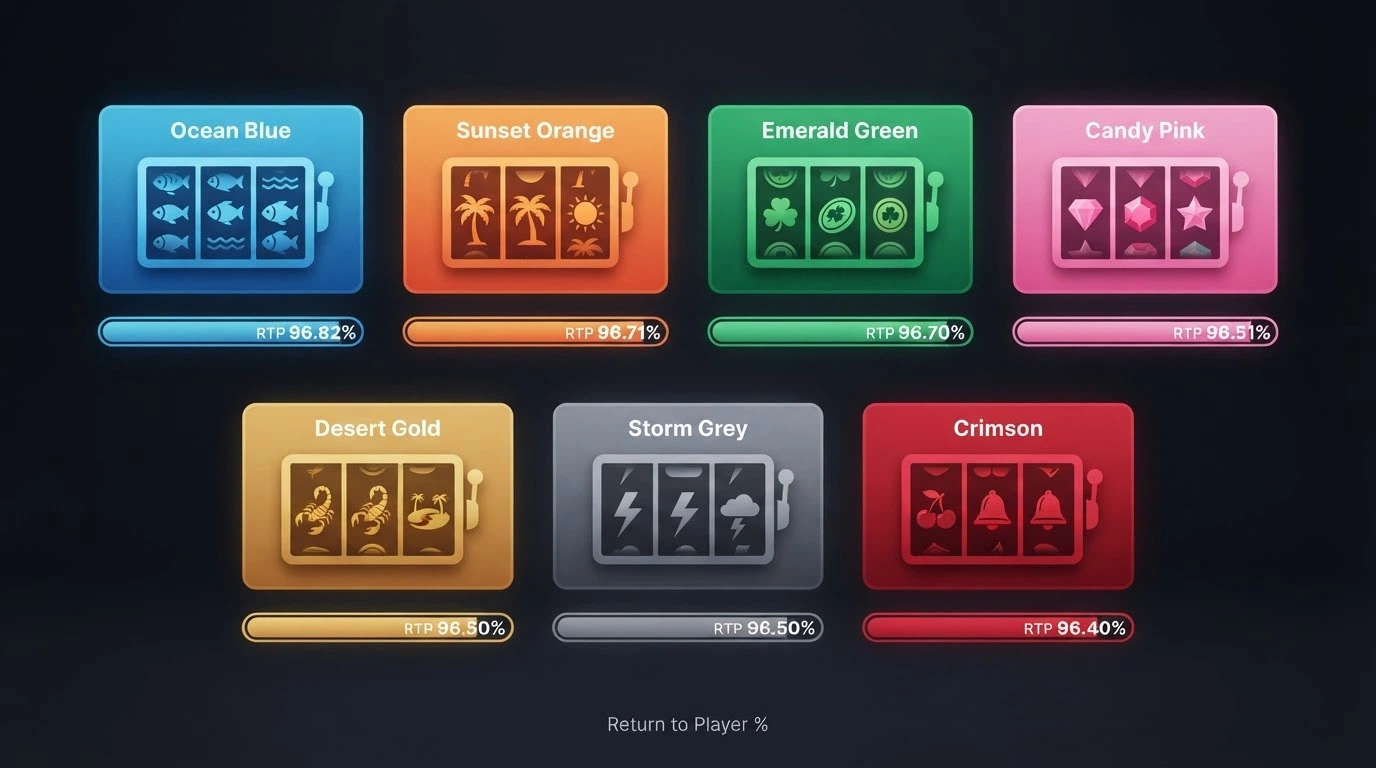
A pokie’s RTP is a published figure, and Pragmatic Play titles range from 94.0% to 97.5% depending on operator configuration. The same game can run at different RTPs at different casinos, and the player cannot always see which version they are playing. Nolimit City publishes 96.0–96.2% default builds but reduced 94% builds circulate. Play’n GO offers 2–3 RTP configurations per game, typically 94% to 96.5%. Microgaming ranges 95% to 97%. Hacksaw Gaming ranges 94% to 96.5%. The configuration the operator chooses is the configuration the player plays, and the spread is wide enough to matter over a session.
The volatility column matters for the shape of the session, not the return. A high-volatility pokie pays out less often but in larger amounts when it does; a low-volatility pokie pays out more often in smaller amounts. The max win is the theoretical ceiling on a single spin and is unrelated to the RTP — Dead or Alive 2’s 111,111x max win is not a forecast, it is a structural feature of the game’s bonus round. A pokie with a 5,000x max win at 96.50% RTP and a pokie with a 100,000x max win at 96.40% RTP are returning almost the same per dollar wagered; the difference is the distribution of the returns across spins.
The Pokies with the Highest RTP at Fast-Paying Casinos
The seven titles in the table above are the ones with independently confirmed RTPs in the data underlying this page. They are all available at the offshore casinos earlier in the ranking, and the RTP figures quoted are the default builds at the providers, not necessarily the configuration at the specific operator the player is on.
Dead or Alive 2 leads the table on RTP at 96.82%, with very high volatility and a 111,111x max win. Big Bass Bonanza sits at 96.71% with high volatility and a 2,100x ceiling. Razor Shark at 96.70% is the most volatile of the set, with a ~50,000x max win. Gates of Olympus, Sweet Bonanza and Wolf Gold cluster around 96.50–96.51% and are the Pragmatic Play core of the offshore set. Money Train 3 is the lowest RTP in the table at 96.40% but offers a 100,000x max win and is the Relax Gaming representative.
A player optimising for same-day payout should care about RTP, not max win. The max win is a feature of the bonus round; the RTP is a feature of every spin. A 96.82% pokie returns more per dollar wagered than a 96.40% pokie, and the difference is the part of the bankroll that is available to be withdrawn at all. A 5,000x max win that does not trigger is worth nothing; a 96.82% RTP compounds across every spin.
Real-Money Slots and the Withdrawal Reality
A real-money pokie at an offshore casino sits at the end of a pipeline. The player deposits, the casino credits the account, the player spins, the winnings accumulate as a real-money balance, the player requests a withdrawal, the casino approves the request, the funds move through the chosen rail, the money arrives. Each step has its own delay, and the steps compound.
The pipeline is why the payment method matters more than the pokie’s RTP for same-day speed. A 96.82% pokie on a card withdrawal at a slow operator can take a week to cash out; a 96.40% pokie on USDT TRC-20 at a fast operator can be in the player’s wallet within an hour. The RTP governs how much of the bankroll survives to be withdrawn; the rail governs how quickly the surviving amount arrives. Both matter, and the page carries both.
Demo mode is the free version of the same pokie, where the wins and losses are play money. Demo play is a reasonable way to learn a game’s mechanics, but the wins do not reach a bank account, and the same-day question does not apply. Real-money play is the only mode in which the pipeline above is relevant.
There Is No Licensed Online Casino in Australia — Here’s What That Means
Online casino games, online pokies and in-play betting are prohibited in Australia under the Interactive Gambling Act 2001. No licence for online casino exists anywhere in the country — not federally, not in any state, not in any territory. Every casino on this page is offshore, and offshore means outside the Australian regulatory perimeter by definition.
The legal status is not ambiguous. The Interactive Gambling Act 2001 prohibits the provision of online casino to persons in Australia. The 2017 amendment strengthened enforcement, and the 2026 reform, passed on 19 August 2026 with substantive measures commencing 1 January 2027, added the most consequential powers yet. From 1 January 2027, banks and payment providers gain express authority to block transactions to illegal gambling operators. From the same date, wagering advertising is restricted to three ads per hour between 6am and 8:30pm, with a live-sport blackout from 15 minutes before to 5 minutes after play, and broadcasting sporting odds is banned outright. The reform also introduces AdStop, a national wagering advertising opt-out register, and prohibits online keno and foreign-matched lotteries.
The ACMA enforces the prohibition. Since its first blocking request in November 2019, the ACMA has had 1,564 illegal gambling and affiliate websites blocked at ISP level as of March 2026, and more than 225 illegal services have voluntarily withdrawn from the Australian market since enforcement was strengthened in 2017. A site that is reachable from an Australian IP address today may be blocked tomorrow, and a balance on that site at the time of blocking is a balance the player may not be able to access.
The individual player is not prosecuted under the IGA. The Act targets the provider, not the customer, and the ACMA’s enforcement record is consistent on that point. That fact does not make the activity licensed, regulated or safe. It means the player is the one carrying the consumer-protection risk that an Australian licence would otherwise cover.
The Interactive Gambling Act and ACMA: How the Prohibition Works
The Interactive Gambling Act 2001 makes it an offence to provide certain interactive gambling services to customers physically present in Australia. The 2017 amendment closed loopholes that had allowed some overseas operators to argue they were not “providing” the service to Australians, and the 2026 reform added payment-blocking, advertising and inducement powers that close other gaps.
The ACMA is the regulator. It investigates complaints, issues warnings, runs civil penalty proceedings, refers operators for prosecution, and directs Australian ISPs to block illegal sites. The blocking programme started in November 2019 and has resulted in 1,564 sites being blocked as of March 2026, with 225+ illegal services having withdrawn from the Australian market voluntarily over the same period. The number grows each month.
The 2026 reform’s new powers are the ones that change the experience of using an offshore casino. Banks and payment providers gain express authority to block transactions to illegal gambling operators from 1 January 2027, which means a deposit or withdrawal that has been flowing freely could be declined by the bank once the new rules take effect. Wagering advertising is restricted to three ads per hour between 6am and 8:30pm, with a live-sport blackout from 15 minutes before to 5 minutes after play. Broadcasting sporting odds is banned outright. AdStop, the national wagering advertising opt-out register, will be administered by the ACMA. Inducements are restricted: a 14-day cool-off after sign-up, a three-month cool-off after BetStop deregistration, and an indefinite ban on inducements for customers identified as at-risk. Online keno and foreign-matched lotteries are prohibited entirely.
The effect on a player using an offshore casino is mostly indirect. The bank-blocking power is the most direct: an Australian bank may decline a transaction to an operator it has identified as illegal, and the player has no recourse to make the bank honour it. The advertising restrictions change what the player sees on Australian broadcasts, not what the offshore casino offers directly. The inducement restrictions apply to licensed operators, not to offshore brands.
Licensed Wagering vs Offshore Casino: Two Completely Different Products
The operators that hold Australian licences — SportsBet, bet365, Ladbrokes, Tab, TABtouch, PointsBet, Neds, Betr, Picklebet, Betfair and around fifty others — are licensed bookmakers. The Northern Territory Racing and Wagering Commission (NTRWC), administered through Licensing NT, is the de facto national licensor for online bookmakers, and the NT regime was reformed in 2026 after criticism of the regulator’s structure. State and territory regimes exist alongside it, and the large operators hold licences in multiple jurisdictions.
What licensed operators offer is race betting and sports betting. What they do not offer is online casino games, online pokies or in-play betting on sport. A player searching for a same-day payout casino in Australia is searching for a product the licensed wagering system does not provide, and the only operators that provide it are offshore. The two products are not interchangeable: a bookmaker’s withdrawal pipeline is a different question from a casino’s withdrawal pipeline, and the licensed bookmakers do not run casino games.
A page that lists “the best licensed online casinos in Australia” is describing something that does not exist. The licensed product is wagering. The unlicensed product is casino. The two are governed by different parts of the Australian regulatory system, and conflating them is a common error on affiliate sites.
What the Player Risks at an Offshore Casino
The IGA does not prosecute the player, but that is the only protection the player has. An offshore casino sits outside the Australian regulatory perimeter, which means the player carries the consumer-protection, dispute-resolution and self-exclusion risks that an Australian licence would otherwise cover.
No Australian consumer protection applies. The Australian Consumer Law does not reach a Curaçao-licensed operator serving Australian players. The operator’s terms of service govern, and the operator’s home regulator — Curaçao in most cases — is the only body with any theoretical jurisdiction. The practical effect is that a dispute over a voided withdrawal, a closed account or a changed bonus term is adjudicated by the operator, not by an external body.
No BetStop coverage applies. BetStop binds Australian-licensed wagering services only. An offshore casino is not connected to the register, will not check a BetStop registration before accepting a deposit, and will continue to accept a self-excluded person’s money. The BetStop record is invisible to the operator.
No ACMA complaints recourse applies. The ACMA’s role is to enforce the IGA against the provider, not to adjudicate player disputes. A player who has a complaint about an offshore casino cannot take it to the ACMA. The ACMA will accept the complaint as intelligence about an illegal operator, which may contribute to a future blocking action, but the player is not the beneficiary of that process.
The site can be blocked at any time. The ACMA can and does direct ISPs to block illegal sites, and the 1,564-figure is the count of sites blocked to date. A site that is reachable today may be blocked next month, and a balance on that site at the time of blocking is a balance the player may not be able to access. The operator has no obligation to return the balance and the player has no Australian regulatory body to appeal to.
The operator can refuse a withdrawal. An offshore operator’s terms of service usually include clauses allowing the operator to void winnings, close accounts and refuse withdrawals on grounds ranging from bonus abuse to “irregular play”. The clauses are enforced at the operator’s discretion, and the player has no external review. A player who has won fairly and is being refused a payout has the operator’s word against their own.
The payment-method ban is a signal. Credit cards and crypto have been banned as payment for online wagering in Australia since 11 June 2024. An offshore casino that asks for a credit card or a crypto deposit is, by construction, accepting a payment no Australian-licensed operator is permitted to take. The player who pays that way is not just outside the Australian system; the operator is openly accepting a payment that the system has prohibited.
Responsible Gambling Tools That Do (and Don’t) Protect You at Offshore Casinos
Australia has built real responsible-gambling infrastructure. BetStop, the National Self-Exclusion Register, has 49,382 registrations as of Q1 FY2025-26 (30 September 2025), with 31,838 active exclusions. Of those who have registered, 77% report a better quality of life, 79% report improved mental health, and 96% have stopped or decreased their betting. The infrastructure is real and the outcomes are documented.
The infrastructure was built for a licensed market the online casino player is outside. BetStop binds Australian-licensed wagering services only, and an offshore casino is not connected to the register. A person who has self-excluded through BetStop can still deposit at an offshore casino on the same afternoon, because the casino has no way to check the BetStop database and no obligation to do so. The self-exclusion works exactly as designed within the system it covers, and it does not cover the system the offshore casino operates in.
The National Gambling Helpline is 1800 858 858, free, confidential and staffed 24 hours a day, seven days a week. Gambling Help Online at gamblinghelponline.org.au provides online chat and counselling. These are real resources, available to anyone regardless of whether they play at a licensed or offshore operator, and they are the right starting point for a player who is concerned about their own or someone else’s gambling.
BetStop: What It Does — and Why It Doesn’t Reach Offshore Casinos
BetStop launched on 21 August 2023 and is the National Self-Exclusion Register for online wagering in Australia. A single registration excludes the person from every Australian-licensed wagering service — the fifty-plus bookmakers operating under state and territory licences — for a period of the registrant’s choosing (three months, one year, or permanently). The system is comprehensive within its scope.
The scope is the limit. BetStop binds the licensed operators that participate in the Australian system, and an offshore casino does not participate. The register is invisible to a Curaçao-licensed operator serving Australian players, and the operator has no integration with the database. A person who has self-excluded through BetStop can sign up at an offshore casino on the same day, deposit, and play without the self-exclusion having any effect.
The research on BetStop’s outcomes is strong. By November 2025, more than 50,000 Australians had registered, and 77% of registrants reported better quality of life after self-excluding, 79% reported improved mental health, and 96% had completely stopped or decreased their betting. The system works for the licensed wagering market. The licensed wagering market does not include online casinos.
The awareness gap is the other side of the same problem. Only 33.5% of wagerers and 26.5% of Australian adults are aware BetStop exists, according to research from the Australian Gambling Research Centre (AGRC) at the Australian Institute of Family Studies. A protection that the majority of the at-risk population does not know about is a protection that is not being used. And the protection, even when used, does not reach the offshore casino the reader of this page is most likely to be using.
Setting Your Own Limits When the Platform Won’t
An offshore casino may offer deposit-limit tools, time-out features and self-exclusion options within its own platform. The tools are real, and they are the most a player can ask of an operator that is not connected to BetStop. The tools are also optional, enforceable only at the operator’s discretion, and ineffective if the player can simply open an account at the next offshore casino in the list.
- Use the operator’s deposit-limit and time-out tools if they are offered. A weekly deposit cap set below the level at which play becomes harmful is a real limit, even if it is only enforced by one operator. The next operator’s deposit limit is a separate decision.
- Keep a written record of deposits and withdrawals. The operator’s own activity statement is a useful check, and a personal ledger the player maintains themselves is better. A player who can see their own monthly spend in one column and their withdrawals in another has a clearer picture than the operator’s marketing-optimised dashboard provides.
- Set a hard budget before depositing and stop when it is gone. The casino’s games do not get easier as the session continues, and the house edge is the same on spin 1 as on spin 500. A budget that is exhausted is a session that is over.
- Use BetStop for the licensed wagering market the player is also using. A self-exclusion through BetStop covers every Australian-licensed bookmaker in one registration and is the most effective single action for a player using both licensed and offshore products.
- Contact the National Gambling Helpline on 1800 858 858 or Gambling Help Online at gamblinghelponline.org.au. Both are free, confidential, available 24/7, and not connected to any operator.
The Real Numbers: Gambling Harm in Australia Right Now
The statistics are worse than most Australians think, and offshore casino play sits outside every protective system. The Roy Morgan research from March 2026 shows 15.1% of the Australian adult population — an estimated 3.32 million people — are experiencing some form of gambling harm. 13.0% (2,857,000 people) from their own gambling and 5.4% (1,177,000) from other people’s gambling. The Journal of Gambling Studies estimates approximately 3.29 million Australians aged 5 and over are affected annually by their own or another person’s gambling, including approximately 1.97 million adults classified as having at-risk or problem gambling.
The AIHW 2022 data shows about 2.1% of Australian adults — roughly 430,000 people — experience problem gambling, with high-risk gambling at 1.8%. The ANU Gambling Participation in Australia 2025 study (n=3,387) found overall gambling participation declined to 58.8% in 2025, but risky gambling, measured on the PGSI scale, increased from 13.7% in 2024 to 19.4% in 2025. Online gambling accounted for 56.1% of all gambling activity. The trend is toward more online, more risky, and the offshore casino segment is the part of the online market least covered by the Australian protective system.
The gap between harm and help-seeking is the part the numbers hide. An estimated 400,000 Australians are high-risk gamblers, and approximately 30,000 have active exclusions through BetStop. The ratio of those at risk to those who have taken the formal step to exclude is roughly 13 to 1. The protective system reaches a small fraction of the people it is designed for, and the people most likely to need it are the people the offshore casino is outside.
The minimum age for any commercial gambling in Australia is 18. The offshore casino will not check that the player is over 18 with the same rigour an Australian licensee does, and the IGA prohibition is structured around the provider, not the player. A reader under 18 is in the wrong place regardless of which casino is fastest.
How We Chose and Ranked These Casinos
The ranking is built from independently tested withdrawal times, verified licence records and published bonus terms — not from commercial relationships.

Withdrawal speed is the primary criterion. The data underlying this page is independent testing from Slotspeak.net, gamblinginsider.com, Adventuregamers.com, Flaxenbd.com, Australiangamblers.com, Tech-insider.org, Casinoaudit.net, Garlandsmith.com, Wizard of Odds and Payoutverdict.com. The figures used in the operator write-ups are the figures those sources published. Where two sources disagree, the more recent figure is used. Where a source has not tested an operator, the operator is ranked below the tested set and the gap is stated.
Licence transparency is the secondary criterion. Operators with a published Curaçao licence number rank above operators that decline to publish one. Bizzo’s Antillephone N.V. licence 8048/JAZ2017-067 is a positive; the operators that do not state a licence number are a gap the reader should weight themselves.
Game library and bonus terms are the third tier. The 5,400-pokie library at Royal Reels and the 50+ providers at SkyCrown are real differentiators; the 30x wagering at Royal Reels is a lower barrier than the 40x at SkyCrown and RocketPlay; the A$100 minimum withdrawal at Fair Go and the $50 cap on Rainbet welcome code balances are constraints the reader needs to know.
What was excluded: licensed wagering operators (SportsBet, Tab, bet365, Ladbrokes, PointsBet, Neds, Betr, Picklebet, Betfair and others) are not ranked, because they are not online casinos. The page is about the product the IGA prohibits, and the licensed wagering system is the system the prohibition carves out.
What was tested and not found: WinSpirit, Scream Casino and Rocket Casino have partial coverage — market share for the first two, USDT TRC-20 speed for the third — and the rest of their profile is not in the data. They are ranked below the fully tested set, and the gaps are stated.
The honesty about the offshore status: every operator on this page is offshore. None holds an Australian casino licence because none can. The page describes what the operators are and what they deliver, and the legal frame sits in plain view above the rankings rather than in a footnote at the bottom.
Your Money, Same Day: What to Actually Do Next
The three things that determine whether a withdrawal lands same day are the payment method, the KYC timing and the operator. PayID and USDT TRC-20 are the rails that clear in minutes; cards and bank transfers do not clear in minutes, and no operator can make them. KYC pre-completion is the difference between an automated queue and a manual one, and the difference is hours turned into days. The operator’s own processing speed is the third variable, and the table earlier in this page is the one that ranks it.
The legal frame is the one the reader has to accept. Online casino is prohibited in Australia. Every brand on this page is offshore. The ACMA can and does block these sites, and the 2026 reform gave banks the power to block transactions to illegal operators from 1 January 2027. The player is not prosecuted, but the player is also not protected — no BetStop coverage, no ACMA complaints recourse, no Australian consumer law, no external dispute resolution if an operator refuses a withdrawal. The same-day speed is real. The legal reality is real too.
The responsible-gambling resources that work are the ones that are not connected to any operator. The National Gambling Helpline is 1800 858 858, free, confidential and staffed 24/7. Gambling Help Online at gamblinghelponline.org.au provides chat and counselling. BetStop, the National Self-Exclusion Register, covers every Australian-licensed wagering service and does not cover the offshore casino the player is most likely to be using. A player who is concerned about their own gambling is best served by the helpline first and the operator’s deposit-limit tools second, because the operator’s tools are optional and the helpline is not.
This page does not recommend an operator. It describes the operators, ranks them on independently tested withdrawal speed, and lays out the legal and consumer-protection frame around them. The choice between SkyCrown, RocketPlay, Royal Reels and the rest is a choice the reader makes with their own risk tolerance, their own deposit size, and their own understanding of what “offshore” means. The choice between PayID and a bank transfer is a choice between a withdrawal that arrives today and one that arrives next week. The choice between completing KYC before depositing and completing it after requesting a withdrawal is a choice between a queue that takes minutes and one that takes days. Those are the choices the page equips the reader to make, and the rest is theirs.
Frequently Asked Questions
Why do some casinos take days to pay out even when they promise fast withdrawals?
The promise is usually about the casino’s own processing queue, and the delay is usually about the payment method the player chose. A casino can approve a withdrawal in minutes and the money can still take 1–5 business days to arrive via card or bank transfer, because those rails are batch-settled. PayID and certain crypto networks clear in real time. The casino is not lying about its speed; the player is just on the wrong rail.
Can I use my credit card to deposit at a same day payout casino in Australia?
Credit cards and credit-related products have been banned as payment for online wagering in Australia since 11 June 2024, as described in the Legality section. The ban targets licensed operators. An offshore casino that asks for a credit card is, by definition, operating outside Australian rules, and the player has no Australian consumer protection if anything goes wrong. Debit cards, bank transfer, PayID / Osko and BPAY remain the legal deposit routes for licensed wagering.
What happens if an offshore casino refuses to pay out my winnings in Australia?
The offshore casino is outside the Australian regulatory perimeter, which means there is no ACMA complaints recourse, no Australian consumer law, and no external dispute resolution body. The operator’s terms of service govern, and the operator’s home regulator (Curaçao in most cases) is the only body with any theoretical jurisdiction. A player who has been refused a payout has the operator’s word against their own. The ACMA will accept the complaint as intelligence about an illegal operator but will not adjudicate the dispute.
Does BetStop self-exclusion apply to offshore online casinos?
No. BetStop binds Australian-licensed wagering services only. An offshore casino is not connected to the register, will not check a BetStop registration before accepting a deposit, and will continue to accept a self-excluded person’s money. BetStop works exactly as designed within the licensed wagering system, and the licensed wagering system does not include online casinos. A player who has self-excluded through BetStop and is still using offshore casinos has not been blocked at the offshore casino; the offshore casino has no way to see the registration.
What is the minimum I can withdraw at a fast payout casino in Australia?
It depends on the operator and the payment method. RocketPlay’s minimum is A$30 via PayID, which is the lowest in the featured set. SkyCrown’s minimum is A$30 via MiFinity and A$100 via bank transfer. Fair Go Casino’s minimum is A$100 across the board. Rainbet’s minimum is around $15 for crypto. A player who has won a small amount and wants to cash out should check the minimum before playing, because a balance below the minimum is trapped at the casino.