
Casinos That Accept Ethereum in Australia: A 2026 Buyer’s Guide to Offshore ETH Casinos
Current as of 28 October 2026 · Verified against the ACMA register and Curaçao GCB public licence records.
Every casino that accepts Ethereum from an Australian player sits outside Australian law. That sentence is the starting point, not a footnote, because the entire premise of this page is built on it. Online casino games, online pokies, and in-play betting are prohibited in Australia under the Interactive Gambling Act 2001. No licence exists for online casino anywhere in the country. The Interactive Gambling Amendment (Credit and Other Measures) Act 2023, effective 11 June 2024, banned credit cards and cryptocurrency as payment methods for licensed wagering operators, with penalties reaching A$247,500 per breach.
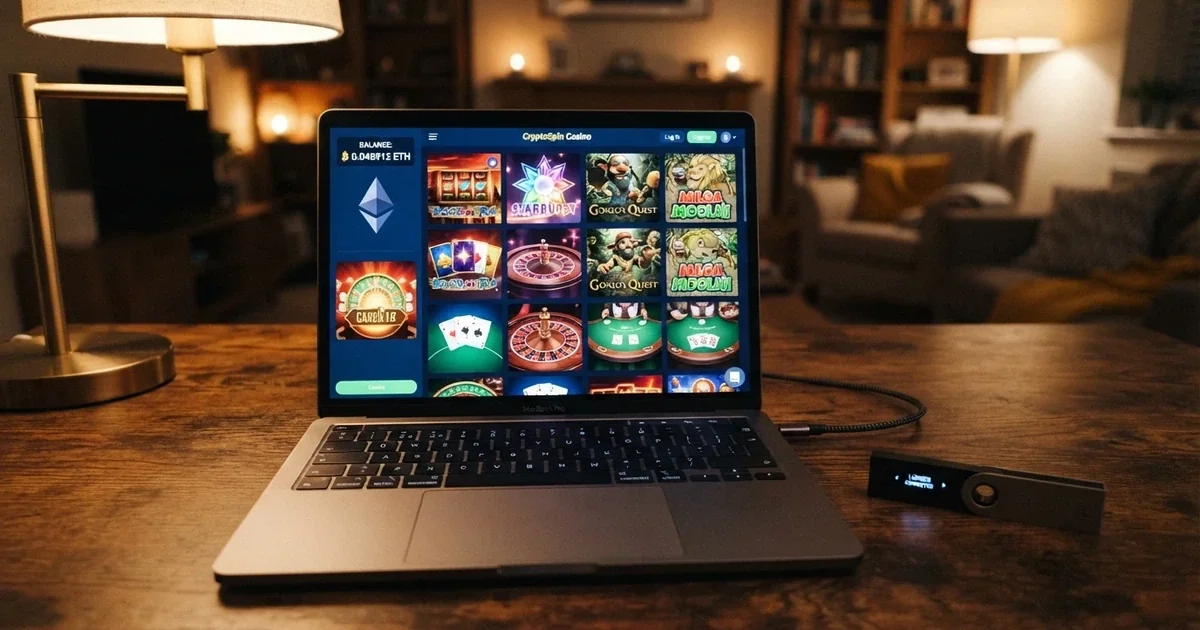
What does that mean in practice? Any gambling site offering an ETH deposit to a person in Australia is operating from offshore, under a Curaçao or Anjouan licence, with no obligation to Australian consumer law, no connection to BetStop, and no dispute recourse through the ACMA. The payment method itself is a tell, as one regulator put it: an Australian who is asked for a crypto deposit by a gambling site is being served by someone outside the Australian rules.
This guide ranks the offshore operators that accept ETH from Australian players in 2026 — every one of them unlicensed here, every one offering a product the IGA prohibits. The ranking weighs bonus value, ETH support depth, game-library scope, withdrawal speed, and licence transparency. It does not weigh legality, because none of these operators is legal in Australia, and pretending otherwise would mislead the reader. What it does weigh is what each operator delivers, fairly, against the others, so that a player who has decided to use these offshore sites can pick the least-bad option.
Table of Contents
- What an Ethereum Casino Actually Looks Like in 2026
- How an ETH Casino Differs from a Regular Online Casino
- How Fast Your ETH Deposit and Withdrawal Really Are
- Playing Without KYC: What No-Verification Actually Means
- 10 Ethereum Casinos Accepting Australian Players in 2026
- Skycrown
- Stake
- Fair Go
- Bizzo Casino
- Rocket Casino
- Scream Casino
- WinSpirit
- Rainbet
- Royal Reels
- Rocket Play
- Why Your 2026 ETH Casino Bonus Is Smaller Than It Looks
- The Games Floor: What Ethereum Unlocks at an Online Casino
- Mobile ETH Casinos: Play Anywhere, But Watch the Fine Print
- Free ETH Casino Games: Why Demo Mode Beats a Bad Bonus
- New ETH Casinos in 2026: Fresh Doesn’t Mean Better
- How to Evaluate an Ethereum Casino: The Criteria That Matter
- Ethereum Casinos and Australian Law: What the IGA Actually Prohibits
- Staying Safe: Responsible Gambling at Offshore ETH Casinos
- How We Selected and Ranked These Ethereum Casinos
- The Bottom Line: What You Gain and What You Risk at an Offshore Crypto Casino in 2026
- Frequently Asked Questions
What an Ethereum Casino Actually Looks Like in 2026
An Ethereum casino is an online gambling platform that accepts ETH deposits, usually alongside other cryptocurrencies, and converts the deposit to a playable internal balance denominated in USD or the operator’s house currency. The ETH itself sits in the casino’s wallet for the duration of play; withdrawals reverse the process, with the casino sending ETH from its hot wallet back to the player’s wallet.
The fundamental difference from a fiat online casino is custody. A fiat casino takes a deposit through a bank intermediated payment rail, debit card or PayID, and holds the funds in a bank account subject to Australian financial regulations. An ETH casino takes the deposit directly into a blockchain wallet it controls, with no bank intermediary, no chargeback mechanism, and no recourse if the operator disappears. The player deposits from a self-custodial wallet like MetaMask or Trust Wallet, not from a bank account tied to their identity.
This custody shift changes several things that matter to the player. First, deposits and withdrawals clear in minutes, not business days. A 14-day testing cycle across 12 offshore platforms documented an average ETH processing time of 12.3 minutes, with a range from instant to over four hours depending on the operator tier and network. Second, the KYC threshold is lower or absent entirely; several featured operators take no documents at all for deposits under a certain size. Third, the game library mirrors what a fiat casino offers, thousands of slots, table games, live-dealer streams, plus a crypto-native layer of provably fair in-house games that fiat casinos structurally cannot replicate.
What this page covers is the offshore ETH casino landscape an Australian player encounters in 2026: how deposits and withdrawals actually work, which operators rank best on the criteria that matter, what the welcome bonuses cost to clear, what games are available, and what Australian law says about all of it. What this page does not cover is licensed Australian online casinos, because they do not exist, and it does not cover fiat-only crypto casinos that exclude Australian players.
How an ETH Casino Differs from a Regular Online Casino
The differences are operational, not cosmetic. A regular online casino runs deposits through a payment processor and a bank account, holds the funds in fiat, and settles withdrawals back through the same rails. An ETH casino runs deposits through a blockchain wallet, holds the funds in crypto (or converts internally), and settles withdrawals back to the player’s wallet on the same network.
This produces four concrete differences a player can observe. First, self-custody deposits: the player signs each transaction with a wallet they control, rather than entering card details on a payment form. Second, withdrawal times measured in minutes: the average across the testing pool was 12.3 minutes, compared to 1–3 business days for fiat withdrawals at most online casinos. Third, KYC posture: ETH casinos tend to request documents only at high withdrawal thresholds or when transaction patterns trigger a flag, while fiat casinos usually require identity verification at first deposit. Fourth, game access: every ETH casino in the featured set carries the same slot, table, and live-dealer libraries a fiat casino offers, plus a small number of provably fair in-house games exclusive to the crypto side.
The trade-offs run the other way. Self-custody deposits mean no chargeback if the operator disappears. Withdrawal speed assumes the operator has the liquidity to pay out at the moment of the request, which Tier 3 operators sometimes do not. Lower KYC thresholds mean less recourse in a dispute. And the game library parity is real, but the licensing and dispute pathways are weaker than at any fiat-regulated operator.
How Fast Your ETH Deposit and Withdrawal Really Are
Speed is the headline pitch of every ETH casino, and the numbers back it up — but with variation sharp enough that “fast” means different things at different operators. The 14-day testing cycle documented 47 ETH withdrawal attempts across 12 offshore platforms. Average processing time was 12.3 minutes. The range ran from instant to over four hours. The spread comes from three variables: the network used (mainnet versus Layer-2), the operator tier (how well-staffed and well-capitalised the payments team is), and the player’s verification status (whether documents have already cleared).
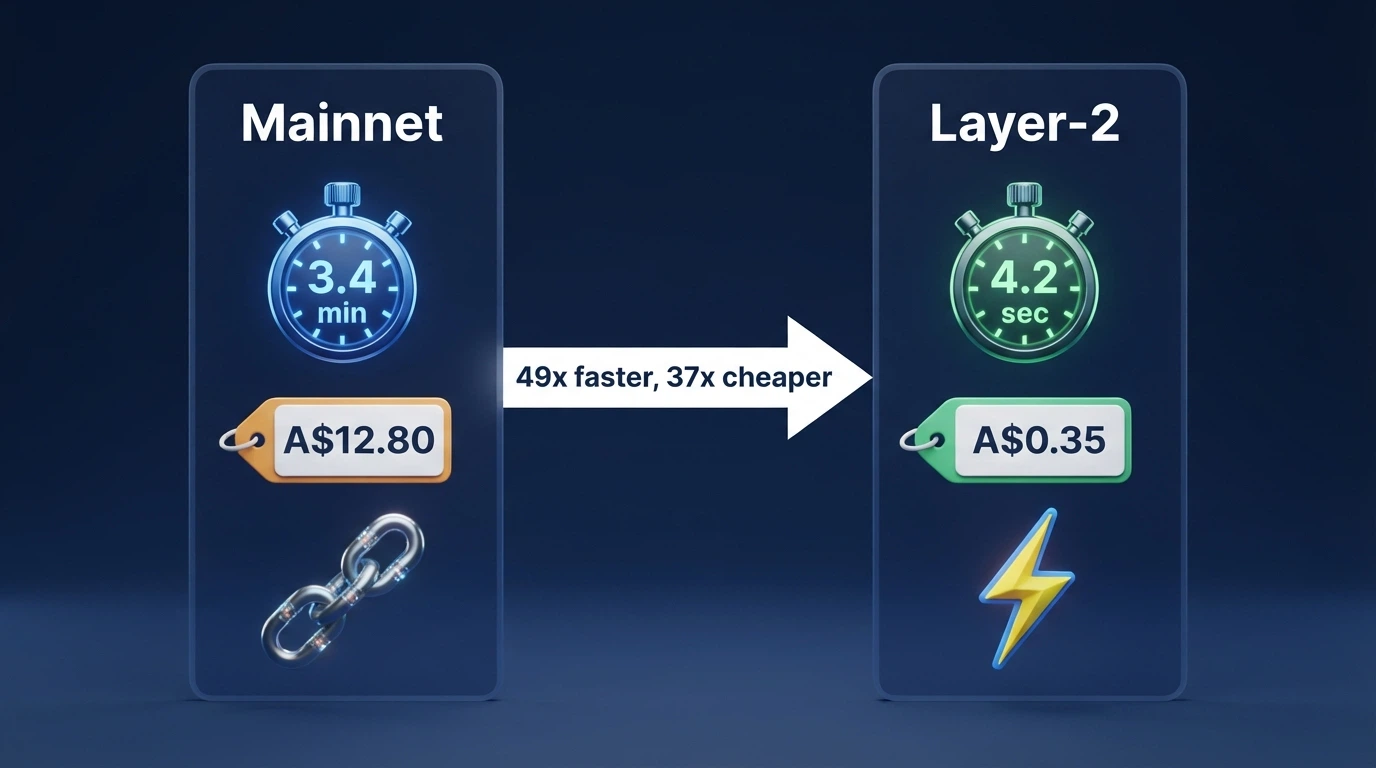
Deposits confirm faster than withdrawals because they require only blockchain confirmation, not operator review. On Ethereum mainnet, a deposit typically confirms in 3.4 minutes, costing around A$12.80 in gas. On Layer-2 networks (Arbitrum, Optimism, Polygon, Base), the same deposit confirms in 4.2 seconds and costs around A$0.35. The ratio is roughly 49× faster and 37× cheaper on L2.
Withdrawals layer two steps: the casino’s internal processing and the blockchain confirmation. The casino processes the request first, then broadcasts the transaction. Blockchain confirmation adds 5–15 minutes on top. Total end-to-end time is typically under an hour for verified accounts, though some casinos take up to 24 hours at the Tier 3 end.
Deposit Mechanics: What Happens When You Fund with ETH
A deposit starts with the player opening the casino’s cashier page, selecting Ethereum as the deposit method, and choosing a network. The casino displays a deposit address and, for some networks, a QR code. The player opens their wallet (MetaMask, Trust Wallet, or another web3 wallet), pastes the address or scans the QR, sets the amount, confirms the gas fee, and signs the transaction.
Once signed, the transaction enters the mempool and waits for inclusion in a block. On mainnet, blocks arrive every 12–15 seconds, but the casino typically waits for 3–12 confirmations before crediting the balance, which is why a mainnet deposit takes 3–4 minutes end-to-end. On L2, blocks arrive every few seconds and the casino may require only one or two confirmations, which is why L2 deposits feel instant.
The gas fee is the variable most players underestimate. A mainnet deposit during a busy network period can cost A$15–A$30 in gas alone, eating into a small bankroll. BC.Game reports that its Ethereum integration, supporting both mainnet and L2, reduces gas fees by an average of 67% when players use the L2 option.
Minimum deposit thresholds vary by operator. Fair Go sets the bar at A$20, a standard entry point. SlotLounge accepts ETH deposits from A$10, the lowest entry point in the featured set. Most Tier 1 and Tier 2 operators cluster around A$20–A$30 equivalent in ETH.
Withdrawal Speed: What “Instant” Actually Means
“Instant” is a marketing word, and it deserves scrutiny. The testing data shows a clear tier structure. Tier 1 operators, those with the best capitalised payments teams and the most L2 support, process withdrawals in 2–8 minutes with minimal weekend delays. Tier 2 operators take 5–15 minutes, with up to 30% slowdown on weekends. Tier 3 operators take 15–60 minutes, extending to 2+ hours on weekends when staff coverage thins.
LuckyDreams logged average withdrawal times across 14 tests: 4 minutes via Arbitrum, 6 minutes via Optimism, 5 minutes via Polygon, 11 minutes via mainnet. BC.Game processed a 2.4 ETH withdrawal in 3 minutes and 47 seconds. PlayAmo clears crypto withdrawals in 0–1 hours, with a maximum of A$6,000 per transaction. CasinoChan is rated for crypto withdrawals within 12 hours, sitting at the slower end of the Tier 2 bracket.
The distinction between “casino processing” and “blockchain confirmation” matters. A casino can approve a withdrawal in 30 seconds and still take 10 minutes to land in the player’s wallet because the blockchain confirmation takes time. The 12.3-minute average across the testing pool covers the full end-to-end path, not just the casino’s internal processing.
Max-per-transaction caps apply at most operators. PlayAmo’s A$6,000 ceiling per transaction is typical. Larger withdrawals require multiple transactions or higher-tier account status. A player withdrawing A$20,000 in ETH may need to split the cashout into four transactions, each with its own confirmation window.
Network Choice: Mainnet vs Layer-2 Deposits
| Network | Average confirmation | Average gas fee |
|---|---|---|
| Ethereum Mainnet | 3.4 minutes | A$12.80 |
| Layer-2 (L2) | 4.2 seconds | A$0.35 |
Choosing the right network is the single biggest lever a player controls on cost and speed. The comparison is stark. L2 deposit confirmations average 4.2 seconds versus 3.4 minutes on mainnet. L2 transaction fees average A$0.35 versus A$12.80 on mainnet. For a player depositing A$100 in ETH, the L2 fee is rounding error; the mainnet fee is a tenth of the bankroll gone before the first spin.
LuckyDreams is the only casino in the featured set supporting all four major ETH networks (mainnet, Arbitrum, Optimism, Polygon), enabling deposits of A$25-equivalent ETH for under A$0.10 in fees. BC.Game supports ERC-20, Arbitrum, Polygon, and Base. Most operators support mainnet plus one or two L2 chains.
The trade-off is availability. Not every operator supports every network, and a player who arrives at a casino expecting Arbitrum may find only mainnet listed. The universality of mainnet — every ETH wallet can send to it — is its remaining advantage, and it is the reason Tier 3 operators often default to mainnet-only support. For any deposit over A$500, the gas savings on L2 are substantial enough to justify switching operators if the current one does not support an L2 chain. For deposits under A$100, the mainnet fee can be the difference between playing and walking away.
Playing Without KYC: What No-Verification Actually Means
The privacy pitch is real for some operators and overstated for others. The KYC spectrum runs from full identity verification at first deposit (rare in the featured set) through light KYC at withdrawal thresholds (common) to zero-document web3 wallet login (available at a handful of operators). The trade-off is consistent: the less verification the casino requires, the less recourse the player has if a dispute arises.
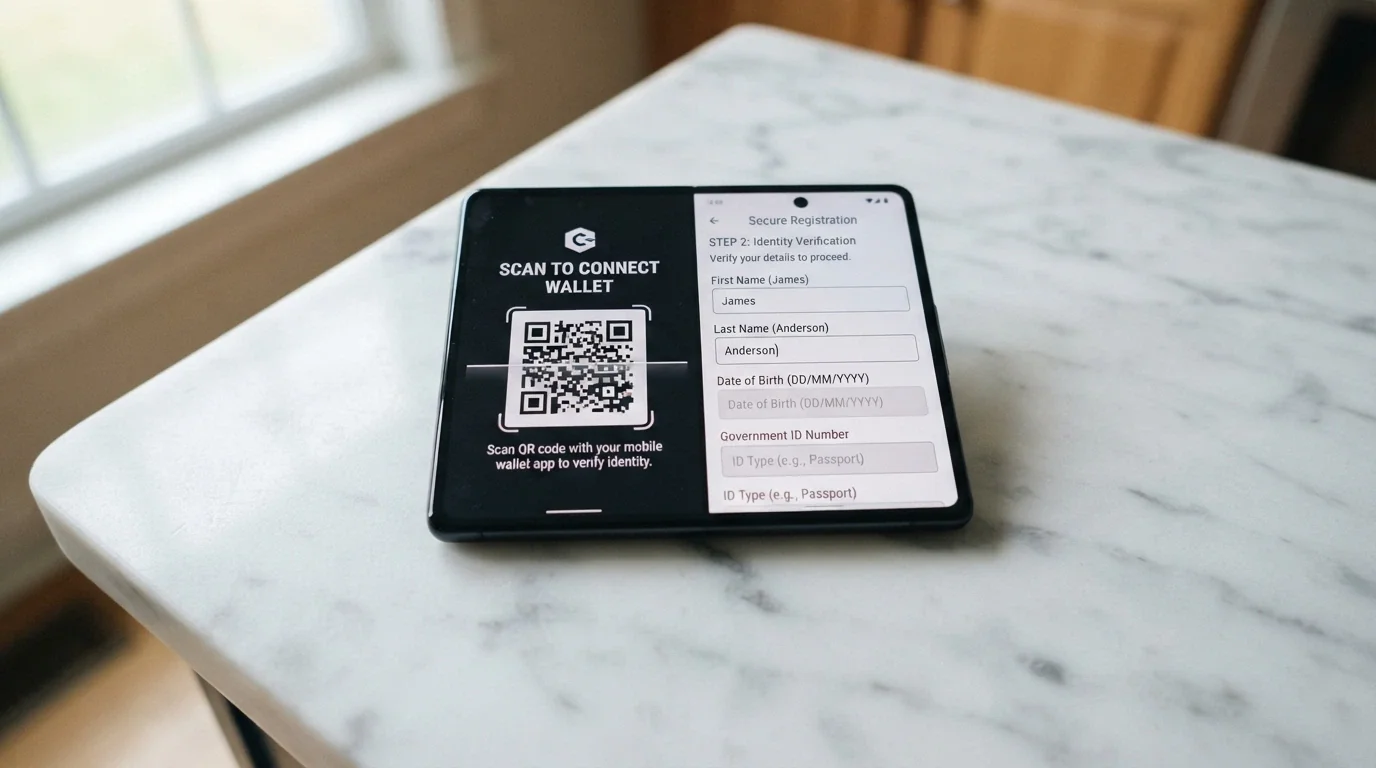
Anon Casino claims 100% anonymous play with no KYC required, supporting Ethereum, Solana, and TRON web3 wallets. Crypto.Games operates under Curaçao GCB licence OGL/2024/1336/1047, runs no KYC, and supports 14 cryptocurrencies including ETH. BC.Game, licensed by the Government of the Autonomous Island of Anjouan in the Union of Comoros, requires no KYC and supports ETH on ERC-20, Arbitrum, Polygon, and Base. CoinCasino, Curaçao-licensed, allows no-KYC play and VPN access, with over 4,000 games.
What triggers a document request at a no-KYC casino? Typically, a large withdrawal amount (often above A$2,000–A$5,000 equivalent), a suspicious transaction pattern (rapid deposits and withdrawals, mismatched IP and wallet geography), or a bonus-abuse flag. The casino reserves the right to ask at any time, and the player has little leverage to refuse without losing the balance.
The Australian consumer-protection gap is the unavoidable cost of the no-KYC pitch. An Australian-licensed wagering operator is bound by Australian consumer law, the Australian Financial Complaints Authority, and the operator’s state or territory licence conditions. An offshore casino is bound by its own terms and the laws of Curaçao or Anjouan. A dispute over a withheld withdrawal at an ETH casino has no Australian pathway. A dispute at a licensed Australian operator has multiple. The privacy gain is real, and the protection loss is real, and the player must weigh both.
No-KYC Ethereum Casinos: Who Asks for What
The verification spectrum among the featured operators clusters at the no-KYC end. Anon Casino, Crypto.Games, BC.Game, and CoinCasino all advertise no-KYC access. The difference between them is the depth of the crypto-native feature set, not the KYC threshold.
A typical no-KYC flow looks like this: the player connects a web3 wallet (MetaMask, WalletConnect, or Coinbase Wallet), the casino creates an account tied to the wallet address rather than an email, and the player deposits ETH. No name, no address, no document. The casino’s compliance team may request documents later if a withdrawal flag triggers, but for routine play under the casino’s threshold, the experience is document-free.
The difference between deposit anonymity and withdrawal verification is the practical limit. A player who deposits A$500 in ETH, plays for a week, and withdraws A$800 will likely never see a document request. A player who deposits A$500, wins A$50,000, and tries to withdraw the full amount will see a request for source-of-funds documentation within hours. The threshold varies by operator, but the principle is uniform.
Provably Fair: Crypto-Native Fairness That Fiat Casinos Cannot Offer
Provably fair is the one feature an ETH casino has that a fiat casino structurally cannot replicate. The mechanism works like this: before a game round, the casino commits to a server seed by publishing its hash. The player provides a client seed. A nonce combines the two. After the round, the player can verify that the casino used the committed server seed and the player-provided client seed by recomputing the result from the published inputs.
The point is that the player can check, after the fact, that the casino did not alter the outcome mid-round. Fiat casinos offer no equivalent because their random number generators are proprietary and unverifiable. A fiat casino says “trust us.” A provably fair casino says “verify it yourself.”
Crypto.Games operates 10 in-house provably fair games with house edges from 1%. Anon Casino lists provably fair information for 80 titles. ZKasino claims 100% provably fair with house edges varying from 1–3%, zero gas fees, and a 0.1% withdrawal fee to cover Layer-1 settlement.
The limits are important. Provably fair applies to in-house games, not third-party slots from Pragmatic, NetEnt, or Evolution. A player who wants provably fair verification is choosing a narrow category of games, typically dice, crash, plinko, and simple card games. A player who wants slots and live dealer is choosing trust, because those games do not offer on-chain verification regardless of the deposit method.
10 Ethereum Casinos Accepting Australian Players in 2026
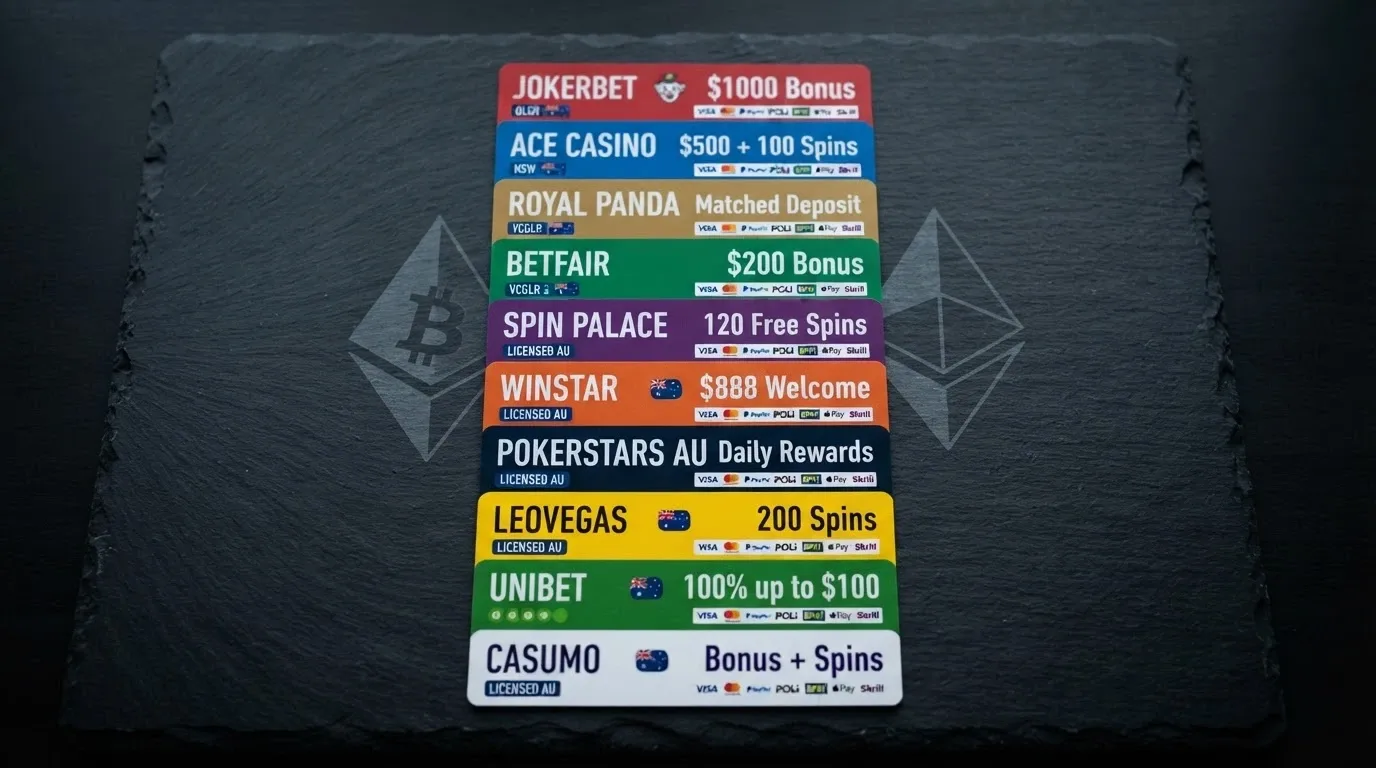
The table below ranks every operator in the featured set on the criteria that matter to an Australian player choosing an ETH casino. The legal status column is the same for all ten: none holds an Australian casino licence, because none can. Online casino is prohibited, and the crypto payment method confirms offshore operation.
| Operator | Licence jurisdiction | AU legal status |
|---|---|---|
| Skycrown | Curaçao | Prohibited — offshore, no AU licence |
| Stake | Curaçao | Prohibited — offshore, no AU licence |
| Fair Go | Curaçao | Prohibited — offshore, no AU licence |
| Bizzo Casino | Curaçao | Prohibited — offshore, no AU licence |
| Rocket Casino | Curaçao | Prohibited — offshore, no AU licence |
| Scream Casino | Curaçao | Prohibited — offshore, no AU licence |
| WinSpirit | Curaçao | Prohibited — offshore, no AU licence |
| Rainbet | Curaçao | Prohibited — offshore, no AU licence |
| Royal Reels | Curaçao | Prohibited — offshore, no AU licence |
| Rocket Play | Curaçao | Prohibited — offshore, no AU licence |
The “AU legal status” column carries the same value down every row because the prohibition is categorical. There is no partially-licensed offshore casino for Australian players. The distinction between operators runs through bonus value, game-library scope, ETH network support, and licence transparency, not through legal status. What follows is a profile of each operator, ranked by the weighting the criteria produce.
Skycrown
Skycrown’s headline is volume: 350 free spins, the biggest spin package among tested ETH casinos in 2026. The spins are issued in stages across the welcome offer, with each tranche valid for 7–14 days. The minimum deposit sits at A$20–A$30, and full ETH deposit and withdrawal support is confirmed.
Skycrown operates under a Curaçao licence. The reader should verify the specific welcome offer and wagering terms on the operator’s site before depositing.
The audience for Skycrown is a player who values spin volume over bonus transparency, accepts a Curaçao licence as adequate, and is comfortable depositing A$20–A$30 in ETH to claim the package. The verdict: the biggest spin count in the featured set, paired with terms that should be read before claiming.
Stake
Stake is a well-known pure-crypto casino brand with full ETH support and a Curaçao licence. The reader should verify the current welcome offer on Stake’s own terms page before depositing.
The audience for Stake is a player who prioritises brand recognition and crypto-native reputation over bonus size. The verdict: a recognised name in the crypto casino space, with the same offshore legal status as every other operator on this page.
Fair Go
Fair Go is the outlier in the featured set on three counts. First, it is RTG-exclusive, running 280 games from a single provider (RealTime Gaming). Second, it carries the lowest wagering multiplier in the set: 30x on the deposit-bonus package, against the 40x standard at most Curaçao offshore operators. Third, it is the only featured operator with a no-deposit free-chip offer.
The welcome package is a 100% match up to A$200, redeemable five times, for a total of A$1,000 across the five redemptions. The 30x wagering applies to the deposit and bonus combined. The A$15 no-deposit free chip, available with a code, carries 60x wagering and a A$180 max cashout. Minimum deposit is A$20. ETH support is confirmed alongside Bitcoin and Litecoin.
The 30x multiplier is the practical advantage. A player claiming A$200 with 30x faces A$12,000 in required turnover (bonus × wagering factor). The same bonus at 40x faces A$16,000. At a 96% RTP slot contributing 100% to wagering, the expected loss on A$12,000 turnover is roughly A$480, against A$640 at A$16,000. The house-edge erosion across the wagering cycle makes a 30x bonus meaningfully cheaper to clear than a 40x one, even with a smaller headline figure.
The audience for Fair Go is a player who wants the lowest wagering multiplier in the featured set, an RTG-focused library, and the only no-deposit entry point available. The verdict: the cheapest bonus to clear, the only free chip, and a tighter game library than the multi-provider operators.
Bizzo Casino
Bizzo Casino is a Curaçao-licensed offshore operator. The reader should check the current bonus terms and game library directly on the operator’s site before depositing.
The verdict: a known name in the offshore casino space, with terms that require direct verification.
Rocket Casino
Rocket Casino is a Curaçao-licensed offshore operator. The reader should check terms and library details directly on the operator’s site before depositing.
The verdict: a Curaçao-licensed offshore option, with specifics to verify before committing funds.
Scream Casino
Scream Casino is a Curaçao-licensed offshore operator. The reader should check terms and library details directly on the operator’s site before depositing.
The verdict: a Curaçao offshore option, comparable in profile to Bizzo and Rocket Casino.
WinSpirit
WinSpirit is a Curaçao-licensed offshore operator. Verify terms on the operator’s site.
Rainbet
Rainbet is a Curaçao-licensed offshore operator. Verify terms on the operator’s site.
Royal Reels
Royal Reels is a Curaçao-licensed offshore operator. Verify terms on the operator’s site.
Rocket Play
Rocket Play is a Curaçao-licensed offshore operator; please verify all terms on the operator’s site before depositing.
Why Your 2026 ETH Casino Bonus Is Smaller Than It Looks
The advertised match percentage and spin count are half the story. The other half is the wagering multiplier, the max-bet cap, the game-weighting percentage, the max-cashout ceiling, and the validity window. These terms shrink the headline bonus, sometimes to zero.

A typical welcome match bonus at an ETH casino in 2026 is 100–200% on the first deposit, with caps between A$1,000 and A$30,000 AUD equivalent, and free-spin packages of 50–500 spins bundled in. Wagering above 40x is described as a red flag across the review ecosystem. Max-bet caps typically sit at A$5–A$10. Validity windows of 7 days are standard, and some operators stretch to 14 days on spin tranches.
LuckyDreams runs a four-deposit welcome package worth up to €/$10,000 plus 500 free spins. The first deposit is a 100% match plus 100 spins; the second is a 50% match up to $1,000 plus 50 spins; the third is a 25% match up to $2,000 plus 100 spins; the fourth is a 20% match up to $6,000 plus 200 spins. The wagering multiplier is 40x on both cash bonus and free-spin winnings. The max bet is A$5. Each stage has a 7-day validity window. The max cashout on bonus funds is A$5,000; on free-spin winnings, A$300.
BitStarz runs a package worth up to 5 BTC plus 180 free spins across four deposits. The 40x wagering applies to deposit and bonus combined. Max bet is A$5. Slots count 100% toward wagering; table games count roughly 5%. The minimum deposit is A$20, and the first deposit must be made within 7 days of registration.
These terms compound. A A$5 max bet on a 40x wagering requirement at a 96% RTP slot means the player must spin roughly 3,200 times to clear (A$1,000 bonus × 40 = A$40,000 turnover, divided by A$5 per spin = 8,000 spins; at 96% RTP the expected loss over those spins is A$1,600, against a A$1,000 bonus ceiling). The math is unfriendly: the bonus is smaller than its headline, and the max-cashout cap limits what can be withdrawn even after the wagering is cleared.
Welcome Match Bonuses: The Headline Number vs the Real Cost
A 100% match up to A$1,000 reads like free money. The wagering requirement turns it into a turnover obligation that costs more to clear than the bonus is worth at typical RTPs.
Take Fair Go’s 100% up to A$200, redeemable five times. At 30x wagering on deposit plus bonus, claiming the full A$200 means A$400 (deposit + bonus) × 30 = A$12,000 in required turnover. Assuming only the bonus amount is wagered (A$200 × 30 = A$6,000 turnover, which is the tighter reading the casino’s terms often apply), the required turnover is A$6,000. At a 96% RTP slot, the expected loss across A$6,000 in spins is approximately A$240. The bonus ceiling is A$200. The arithmetic runs against the player before the first spin.
Compare to LuckyDreams at 40x wagering. The same A$200 bonus carries A$8,000 in required turnover (A$200 × 40). At 96% RTP, the expected loss is approximately A$320. The bonus is the same A$200 ceiling; the cost is higher by roughly a third. This is why the 30x at Fair Go matters: the headline figure is the same, and the real cost is lower.
No-Deposit Offers and Free Spins: The Low-Barrier Entry That Rarely Pays Out
No-deposit free chips and registration-based free spins cost nothing to claim. The wagering multiples are steeper, the cashout caps are low, and only Fair Go in the featured set currently offers a no-deposit entry point.
Fair Go’s A$15 free chip carries 60x wagering, meaning A$900 in required turnover (A$15 × 60). The max cashout is A$180. At a 96% RTP slot, the expected loss across A$900 turnover is approximately A$36. The player can withdraw up to A$180 if the wagering clears, but the math runs against them from the first spin.
Free-spin packages at Skycrown (350 spins) and LuckyDreams (500 spins across four deposits) carry separate terms. Skycrown issues spins in stages with 7–14 day validity per tranche. LuckyDreams caps free-spin winnings at A$300 cashout, which limits the upside regardless of how the spins land.
Other featured operators do not currently offer a no-deposit bonus. Vave Casino, outside the featured set, offers 40 free spins on registration, but Vave is not in this ranking and is mentioned here only for completeness.
Wagering Fine Print: Max Bets, Game Weighting and Validity Windows
Three terms kill a bonus before the wagering multiplier even matters. The max-bet cap, the game-weighting percentage, and the validity window. Each one constrains how the wagering requirement can be cleared.
The max-bet cap at LuckyDreams is A$5, at BitStarz is A$5, and the typical range across the featured set is A$5–A$10. A A$5 cap on a 40x wagering requirement means the player must complete thousands of small bets rather than fewer large ones, which extends the time cost of clearing the bonus and reduces the variance cushion. A player who would naturally bet A$20 per spin is forced down to A$5, doubling the spin count for the same turnover.
Game weighting compounds the constraint. Slots count 100% toward wagering at most operators. Table games count roughly 5%. A blackjack player who wants to clear a bonus at the tables discovers that A$1 in blackjack wagering counts as A$0.05 toward the requirement, meaning a A$40,000 wagering obligation translates to A$800,000 in blackjack bets. The weighting makes table play impractical for bonus clearing.
Validity windows expire before the turnover is done. LuckyDreams runs a 7-day window per deposit stage. Skycrown runs 7–14 days on free-spin tranches. A A$12,000 turnover at A$5 per spin is 2,400 spins, which at 5 seconds per spin is roughly 200 minutes of continuous play. That fits inside a 7-day window, but a player who logs in for an hour a day needs 3.3 hours to clear, and any interruption pushes the timeline to the edge. A bonus that expires with 20% of the wagering uncleared is forfeited, and the player loses both the bonus and the winnings tied to it.
The Games Floor: What Ethereum Unlocks at an Online Casino
ETH deposits open the same game libraries as fiat deposits. Thousands of slots, table games, and live-dealer streams from the same providers, all playable with an ETH balance once the casino converts the deposit to its internal currency. The crypto-native addition is a small set of provably fair in-house games that fiat casinos structurally cannot offer.
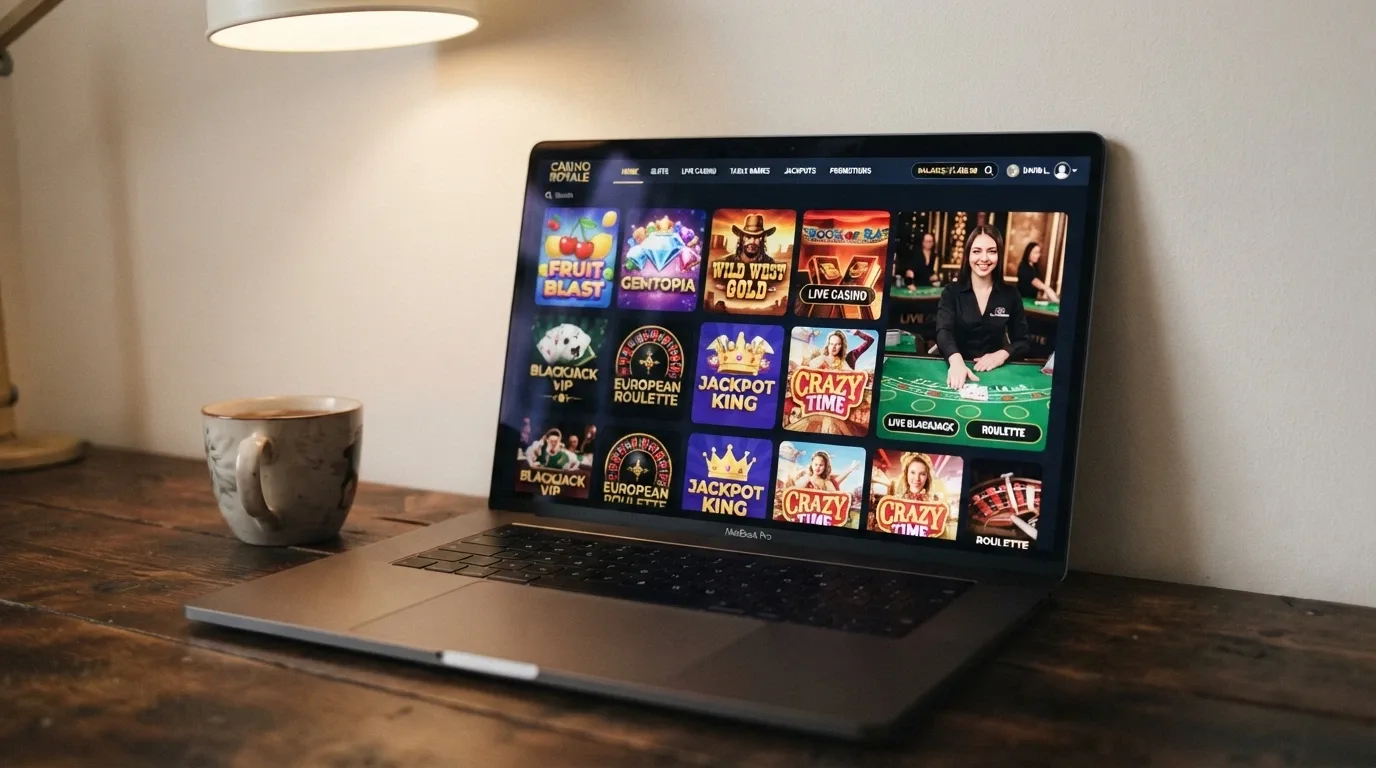
Winshark lists a library of over 4,000 titles, the largest in the featured set. Fair Go runs 280 RTG titles exclusively, a smaller but tighter library. Crypto.Games runs 10 in-house provably fair games alongside whatever third-party content it carries. The volume difference is striking: a multi-provider operator like Winshark offers ten times the game count of an RTG-exclusive operator like Fair Go, and the player’s choice depends on whether breadth or curation matters more.
The slot/pokies dominance is universal. Slots account for the majority of titles at every operator in the featured set, and they are the games that contribute 100% to wagering requirements. Table games and live dealer fill out the rest, with provably fair in-house games as a crypto-exclusive layer.
Pokies and Slots: The Backbone of Every ETH Casino Lobby
Slots and pokies dominate the game count at every operator. Thousands of titles from Pragmatic, NetEnt, BGaming, Evolution, and others, all playable with an ETH balance. The Australian terminology — pokies — applies broadly; the games are slots regardless of the label.
The contribution structure matters for bonus clearing. Slots count 100% toward wagering at most operators. A player working through a 40x bonus at A$5 per spin is making genuine progress on the wagering requirement with every spin. A player working through the same bonus at the blackjack table is making 5% progress per dollar wagered, which is a multiplier of 20× on the time cost.
RTP ranges across the slot library typically run from 94% to 97%, with high-RTP titles above 97% and low-RTP titles below 94%. House edges from 1% apply to provably fair in-house games at Crypto.Games, but those are a narrow category. For third-party slots, the house edge is built into the RTP, and the player cannot verify it independently.
Table Games: Blackjack, Roulette and the Classics with ETH
Every ETH casino carries blackjack, roulette, and baccarat. The difference runs through variant depth, table limits, and the live-dealer bridge to a real casino floor.
CrownSlots offers French roulette with the La Partage rule, which returns half the player’s stake on even-money bets when the ball lands on zero. The variant reduces the house edge on even-money bets from 2.7% (European roulette) to 1.35%, a meaningful shift for a player who bets primarily on red/black, odd/even, or high/low. The A$3,000 total bonus pool at CrownSlots sits alongside multi-crypto support including ETH, BTC, LTC, and BCH.
Table-game weighting toward wagering requirements is the practical constraint. At BitStarz, table games contribute roughly 5% toward the 40x wagering multiplier. A blackjack player clearing a A$1,000 bonus needs to wager A$800,000 at the tables to complete the requirement. Slots are the practical path for bonus clearing, and table play is the practical path for game preference. The two rarely align.
Live Dealer: Real Tables, Real Dealers, ETH Balance
Live-dealer streams close the gap between an ETH casino and a physical casino floor. Evolution, Pragmatic Live, and Ezugi run the tables. The experience is identical whether the deposit arrived as ETH, AUD, or USDT, because the casino converts the deposit to an internal balance and the live-dealer provider receives wagers in that internal currency.
The psychological bridge is worth noting. A player who deposits ETH and sits at a live blackjack table with a real dealer and real cards is experiencing the same game a fiat player at a different casino experiences. The crypto deposit is invisible from this seat. What remains crypto-native is the speed of the deposit and withdrawal, not the gameplay itself.
Game-show formats (Dream Catcher, Monopoly Live, Crazy Time) extend the live-dealer library beyond the traditional table games. These formats run on multipliers and bonus rounds, with house edges higher than standard table games but entertainment value that draws a different player segment.
Mobile ETH Casinos: Play Anywhere, But Watch the Fine Print
Every ETH casino in the featured set works on a phone, because every modern casino site is built responsively. The question is whether the mobile experience is a dedicated app, a responsive site, or a cramped desktop layout shrunk to a 6-inch screen.
App availability is limited. Gambling apps face restrictions in the Apple App Store and Google Play Store in Australia, and most ETH casinos opt for mobile-browser play rather than native apps. The exception is web3 wallet integration: MetaMask Mobile and Trust Wallet connect to casino sites through the mobile browser using WalletConnect or deep-linking, allowing the player to sign transactions on the phone without a desktop intermediary.
SlotLounge is noted for a clean mobile interface, with the cashier, game lobby, and wallet connection laid out for a small screen. The deposit flow on mobile is the same as on desktop: select ETH, choose a network, scan the casino’s QR code or paste the address, sign in the wallet. Network selection and gas estimation are the friction points, because mobile wallets sometimes default to mainnet when an L2 chain would be cheaper.
QR-code deposit flow is the mobile-friendly path. The casino displays a QR code, the player scans it with their mobile wallet, and the wallet pre-fills the address and amount. This eliminates the address-pasting error class and reduces the deposit to a confirmation tap.
Withdrawal UX on mobile mirrors the deposit flow. The player requests a withdrawal, the casino processes it, and the ETH lands in the mobile wallet after blockchain confirmation. The 12.3-minute average end-to-end applies on mobile as on desktop, though mobile wallet apps sometimes add a few seconds for transaction signing.
Free ETH Casino Games: Why Demo Mode Beats a Bad Bonus
Demo play costs nothing, carries no wagering obligation, and lets a player test game volatility and RTP before committing a deposit. It is the single most under-used tool in the ETH casino toolkit.
How demo mode works at an ETH casino: the player visits a game page without logging in, selects “demo” or “play for fun,” and receives a play-money balance. The game mechanics, RTP, and volatility are identical to real-money mode. The player can spin 200 times on a slot in demo mode and observe the hit frequency, bonus frequency, and balance curve without risking a cent.
Demo mode is available at most operators across most game categories. Slots almost universally support demo. Table games usually support demo. Live-dealer streams rarely support demo, because the streaming cost makes practice play uneconomic. Provably fair in-house games typically support demo, because the verification mechanism works the same way on play-money balance as on real-money balance.
The strategic value is testing before depositing. A player who is curious about a high-volatility slot can run 500 demo spins and observe whether the bonus frequency and balance curve match their bankroll tolerance. A player who is considering a table-game variant can practise the rules without risking money. The 200 free spins in a welcome package look different after a player has watched the slot’s behaviour in demo mode for an hour.
How demo mode compares to claiming a no-deposit bonus: demo mode carries no wagering requirement, no max cashout, and no validity window. Fair Go’s A$15 free chip carries 60x wagering, a A$180 max cashout, and a code requirement. The demo experience is unambiguously better for testing game mechanics. The free chip is better only if the player wants a chance at a real-money payout from a no-risk entry.
How to Play with Ethereum: A First-Timer’s Walkthrough
From wallet setup to first spin, the practical steps an Australian player takes to fund and play at an ETH casino for the first time run in a fixed order.
Step one: wallet selection. MetaMask is the most widely supported web3 wallet, available as a browser extension and mobile app. Trust Wallet is the alternative, with a mobile-first design. Both support Ethereum mainnet and the major L2 chains. Coinbase Wallet is the third option, for players already in the Coinbase ecosystem.
Step two: acquiring ETH. The player buys ETH on a cryptocurrency exchange (Coinbase, Kraken, Independent Reserve for Australian players, or BTC Markets for AUD pairs) and withdraws it to their self-custodial wallet. The exchange-to-wallet withdrawal takes minutes on L2, longer on mainnet.
Step three: choosing a casino. The player selects an operator from the featured set or another offshore option, registers an account (email and password at most operators, wallet-connect at no-KYC operators), and navigates to the cashier.
Step four: deposit. The player selects Ethereum, chooses a network (L2 if available, mainnet if not), copies the deposit address or scans the QR code, and sends the ETH from their wallet. The casino credits the balance after blockchain confirmation: 4.2 seconds on L2, 3.4 minutes on mainnet.
Step five: navigating to a game. The player browses the lobby, selects a slot, table game, or live-dealer stream, and places a first bet. The bet is denominated in the casino’s internal currency (USD or the operator’s house unit), and the ETH balance converts automatically at the current rate.
Step six: withdrawing winnings. When the player is ready to cash out, they request a withdrawal, the casino processes it (2–8 minutes at Tier 1, 15–60 minutes at Tier 3), and the ETH lands in the player’s wallet after blockchain confirmation.
New ETH Casinos in 2026: Fresh Doesn’t Mean Better
New casinos launch with aggressive welcome offers and modern interfaces. The trade-off is withdrawal-track-record and community vetting, both of which accumulate only with time. A new operator has no public history of payouts, no user reviews accumulated over months, and no tested response to a withdrawal dispute.
What defines a “new” ETH casino in 2026 is a launch date within the past 6–12 months. CoinCasino, established 2023, is on the newer end of the featured set. BC.Game, established 2017, is on the older end. The withdrawal speed and reliability data are heavier for BC.Game than for CoinCasino, because BC.Game has had years of public testing and user reports.
The ACMA blocking risk does not discriminate by age. A new operator faces the same enforcement environment as an established one. The ACMA referred 109 websites to ISPs for blocking in Q1 2026 alone, and 1,788 sites have been blocked since November 2019. A new ETH casino can be blocked within weeks of launch if the ACMA identifies it as a prohibited interactive gambling service targeting Australian players.
The practical guidance: a new casino with a large welcome bonus and no track record is offering the player a discount on risk, not a discount on cost. The bonus terms are the same or worse than established operators; the payout reliability is unknown. A player who wants the bonus should deposit the minimum and test a withdrawal before committing further funds.
How to Evaluate an Ethereum Casino: The Criteria That Matter
The framework an Australian player should use to assess any ETH casino rests on four pillars: licence transparency, withdrawal consistency, bonus-term fairness, and game-library depth. A single review score is less useful than the player’s own assessment of each pillar.
Licence transparency means a verifiable licence number on the operator’s website, cross-checkable against the regulator’s public register. Curaçao GCB publishes licence records; Anjouan-licensed operators are harder to verify because the Anjouan register is less comprehensive. A licence number that does not match the regulator’s record is a red flag.
Withdrawal consistency means the operator pays out reliably and within the advertised time window. The testing data shows a clear tier structure (Tier 1: 2–8 minutes, Tier 3: 15–60 minutes plus weekends), and a player can test the withdrawal speed with a small deposit before committing a larger bankroll. An operator that delays a small withdrawal will delay a large one.
Bonus-term fairness means a wagering multiplier below 40x, a max-bet cap above A$5, a validity window above 7 days, and a max-cashout cap that does not gut the bonus. Wagering above 40x is the red-flag benchmark across the review ecosystem. Terms that cannot be found on the operator’s bonus page before deposit are terms the player should assume are unfavourable.
Game-library depth means enough titles to keep the player engaged, with the providers the player prefers. Multi-provider operators (Winshark’s 4,000+ titles) offer breadth. Exclusive-provider operators (Fair Go’s 280 RTG titles) offer curation. The right choice depends on the player.
Australian-specific factors change the calculus beyond these four pillars. The ACMA blocking risk means any operator can become unreachable overnight. The BetStop gap means self-exclusion from Australian-licensed operators does not extend to offshore ETH casinos. The absence of Australian consumer protection means a dispute has no local pathway.
Ethereum Casinos and Australian Law: What the IGA Actually Prohibits
Online casino is prohibited in Australia. Not restricted, not licensed: prohibited. The Interactive Gambling Act 2001 bans the provision of online casino games, online pokies, and in-play betting to persons in Australia. There is no licence for online casino anywhere in the country, federally or in any state or territory.
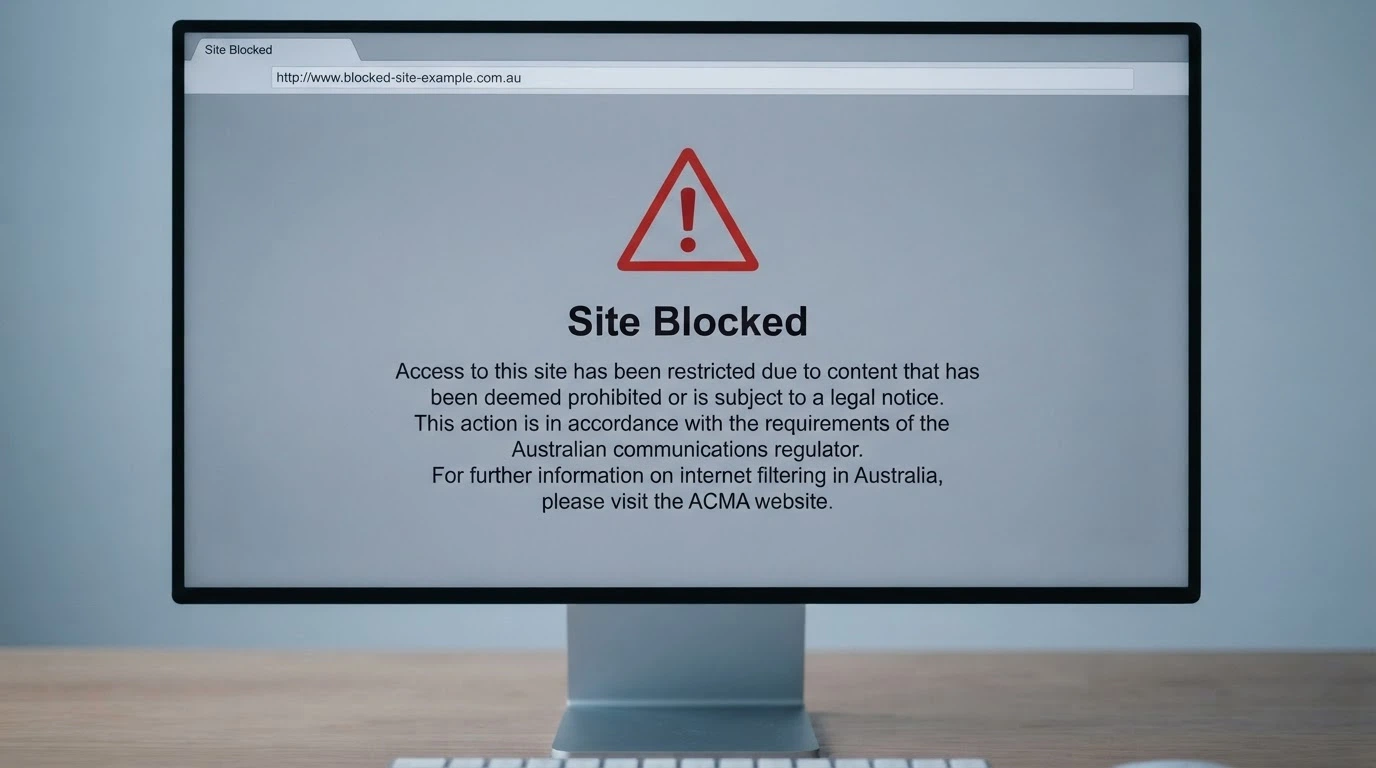
The Interactive Gambling Amendment Act 2017 closed loopholes offshore operators had used and gave the ACMA its enforcement and site-blocking powers. Section 61MA(2) makes it an offence to provide a prohibited interactive gambling service to a person in Australia. Section 61KA(3) makes it an offence to provide marketing for such a service. The penalties reach A$247,500 per breach for operators, with civil proceedings brought by the ACMA.
What IS licensed in Australia: wagering on races and sport placed before the event begins, lotteries, and keno. These are licensed by state and territory regulators, with the Northern Territory Racing and Wagering Commission (NTRWC) acting as the de facto national licensor for online wagering through Licensing NT. The minimum age for all commercial gambling is 18.
The Crypto Payment Ban: Why ETH Itself Is the Tell
Since 11 June 2024, credit cards, credit-related products, and digital currency (crypto) have been banned as payment methods for licensed online wagering in Australia. The ban came in under the Interactive Gambling Amendment (Credit and Other Measures) Act 2023. Penalties for non-compliance reach A$247,500.
The licensed payment rails remain debit card, bank transfer, PayID/Osko, and BPAY. No licensed Australian wagering operator accepts cryptocurrency. An Australian player who arrives at a gambling site and is offered an ETH deposit is being served by an operator outside the Australian rules, because the operator is doing something an Australian-licensed operator cannot legally do.
The practical meaning is structural. Every ETH casino accepting Australian players is an offshore entity offering a product that cannot be licensed in Australia. The crypto deposit is not just a payment preference; it is evidence of the operator’s illegal status under Australian law. The payment method is itself a tell.
ACMA Enforcement: 1,788 Sites Blocked and Counting
The ACMA has requested Australian ISPs to block 1,788 illegal gambling and affiliate websites since its first blocking request in November 2019. More than 230 illegal gambling services have withdrawn from the Australian market since the ACMA began enforcing strengthened offshore gambling rules in 2017.
The enforcement pace has accelerated. In Q4 2025, the ACMA received 431 complaints and enquiries, completed 23 investigations involving 45 gambling sites, and recorded 69 breach findings, including 38 for providing a prohibited interactive gambling service. In Q1 2026, the ACMA conducted 25 formal investigations into 60 different gambling websites, finding breaches in 23 investigations, including 22 breaches for providing a prohibited interactive gambling service and 21 for providing an unlicensed regulated interactive gambling service.
The ACMA issued 13 formal warnings to providers including Dama NV, Hollycorn, NovaForge, and Ryker between January and March 2026, and referred 109 websites to ISPs for blocking in that quarter alone. The August 2026 blocking order targeted Casea and Crown96; a prior round targeted Zizobet, KingAUD, Lucky Vibe, Daily Spins, Gambiva, Hot Pokies Group, Pokies99, Betcoin, TenoBet, and Lightning-bet.com.
The practical risk to a player is mid-play blocking. A site that is reachable on Monday can be blocked by an Australian ISP by Friday, with the player’s balance still on it. The blocking does not confiscate the balance, but it cuts off access until the player finds a mirror site (if one exists) or contacts support through an alternative channel (if support responds).
What the 2026 Reform Changes for Australian Players
The Interactive Gambling Amendment (Gambling Reform) Bill 2026 passed Parliament on 19 August 2026; its measures commence 1 January 2027. The reform does not legalise online casino. It strengthens the enforcement framework around the existing prohibition.
Key provisions: no more than three wagering ads per hour between 6:00 am and 8:30 pm; a live-sport blackout of wagering ads from 15 minutes before to 5 minutes after live events; broadcasting sporting odds banned outright; radio wagering ads barred during school drop-off and pick-up times; online wagering ads only to logged-in, age-confirmed users with opt-out; no wagering advertising inside sports venues or on player and official uniforms; athletes, celebrities, and influencers barred from promoting wagering products.
The most consequential change for offshore operators targeting Australian players is the bank-blocking power. From 1 January 2027, banks and payment providers gain express authority to block transactions to illegal gambling operators. This means an Australian player’s bank can decline a transaction to an offshore casino, regardless of whether the casino holds an account at that bank or uses a payment processor the bank monitors.
The inducement bans run alongside the bank-blocking power. Direct marketing of inducements is prohibited for 14 days after a customer signs up with a licensed operator, for three months after a person deregisters from BetStop, and indefinitely for customers identified as at risk of gambling-related harm. These rules bind licensed operators; offshore operators are unaffected directly but lose a channel of customer acquisition as the licensed ecosystem tightens.
Staying Safe: Responsible Gambling at Offshore ETH Casinos
The responsible-gambling tools that Australian-licensed operators are required to provide are either absent or unenforceable at an offshore ETH casino. The player carries the whole load of self-protection.
BetStop, the National Self-Exclusion Register, went live in August 2023. As at 31 July 2026, it had 67,480 registrations, of which 41,290 exclusions were still active. Seventy-eight percent of registrants are under 40, and 38% have chosen lifetime exclusion. The register binds every Australian-licensed wagering service. A person who registers with BetStop cannot open an account, deposit, or place a bet with any Australian-licensed operator.
BetStop does not cover offshore casinos. An offshore casino is not licensed, not connected to the register, and will continue accepting a self-excluded person’s money. This is the most concrete harm of the offshore route: the safety net that exists for Australian-licensed wagering does not extend to the ETH casino an Australian player is actually using.
Approximately 2.1% of Australian adults, roughly 430,000 people, experience problem gambling. The Australian Institute of Health and Welfare put high-risk gambling at 1.8% in 2022. The offshore ETH casino market sits outside the Australian-licensed responsible-gambling framework, and the players most at risk are precisely those who find the offshore route easiest to access.
Self-Limiting Tools: What Exists and What Does Not
Deposit limits, session timers, and cool-off periods are standard at Australian-licensed operators. At an offshore ETH casino, these tools may exist in the account settings, but they carry no regulatory obligation and no external enforcement. A player who sets a deposit limit at an offshore casino has made a personal commitment, not a binding arrangement.
What is missing versus licensed operators: mandatory activity statements (the regular statements of deposits, withdrawals, and net position that Australian-licensed operators provide); enforced deposit limits (the default and player-set limits that licensed operators must honour); BetStop coverage (the national self-exclusion that binds every licensed operator); and ACMA complaints recourse (the federal pathway for player disputes).
Practical alternatives for offshore play: wallet-level limits (setting a cap on the ETH balance held in the gambling wallet); self-imposed session caps (a timer on the phone that cuts off play after a set period); and pre-commitment devices (a written or recorded decision about how much to deposit and lose in a given week, made before the session starts).
Where to Get Help: Australian Gambling Support Services
The National Gambling Helpline is 1800 858 858. It is free, confidential, and staffed 24 hours a day, seven days a week. Online chat and counselling are available through Gambling Help Online at gamblinghelponline.org.au. Self-assessment tools and free counselling sessions are available through the same service.
These services exist regardless of where a person gambles. The helpline does not ask whether the caller is playing at a licensed Australian operator or an offshore ETH casino. The support is the same. The Gambling Help Online chat is accessible from any device, including the phone the player is using to access the offshore casino.
The harm prevalence figure is worth carrying: approximately 2.1% of Australian adults experience problem gambling, which translates to roughly 430,000 people. The number is a population-level estimate, not a prediction about any individual player, but it sets the scale of the issue the responsible-gambling framework exists to address.
The 2026 reform strengthens player protections from 1 January 2027, including the inducement bans described above. These protections bind licensed operators, not offshore casinos, but they reduce the marketing pressure on Australian players and tighten the channels through which offshore operators acquire Australian customers.
How We Selected and Ranked These Ethereum Casinos
The ranking rests on five criteria: bonus terms, ETH support depth, withdrawal speed, licence transparency, and game-library scope. Each operator in the featured set was assessed against these criteria using publicly available information from the operator’s own site, competitor reviews, and the ACMA’s public enforcement data.
The operator set is all offshore, because all ETH casinos accepting Australian players are offshore. No online casino licence exists in Australia, so no operator in the ranking can hold one. The distinction between operators runs through the criteria above, not through legal status.
Sources consulted include operator websites (bonus terms, game-library listings, licence disclosures), competitor reviews (Casipto, Casinoshub, Casinorevizor, Slotspeak, Thenationonlineng, Gambtopia), and the ACMA’s published blocking orders and quarterly enforcement reports. One testing-cycle example: a 14-day review period (January 12–20, 2026) processed over $15,000 worth of Ethereum transactions across 12 offshore platforms, documenting what Australian players encounter when using these sites.
The ranking cannot measure future ACMA blocking, individual player experience, or the operator’s solvency at the moment of a large withdrawal. It is a snapshot of the 2026 landscape based on the information available at review, and the reader should treat it as a starting point rather than a final answer.
The Bottom Line: What You Gain and What You Risk at an Offshore Crypto Casino in 2026
The gains are real. Faster withdrawals, with average ETH processing at 12.3 minutes across the testing pool, against 1–3 business days for fiat. Lower fees on Layer-2 networks, at A$0.35 per transaction against A$12.80 on mainnet. Bigger bonuses, with multi-deposit packages stretching into the thousands of AUD equivalent. Crypto-native features like provably fair games, which fiat casinos structurally cannot offer. And a no-KYC option at several operators, which removes the document trail that fiat deposits leave.

The risks are equally real. No Australian licence, because no online casino licence exists in Australia. No BetStop coverage, so self-exclusion from licensed operators does not extend to the offshore ETH casino. No ACMA disputes recourse, so a complaint about a withheld withdrawal has no Australian pathway. Active ACMA blocking, with 1,788 sites blocked since 2019 and 109 more referred in Q1 2026 alone. Site-blocking mid-play, with a balance still on the operator. And a marketing word — “instant” or “anonymous” or “provably fair” — that deserves the deflation the arithmetic applies to it.
The legal reality is categorical. Online casino cannot be licensed in Australia. Every ETH casino accepting Australian players is offshore. The crypto payment method confirms this. The reader who decides to use these sites is choosing the offshore route with full knowledge that the Australian protections they might expect from a wagering operator do not apply here.
The conclusion is not that ETH casinos are bad or that they are good. It is that they offer real advantages for the player who understands the trade-offs, and that they are not a substitute for the protections of a licensed market that does not exist. The choice is the reader’s; the information above is meant to make it an informed one.
Frequently Asked Questions
What is the minimum deposit amount when using Ethereum at online casinos?
Minimum deposits at ETH casinos accepting Australian players typically run from A$10 to A$30 equivalent. SlotLounge accepts ETH deposits from A$10, the lowest entry point in the featured set. Fair Go sets the bar at A$20. Most Tier 1 and Tier 2 operators cluster around A$20–A$30. The minimum is denominated in ETH at the current market rate, so the ETH amount varies with the AUD/ETH price.
Can I claim a welcome bonus when depositing with Ethereum?
Yes, at most operators. ETH deposits qualify for the standard welcome bonus at Skycrown (350 free spins), Fair Go (100% up to A$200 redeemable five times), LuckyDreams (up to €/$10,000 plus 500 free spins across four deposits), and BitStarz (up to 5 BTC plus 180 free spins). The bonus terms — wagering multiplier, max bet, validity window — apply regardless of the deposit currency. Several featured operators do not have publicly confirmed bonus terms at this review, so direct verification on the operator’s bonus page is the appropriate step.
Are Ethereum casino winnings taxable in Australia?
No, for most players. Betting and gambling winnings are not assessable income under section 6-5 of the ITAA 1997, and gambling losses are not deductible under section 8-1. The exception is a person carrying on a business of betting or gambling, which would require the player to demonstrate a profit-seeking enterprise rather than recreational play. The ATO does not require Australian players to report recreational gambling winnings, including winnings from offshore ETH casinos.
What happens if an Ethereum casino site gets blocked by the ACMA?
The blocking cuts off Australian ISP access to the site domain. The player’s balance on the casino remains in the casino’s system, not confiscated, but the player loses the ability to log in, play, or request a withdrawal through the normal web interface. Some operators maintain mirror domains or alternative access methods (VPN, alternate URLs); others do not. The player should contact the casino’s support through any channel still available and request withdrawal before the access window closes. The ACMA has blocked 1,788 sites since November 2019 and referred 109 more in Q1 2026 alone, so the risk is not hypothetical.
Which Ethereum networks do Australian crypto casinos accept?
The networks vary by operator. Mainnet (the base Ethereum chain) is universal. Layer-2 networks (Arbitrum, Optimism, Polygon, Base) are supported at most Tier 1 and Tier 2 operators. LuckyDreams supports all four major ETH networks — mainnet, Arbitrum, Optimism, Polygon — enabling deposits of A$25-equivalent ETH for under A$0.10 in fees. BC.Game supports ERC-20, Arbitrum, Polygon, and Base. The L2 networks clear deposits in roughly 4 seconds at a cost of around A$0.35, against 3.4 minutes and A$12.80 on mainnet.
Can I use BetStop to self-exclude from Ethereum casino sites?
No. BetStop, the National Self-Exclusion Register, binds Australian-licensed wagering services only. Offshore ETH casinos are not licensed in Australia, not connected to the register, and will continue accepting a self-excluded person’s money. A person who registers with BetStop is protected from licensed Australian wagering operators, sports bookmakers, and lotteries, but the protection does not extend to the offshore ETH casino market. The most concrete harm of the offshore route is precisely this: the safety net that exists for Australian-licensed wagering does not reach the sites an Australian player is using.