Aussie crypto casinos in 2026: who takes your Bitcoin, what the welcome bonus really costs, and why none of them hold an Australian licence
 Available in AU
Crypto casinos accepting Australian players in 2026 are all offshore. None of them hold an Australian licence, because the Interactive Gambling Act 2001 prohibits online casino and online pokies outright — there is no licence to hold. What this page does is rank the operators Australians actually reach, by the terms research has confirmed: welcome package, wagering multiple, payout speed, offshore licence, games on the lobby. Where research carries a figure, the figure goes on the page; where it doesn’t, the gap stays. Every number below is a snapshot — bonus terms at offshore casinos change often, and the ACMA is still adding to its list of blocked sites.

Data current as of 18 October 2026; licence claims verified against each operator’s published terms and against the ACMA register of blocked services.
Table of Contents
- Australia’s crypto operators are all offshore — here’s what that means
- The 10 unlicensed crypto casinos Australians actually use, ranked
- No-KYC play is the whole appeal — and the whole risk
- Why your crypto casino bonus is smaller than it looks
- Crypto withdrawals are fast — the casino’s approval step is not
- Crypto pokies: the RTP and volatility maths most lists skip
- New crypto casino brands keep arriving — fresh is not a safety signal
- The law is blunt: online casino is prohibited in Australia
- Anonymity removes the circuit-breakers — play within reach of help
- How we chose and checked these operators
- What to actually do before your first crypto deposit
- Frequently asked questions
Australia’s crypto operators are all offshore — here’s what that means
What a crypto casino is — and what it is not
A crypto casino is an online gambling site that takes deposits in cryptocurrency — Bitcoin, Ethereum, USDT and the altcoin stack — and pays winnings back in the same coins. The games on the lobby are familiar: pokies, table games, live dealer rooms, and on some operators a small sports book. The deposit and the payout travel through a wallet, not a bank.
The thing it is not, in Australia, is a licensed wagering service. The Interactive Gambling Act 2001 prohibits online casino and online pokies to persons in Australia, and it does so without exception. There is no licence available anywhere in the country — not federally, not in any state or territory. A licensed Australian bookmaker can offer pre-event sports and racing betting, lotteries and keno; it cannot offer a slot. Anyone offering a slot to an Australian is operating outside the Australian framework, regardless of where the servers sit.
That is the first thing the reader needs to know about the ten operators reviewed below. The bonus number, the wagering figure, the payout time — those are the comparison points. The status is not: every one of them is offshore, and the licence they hold is not Australian.
The crypto payment ban is the tell
Australian law makes the payment method itself a tell. Credit cards, credit-related products and digital currency (crypto) have been banned as payment for online wagering in Australia since 11 June 2024, under the Interactive Gambling Amendment (Credit and Other Measures) Act 2023. The penalty for an operator taking such a payment is up to A$247,500.
So when a gambling site asks an Australian for a Bitcoin or USDT deposit, the site is being served from outside the Australian rules. The crypto request is the smoking gun. No Australian-licensed operator can take that deposit legally; the operator sitting on the other end of the wallet address is therefore unlicensed in Australia.
That single fact reframes everything below. The welcome package, the wagering requirement, the payout time — none of those numbers are policed by an Australian regulator. They are the operator’s own terms. The reader is taking them on the operator’s word, and the operator is offshore.
Online-only brands, not the TAB next door
These are not the TAB at the bottom of the high street. The offshore crypto casinos that accept Australian players run their entire operation online. There is no local shopfront, no Australian head office, no Australian staff. The licence they hold is typically issued by Curacao, Tobique, Anjouan or another offshore jurisdiction; that licence permits them to operate the website. It does not authorise them to take Australian customers.
What the ACMA has done about this is concrete. Since its first blocking request in November 2019, the regulator has had 1,564 illegal gambling and affiliate websites blocked by Australian ISPs, and more than 225 illegal services have withdrawn from the Australian market since 2017. The site is reachable today and could be blocked tomorrow. A balance on the account at the moment of blocking remains on the account, in the operator’s terms, not in the player’s.
The national self-exclusion register does not reach any of these operators either. It binds Australian-licensed services only. The offshore brand accepts a self-excluded Australian’s deposit all the same.
The 10 unlicensed crypto casinos Australians actually use, ranked
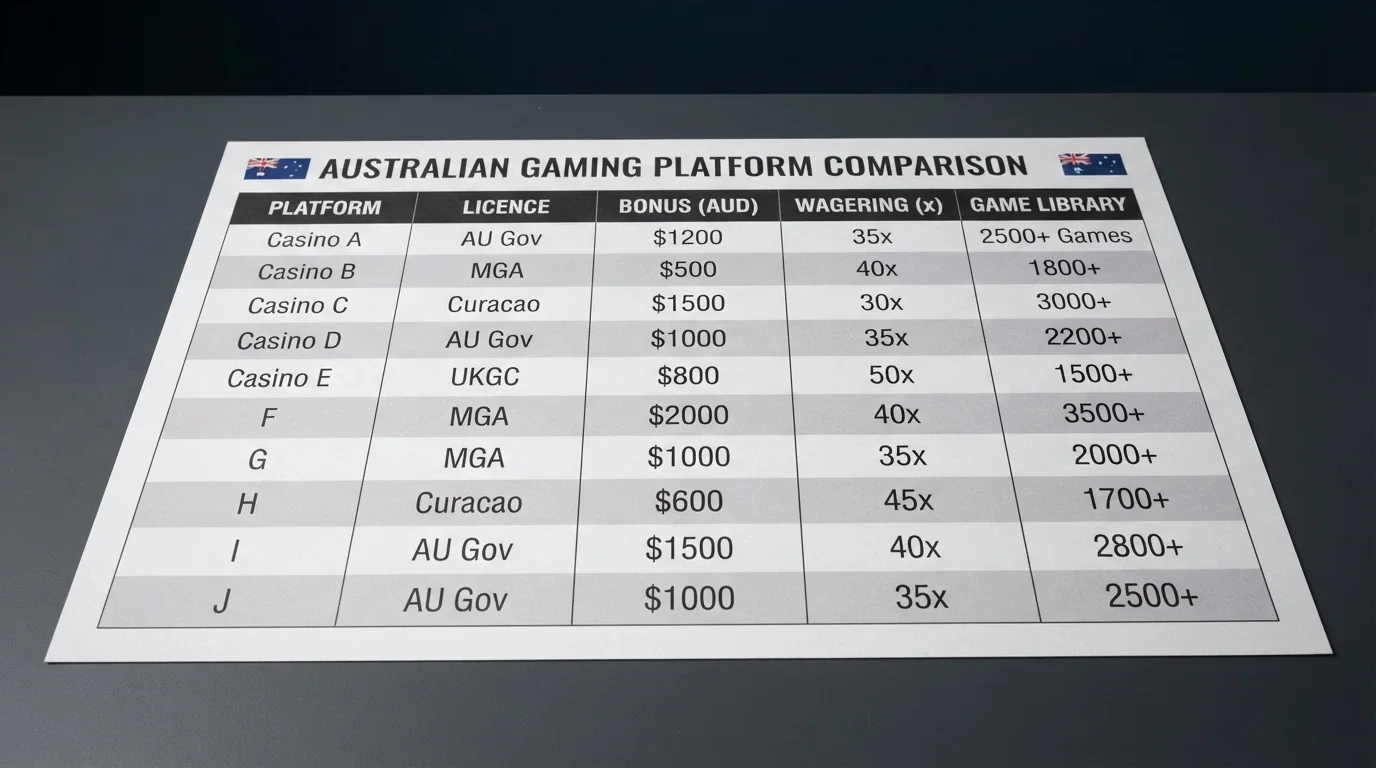
Online casino is prohibited in Australia, so every operator below is offshore with no Australian licence. The table ranks the ten by what research actually confirmed — welcome bonus, wagering multiple, offshore licence, games on the lobby — and uses an em dash where the figure wasn’t verified. The operator write-ups that follow add what the table can’t carry: the deposit path, the payout time, the gaps a player should check before signing up.
| Operator | Offshore licence | Welcome bonus | Wagering | Game library |
|---|---|---|---|---|
| BitStarz | Curacao | A$10,000 + 180 FS | 40× | 70+ studios |
| Rocket Play | Curacao | A$2,000 + 100 FS | — | 3,000+ slots |
| SkyCrown | Curacao | A$8,000 + 400 FS | 40× (bonus + FS) | — |
| BC.Game | Curacao | A$1,600 + 400 FS | 40× (bonus only) | 10,000+ |
| Stake | Curacao | — | — | — |
| Rainbet | Curacao | A$2,100 + 60 FS | 40× | 5,700+ |
| Royal Reels | — | A$10 no-deposit | 31× avg | 5,400+ |
| Fair Go | Curacao #1668/JAZ | A$1,000 (5 × A$200) | 30× (bonus + deposit) | 280 |
| Bizzo | TechSolutions Group N.V. | — | 40× (spins) | 8,000+ |
| Wild Tokyo | — | A$5,300 + 620 FS | 35× (bonus only) | — |
BitStarz: the biggest welcome package, plus 30 deposit-free spins
BitStarz runs the largest headline welcome package of the ten. Across the first four qualifying deposits the operator offers up to A$10,000 (or up to 5 BTC) plus 180 free spins, with 40× wagering on the bonus. The 180 spins are released in batches of 20 a day over nine consecutive days — a slow drip, not a single drop on day one. A player who wants the full allocation commits to the operator for the release period, not just the first session.
The unusual feature is the no-deposit side. New players get 30 free spins with no deposit required, which makes BitStarz one of only three operators on the list with a genuine deposit-free offer. The 30-spin win will still face the site’s standard 40× wagering on spin winnings — a number research inferred from the wider bonus policy rather than from a published no-deposit T&C — so the A$0 entry isn’t free of effort.
The 70+ studio count covers BGaming, Pragmatic Play, Play’n GO, Evolution, NetEnt, Nolimit City and Endorphina among others, which gives the lobby a real spread across high-volatility slots, live dealer tables and crypto-specific titles. BitStarz is the operator of the ten most likely to satisfy a player who already knows which studio’s catalogue they want to play.
For a player who actually intends to chase the full A$10,000 bonus, the 40× wagering is the bill to read before signing up — not after.
Rocket Play: ~2-hour crypto withdrawals across 34 payment methods
Rocket Play’s pitch is operational rather than promotional. The casino accepts deposits through 34 payment methods, and crypto withdrawals take about two hours to land in the player’s wallet — long for the set, but consistent rather than erratic. The welcome package is more modest: up to A$2,000 + 100 free spins with a minimum deposit of A$25. Research did not confirm the wagering multiplier on this welcome, so the headline figure sits next to an em dash in the table.
The withdrawal ceiling is set in euros and applies uniformly: EUR 5,000 per week and EUR 15,000 per month, with no win cap. A player turning over a healthy bonus balance would be capped at the weekly figure, which is the practical limit on what the casino will release in one go.
The lobby is positioned around 3,000+ slots from Playson, IGT, Wazdan, BGaming and NetGame, with a separate list of 1,248 BTC pokies hosted by the operator under the same roof.
Where Rocket Play stands out is the two-hour crypto withdrawal across 34 payment methods, which makes it the consistency pick of the set when the welcome offer is secondary to payout reliability.
SkyCrown: the largest match package, capped by withdrawal limits
SkyCrown’s headline is the size of the four-tier package: up to A$8,000 + 400 free spins, with 40× wagering on both the bonus and the spin winnings. The minimum deposit steps up from A$30 on the first bonus to A$50 on the fourth, which means chasing the full package costs more than the headline suggests in cash.
The two caps are where the package actually meets the player. The free-spin winnings are capped at A$300 per bonus part — a hard ceiling on what those 400 spins can convert into. Separately, the operator’s withdrawal limits are A$5,000 per day, A$10,000 per week and A$15,000 per month. A player turning over the full A$8,000 bonus will run into the weekly figure before the monthly one.
Research did not confirm the studio count or the precise RTP profile of the bonus slot, so those cells of the comparison stay empty above. A player deciding on SkyCrown should check the bonus-game contribution table on the operator’s own site before depositing.
The A$300 free-spin cap and the A$5,000 daily withdrawal ceiling are the numbers that decide whether the headline package converts into anything a player can actually take home.
BC.Game: the lowest wagering among the tested set, with seven coins
BC.Game offers the lowest tested wagering multiple of the ten. Four match bonuses of up to A$1,600 + 400 free spins carry 40× wagering on the bonus only — meaning the deposit itself is not locked, which materially changes what the player has to clear. By comparison, BC.Game’s 40× on bonus alone is the gentler of the 40× figures in the set, and the welcome is the second-largest in free-spin count.
The seven supported coins are the widest list in the featured set: BTC, ETH, LTC, USDT, ADA, XRP and DOGE. A player who holds an altcoin rather than Bitcoin will often find BC.Game the simplest of the ten to deposit with.
The 10,000+ game count is the broadest library of the operators whose catalogue was confirmed in research. The lobby mixes slots, live dealer rooms and the operator’s own Originals — the latter being a small set of in-house titles where each spin can be verified against a published hash.
40× bonus-only is the lowest tested wagering of the ten, and the seven-coin support list is the broadest of any operator reviewed.
Stake: a household crypto name with terms we could not verify
Stake is the brand most Australians will recognise by name, and the one this page is least able to confirm terms for. The operator is Curacao-licensed and offshore, with no Australian licence — that part is unambiguous. The welcome offer, the wagering multiple, the bonus validity period, the maximum cashout: research did not confirm any of these in the latest run. Publishing a guess would be worse than publishing a gap, and a player should treat the gap as the gap.
Stake is a brand Australians recognise; the published bonus terms are not on this page because they were not confirmed during research, and a player should read Stake’s own site before depositing.
Rainbet: ~10-minute Bitcoin withdrawals and 20+ coins
Rainbet’s measure is speed. Bitcoin withdrawals take about ten minutes to land, which is the fastest of the ten operators whose payout time was confirmed in research. The casino supports 20+ cryptocurrencies, so the speed holds across the major altcoins rather than just Bitcoin.
The welcome package is up to A$2,100 + 60 free spins, delivered across three deposits in 20-spin increments, with 40× wagering locked to the bonus. The 5,700+ game count includes the operator’s own provably fair Originals, which is the technical underpinning that lets a player verify each spin was not pre-determined by the house.
Rainbet’s 10-minute Bitcoin withdrawal is the only payout figure in the comparison table measured in single digits, but the A$2,100 welcome and 40× wagering put it in the middle of the field on offer terms.
Royal Reels: a A$10 no-deposit bonus after phone verification
Royal Reels runs the lowest-friction entry on the page. A new player gets a A$10 no-deposit bonus after phone verification — no deposit required, no crypto transfer, just a phone number. The casino also runs instant crypto and PayID withdrawals once a player has deposited, which makes the operator one of the few where an Australian can move money in and out via PayID rather than only via wallet.
The lobby is 5,400+ pokies from 40+ software providers. The wagering requirement averages 31× across 14 active bonuses — meaningfully lower than the 40× cluster that dominates the table. The offshore licence was not confirmed during research, which the comparison table shows as a gap.
The A$10 no-deposit is the lowest-friction entry on the page — but phone verification still happens, and the 31× average wagering is what the player pays to convert that A$10 into anything withdrawable.
Fair Go: 30× wagering on a five-part A$1,000 match
Fair Go is the smallest operator in the set, with a five-part welcome package totalling up to A$1,000 — five separate 100% matches up to A$200 each — with 30× wagering on the bonus plus deposit. The minimum deposit is A$20 per match, and the bonus structure means the player is committed to five deposits rather than one.
The library is 280 games, the smallest of the ten by a wide margin. The studio focus is RTG (Realtime Gaming), which is an older catalogue than the BGaming/Pragmatic Play mix the bigger operators carry. The Curacao licence number (#1668/JAZ) is the only one in the comparison table verified to a specific identifier, which gives the licence a slight edge in verifiability over the unnumbered Curacao licences the other operators list.
Fair Go’s 30× (bonus + deposit) wagering is the lowest of the ten operators whose terms research confirmed — but the 280-game library is also the smallest, and the player is choosing a tighter bonus over a tighter catalogue.
Bizzo: 8,000+ games and a 10-spin app-install offer
Bizzo runs the broadest library of the set. 8,000+ games from 70+ studios sits at the top of the comparison table alongside the higher-volatility operators. The casino supports PayID for deposits and withdrawals, alongside cards, e-wallets and crypto — which makes Bizzo one of the rare operators where an Australian can bank in Australian dollars and still reach the crypto lobby.
The bonus side is different from the headline figures. There is a no-deposit context for the 10–25 free spins, and 40× wagering applies to the spin winnings. The app-install offer is a genuine no-deposit promotion: install the app and the spins land without a deposit. The headline welcome offer was not confirmed by research, so the welcome cell sits empty in the table.
The 8,000-game library and the PayID deposit and withdrawal path are the practical wins; the 10 free spins for app install are a token gesture by comparison, and the headline welcome offer is not on this page because research did not confirm it.
Wild Tokyo: ranked first for speed and reliability in one AU test
Wild Tokyo is the speed and reliability pick in one Australian test of bitcoin casinos, which is what the published ranking claims rather than what this page has independently verified. The welcome package is AU$5,300 + 620 free spins with 35× wagering on the bonus only, and the supported coins are BTC, ETH, USDT and LTC — a tight list that covers the four most-traded tokens and excludes the altcoin long tail.
The offshore licence was not confirmed by research, which the table shows. A player trusting the test ranking is trusting an Australian affiliate’s measurement rather than a regulator’s record.
The A$5,300 + 620 FS line looks generous until you notice the 35× wagering and the offshore licence that research did not confirm; the operator is the speed pick in one Australian test, not a recommendation from this page.
No-KYC play is the whole appeal — and the whole risk
The verification you skip — and the checks you still face
No-KYC play means no identity upload, no driver licence scan, no utility bill. A player deposits from a wallet, plays, and withdraws to a wallet. The casino never sees the player’s name. That is the central pitch of the crypto casino as a category, and the reason Australian players move offshore in the first place: the IGA prohibits online casino in Australia, so there is no Australian operator to play with KYC; the offshore route is what crypto was built to enable.
What still happens is the operator’s own checks. Withdrawal limits apply regardless of KYC status — Rocket Play’s EUR 5,000 per week and EUR 15,000 per month, SkyCrown’s A$5,000 per day, A$10,000 per week, A$15,000 per month. A player who suddenly requests a five-figure payout will trigger an internal review even without a regulator breathing down the operator’s neck.
What also still happens is the two-stage withdrawal: casino processing time on the operator’s side, then blockchain confirmation time on the network. The player’s Bitcoin doesn’t arrive faster than the slowest of those two stages, and KYC status doesn’t shorten either one.
Deposits without KYC remove every external safety net
The bank is the friction flag an Australian-licensed operator cannot avoid. The bank notices unusual gambling flows, the bank flags them, the bank sometimes closes the account. That is a circuit-breaker a problem gambler relies on without knowing they rely on it.
The crypto deposit bypasses the bank entirely. The wallet sends, the wallet receives, no bank sits in between to notice. ACMA’s national self-exclusion register does not reach offshore casinos either, so a self-excluded Australian can still deposit at an offshore crypto casino. There is no Australian complaints body to escalate to. There is no Australian regulator who can order a refund.
The mechanism that protects the licensed market — a payment system that notices patterns, a self-exclusion register the operator must respect, a regulator who can punish misbehaviour — is precisely what the offshore crypto casino is built to bypass. The player gets convenience. They also lose the trip-wires.
Which coin and network to use for Australian deposits
For USDT, the network choice matters more than the coin choice. TRC-20 (Tron) is the recommended network for most Australian players because it confirms faster and costs less in fees than ERC-20 (Ethereum mainnet). The same dollar amount arrives faster and cheaper via Tron.
Coin support varies by operator. BC.Game accepts seven (BTC, ETH, LTC, USDT, ADA, XRP, DOGE); Wild Tokyo accepts four (BTC, ETH, USDT, LTC); Rainbet accepts 20+. The decision is usually practical: which coin is the player already holding, and which operator supports it.
Bitcoin is the default. Ethereum is the second-most-supported. USDT is the third, because stablecoin deposits let a player move fiat into the casino without the volatility risk of holding crypto between deposits. Pick the coin the player already holds, and pick the network the operator recommends for it.
Why your crypto casino bonus is smaller than it looks
A 40× wagering requirement turns a welcome bonus into hours of turnover before any of it can be withdrawn. The maths is the same across the ten operators, and the maths is the point.
Welcome packages: the real cost of a 40× wagering requirement
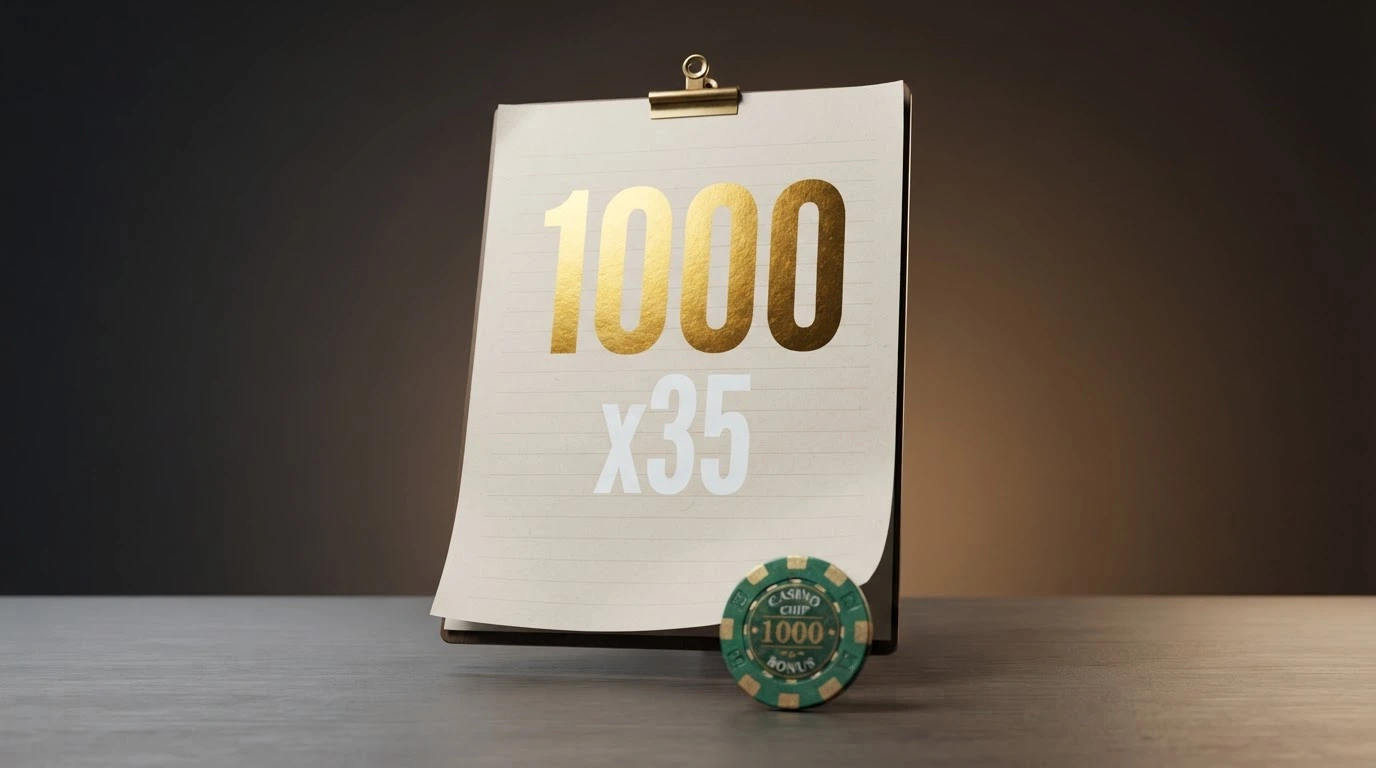
The wagering multiple is the multiplier applied to the bonus before it converts to withdrawable cash. A A$1,000 bonus with 40× wagering means A$40,000 of qualifying bets before the bonus pays out as cash. A A$10,000 bonus with the same multiple means A$400,000.
Three of the ten carry 40× on the bonus only — BC.Game and Wild Tokyo are two of them, with the lowest tested wagering in that cluster. One — Fair Go — runs 30× but on bonus plus deposit, which is the wagering multiple applied to a larger base. Royal Reels averages 31× across its 14 active bonuses. The range across the featured set is 30× to 40×, with most operators sitting at 40× and the qualifier — bonus only versus bonus plus deposit — being the practical distinction.
The implied turnover for the biggest welcome in the set, BitStarz’s A$10,000 at 40×, is A$400,000. Assuming only the bonus amount is wagered (not the deposit), a player clearing the full package would turn over A$400,000. On Gates of Olympus 1000 (96.50% RTP), the 3.5% house edge across that turnover puts the expected loss at A$14,000 — the cost of clearing the bonus, in plain arithmetic, before any withdrawal. That is the cost of the headline, and the figure a player should compare against the A$10,000 they hope to clear.
No-deposit offers: three of the ten actually have one
Three of the ten featured operators run a genuine deposit-free promotion. BitStarz offers 30 free spins with no deposit required. Royal Reels offers a A$10 bonus after phone verification. Bizzo offers 10 free spins for installing the mobile app. The other seven do not have a deposit-free offer confirmed by research.
No-deposit terms still carry wagering. BitStarz’s 30 FS face the site’s standard 40× on spin winnings; Bizzo’s 10 spins carry 40× on spin winnings; Royal Reels’ A$10 carries the operator’s 31× average. A no-deposit promotion is not a free withdrawal — it is a way to play before committing a wallet.
A player seeing a “no-deposit crypto casino” claim from any of the other seven operators should check the operator’s own terms before assuming the offer exists. The claim is the marketing; the terms are the contract, and the contract is not always the same as the marketing.
Free-spins fine print: batch release, wagering and cashout caps
Free spins at offshore crypto casinos ship under three rules a player should know before clicking.
The first is batch release. BitStarz releases 180 spins in batches of 20 across nine days; Rainbet releases 60 across three deposits; Bizzo releases 10–25 as a one-off on app install. A player who wants the full free-spin allocation commits to the operator for the release period, not just for the day.
The second is wagering. SkyCrown’s 400 free spins carry 40× wagering on the winnings. Bizzo’s 10–25 carry 40× on spin winnings. A A$5 win on a 40× wagered spin requires A$200 of qualifying bets before it converts to withdrawable cash.
The third is the cashout cap. SkyCrown’s free-spin maximum win is A$300 per bonus part — a hard ceiling that turns a freak spin result into a modest payout, not a jackpot. Hitting a 5,000× win simply hits the cap: the operator voids the excess and the player walks away with the A$300 maximum, regardless of the ‘lucky’ result.
Crypto withdrawals are fast — the casino’s approval step is not
The two-stage withdrawal: processing vs blockchain confirmation
A crypto withdrawal is not one event. It is two stages in sequence, and the speed a player experiences is whichever of the two is slower.
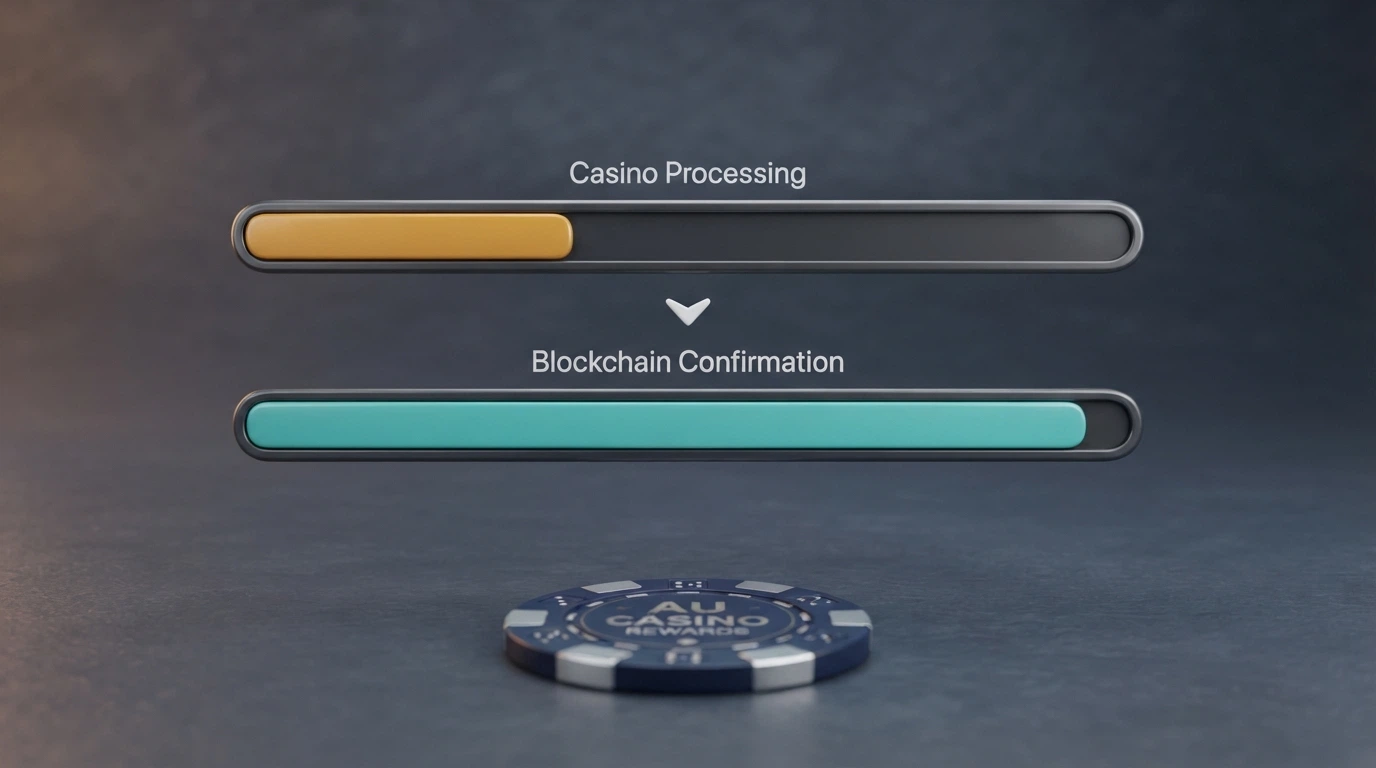
Stage one is casino processing time: the operator’s internal review, its compliance check, its payout queue. This is the step the operator controls. Rainbet clears it in about ten minutes; Rocket Play in about two hours; an unnamed operator in an Australian test averaged five hours and twenty-four minutes over five measured cycles.
Stage two is blockchain confirmation time: the network confirming the transaction. Bitcoin takes roughly ten minutes for one confirmation; Ethereum varies with gas; USDT on TRC-20 confirms in roughly a minute, while USDT on ERC-20 can take five to fifteen depending on the gas fee the player is willing to pay. The network step is what the player controls, through the choice of coin and the choice of network.
A withdrawal that “takes about 10 minutes” is a withdrawal where both stages are short. A withdrawal that “takes about 2 hours” is a withdrawal where stage one is the bottleneck. The advertised figure is the sum, and the sum can flatter either stage. The total speed experienced depends entirely on picking an operator with a fast internal queue and pairing it with a network known for quick confirmations.
Measured payout speeds across the featured set
Rainbet is the speed benchmark of the featured set. Bitcoin withdrawals take about ten minutes, and the operator supports 20+ cryptocurrencies so the speed is not Bitcoin-specific. Rocket Play is the consistency pick: crypto withdrawals take about two hours, and the operator accepts 34 payment methods — the deepest deposit and payout path of the ten.
Royal Reels claims instant crypto and PayID withdrawals once a player has deposited, which would put it ahead of both if the claim holds. The “instant” figure was published on the operator’s own site and was not measured independently during research.
Under fifteen minutes is the benchmark a competitive operator meets or beats. Anything slower is slower. The block on stage one is the casino’s own queue; the block on stage two is the network the player chose.
Crypto pokies: the RTP and volatility maths most lists skip
The RTP and volatility of a pokie are the two numbers that decide what the game costs in the long run. Both are in the table below, for the eight crypto-themed and broadly-played titles research confirmed.
| Pokie | Provider | RTP | Volatility | Max win |
|---|---|---|---|---|
| Gates of Olympus 1000 | Pragmatic Play | 96.50% | High | 15,000× |
| Book of Dead | Play’n GO | 96.21% | — | — |
| Satoshi’s Secret | Endorphina | 89.83% | Medium-low | — |
| Crypto Crown 5 | AvatUX | 96.14% | High | 5,000× |
| Crypto Bro | AvatUX | 96.00% | — | 20,000× |
| Pots of Power: Zeus | AvatUX | 96.10% | High | 10,000× |
| Aztec Magic Bonanza | Booongo | 96.20% | — | 15,000× |
| 20 Coins | Evoplay | 96.00% | — | — |
RTP: what a pokie returns and why 89.83% is worse than 96.5%
RTP is the percentage of wagered money a pokie returns to players over a very large number of spins. The other percentage is the house edge. A pokie with 96.50% RTP keeps 3.50% in the long run; a pokie with 89.83% RTP keeps 10.17%. The difference is not subtle.
Gates of Olympus 1000 returns 96.50%. Satoshi’s Secret returns 89.83%. On A$10,000 of wagering, that spread is a A$350 expected loss versus a A$1,017 expected loss — a nearly three-fold difference on the same action. The pokie with the lower RTP is the more expensive way to clear a wagering requirement, full stop.
Book of Dead illustrates a separate complication: the headline RTP is 96.21%, but the same title ships in lower-RTP versions (95%, 92%, 91.2% and 87.2%). Operators select which configuration to host, and the player usually cannot tell from the lobby which one is loaded. A player who specifically wants 96.21% should check the operator’s game-information panel before placing the first spin.
Volatility and max win: what the maths leaves out
RTP tells a player what the game costs. Volatility tells the player how the cost is delivered.
A high-volatility pokie like Gates of Olympus 1000 or Pots of Power: Zeus pays out rarely, and pays out big when it does. A medium-low volatility pokie like Satoshi’s Secret pays out often, and pays out small. The RTP can be identical between two games while the player experience is entirely different: one delivers a stream of small wins and a long session; the other delivers a fast losing streak and the rare 5,000× or 10,000× hit.
Max win is the upper boundary the maths allows. Crypto Bro caps at 20,000×; Gates of Olympus 1000 at 15,000×; Pots of Power: Zeus at 10,000×; Aztec Magic Bonanza at 15,000×; Crypto Crown 5 at 5,000×. Those numbers are the headline ceiling the marketing material loves. The base-rate expectation at those maxima is the long-run RTP figure — the volatility figure is what tells the player how likely the ceiling actually is.
The cleared-bonus calculation in the section on welcome packages used Gates of Olympus 1000’s 96.50% as the working RTP. A player who cleared the same bonus on Satoshi’s Secret would expect to lose about three times as much on the same turnover. The pokie choice is the hidden multiplier on the bonus cost.
New crypto casino brands keep arriving — fresh is not a safety signal
The crypto casino market is not a stable list. New brands launch monthly, often with the same Curacao or Tobique template, the same 40× wagering default, and the same crypto deposit path. Freshness is not a credential — it is the absence of one.
What to check before trusting a brand new name
A new operator has not yet earned a track record. The first deposit carries risks an established operator has already absorbed: a payout that is slow on day one, a bonus that is voided on day two, an account that is closed on day three with terms the player agreed to on day zero.
Four checks before a first deposit. First, the offshore licence — is it Curacao, Tobique, Anjouan, or something less established, and is the licence identifier verifiable on the regulator’s register? Second, the published bonus terms — wagering, validity, max cashout, game weighting, in the operator’s own T&C, not in the affiliate’s marketing. Third, the withdrawal record — what does the operator’s own help centre say about payout times, and what does an independent forum say about refused withdrawals? Fourth, the launch date — a brand launched last month has no track record; a brand launched in 2021 has some.
The crypto casino market keeps adding names. Most of them will not be on this page next year, because most of them will not last. The reader’s job is the same regardless of how new the operator is: the brand is offshore and unlicensed in Australia, and the published terms are the contract the player signs when they deposit.
The law is blunt: online casino is prohibited in Australia
What the IGA prohibits, and who it actually punishes
The Interactive Gambling Act 2001 prohibits the provision of online casino, online pokies and in-play sports betting to persons in Australia. There is no licence for any of those activities federally or in any state or territory. Sections 5, 15 and 15A of the Act set out the prohibited interactive gambling service and the offences attached.
The Act targets the provider, not the player. The individual Australian who deposits at an offshore crypto casino is not prosecuted under the IGA. The casino, the affiliate that markets it, and the payment provider that processes deposits to it are the targets. That asymmetry is the reason offshore crypto casinos remain reachable: the supply side carries the legal risk, not the demand side.
It is worth separating that asymmetry from safety. “Not illegal for you” is not “safe for you”. There is no Australian consumer protection, no Australian complaints body, no Australian regulator who can order a refund. The site can be blocked by ACMA at any time, with a balance still on it. The legal risk is on the operator; the financial risk is on the player.
The 2026 gambling reform: what it changes and when
The Interactive Gambling Amendment (Gambling Reform) Bill 2026 passed Parliament on 19 August 2026 and its measures commence on 1 January 2027. The Bill is the biggest tightening of the offshore squeeze in a decade. Five changes matter for the crypto casino user.
From 1 January 2027, banks and payment providers gain express authority to block transactions to illegal gambling operators. A player using a bank transfer or a credit card — not the crypto deposit, which is already banned as payment in 2024 — will see the bank refuse the transaction. The crypto route is unaffected by that specific change, because crypto was already banned as payment for online wagering under the 2023 amendment.
From the same date, no more than three wagering ads per hour between 6:00 am and 8:30 pm, with a live-sport blackout from fifteen minutes before to five minutes after a live sporting event. Radio ads are barred during school times. Broadcasting sporting odds is banned outright. Athletes, celebrities and influencers are barred from promoting wagering products. Wagering advertising inside sports venues and on the uniforms of players and officials is prohibited.
From 1 January 2027, direct marketing of inducements is prohibited for fourteen days after a customer signs up with a licensed operator and for three months after a person deregisters from the national self-exclusion register. The licensed operators are the target. Offshore crypto casinos do not run a sign-up flow the regulator can interrupt, and they do not run an inducement email the regulator can fine.
The reform tightens what the licensed market can advertise and how licensed operators can chase customers. It does not legalise online casino, and it does not extend Australian consumer protection to the offshore sites Australians actually use.
Offshore licences offer no Australian protection
A Curacao licence permits an operator to run an international online casino. A Tobique licence does the same. Neither licence authorises the operator to take Australian customers, and neither licence obliges the operator to behave as an Australian-licensed wagering service would.
The difference matters in practice. An Australian-licensed wagering operator must comply with state and territory rules on deposit limits, activity statements, complaints handling and responsible gambling. An offshore operator must comply with the rules of whichever jurisdiction issued its licence, and those rules do not include Australian consumer protection. A player with a complaint has no Australian regulator to escalate to. The site itself can be blocked by ACMA at any time, with the player’s balance sitting in the operator’s terms.
ACMA has blocked 1,564 illegal gambling and affiliate websites since 2019 and more than 225 services have withdrawn from the Australian market since 2017. The list grows. A site that is reachable today can be on the blocked list tomorrow. A balance held at the moment of blocking stays on the operator’s terms, not on the player’s.
Anonymity removes the circuit-breakers — play within reach of help
Help that works: the helpline and self-exclusion
The National Gambling Helpline is 1800 858 858 — free, confidential and staffed 24 hours a day, every day of the year. Online chat and counselling are available through Gambling Help Online at gamblinghelponline.org.au. Both services are run for Australians and are independent of any casino, licensed or offshore.

BetStop, the National Self-Exclusion Register, went live in August 2023. As at 31 July 2026, the register had 67,480 registrations, of which 41,290 exclusions were still active — more than 60% of everyone who ever registered. Seventy-eight percent of registrants were under 40; thirty-eight percent chose lifetime exclusion. The numbers show the register catching people early.
The register’s limit is that it binds Australian-licensed wagering services only. An offshore crypto casino is not connected to BetStop, and a self-excluded Australian can still deposit, wager and withdraw at one. The mechanism that protects the licensed market does not extend to the offshore sites most of this page covers. A player who has registered with BetStop and then opens a crypto casino account has registered in one place and undone the registration in another.
Why crypto anonymity is the specific risk to watch
About 2.1% of Australian adults — roughly 430,000 people — experience problem gambling, and the Australian Institute of Health and Welfare put high-risk gambling at 1.8% in 2022. Australians lose around A$32 billion on legal gambling every year, the heaviest per-person losses of any country on earth. Those are the licensed-market numbers. The offshore crypto casino numbers are not measured by AIHW.
The anonymity that crypto offers is the specific risk for the 430,000. A bank account notices an unusual gambling flow and flags it. BetStop blocks the licensed operator. The licensed operator’s deposit limit and activity statement catch a player who has set them. The crypto casino bypasses every one of those mechanisms. The deposit leaves a wallet, not a bank. The operator is offshore, outside BetStop. The player’s self-exclusion applies only to the licensed market. The player who needs the trip-wires is the player the offshore market was built to bypass.
The helpline, the online chat and the register are all there for the moment the player decides to reach for them. They work from inside Australia regardless of where the gambling happens, and reaching out is free, confidential and available every hour of every day.
How we chose and checked these operators
The starting point is the legal position. No Australian licence exists for online casino, so there is no Australian register to check operators against. The benchmark is the Interactive Gambling Act 2001 prohibition itself, with the ACMA register of 1,564 blocked sites and 225 withdrawn services as the regulator’s enforcement record.
The ten operators below the ACMA line are the ones that Australian-facing affiliate sites in the search archive currently rank in the top tier, that accept Australian players, that take at least one of Bitcoin, Ethereum or USDT, and that had at least one of welcome bonus, wagering requirement or payout speed confirmed by an Australian-facing source in the latest research pass. The set is not the entire offshore market; it is the top of the search-result pile, presented honestly.
Ranking is by the figures research actually confirmed, with no invented weighting: welcome bonus size, wagering multiple, offshore licence, payout time, game library count. Where research carried a number, the number is on the page; where it didn’t, an em dash sits in the table and the operator block explains the gap. Bonus terms at offshore casinos change often, and the reader should verify the offer on the operator’s own site before any first deposit.
What to actually do before your first crypto deposit
The decision is not which crypto casino to pick. The decision is whether to play at an offshore, unlicensed site at all.
If the answer is yes, three checks before the first deposit. First, read the wagering requirement in the operator’s own T&C, not in the affiliate’s marketing. Second, read the withdrawal limits and the maximum cashout on the bonus, because those are the figures the bonus number runs into. Third, set a personal loss limit before the first wallet transfer, and keep help within reach: 1800 858 858 and gamblinghelponline.org.au run 24/7, and the national self-exclusion register’s protections do not reach the offshore site once the deposit has been made.
The 2.1% problem-gambling prevalence figure is the one to keep in mind. The anonymity the offshore route offers is the same feature that bypasses every Australian safety mechanism. A player who needs those mechanisms is the player the offshore market was built to bypass.
Frequently asked questions
Is it legal to play at a crypto casino from Australia?
It is not illegal for the player. The Interactive Gambling Act 2001 prohibits online casino in Australia and targets the provider, not the consumer. The crypto casino itself is operating offshore, unlicensed in Australia, and outside any Australian complaints body or self-exclusion register.
What cryptocurrencies do Australian crypto casinos accept?
Coin support varies by operator. BC.Game takes BTC, ETH, LTC, USDT, ADA, XRP and DOGE; Wild Tokyo takes BTC, ETH, USDT and LTC; Rainbet supports 20+. Most operators accept Bitcoin and Ethereum, with USDT, Litecoin and Dogecoin common beyond those.
What happens if an offshore crypto casino refuses to pay out?
There is no Australian consumer protection. The operator sits outside ACMA’s complaints process and outside BetStop. The player has no Australian regulator to escalate to, and the site can be blocked by ACMA at any time, potentially with a balance still held on the account.
Does BetStop cover crypto casinos in Australia?
No. BetStop binds Australian-licensed wagering services only. Offshore crypto casinos are not connected to the National Self-Exclusion Register, and a self-excluded Australian can still deposit, wager and withdraw at an offshore casino with no integration with the register.
Are my gambling winnings taxable if I play at a crypto casino?
Not for a recreational punter. Under section 6-5 of the ITAA 1997, gambling winnings are not assessable income and losses are not deductible under section 8-1 — unless the ATO considers the activity to be a business of betting, which involves systematic, organised activity pursued principally for profit.
Published by the Welcome Bonus Casinos AU team.