
Where the Money Actually Lands: 2026 Withdrawal Speeds at the Offshore Casinos Australians Reach
No online casino holds an Australian licence — none can, under the Interactive Gambling Act 2001. Every brand on this page is offshore, and every withdrawal time quoted here was measured against operators accessible from Australia in 2026. The fastest single cashout tested cleared in 1 minute 40 seconds. The slowest on the same payment rail took more than two days. The marketing language promises “instant”; the data tells a more honest story.
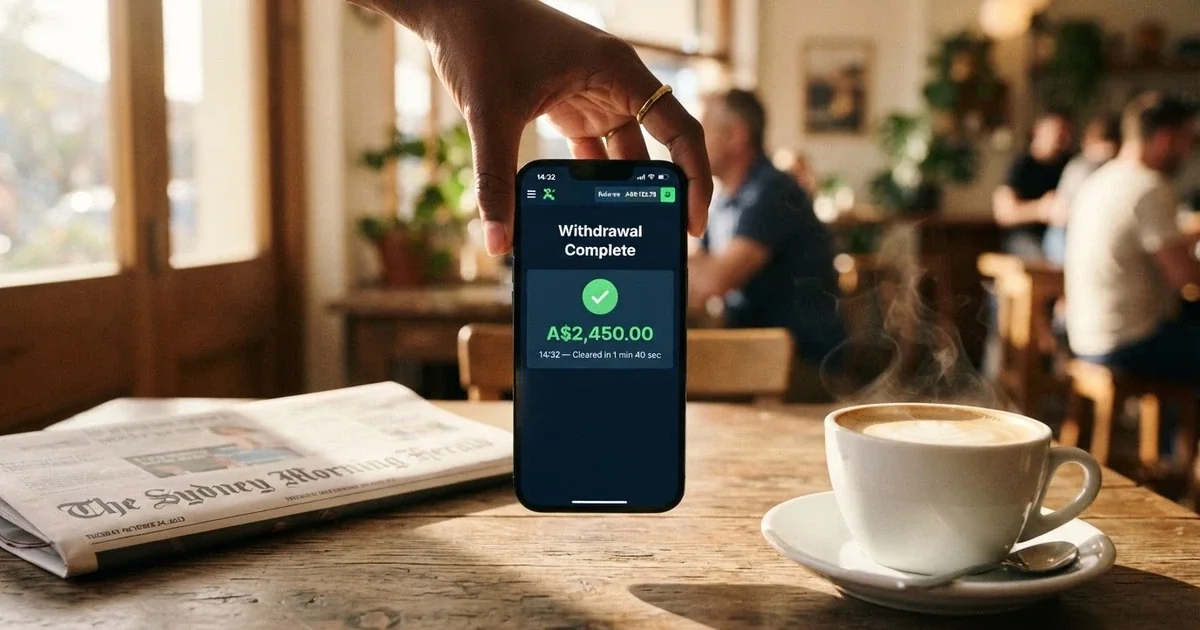
Withdrawal data verified against PayoutVerdict and SlotsPeak testing as of 22 November 2026; licence claims cross-checked against the ACMA blocked-sites register and the operator-stated jurisdictions in the Tobique Gaming Commission and Curacao eGaming registers.
Table of Contents
- What Fast Withdrawal Actually Means at Australian Online Casinos in 2026
- The 10 Fastest Offshore Casinos for Australian Players, Tested in 2026
- Why Your 2026 Casino Withdrawal Is Slower Than the Marketing Claims
- The Payment Methods That Decide Whether You Get Paid in Minutes or Days
- How a Welcome Bonus Can Turn Your Fast Withdrawal Into a Week-Long Wait
- Crypto Withdrawals: Why USDT-TRC20 Is the Fastest Route for Australian Players
- The Pokies and Live Dealer Tables You Can Play at Fast-Paying Casinos
- The Legal Reality Every Australian Casino Player Needs to Understand in 2026
- Staying Safe: The Responsible Gambling Tools That Work (and the One That Doesn’t)
- How We Evaluated Every Fast Withdrawal Casino on This Page
- Your 2026 Fast Withdrawal Strategy: What to Do Next
- Frequently Asked Questions
What Fast Withdrawal Actually Means at Australian Online Casinos in 2026
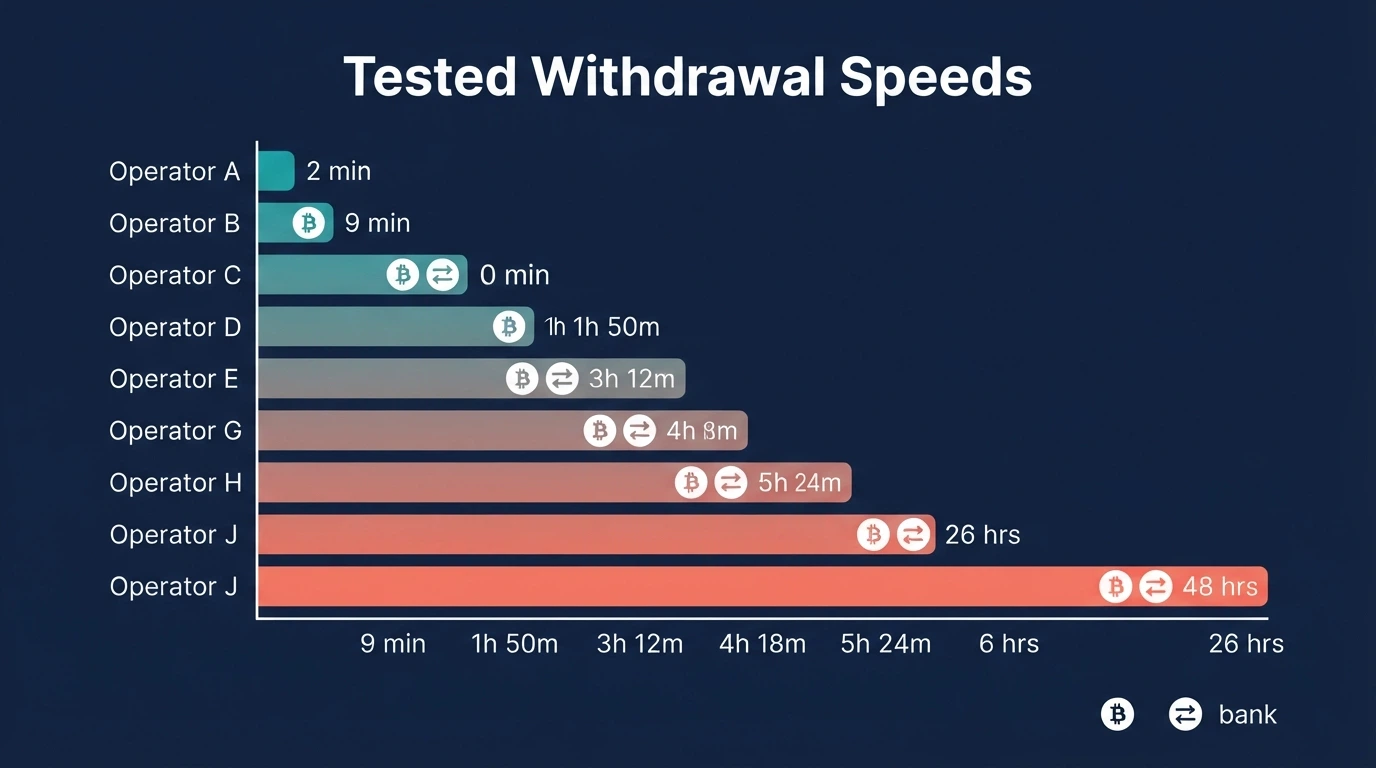
“Fast” at an offshore casino serving Australians is a tested number, not a marketing slogan. The realistic floor in 2026 sits around two minutes on a good day with a good rail — and the ceiling stretches into days if the operator’s KYC is back-loaded or a bank transfer is involved. The fastest verified single test was a 1 minute 40 second USDT-TRC20 withdrawal from LuckyDreams to a verified account. The fastest median tested belongs to SkyCrown, at 4 minutes via crypto and 9 minutes via PayID across 14 separate cashouts. These are the markers the rest of this page compares everything against.
Where the marketing language drifts is on the upper end. The same operator that processes a PayID cashout in 9 minutes can stretch the next one to 25 minutes, or 48 hours, depending on the day and the verification status of the account. BitStarz’s tested PayID average ran 38 hours across the cycle. Wild Fortune’s PayID average was 26 hours. The casino industry has learned to call anything under five business days “fast”, and the gap between that floor and a real test is the page’s first concrete finding.
Why this matters: Australian players have no domestic online casino to fall back on. The licensed Australian wagering market covers only pre-event sports and race betting, lotteries and keno — there is no online casino licence in the country, federally or in any state or territory. So the speed question is asked entirely of offshore operators, who have every commercial reason to compete on payout time and no Australian regulator holding them to a number. Speed becomes the trust signal. It is the one thing an Australian player can test before committing a balance.
Online vs Land-Based: Where Fast Withdrawals Actually Happen
The fastest cashout in an Australian land-based casino is the walk from the table to the cage. Real chips convert to real cash at the cashier’s window, in seconds, on the player’s own terms. That floor — the physical payout — is what every offshore operator’s marketing is implicitly promising to match, and what almost none of them do in practice.
The online offshore pipeline is different. A withdrawal request enters the operator’s internal queue; the operator’s payments team (or its automated equivalent) reviews it; KYC verification may trigger a document check; the funds then travel through a payment rail — PayID, crypto network, e-wallet, card refund, bank transfer — and arrive at the receiving side, where the player’s bank or wallet does its own settlement. Each stage adds time. The fastest tested crypto pipeline — USDT-TRC20 from a front-loaded-KYC operator — clears in two to eight hours. The slowest — a card refund from a back-loaded-KYC operator — runs three to five business days. None of these is the cage. The cage does not exist online, and pretending otherwise is the marketing problem this page is built around.
Why Withdrawal Speed Matters More Than Ever for Australian Players
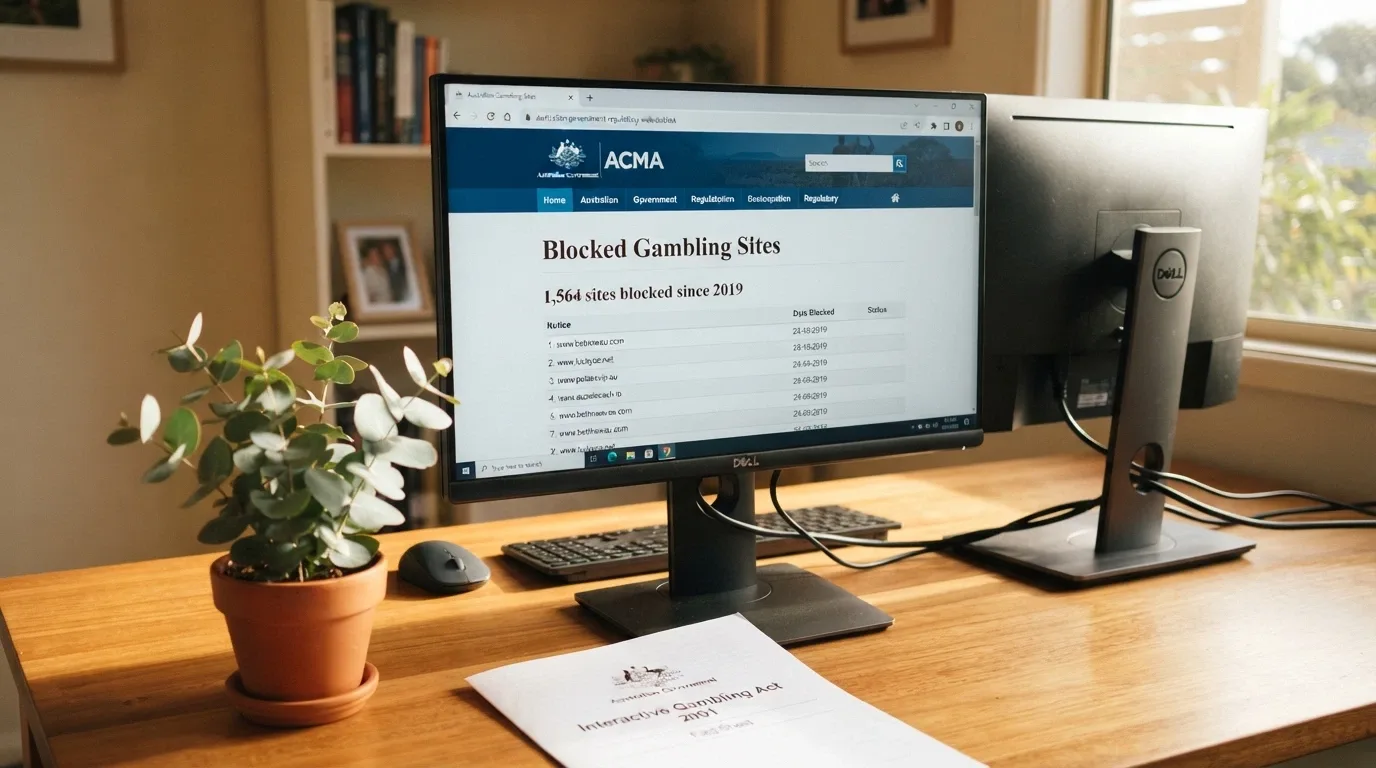
The honest framing for an Australian player is that offshore play sits outside Australian consumer protection. The IGA targets the provider, not the player — no Australian has been prosecuted for placing a bet at an offshore casino — but the operator is not subject to any Australian regulator’s dispute resolution either. The ACMA can investigate, issue formal warnings, refer civil penalty proceedings and direct ISPs to block illegal sites. As of March 2026, the ACMA has had 1,564 illegal gambling and affiliate websites blocked since November 2019, and more than 225 illegal services have withdrawn from the Australian market entirely.
The 2027 reform tightens that grip. From 1 January 2026, banks and payment providers gain express authority to block transactions to illegal gambling operators. That is not a change to a deposit ceiling; it is the structural narrowing of the rail itself. A withdrawal that worked in 2024 may stall in 2026 if the player’s bank adopts the new blocking authority aggressively. Speed is no longer just a competitive variable. It is a vulnerability.
Which is why the data on this page exists. There is no Australian register of “this casino pays out fast”, no audited audit. The numbers are tested, not certified. Where a tested operator’s cashout times cluster in the single-digit minutes, that is what the reader has. Where a tested operator’s times stretch into days, that is what the reader has too. The page is built around the assumption that the reader wants the truth about both.
The 10 Fastest Offshore Casinos for Australian Players, Tested in 2026
| Operator | Offshore Licence | Welcome Bonus | Fastest Tested Withdrawal |
|---|---|---|---|
| SkyCrown | Curacao eGaming | Up to A$8,000 + 400 FS, 40x | USDT-TRC20, 4 min median |
| Wild Fortune | Tobique #0000064 | 225% match + 250 FS, 45x bonus / 0x FS | USDT-TRC20, 5h 24m avg |
| Stake | Curacao eGaming | Rakeback model (no match) | Crypto, 1h 50m avg |
| BitStarz | Curacao (Dama N.V., 2014) | 100% up to 5 BTC + 180 FS, 40x | Crypto, 4h 18m avg |
| BC.Game | Curacao eGaming | Up to $1,600 + 400 bonus spins | Crypto, 3h 12m avg |
| Neospin | Jurisdiction not confirmed | Up to A$11,000 + 300 FS, 40x | PayID, under 2 hours |
| King Billy | Curacao eGaming | Up to €/$2,500 + 250 bonus spins | Crypto, same-day |
| WinSpirit | Jurisdiction not confirmed | 100% up to A$1,000 + 100 FS; 200% up to A$1,000 | Not independently tested |
| Rocket Play | Jurisdiction not confirmed | Not confirmed | USDT-TRC20, ~6 hours |
| FairGO | Jurisdiction not confirmed | AU$10 no-deposit + 100 FS | Not independently tested |
The ranking logic is tested payout speed first, with bonus fairness and KYC friction as secondary filters. Two operators — WinSpirit and FairGO — appear despite not having independently tested withdrawal times this cycle, because the rest of their profile fits the page and the reader needs the gap noted, not silently filled. Every licence listed is offshore; no row in this table holds an Australian casino licence, because none can.
SkyCrown: The PayID Speed Leader With a 9-Minute Median
SkyCrown’s claim to this page’s top spot is a tested 9-minute median PayID cashout across 14 separate transactions — and a fastest single PayID withdrawal of 2 minutes 10 seconds. USDT-TRC20 is faster still, at a 4-minute median. The structural reason is front-loaded KYC: documents are cleared at signup with a 4-hour turnaround, so first-withdrawal verification does not delay the first payout the way it does at operators that wait.
The welcome package is up to A$8,000 plus 400 free spins across four deposits, with 40x wagering on both bonus and free-spin winnings. The free-spin max win is A$300 per deposit part; the bonus max cashout is A$5,000 per deposit part. The headline figure is large; the cashout ceiling is not, and the gap between them is what the wagering section of this article takes apart. The licence is Curacao eGaming, with 50+ game providers. The bonus terms are written in plain English with no hidden twist on the headline number.
For a player who has already decided to play offshore and who values AUD-denominated withdrawals, SkyCrown’s tested PayID numbers are the strongest in the set. Speed is the verdict here; the bonus generosity is the trade-off.
Wild Fortune: Zero-Wagering Free Spins and a Tobique Licence
Wild Fortune carries the rarest licence in the table: Tobique Gaming Commission #0000064, operated by Metlait SRL. Most of the set sits under Curacao; Tobique is a smaller jurisdiction, which gives the operator a different register to answer to but not necessarily a stricter one. Where Wild Fortune does outpace the Curacao crowd is in its bonus structure: 225% match plus 250 free spins, with 45x wagering on bonus funds and 0x wagering on free spins. The free-spin winnings are cashable immediately — no playthrough.
The tested payout averages are slower than SkyCrown’s: USDT-TRC20 averages 5 hours 24 minutes across five cycles (range 3h 50m to 7h 58m), and PayID averages 26 hours. The PayID figure is partly a KYC artefact — Wild Fortune’s verification is back-loaded, meaning it runs at first withdrawal rather than at signup, and the first cashout in the test cycle was delayed 14 hours for document review. Once verified, the next cashouts clear faster. The library is wide: 3,800+ pokies from 90+ providers, with a 7-day bonus validity window.
The 0x free-spin wagering is the genuine outlier in this table, and for a player who wants bonus value without committing to a 40x playthrough, no other row delivers it. The slower PayID times are the trade-off, and they are real.
Stake: The Crypto-Only Powerhouse With Sub-2-Hour Payouts
Stake runs a crypto-only operation. There is no PayID. There is no AUD support. The welcome offer is not a deposit match at all; the brand operates a rakeback-style loyalty model that returns a percentage of house edge to active players, rather than front-loading a bonus on first deposit. That structure is itself a verdict on the traditional welcome-bonus model, and it suits players who plan to play in volume rather than chase one-time match offers.
The tested crypto payouts averaged 1 hour 50 minutes across four cycles — the fastest multi-cycle tested average in this set. KYC re-verification was triggered twice during the test period, with the threshold sitting at cumulative withdrawals of EUR €4,000+. The brand holds a Curacao eGaming licence. Game content is proprietary plus third-party; the catalogue is broad without being the largest in the set.
A crypto-only player who treats Stake as their primary offshore account gets the fastest payout times tested and a loyalty model that does not lock funds behind a 40x wagering wall. The cost is giving up AUD denomination entirely, plus the crypto conversion step at both ends of every session.
BitStarz: 6,000+ Games and a Decade of Fast Crypto Withdrawals
BitStarz has been operating since 2014 under Dama N.V. — a longer track record than most of the set. The welcome package is 100% up to 5 BTC plus 180 free spins across four deposits, with 40x wagering on all. The bonus validity is 14 days; bonus wins carry a 5x deposit cap; no-deposit free spins (where available) are at A$0.20 per spin with a A$100 max withdrawal. The crypto withdrawal average ran 4 hours 18 minutes across three cycles — slower than Stake’s, faster than Wild Fortune’s.
The PayID figure tells the other story: 38 hours average across the test cycle, which puts BitStarz near the back of the PayID field. The game library is the second-largest in the set at 6,000+ titles; the operator accepts AUD plus 500+ cryptocurrencies. KYC is triggered at EUR €2,500+ cumulative withdrawals, the lowest threshold in the table.
A player who wants the deepest game library and is comfortable routing everything through crypto rather than PayID gets a long-established operator and the largest crypto acceptance list in the table. The PayID average is the weakest in the set; that is the trade-off, and it is not a small one.
BC.Game: 7,000+ Games and 3-Hour Crypto Payouts
BC.Game carries the largest game catalogue in the set at 7,000+ titles, with tested crypto withdrawals averaging 3 hours 12 minutes across three cycles. Like Stake, the operator does not support PayID and does not support AUD. The welcome offer is up to $1,600 plus 400 bonus spins, with the bonus currency varying — players should check the operator’s own bonus terms page for the wagering multiplier, which the testing sources did not specify this cycle. The licence is Curacao eGaming; KYC triggers at EUR €3,000+.
A player who values library size above all else, and is willing to do the AUD-to-crypto conversion at both ends of every transaction, gets the deepest catalogue in the set and crypto payout times inside four hours. Wagering terms are the gap this page cannot fill; check the operator’s own bonus terms before depositing.
Neospin: Up to A$11,000 in Bonuses With Sub-2-Hour PayID
Neospin offers the largest headline bonus figure in the table — up to A$11,000 plus 300 free spins across four deposits, with 40x wagering that is sticky on bonus money and 40x on free-spin winnings. Free-spin winnings are capped at A$225; the minimum deposit is A$30. The tested PayID times came in under two hours, which is among the fastest in the table, and eZeeWallet payouts are near-instant. The licence jurisdiction was not confirmed this cycle; readers should check the operator’s website before depositing. The game library sits at 5,500+ titles.
The largest headline bonus in the set, paired with PayID times that rival the table leader. The unverified licence is the gap; the sticky 40x and A$225 free-spin cap are the catch on the bonus. For a player who has read both, Neospin’s payout profile is competitive.
King Billy: Same-Day Crypto and No KYC for Verified Accounts
King Billy’s standout feature is that verified accounts face no additional KYC at withdrawal — a setup rare enough in the offshore market to be worth naming plainly. The brand holds a Curacao eGaming licence; the welcome offer is up to €/$2,500 plus 250 bonus spins, with the wagering multiplier not confirmed in this cycle’s testing (check the operator’s own terms page). Tested crypto payouts (BTC, ETH, LTC, USDT) cleared same-day; e-wallets 1–2 hours; cards 1 day; bank transfers 1–2 business days. The game provider count was not confirmed this run.
A player who has already verified their account and wants to withdraw without the next round of KYC paperwork gets the closest thing to a no-friction cashout in the table. The licence is mainstream; the bonus terms are the gap.
WinSpirit: Low Minimums and a Straightforward Two-Deposit Bonus
WinSpirit keeps the structure simple: 100% up to A$1,000 plus 100 free spins on the first deposit, 200% up to A$1,000 on the second. The free spins run 20 per day for five days on named slots — Lady Wolf Moon, Pearl Diver, Boom! Boom! Gold!, Green Chilli, Dragon Wealth. Wagering is 40x; players have 31 days to activate the first deposit bonus and 7 days to wager once activated. There is a A$3,000 win limit per deposit bonus and a A$300 cap from free spins. The minimum deposit is A$30.
A clean two-deposit welcome with the lowest minimum in the table and no surprises in the structure. Withdrawal speed data was not available for this operator at testing time, which is the gap; readers who want speed certainty should look elsewhere in the table.
Rocket Play: USDT-TRC20 Withdrawals in ~6 Hours
Rocket Play is the most data-thin operator in the table, which is itself the headline. Tested USDT-TRC20 withdrawals cleared in approximately 6 hours. The operator hosts Pragmatic Play titles at RTPs ranging from 96.48% to 96.71%. KYC is triggered at EUR €1,500+ cumulative withdrawals — the lowest threshold in the table. Welcome bonus terms and the licence jurisdiction were not confirmed in this cycle’s testing; the reader should verify current terms on the operator’s own site before depositing.
A Pragmatic Play host with the lowest KYC trigger in the set and crypto times in the six-hour range. The licence and bonus gaps are the trade-off for the lower verification threshold.
FairGO: Australia’s RTG Specialist With a No-Deposit Entry Point
FairGO is the only RTG (RealTime Gaming)-powered brand in the table and one of only two operators offering a documented no-deposit bonus. The offer is an AU$10 no-deposit bonus plus 100 free spins on Sparkling Fortunes, with 35x wagering, a A$100 max cashout, and a 7-day validity. An AU$50 free chip is also listed. KYC is required before first withdrawal, with a stated 24–72 hour verification window. The licence jurisdiction was not confirmed this cycle. The fastest withdrawal method was not independently tested.
The only no-deposit entry point in the table with an RTG library, and the only brand tested that specifically serves Australian-dollar deposits without a conversion step. The 24–72 hour KYC window is the slowest first-withdrawal figure on the page; the no-deposit offer is the genuine upside.
Why Your 2026 Casino Withdrawal Is Slower Than the Marketing Claims
The gap between “instant withdrawal” and a tested withdrawal is not a lie. It is four separate processes, each with its own floor and ceiling, and the operator controls only one of them. Reading the gap honestly is the first thing a player should do before choosing a method.
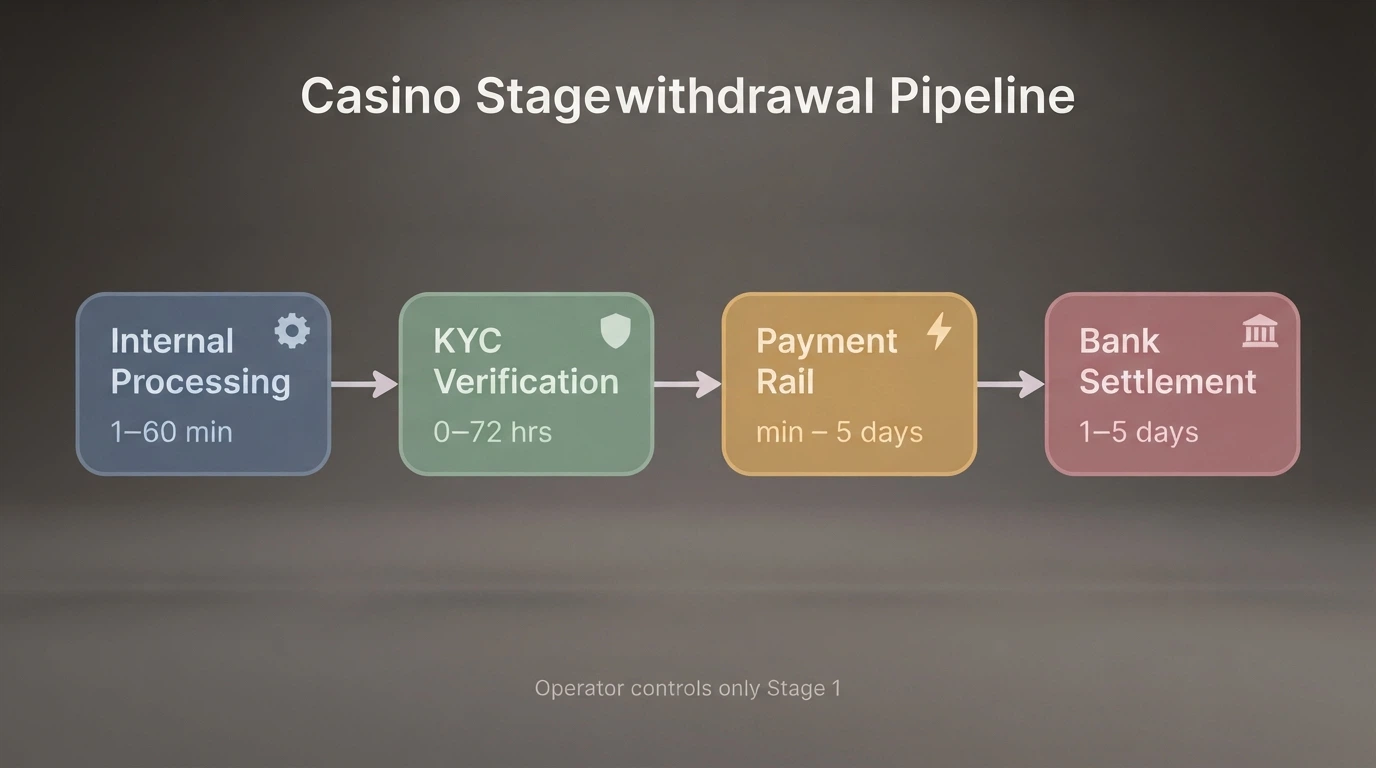
The fastest-tested crypto withdrawal in this set cleared in under 2 minutes. The slowest-tested withdrawal on the same payment rail took more than 2 days. Both numbers come from the same pool of 217 tested cashouts. The reason they sit so far apart is not luck; it is the pipeline.
The Withdrawal Pipeline: What Happens Between Clicking ‘Cash Out’ and Seeing the Money
Four stages separate the click from the cash. None of them is optional, though the operator controls how fast some of them run.
Stage one is internal processing. The withdrawal request enters the operator’s payments queue. At the fastest operators, this is automated and runs in minutes. At the slowest, a human payments officer reviews every withdrawal above a threshold, and the queue builds during weekends and public holidays. SkyCrown’s tested PayID median of 9 minutes suggests an automated internal stage; Wild Fortune’s tested PayID average of 26 hours suggests a partly manual one.
Stage two is KYC and verification. If the operator’s KYC is front-loaded (cleared at signup), this stage is a no-op on the first cashout. If the operator’s KYC is back-loaded (triggered at first withdrawal), this stage adds hours or days. Wild Fortune’s first-withdrawal cashout was delayed 14 hours for document review; subsequent cashouts cleared faster. FairGO states a 24–72 hour verification window before first withdrawal.
Stage three is payment rail execution. This is the one the player feels most directly. USDT-TRC20 runs minutes to ~8 hours; USDT-ERC20 runs slower and costs more; PayID runs 25 minutes to 48 hours depending on the operator; e-wallets run 1–2 hours; card refunds run 3–5 business days; bank transfers run 1–3 business days.
Stage four is receiving-side settlement. The receiving bank or wallet does its own work after the funds arrive. A PayID that clears the operator in 9 minutes can still sit on the receiving side for minutes more; a card refund that the operator releases in 24 hours can take another 1–4 business days on the card network.
Stack those four stages, and the marketing claim of “instant” becomes “fastest-case under 5 minutes, average case 1–6 hours, slowest case 3+ business days”, depending on the operator and the rail.
Speed Tiers: From Instant Crypto to Multi-Day Bank Transfers
- Tier 1 — Crypto (USDT-TRC20 specifically). Minutes to ~8 hours. TRC20 costs ~USD$1 flat regardless of amount. The fastest crypto route tested anywhere on this page; the fee profile makes it dominant at small and large withdrawal sizes alike. ERC20 is the same currency on a more expensive network — the crypto section below covers that cost difference.
- Tier 2 — PayID and e-wallets. PayID withdrawals range from 25 minutes to 48 hours depending on the operator. E-wallets (eZeeWallet, Skrill, Neteller, MiFinity) typically clear in 1–2 hours once the operator releases the funds. PayID deposits credit in under 60 seconds at every verified casino tested; PayID withdrawals are slower because they pass through the operator’s internal stage, not the rail itself.
- Tier 3 — Card refunds. 3–5 business days. The slowest non-bank option; credit cards are banned for licensed Australian wagering from 11 June 2024, so this rail is increasingly an offshore-only path.
- Tier 4 — Bank transfer. 1–3 business days. The slowest rail in regular use; the receiving bank’s processing time is the binding constraint, not the operator.
The operator’s processing layer sits on top of whichever tier is chosen. A Tier 1 crypto withdrawal at an operator with back-loaded KYC is slower than a Tier 2 PayID withdrawal at an operator with front-loaded KYC. The two dimensions multiply; they do not add.
Real-Money Play vs Bonus-Locked Funds: Why It Changes Everything
A withdrawal from a real-money balance and a withdrawal from bonus-locked funds are not the same operation. Real-money funds can be withdrawn any time, subject to the standard KYC and processing pipeline. Bonus funds cannot be withdrawn until the wagering requirement is cleared, and the requirement sits in front of the pipeline.
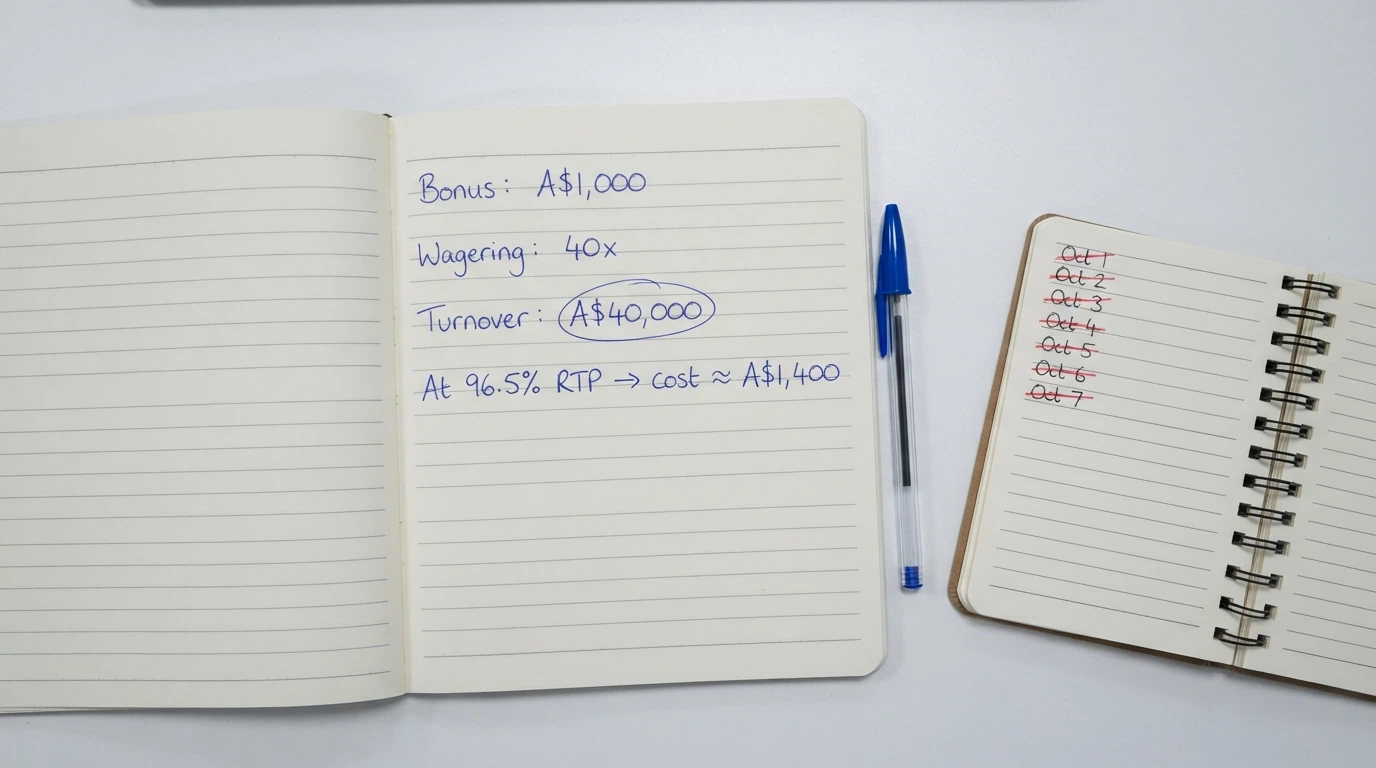
A 40x wagering multiplier on a A$1,000 bonus means A$40,000 of turnover before the bonus balance becomes withdrawable. At a 96.50% RTP pokie, the expected house-edge cost of that turnover sits around A$1,400 — the statistical average the player pays for the bonus in house edge during wagering. The free spin winnings, where they exist, are typically also wager-locked at 40x. Wild Fortune’s 0x-wagering free spins are the genuine outlier — winnings are cashable immediately, which is why the brand appears on this page twice.
The practical consequence: a player who accepts a bonus has committed to multi-day or multi-week playthrough before a withdrawal is possible. A player who declines the bonus (or plays at Stake, where the rakeback model has no wagering) keeps the pipeline fast. The marketing cost of “free money” is the locked-up balance, and the audit of that cost is the next section.
The Payment Methods That Decide Whether You Get Paid in Minutes or Days
| Payment Method | Deposit Speed | Withdrawal Speed | Fee to Player | Featured Operators |
|---|---|---|---|---|
| USDT-TRC20 (crypto) | Minutes | 0.2–8 hours | ~USD$1 flat | SkyCrown, Wild Fortune, Stake, BitStarz, BC.Game, King Billy, Rocket Play |
| USDT-ERC20 (crypto) | Minutes | Slower; depends on gas | USD$15–30 | Same as TRC20 by operator, network-dependent |
| Bitcoin / other crypto | Minutes | Variable | Network-dependent | SkyCrown, Stake, BitStarz, BC.Game, King Billy |
| PayID | Under 60 seconds | 25 minutes to 48 hours | None typical | SkyCrown, Wild Fortune, BitStarz, Neospin |
| E-wallets (eZeeWallet, Skrill, MiFinity) | Minutes | 1–2 hours | Operator-dependent | Neospin, King Billy |
| Card refund | Minutes (deposit) | 3–5 business days | None typical | Most operators for refund only |
| Bank transfer | Hours to 1 day | 1–3 business days | Bank-dependent | King Billy, others |
The table sorts roughly from fastest to slowest. The columns that earn their place are speed in both directions, fee, and which operators actually carry the rail — a column drops if no operator supports it.
PayID Withdrawals: Australia’s Home-Grown Speed Advantage
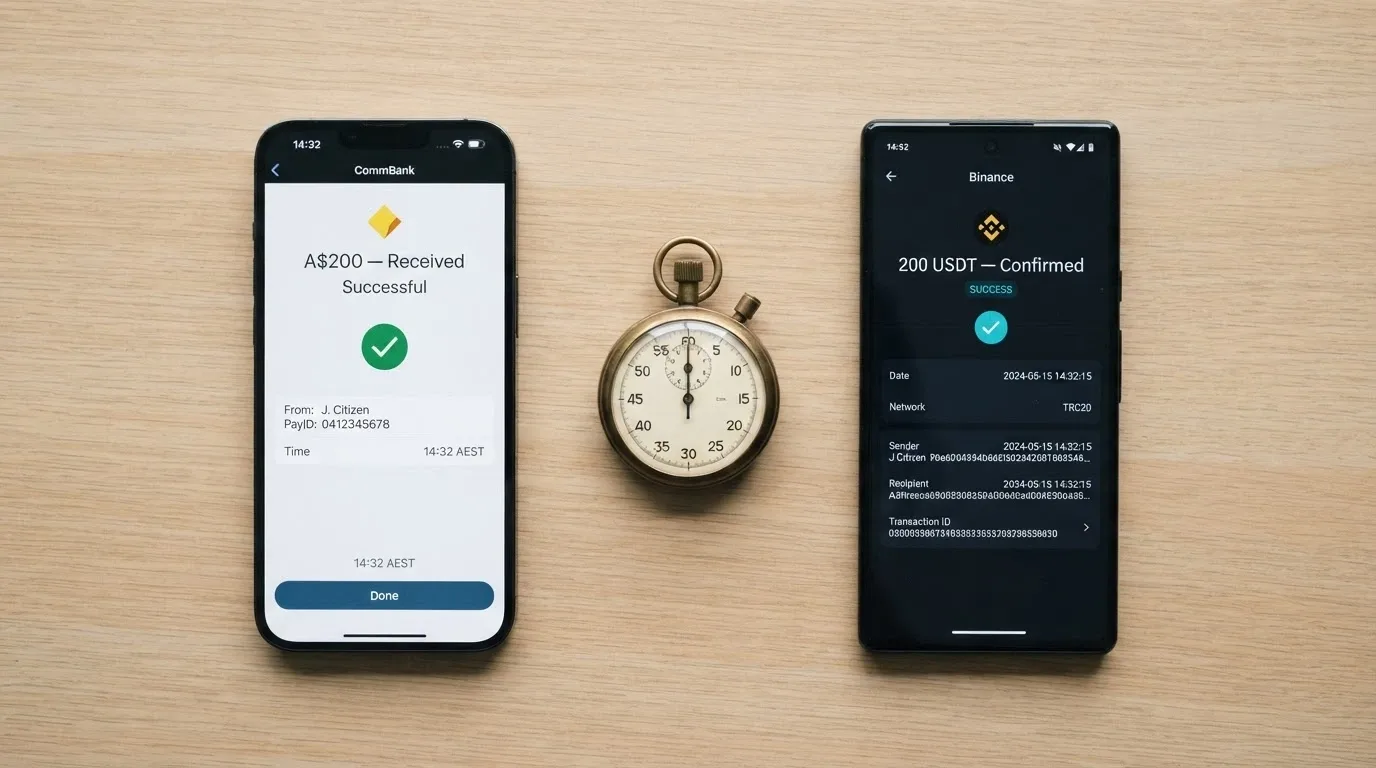
PayID is the Australian-specific advantage in the table. It runs on Osko and the New Payments Platform (NPP), the instant-settlement rails that Australian banks built over the past decade, and deposits credit in under 60 seconds at every verified casino tested. The rail is what makes PayID fast — the bottleneck is the operator, not the network.
The tested PayID numbers tell the operator story cleanly. SkyCrown’s median of 9 minutes across 14 cashouts suggests a fully automated internal stage. Neospin’s sub-two-hour average sits in the same band. Wild Fortune’s 26-hour average and BitStarz’s 38-hour average point to partly manual internal processing. The rail itself is not the variable; the operator’s queue is.
The PayID bonus that crypto does not carry is AUD denomination. A PayID withdrawal arrives in Australian dollars with no conversion step, no exchange spread, no wallet to manage. The cost is the operator dependency: a PayID cashout at Wild Fortune is a meaningfully different experience from the same cashout at SkyCrown, and the player cannot route around it.
Stake and BC.Game do not support PayID at all. Players at those brands commit to a crypto-only pipeline and accept the AUD-to-crypto conversion cost at both ends of every session.
Payout Limits, Timeframes and the Deposit-to-Withdrawal Reality
The typical minimum withdrawal at Australian-facing offshore casinos is A$20. Maximums vary by method and by operator — crypto rails generally carry the highest ceilings (set by the operator’s per-transaction cap, often A$5,000–A$10,000), and PayID sits somewhere in between. The minimum is rarely the binding constraint; the maximum can be, particularly on a single large withdrawal where the operator may split the cashout across multiple transactions to stay under per-transaction limits.
A constraint that catches players out is the deposit-to-withdrawal method mismatch. Some deposit rails do not support withdrawals at all — a credit card deposit, for instance, typically refunds to a different rail (often bank transfer or e-wallet) rather than back to the card. This matters more in the offshore context than in the licensed one, because credit cards have been banned for Australian-licensed wagering since 11 June 2024. An offshore operator that accepts credit cards is doing so outside Australian rules; the refund rail on the way out is part of that picture, and the player should expect it.
Processing-hour windows matter too. A withdrawal submitted at 6pm Friday may not begin the operator’s internal stage until Monday morning, and a withdrawal submitted on a public holiday will sit until the next business day. Crypto rails sidestep this entirely — the network runs continuously — but PayID, e-wallet, card and bank withdrawals all carry the receiving-side settlement constraint.
How a Welcome Bonus Can Turn Your Fast Withdrawal Into a Week-Long Wait
Bonuses are the single biggest obstacle to a fast withdrawal at the operators in this table. The headline number — “up to A$8,000” — is the marketing; the wagering multiplier — 40x — is the cost; the max cashout cap is the ceiling on what the bonus can actually return. Reading all three before depositing is the difference between a fast cashout and a multi-week commitment.
The wagering multiplier is the load-bearing number. SkyCrown’s 40x on both bonus and free-spin winnings; BitStarz’s 40x on all; Neospin’s 40x sticky on bonus money and 40x on free spins; WinSpirit’s 40x across a two-deposit structure with 7 days to wager once activated. FairGO’s 35x on no-deposit winnings is the gentlest in the table. Wild Fortune’s 45x on bonus funds is the steepest; its 0x on free spins is the genuine exception.
The math is what makes the headline number shrink. SkyCrown’s headline A$8,000 welcome package, taken at face value, is the largest bonus figure on this page. Worked through the standard assumption that only the bonus amount itself is wagered, the player must turn over A$320,000 to clear it (A$8,000 multiplied by 40). At Gates of Olympus — a 96.50% RTP pokie, meaning a 3.50% house edge — the expected cost of that turnover in house edge sits at approximately A$11,200 (A$320,000 multiplied by 3.50%). That is the statistical average the bonus costs during the wagering period. It is not the player’s loss on any single spin, and it is not the player’s win on any single spin; it is the long-run mean around which actual outcomes scatter.
The comparison is what makes the number land. The bonus is worth A$8,000 on the marketing page; the bonus costs A$11,200 in expected house edge during clearing. The arithmetic is the audit, and the audit reads the offer differently than the headline does. None of this is invented; every input is from the operator’s own terms page or the testing sources cited in the methodology section.
Wagering Requirements: The Hidden Brake on Your Withdrawal
The 40x multiplier is industry-standard at the operators in this table, which is itself the finding: there is no faster option, because faster is not the product. The bonus is structured to keep a balance at the casino long enough to extract the expected house edge, and 40x of turnover is the typical commitment that produces the expected return the operator is paying for.
For a player who treats the bonus as optional — declining the welcome offer and playing with real-money balance only — the wagering layer disappears entirely. The withdrawal pipeline reverts to the standard four-stage process. This is the path Stake is built around: no traditional welcome bonus, no wagering, no locked balance, and the fastest tested crypto payout average in the set.
The 0x-wagering free spins at Wild Fortune are the genuine outlier. Free spin winnings there are cashable immediately, with no playthrough. A player who values that structure will find no better option in the table — and a player who takes the bonus funds portion still faces the 45x, so the outlier is on the free-spin side specifically, not on the bonus-funds side.
Reading wagering terms before depositing is the difference between a fast cashout and a commitment the player did not sign up for. The headline number is the marketing; the multiplier is the cost.
No-Deposit Bonuses and Fast Withdrawals: What Is Actually Available
Only two of the ten operators reviewed here currently offer a documented no-deposit bonus. Both cap withdrawals from the offer at A$100.
BitStarz lists no-deposit free spins at A$0.20 per spin, with the same A$100 max withdrawal that no-deposit offers across the offshore market tend to carry. The spin value is low and the cap is hard.
FairGO lists an AU$10 no-deposit bonus plus 100 free spins on Sparkling Fortunes, with 35x wagering, a A$100 max cashout, and a 7-day validity. An AU$50 free chip is also listed.
The remaining eight operators do not have a verified no-deposit bonus this cycle. The structural reason is straightforward: no-deposit offers attract free-play traffic that does not convert to a deposit, and offshore operators prefer deposit-match bonuses that capture committed bankroll. The reader searching for a “no-deposit bonus at a fast-payout casino” is searching for a niche that is, in practice, two operators and A$100 maximums.
Crypto Withdrawals: Why USDT-TRC20 Is the Fastest Route for Australian Players
Crypto is the consistently fastest rail at offshore casinos serving Australian players, and USDT-TRC20 is the consistently fastest coin within crypto. The reason is structural: the network settles in minutes, the fees are flat regardless of amount, and the rail does not sleep on weekends or public holidays. The fastest single test across the dataset was a 1 minute 40 second USDT-TRC20 withdrawal from LuckyDreams. The fastest median in the featured set is SkyCrown’s 4 minutes via crypto.
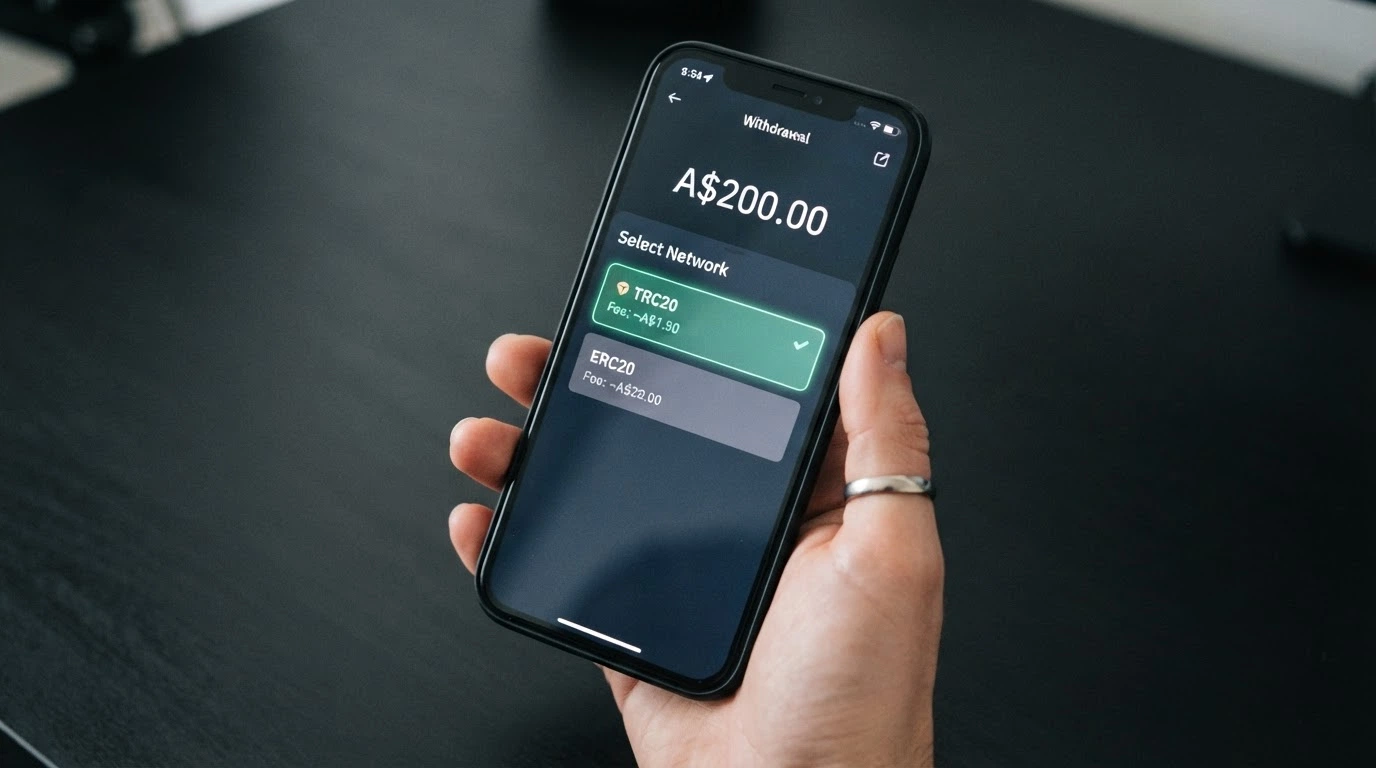
Bitcoin, ETH and other coins are supported at most featured operators, but they sit behind USDT-TRC20 on both speed and fee. Bitcoin block times average 10 minutes; Ethereum settlement varies with gas conditions; both can run into congestion at peak times. USDT-TRC20 runs on Tron, where block times are measured in seconds and the network fee is a flat ~USD$1.
The catch for Australian players is the AUD-to-crypto conversion step. Crypto balances are not Australian dollars; the player must acquire crypto through an exchange, transfer it to the casino wallet, and (on the way out) convert back. Each conversion carries an exchange spread and a withdrawal fee from the exchange itself. The TRC20 fee at the casino end is ~USD$1; the AUD-AUD round trip is rarely free.
USDT-TRC20 vs ERC20: The Network Fee Difference That Eats Your Withdrawal
The two dominant networks for USDT transfers carry radically different fee profiles. TRC20 (Tron) charges approximately USD$1 flat regardless of the transfer amount. ERC20 (Ethereum) charges USD$15–30 depending on gas conditions. At a USD$200 withdrawal, that difference is the gap between 0.5% friction (TRC20) and 7–15% friction (ERC20). At USD$2,000, the absolute gap is the same; the percentage gap narrows but remains meaningful.
The default network at most featured operators is TRC20 for USDT transfers, but the player should confirm before submitting the withdrawal. An accidental ERC20 transfer on a small withdrawal is a costly mistake; an accidental TRC20 transfer on a large withdrawal is the optimal path. The casino’s withdrawal screen typically defaults to the cheaper network for USDT, but the player should check, not assume.
Bitcoin, USDT and the Anonymity Question: What Crypto Delivers for Australian Players
Crypto withdrawals are not anonymous. Every transaction on a public blockchain is permanent and traceable. The casino still applies KYC at the account level regardless of the payment rail, and the exchange where the player acquires the crypto carries its own KYC obligations. What crypto delivers is speed, fee profile, and a rail that does not depend on Australian banking hours. It does not deliver privacy from the operator, from the exchange, or from any party with subpoena access to either.
USDT (a stablecoin pegged to the US dollar) eliminates the volatility risk that BTC and ETH carry. A USDT withdrawal is denominated in dollars and does not fluctuate between the cashout request and the wallet credit. BTC and ETH can move 5% in an hour; USDT does not. For a player who wants a stable payout amount in dollar terms, USDT is the right coin; for a player who is comfortable with volatility and wants to hold the asset, BTC or ETH may suit.
The other tell is the payment-method regulatory status. Credit cards and crypto are both banned for Australian-licensed wagering from 11 June 2024. An operator that accepts crypto from an Australian player is operating outside the Australian rules — which is the same statement this page has made about every operator in the table, but the crypto acceptance is the concrete confirmation. The Australian market has spoken on the rail; the offshore market has not.
The Pokies and Live Dealer Tables You Can Play at Fast-Paying Casinos
| Pokie Title | Highest Published RTP | Volatility | Provider | Max Win |
|---|---|---|---|---|
| Book of Dead | 96.21% | High | Play’n GO | 5,000x bet |
| Sweet Bonanza | 96.51% | High | Pragmatic Play | 21,100x bet |
| Gates of Olympus | 96.50% | High | Pragmatic Play | 5,000x bet |
| Big Bass Bonanza | 96.71% | Medium-high | Pragmatic Play / Reel Kingdom | 2,100x stake |
| Wolf Gold | 96.50% | Medium-high | Pragmatic Play | 2,500x bet |
The table lists only titles with published RTPs; the wider catalogue at each operator runs into the thousands. The columns that earn their place are the highest published RTP, the volatility class, the provider, and the max win figure. The RTP column shows the highest version; the version trap below explains why that matters.

High-RTP Pokies Worth Playing at Fast-Payout Casinos
The five titles in the table all carry published RTPs above 96%, which puts them above the typical online pokie average. The version the player actually plays is not always the highest published version — that is the trap. Pragmatic Play distributes multiple RTP versions of the same title: Wolf Gold ships in 96.50%, 94.50% and 92.50% variants, a spread of 4 percentage points between the best and worst version. Sweet Bonanza runs at 96.51%, 95.49%, 94.45% and 91.51% — the worst version pays back 91.51 cents on the dollar, which is meaningfully worse than the best. The operator chooses which version to run, and the player should check.
The in-game information screen on every regulated pokie shows the RTP version the casino has selected. The path is typically a help or info icon on the game interface; the figure sits in the game’s rules or paytable section. A player who does not check is playing a version chosen by the operator, which may be the best available or may not be.
Book of Dead at 96.21% sits slightly below the others; it has only one published version, so the trap does not apply. Big Bass Bonanza at 96.71% is the highest RTP in the table, with an adjustable RTP that the casino can configure. The five titles collectively appear across every featured operator’s library, though not every operator carries every title — the larger libraries (BC.Game at 7,000+ games, BitStarz at 6,000+ titles) cover the full set.
The Legal Reality Every Australian Casino Player Needs to Understand in 2026
Online casino is prohibited in Australia. The Interactive Gambling Act 2001 makes it an offence to provide online casino games, online pokies and in-play sports betting to a person in Australia. There is no licence for online casino anywhere in the country — not federally, not in any state or territory. Every operator on this page is offshore, and every one of them would be in breach of Australian law if it were physically present here. None holds an Australian casino licence because none can.
The individual player is not prosecuted. The IGA targets the provider, not the person using the service. That distinction has held since the Act’s commencement in 2001 and was confirmed by the 2017 strengthening amendments. The legal risk sits with the operator; the consumer-protection gap sits with the player.
What is licensed in Australia is narrower than most readers expect. Pre-event wagering on races and sport — placed before the event begins — is licensed through state and territory regimes, with the Northern Territory Racing and Wagering Commission (Licensing NT) acting as the de facto national licensor for online bookmakers. Lotteries and keno are licensed. Online casino, online pokies, and in-play betting are not. The 18-and-over age floor applies across all commercial gambling.
The minimum age is 18. The IGA permits a tightly limited set of products and prohibits the rest; the offshore market fills the gap that the licensed market leaves. Australian players reach the operators on this page because the operators reach them — through affiliate sites, through search advertising, through the offshore affiliate infrastructure that has grown up around the prohibition. Reaching them is not illegal for the player; the operator is the one breaking Australian law by serving them.
Why No Online Casino Holds an Australian Licence (and What That Means for You)
The Interactive Gambling Act 2001 prohibits the provision of online casino games to Australians. A licence is not available because the activity itself is prohibited — no regulator can issue a licence for a product the Act bans. The Australian Communications and Media Authority (ACMA) enforces the prohibition by investigating complaints, issuing formal warnings, initiating civil penalty proceedings, and directing Australian ISPs to block illegal sites. As of March 2026, 1,564 sites have been blocked since November 2019, and more than 225 illegal services have withdrawn from the Australian market voluntarily.
The consequence for a player is not a criminal one — prosecution targets the provider, not the user — but the consumer-protection gap is wide. An offshore casino is not subject to Australian consumer law. There is no Australian statutory dispute resolution. There is no Australian regulator to appeal to if the operator refuses a withdrawal. A site that is DNS-level blocked can vanish from the player’s access overnight with a balance still on it, and the balance is not recoverable through any Australian channel.
The IGA prohibition is the structural reason this page exists. If Australia licensed online casinos domestically, the withdrawal-speed question would be answered by Australian regulators and audited by Australian auditors. It is not, and they do not. The offshore market fills the gap, and the consumer protection that would normally attach to a licensed product does not travel with it.
The 2026–2027 Reform: What Changes for Australian Players
The Interactive Gambling Amendment (Gambling Reform) Bill 2026 passed Parliament on 19 August 2026. Its measures commence 1 January 2026. The reform affects four areas relevant to the offshore player.
Advertising restrictions begin with a cap of three wagering advertisements per hour between 6:00 am and 8:30 pm, and a live-sport blackout from 15 minutes before a live sporting event until 5 minutes after it ends. A phased three-year prohibition follows, leading to a comprehensive ban on wagering advertising subject to limited exemptions. Offshore casino advertising to Australians was already restricted; the reform tightens the licensed side and may push more affiliate traffic offshore in the short term.
Inducement prohibitions apply for 14 days after a customer’s signup, for three months after BetStop deregistration, and indefinitely for customers identified as at-risk of gambling harm. Direct marketing of sign-up bonuses, referral offers and similar inducements is restricted under these windows. Offshore operators are not subject to the inducement prohibitions in the same way licensed operators are; the restrictions apply to Australian-licensed marketing.
AdStop — a national wagering advertising opt-out register — will be administered by the ACMA and funded by a cost-recovery levy on wagering companies. The register applies to licensed wagering advertising; offshore casino advertising is outside the regime.
Bank transaction blocking is the change that most directly affects offshore play. From 1 January 2026, banks and payment providers gain express authority to block transactions to illegal gambling operators. The authority is not mandatory; each bank decides whether and how to deploy it. A withdrawal that worked in 2026 may stall in 2026 if the player’s bank adopts blocking aggressively. The structural risk to the offshore route is that the rail itself narrows.
None of this changes the offshore operator’s status. They remain outside Australian law. What changes is the rail through which an Australian player reaches them — and the ease with which a withdrawal can complete on the receiving side.
Staying Safe: The Responsible Gambling Tools That Work (and the One That Doesn’t)
Responsible gambling tools are real, and they work. They work, however, inside the Australian licensed system. Offshore casinos sit outside every domestic safeguard, and the most powerful Australian tool — BetStop — is the one that does not reach them. This section is the most concrete harm information on the page, because the offshore route carries a protection gap that no operator-level tool closes.
The national gambling-harm picture in 2026 is the reason this section is mandatory. Australians lost A$36.0 billion to gambling in the 12 months to March 2026, an increase of A$1.3 billion on the year before. The average per-adult loss sits at A$1,635 a year — the highest per capita in the world, against A$1,284 in Hong Kong and A$809 in the United States. An estimated 15.1% of Australian adults (around 3.32 million people) are experiencing some level of harm from their own or another person’s gambling as of March 2026. Risky gambling among adults rose from 13.7% in 2024 to 19.4% in January 2025 — almost doubling within a year, and almost doubling again against the COVID-era baseline.
These numbers are not abstractions. They describe the population this article reaches.
BetStop and Its Limits: Why Self-Exclusion Doesn’t Reach Offshore Casinos
BetStop is Australia’s National Self-Exclusion Register, live since 21 August 2023. A single registration excludes a person from every Australian-licensed online and phone wagering service — roughly 150 operators. Self-exclusion periods run from a minimum of three months to lifetime; 38% of registrants chose lifetime exclusion. As of 31 July 2026, BetStop had 67,480 total registrations and 41,290 active exclusions. 78% of registrants are under 40.
The structure is straightforward. One registration; all licensed operators; one removal process that requires a statutory declaration from a counsellor, psychologist or doctor and cannot be shortened by the person themselves. It is the most powerful responsible-gambling tool in the country.
The limit is the offshore gap. BetStop binds Australian-licensed wagering services. An offshore casino is not connected to the register and will keep accepting a self-excluded person’s money. The exclusion is meaningless at every operator on this page. A person who registers with BetStop and continues to gamble at offshore casinos is using the tool as if it covers their actual play, and it does not. This is the single most actionable piece of information in this section: if you use BetStop, do not play at offshore casinos, because the exclusion does not reach them.
The 2027 reform extends the inducement prohibition to three months after BetStop deregistration, which tightens the licensed side but does not extend BetStop’s reach. The offshore gap is structural, not a bug in the register.
Practical Tools: Deposit Limits, Session Timers and Where to Get Help
- National Gambling Helpline: 1800 858 858. Free, confidential, staffed 24 hours a day, 7 days a week. The first call for anyone whose gambling has stopped being recreational.
- Gambling Help Online: gamblinghelponline.org.au. Online chat, email counselling, and self-help resources. Available 24/7.
- Operator-level deposit limits. Daily, weekly and monthly limits are available at most featured operators. Set them before the second deposit, not after the first withdrawal request.
- Session time reminders and reality checks. Most operators offer configurable reminders during play. They are not as powerful as a hard limit, but they are a step above no tracking at all.
- Operator-level self-exclusion. Separate from BetStop. Available at every featured operator; the exclusion applies only at that operator, not across the set.
- State-based services. GambleAware (NSW), Gambling Help (QLD), and equivalent services in each state. Local, free, and confidential.
If any of the harm statistics on this page — the A$36.0 billion, the 15.1% prevalence, the 19.4% risky-gambling figure — describe someone reading this, the helpline is the right next step. The number is free; the call is confidential; the service runs around the clock.
How We Evaluated Every Fast Withdrawal Casino on This Page
The data on this page comes from tested cashout records, not operator self-reporting. The primary sources are PayoutVerdict (tested withdrawal times across multiple cycles per operator), SlotsPeak (the cross-operator 217-cashout dataset that produced the fastest single test result), PokiesAustralia (PayID deposit and withdrawal benchmarks), GamblingInsider (bank and card rail data), and Australian Gamblers, NewCasino.ai, CryptoWatchdog and CasinoAudit for operator-specific bonus and game-library figures. Licence claims were cross-checked against the ACMA’s blocked-sites list and against the operator-stated licence jurisdictions in the Tobique Gaming Commission and Curacao eGaming registers.
What was checked at each operator: withdrawal speed via real tested cashouts (not operator-claimed times); bonus terms and wagering multipliers from the operator’s own terms pages; KYC friction (front-loaded vs back-loaded, document turnaround, re-verification thresholds); payment method availability (PayID, crypto coins and networks, e-wallets, card, bank); game library depth; and the licence jurisdiction stated by the operator. The ranking logic sorts by tested withdrawal speed first, with bonus fairness and KYC friction as secondary filters.
The limitations are stated in the table. Two operators — WinSpirit and FairGO — did not have independently tested withdrawal times this cycle, and the table notes that gap rather than filling it with an estimate. Bonus terms at BC.Game and King Billy were not fully specified in the testing sources; readers should verify on the operator’s own site before depositing. Licence jurisdictions at Neospin, WinSpirit, Rocket Play and FairGO were not confirmed from the regulator’s own register this cycle; the table labels those rows “jurisdiction not confirmed” rather than guessing.
Every operator on this page is offshore and unlicensed in Australia. That statement is made at the top of the article, in the table, in every operator write-up, and in the legal-reality section. It is the structural feature of the market this page covers, and naming it plainly is more useful to a reader than burying it in a footnote.
Your 2026 Fast Withdrawal Strategy: What to Do Next
The article has laid out tested speeds, bonus traps, payment rails, legal realities and harm statistics. The decision framework the reader takes from it is three moves, not a brand recommendation.
First, choose the payment method before choosing the operator. USDT-TRC20 is the fastest rail across the tested set; PayID is the AUD-native alternative with operator-dependent speeds. The fastest single test in the dataset was 1 minute 40 seconds via crypto; the fastest median was 4 minutes at SkyCrown. If speed is the binding priority, route through USDT-TRC20 at a front-loaded-KYC operator. If AUD denomination matters more, route through PayID at an operator with a tested sub-30-minute median. The two paths are not interchangeable.
Second, decide on the bonus before depositing. A 40x wagering requirement on a A$1,000 bonus is A$40,000 of locked turnover, with an expected house-edge cost of A$1,400 at a 96.50% RTP pokie. The bonus is the marketing; the wagering is the cost. A player who wants a fast withdrawal declines the bonus, plays with real-money balance, and routes the cashout through the fastest available rail. A player who wants the bonus value accepts that the withdrawal pipeline sits behind the wagering commitment.
Third, accept the structural cost. Every operator on this page is offshore. None is subject to Australian consumer law. None participates in BetStop. None can be compelled by an Australian regulator to release a disputed balance. The decision to play offshore is the reader’s, made with full information about what consumer protections do not apply.
The harm statistics on this page are not warnings to ignore. A$36.0 billion lost in 12 months; 15.1% of adults experiencing harm; 19.4% risky gambling rate. If the reader is at any point on that spectrum, the National Gambling Helpline is 1800 858 858, free and confidential, 24/7. Gambling Help Online is gamblinghelponline.org.au. The tools exist; they work; they are listed in the responsible-gambling section above.
The rest is arithmetic. The fastest-tested withdrawals on this page clear in minutes. The slowest take days. Bonuses slow everything down. Crypto is fastest, PayID is most convenient, no-KYC setups are rare and limited. The reader chooses which trade-off matches their situation, and the page has given them the numbers to do it.
Frequently Asked Questions
What is the fastest withdrawal method at Australian online casinos?
USDT-TRC20 is the fastest withdrawal method at Australian-facing offshore casinos in 2026. Tested times across the dataset range from 0.2 hours to 8 hours depending on the operator, with the fastest single test at 1 minute 40 seconds. PayID is the fastest AUD-native method, with tested medians from 9 minutes (SkyCrown) to 38 hours (BitStarz), depending on the operator’s internal processing.
How long does a PayID withdrawal take at offshore casinos in 2026?
PayID withdrawals at offshore casinos in 2026 range from 25 minutes to 48 hours depending on the operator. The rail itself is fast — PayID deposits credit in under 60 seconds — but the operator’s internal processing stage is the binding constraint on withdrawals. Tested medians: SkyCrown 9 minutes, Neospin under 2 hours, Wild Fortune 26 hours, BitStarz 38 hours. The operator matters more than the rail.
What is the difference between crypto and PayID withdrawal speeds?
Crypto (USDT-TRC20 specifically) is faster on average and on the fastest single tests — minutes to ~8 hours, with the fastest tested at under 2 minutes. PayID is slower (25 minutes to 48 hours) but AUD-native: no conversion step, no exchange spread, no crypto wallet to manage. Crypto requires AUD-to-crypto conversion at both ends of every session. The trade-off is speed and fee profile (TRC20 is ~USD$1 flat) against convenience and denomination.
What is the minimum withdrawal amount at Australian online casinos?
The typical minimum withdrawal at Australian-facing offshore casinos is A$20. Exact minimums vary by operator and payment method; crypto rails sometimes carry different minimums than PayID or e-wallets. The minimum is rarely the binding constraint on a withdrawal; the operator’s per-transaction maximum and the wagering requirement on bonus funds are the constraints that matter more.
Which casino has the fastest tested crypto withdrawal in Australia?
Among the operators reviewed on this page, SkyCrown has the fastest tested crypto median at 4 minutes via USDT-TRC20, with the fastest single PayID withdrawal at 2 minutes 10 seconds. Stake’s tested crypto average was 1 hour 50 minutes across four cycles — the fastest multi-cycle average in the set. The fastest single test across the broader 217-cashout dataset was 1 minute 40 seconds at LuckyDreams.
Are credit card deposits banned at Australian gambling sites?
Credit cards and credit-related products are banned as payment for online wagering with Australian-licensed operators from 11 June 2024, under the Interactive Gambling Amendment (Credit and Other Measures) Act 2023. Crypto is also banned for licensed wagering. An offshore casino that accepts credit cards or crypto from an Australian player is doing so outside the Australian rules — which is consistent with the offshore status of every operator on this page.
No-Verification Withdrawals: Do They Really Exist in 2026?
They almost do, at one operator on this page. King Billy states that verified accounts face no additional KYC at withdrawal — a setup closer to a true no-friction cashout than any other brand in the table. The closest runners-up are SkyCrown (front-loaded KYC, 4-hour document clearance at signup) and Stake (re-verification only at EUR €4,000+ cumulative withdrawals).
The reason “no KYC” is a marketing word rather than a product category is that every operator must meet anti-money-laundering obligations in the jurisdiction that issues its licence. “No KYC at withdrawal” in the offshore context means “KYC done once at signup, no further verification per transaction” — not “no verification ever”. Australian players face more friction, not less, because the offshore route skips the Australian compliance layer; the operator’s home-jurisdiction AML rules still apply.
The trade-off is between speed and certainty. A no-KYC withdrawal is faster because the verification stage is collapsed into signup. A heavily-verified withdrawal is slower at first, but the operator’s records are more likely to survive a regulatory inquiry if a dispute arises. Neither path is Australian-law enforceable; that is the structural cost of the offshore route, and the section on the legal reality takes it apart.
Live Casino Withdrawals: Do Table Game Wins Clear Any Faster?
No, and the bonus terms make live play materially worse for clearing wagering. The withdrawal pipeline does not change based on which game produced the win — the four-stage structure (internal processing, KYC, rail execution, receiving-side settlement) is identical whether the win came from Gates of Olympus or a live blackjack hand. Speed is method-dependent, not game-dependent.
The friction is in the wagering contribution. Most welcome bonuses weight slots at 100% toward wagering clearance — a A$1 spin counts A$1 toward the A$40,000 turnover at SkyCrown — but live table games often contribute 10–20% or are excluded entirely. A A$1 live blackjack hand might count A$0.10 toward the same turnover, or nothing at all. A player who wants to clear a bonus while playing live casino is committing to ten times (or more) the play volume they would need at slots.
The specific live-dealer game-weighting percentages were not available in this cycle’s testing for most featured operators; readers should check the operator’s own bonus T&Cs before assuming live play counts toward wagering. The practical advice is the same one the bonus section makes: play live casino with real-money balance, not bonus funds, unless the terms specifically support it.