
Where the High-Roller Bonus Numbers Actually Land
High roller is a sliding scale. The label sits on a minimum-deposit threshold rather than a regulatory category, and at the offshore casinos that people in the country use, the entry point is A$200–A$500 with bonuses that climb to A$8,000. The bankroll behind those numbers is the real story. A player putting A$100 a spin through a high-volatility pokie needs 250–500 base bets to survive a normal session — a A$25,000 to A$50,000 balance before the first spin. None of the ten operators on this page hold an online casino licence from the country, as no such licence exists. The Interactive Gambling Act 2001 prohibits online casino outright.

Data current as of 16 October 2026; bonus and enforcement status checked against the ACMA’s illegal-gambling enforcement list.
Table of Contents
- What a High Roller Casino Actually Looks Like in 2026
- The 10 Offshore Casinos Australian High Rollers Actually Use in 2026
- Why Your 2026 High-Roller Bonus Is Smaller Than It Looks
- High-Stakes Pokies: Where A$25+ Spins Meet Volatility
- How High Rollers Move Money When Credit Cards Are Banned
- High-Roller Casino Apps: What You Actually Get on Mobile
- The Legal Reality: Why Every High-Roller Casino Is Offshore
- Playing Big Without Letting the Game Play You
- How We Evaluated and Ranked These High-Roller Casinos
- Is a High-Roller Casino Bonus Worth the Risk in 2026?
- Frequently Asked Questions
What a High Roller Casino Actually Looks Like in 2026
What “High Roller” Means in Dollar Terms
A high-roller casino is not a category an operator brands — it is a deposit threshold. Market convention sits at A$200–A$500 minimum deposit to unlock the larger welcome tiers, with bonuses ranging from A$1,000 to A$5,000 as the typical band. The package scales up from there: SkyCrown’s headline runs to A$8,000 across four deposits; Dazard lists A$7,500; Rolling Slots A$6,400. The threshold is the gate, not the bankroll.
The bet size that follows is what separates a high roller from an ordinary punter. A$25 a spin is the floor — the level at which volatility starts to mean something in dollar terms. At A$25 a spin, a session of 200–400 spins (the minimum stress test for a high-volatility pokie) burns through A$5,000–A$10,000 before the variance has a chance to even out. The bankroll depth has to match the bet, not just the deposit bonus.
Bankroll depth is where most first-time high rollers miscalculate. A 100–150 base-bet bankroll is the standard guideline for low-volatility pokies; for high-volatility titles it stretches to 250–500 base bets. A player with A$10,000 backing A$100 spins holds only 100 base bets, while a player with A$500 backing A$1 spins holds 500 base bets. The smaller bankroll is technically deeper, and gets more spins through a session despite risking less per spin.
How a High-Roller Casino Works Online
The on-ramp for an Australian player is the same as for any other market, with one critical exception: every step happens offshore. Account registration, KYC verification, deposit and bonus activation all run through a Curacao-, Anjouan- or Kahnawake-licensed operator that holds no Australian wagering licence. The Australian Communications and Media Authority enforces the prohibition, and the player’s recourse if a withdrawal is delayed or a win is voided is whatever complaint process the operator publishes in its terms.
The first practical tell is the deposit page. Credit cards and crypto have been banned as payment methods for online wagering in Australia since 11 June 2024, with penalties of up to A$247,500 for non-compliance by the operator. An Australian player who sees Visa, Mastercard or Bitcoin on a casino’s cashier page is therefore looking at an offshore site. Legal AU deposit routes — debit card, bank transfer, PayID/Osko, BPAY — exist for licensed wagering, and offshore operators may offer some of these through intermediary payment processors, but the credit-card and crypto presence remains the cleanest indication the site is operating outside Australian rules.
Bonus activation runs the standard offshore pattern: opt in or accept at the cashier, deposit at or above the minimum, the bonus lands on the balance. From there the wagering requirement is what governs the bonus, not the player’s choice of game. The individual player is not prosecuted under the Interactive Gambling Act — that targets the provider, not the punter — but the consumer-protection gap is real. As the ACMA warns, even if an offshore service looks legitimate, it is unlikely to have the customer protections Australian-licensed wagering carries.
Real-Money Play and the Bankroll Reality
The financial commitment behind high-roller play is what most comparison pages leave out. Real-money high-stakes play demands a bankroll sized to absorb variance, not just a deposit large enough to clear the bonus threshold. At A$25 a spin on a high-volatility pokie, the realistic session budget is A$5,000–A$10,000. At A$100 a spin, the bankroll that survives the variance is A$25,000–A$50,000.
The base-bet rule makes the gap visible. For low-volatility pokies, 100–150 base bets is the typical guideline. For high-volatility titles, 250–500 base bets. The arithmetic on a A$10,000 balance at A$100 a spin gives 100 base bets — shallow for high volatility, deep for low. The same A$10,000 at A$10 a spin gives 1,000 base bets, which is twice the upper guideline. The bigger bet is not the more durable session. It is the more fragile one.
A stress test of 200–400 spins at standard bet is the working minimum. At A$5 a spin, plan A$1,000–A$2,000. At A$25, A$5,000–A$10,000. At A$100, A$20,000–A$40,000. Players who fund only the deposit bonus have not funded the play — they have funded the entry fee, and the variance eats the rest.
The 10 Offshore Casinos Australian High Rollers Actually Use in 2026
Every brand below operates outside Australian online gambling rules. The Interactive Gambling Act 2001 prohibits online casino in this country; the ACMA has had 1,788 illegal gambling and affiliate sites blocked by Australian ISPs as of August 2026; and over 230 illegal services have withdrawn from the market since 2017. The ranking here reflects bonus value, wagering fairness and game-provider depth — not legality, which is uniform across the table.

| Operator | Welcome Bonus (A) | Free Spins / No-Deposit Offer | |—|—|—|—|—| | SkyCrown | 8,000 + 400 FS | 40 | 10 (HR) | 400 FS | | RocketPlay | 500 + 100 FS + 500 | 40 | 7.50 | 100 FS on Aztec Magic | | Rolling Slots | 6,400 + 750 FS | 45 | — | 750 FS | | Fair Go | 1,000 (5 × 200) | 30 | — | A$15 no-deposit chip | | LEON BET | 4,500 (3 deposits) | — | — | — | | Royal Reels | 500 | 30–40 | — | A$10 no-deposit | | WinSpirit | 200% match | 20–40 | — | 25 FS | | Rainbet | 700 | 40 | 2% of deposit | FS on Sweet Bonanza | | Bizzo Casino | — | 40 | 5 | 30 FS no-deposit | | Stake | — | — | — | — |
Em dashes mark the cells research did not confirm this run. The gaps are the point — a player reading the table can see which operators publish their terms and which do not.
SkyCrown — The 450% Welcome Giant with Short Fuse
The largest raw welcome package in the Australian-facing offshore set sits at SkyCrown: 450% up to A$8,000 plus 400 free spins, spread across four deposits. The first deposit alone is 120% up to A$1,200 with 125 free spins on Wolf Treasure by IGTech. The headline is a marketing figure, not a cashable one. Wagering is 40x on the bonus, 30x on free-spin winnings, with a A$10 maximum bet during the high-roller bonus playthrough. Standard bonuses get A$7.50 and 14 days; the high-roller tier drops to 5 days.
The short fuse is the catch. Five days to clear A$8,000 × 40x = A$320,000 in turnover is a play schedule most recreational bankrolls cannot sustain. SkyCrown caps bonus-to-cash conversion at A$5,000 per welcome bonus, which means even a successful clearance converts up to roughly five-eighths of the headline. The game roster covers 40+ providers including Pragmatic Play and Evolution, which gives a high roller somewhere to put the volume.
For a player who funds the wagering in one continuous session and is content converting up to A$5,000 in bonus cash, SkyCrown’s package is the headline leader of this set. For everyone else, the 5-day window makes the bonus effectively a deposit-match with extra steps.
RocketPlay — Dama N.V.’s Recurring High-Roller Reload
RocketPlay splits its welcome across two deposits — 100% up to A$500 plus 100 free spins on the first, 200% up to A$500 on the second — for a combined A$1,000 ceiling. That is modest against the A$6,400–A$8,000 packages higher up the table. What RocketPlay offers that the others do not is a recurring high-roller bonus: 50% up to A$2,500 on deposits of A$300 or more. For a high roller making repeated deposits, the reload is where the operator earns its keep.
The terms are ordinary for the market. Wagering sits at 40x, max bet during wagering at A$7.50, validity at 5 days. The 100 free spins drop on Aztec Magic by BGaming in batches of 20 per day over 5 days, with a A$300 max win from the spins. The operator group is Dama N.V., and the ACMA issued formal warnings to Dama in Q4 2025 for prohibited and unlicensed services under other brand names — RocketPlay itself does not appear on the published warning list, but the group context matters.
The reload makes RocketPlay the right choice for a high roller who plans to deposit more than twice. A single deposit elsewhere on this list beats a single deposit here; four deposits here beat four deposits almost anywhere else in the set.
Rolling Slots — 750 Free Spins and a 45x Hurdle
The free-spin count in Rolling Slots’ welcome is the highest in the table: 750 free spins on the high-roller route, 650 on the standard route. The matched deposit runs to A$6,400 across four deposits, with a dedicated high-roller first-deposit tier at 100% up to A$1,800 plus 300 free spins from a A$450 minimum. The headline number is real, and the free-spin drip is the kind of figure that wins the comparison-trap click.
The wagering requirement is also the steepest in the set, at 45x. For an A$1,800 high-roller deposit that is A$81,000 in turnover before withdrawal, on a 5–14 day window the operator does not pin down publicly. The 10% weekly cashback up to A$300 at 30x wagering softens the loss rate for ongoing play — VIP cashback drops to 20x — but it does not move the welcome’s clearance math.
Rolling Slots suits a player who values free-spin volume over cash conversion and is willing to grind the 45x multiple. A player who converts bonus to cash at speed is paying for the spin count.
Fair Go — RTG-Only Australian Specialist with 30x Wagering
Fair Go is the lowest-wagering operator in the set: 30x on deposit plus bonus across a five-deposit welcome of 100% up to A$200 each, for A$1,000 total. No other operator here publishes a 30x headline. The brand is positioned at Australian players specifically — the site is anglicised, the AUD is the default currency — and the game library is RealTime Gaming exclusively. RTG is a single provider with a back catalogue of pokies and table games; it is not the breadth of a 40-provider casino, but the games are familiar to long-time AU-facing players.
The no-deposit offer sits on the other end of the spectrum. A$15 free chip at 60x wagering with a A$180 max cashout — and wagering contributes only on RTG pokies. The 60x multiple is well above the roughly 35x industry average for no-deposit bonuses, which makes the A$180 cashout ceiling effectively a sample rather than a starter bankroll.
Fair Go is the right pick for a player who values the lowest welcome wagering on this page and is comfortable inside the RTG catalogue. The A$15 free chip is not a bankroll builder — it is a sample of the platform on the operator’s terms.
LEON BET — A$4,500 Tiered Welcome, Domain Already Blocked
LEON BET’s headline runs to A$4,500 across three deposits: 100% up to A$500, then 70% up to A$1,000, then 150% up to A$3,000. The third-deposit match is unusually large for this market, and the escalating structure rewards a player who returns for the second and third legs of the package. Game-provider depth and bonus-terms specifics were not confirmed in this run’s research, so the wagering multiple, max bet and validity window are not stated here.
The ACMA blocked the Leon domain in February 2025. Whether the current operator is reachable from an Australian IP depends on the exact mirror in use, and access can end without notice.
The wagering gap is the bigger problem than the access risk. A welcome package is only as valuable as the multiple it carries, and that figure is not confirmed for the current offer. A high roller who can verify the terms on the live site before depositing can make a real comparison; everyone else is reading a headline without the multiplier.
Royal Reels — 30+ Providers and a Modest A$500 Match
Royal Reels’ welcome is straightforward: 100% up to A$500 from a A$30 minimum deposit, with a A$10 no-deposit sweetener on sign-up and wagering in the 30–40x band. No free spins in the standard welcome, but the no-deposit chip is the same play-money the bigger brands hide behind welcome packages.
The library lists 30+ providers — Pragmatic Play, Evolution, Yggdrasil, Hacksaw Gaming among them — which is breadth most of the rest of the table does not match. For a player who weighs game-provider depth over headline bonus size, Royal Reels is the strongest library play in this set.
The trade-off is the matched-deposit ceiling. A$500 against SkyCrown’s A$8,000 is roughly a sixteenth of the headline; against Rolling Slots’ A$6,400 it is a thirteenth. The lower wagering band (30–40x) compresses the turnover gap, but does not close it. Royal Reels is for a player who values the catalogue and is happy to redeposit rather than chase the headline.
WinSpirit — 200% Match and a Wide Wagering Range
WinSpirit’s 200% welcome bonus plus 25 free spins is on the more generous side of the percentage match — but the wagering is published as a 20–40x range rather than a confirmed single figure, and the validity window sits in the 7–14 day band. The percentage is the marketing word; the multiplier is the math.
The range matters because it changes the turnover by a factor of two. At 20x, an A$1,000 deposit at 200% match clears at A$60,000 in turnover. At 40x, that becomes A$120,000. The operator does not pin the figure down publicly in this run’s research, and the reader who lands at the top of the band pays double the player who lands at the bottom.
WinSpirit is a value proposition whose value depends on a number the operator has not locked down. A high roller who can read the live bonus terms before depositing will know exactly what they are buying. A player who reads the headline alone is buying a coin flip.
Rainbet — Anjouan-Licensed with Provably Fair Originals
Rainbet is the only operator in the set with a visible offshore licence: Anjouan, under ALSI-152406029-FI2. Its first-deposit promotion runs to A$700 from a A$30 minimum at 40x wagering, with free spins on Sweet Bonanza and a max-bet rule that is unusual for the table — 2% of the deposit amount, not a flat dollar cap. A A$700 deposit gives a A$14 max bet; a A$300 deposit, A$6. The library includes Rainbet Originals, a small suite of provably fair titles whose outcomes the player can verify on-chain.
The 2% rule is a smarter structure than a flat cap, but it produces a smaller max bet at exactly the deposit level most casual players use. The A$700 max is also well below the A$1,000–A$8,000 range the rest of the table competes on. Rainbet is the right pick for a player who values a visible licence and provably fair games over matched-deposit size; it is not the right pick for a player whose entry ticket is the bonus ceiling.
Bizzo Casino — A$5 Max-Bet Hard Line
Bizzo’s wagering sits at 40x with a A$5 maximum bet during wagering — the strictest cap in the set, and strictly enforced. Players have reportedly had winnings voided over a single A$6 spin during the bonus playthrough. The 30-free-spin no-deposit offer at 40x wagering is valid until December 2026, which gives a clear window for sampling without committing a deposit.
The welcome bonus amount was not confirmed in this run’s research, so the matched-deposit comparison cannot be drawn. What can be said is that the max-bet ceiling is the lowest dollar figure on the table and the enforcement is the most punitive.
Bizzo is for a player who reads the bonus terms line by line and never lets a spin stray above A$5. For everyone else, the enforcement risk is real.
Stake — 1.28% AU Market Share, Bonus Terms Not Confirmed
Stake holds 1.28% of the Australian-facing market share among operators in the AU operators skill — the largest market presence on this list. The wagering, max-bet and bonus terms for the current high-roller offer were not confirmed in this run’s research, so the comparison column is empty.
The market position is the data point. A 1.28% share at a market where each operator holds zero legitimate footprint is a measure of brand reach, not legality. A player comparing offers on this page should treat the empty cells as a flag to verify the terms on the live site before committing.
What “Best” Means When Every Option Is Offshore
The ranking on this page weighs bonus size, wagering fairness, max-bet ceiling, game-provider depth and regulatory visibility. The legal status of every operator here is uniform: offshore, unlicensed in Australia, reachable only because Australian ISPs have not been directed to block the domain. The comparison table ranks them by what they offer, not what they are licensed to offer — because no row in this table is licensed to offer anything in Australia.
The terms vary widely enough that the ranking is not a draw. Fair Go’s 30x wagering is the lowest in the set; Rolling Slots’ 45x is the highest. SkyCrown’s A$8,000 is the largest headline; Royal Reels’ A$500 the smallest. Rainbet’s Anjouan licence is the only visible regulator; Bizzo’s A$5 max bet is the strictest ceiling. The columns a player cares about — wagering, max bet, terms — change more between rows than the legal status does.
Why Your 2026 High-Roller Bonus Is Smaller Than It Looks
The marketing word is “bonus”. The mathematical word is “expected loss”. For SkyCrown’s A$8,000 welcome at 40x wagering and the industry-standard 96.0% RTP, the required turnover is A$320,000, and the house edge on that turnover at 4% gives an expected loss of A$12,800. The expected cost of clearing the bonus is 1.6 times the bonus amount itself. A player who reads the headline and skips the math is paying a 60% premium above the bonus to clear it.
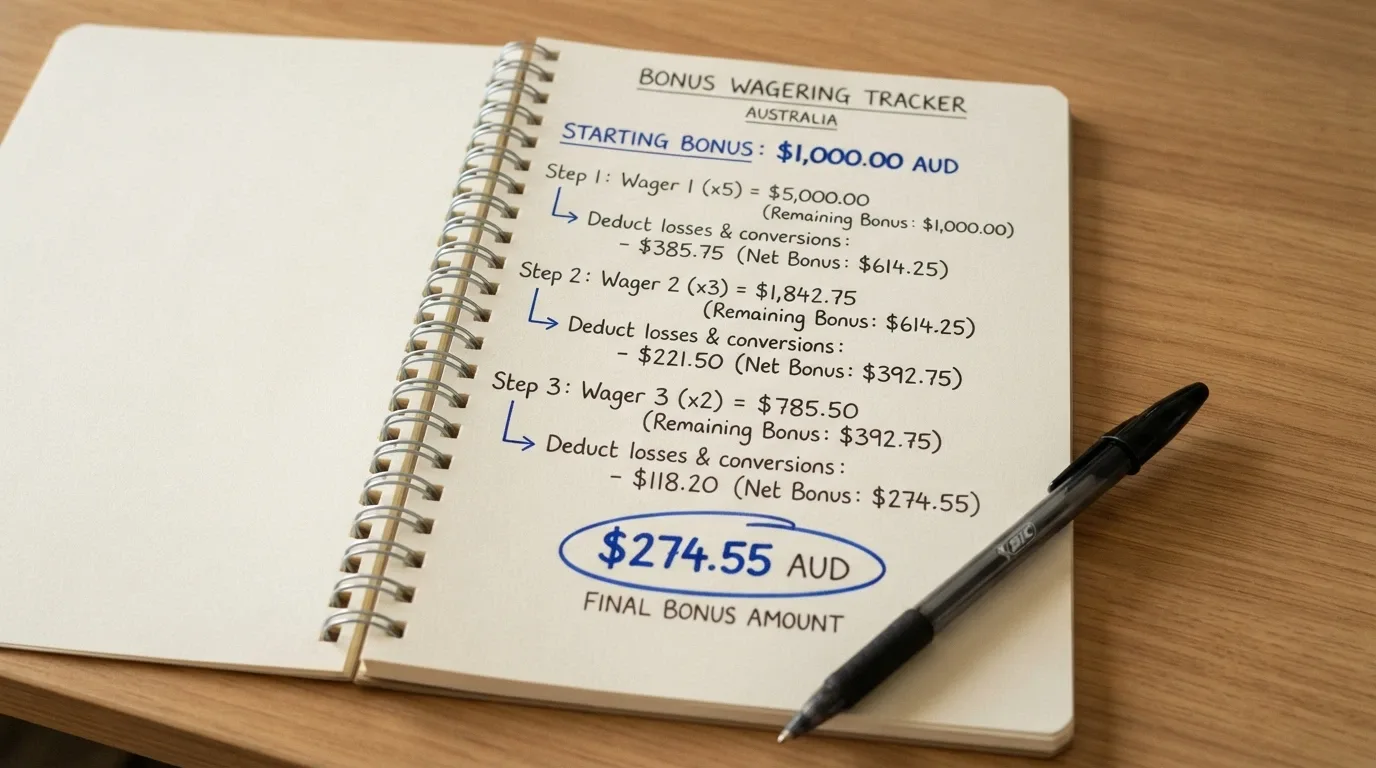
The same arithmetic applies at every wagering multiple in the table. At 30x on a A$1,000 bonus, turnover is A$30,000 and expected loss is A$1,200. At 45x on A$1,800, turnover is A$81,000 and expected loss is A$3,240. The wagering multiple is the dial; the bonus amount is the multiplier on that dial. The headline climbs, but the expected loss climbs faster.
Welcome Deposit Matches at High-Roller Scale
The headline range across the table runs from Royal Reels’ A$500 to SkyCrown’s A$8,000, with most operators clustering between A$1,000 and A$5,000. Match percentages vary from 100% (the standard) to 450% (SkyCrown’s headline) and 200% (WinSpirit). The A$200–A$500 minimum-deposit gate is the entry ticket at the top end, with Rolling Slots’ A$450 high-roller tier at the upper boundary and Vegazone’s A$750 minimum at the highest published.
The percentage match is half the story. A 100% match on A$1,000 gives A$1,000 in bonus; a 200% match on the same deposit gives A$2,000; a 450% match on roughly A$1,778 gives the A$8,000 SkyCrown ceiling. Each tier requires a larger deposit to enter and carries a heavier turnover requirement. The headline scales, but so does the expected cost.
| Offer Type | Typical High-Roller Range (A$) | Wagering (×) | Max Cashout / Win Cap | Typical Validity |
|---|---|---|---|---|
| Matched deposit welcome | 1,000–8,000 | 30–45 | 5,000 (SkyCrown) | 5–14 days |
| High-roller reload | up to 2,500 | 40 | — | 5 days |
| No-deposit bonus | 5–25 chip | 30–60 | 150–180 | 7–14 days |
| Free spins | 100–750 spins | 30–40 (winnings) | 50–300 per batch | drip 20/day |
| Cashback | 10% up to 300 | 30 (20x VIP) | — | weekly |
The cashout cap on SkyCrown’s A$5,000 per welcome bonus is a structural ceiling most operators do not publish. It means even a successful clearance of an A$8,000 bonus converts up to A$5,000 in cash. The remaining A$3,000 is bonus value that disappears at conversion.
No-Deposit Bonuses: Tiny Chips, Big Wagering
The no-deposit offer at Fair Go — A$15 free chip at 60x wagering with a A$180 max cashout, on RTG pokies only — illustrates the segment’s economics. The chip is the smallest unit in the table; the wagering is the highest; the cashout ceiling is one to two times the chip value. At 60x on A$15, the required turnover is A$900, and at the typical 96% RTP the expected loss on that turnover is A$36 — more than double the chip itself.
The 60x wagering sits well above the roughly 35x industry average for no-deposit offers. Fair Go’s chip is sampling a platform, not building a bankroll. A$180 cashout at the upper end is the realistic ceiling, and most players will not reach it because the variance eats the chip before the wagering completes.
No-deposit bonuses across the set follow the same shape: A$5–A$25 chip, 30x–60x wagering, A$150–A$180 max cashout. They are loss-leaders for the operator and arithmetic traps for the player. The right framing is platform sample, not starter bankroll.
Free Spins for High Rollers: Volume vs Real Value
Rolling Slots’ 750 free spins is the headline figure in the table; SkyCrown’s 400 the second; RocketPlay’s 100 the third. The drip delivery — 20 per day over five days at RocketPlay — stretches the play window and bounds the volume. A player cannot sit down and burn through 750 spins in an evening.
Wagering on free-spin winnings runs at 30x (SkyCrown) to 40x (LevelUp). The win cap per batch is the second constraint: A$300 at RocketPlay, A$50 at LevelUp, A$1,000 at LevelUp on standalone free spins. The cap converts a 21,100x max-win pokie into a A$50–A$1,000 ceiling per batch, regardless of what the spin lands.
The arithmetic: 750 free spins at average 96% RTP and a modest A$1 nominal stake per spin is A$750 in turnover. At 4% house edge, expected loss is A$30. Max win from the bonus is bounded by the operator’s cap. The free-spin bundle is a sample of the catalogue, not a high-roller bankroll. A player who reads 750 free spins as 750 shots at a jackpot is reading the marketing page.
The Fine Print That Shrinks Your High-Roller Bonus
Four terms govern every bonus on this page. They cut the real value independently and they stack.
Wagering multiples run from 30x (Fair Go) to 45x (Rolling Slots), with 40x the most common figure. The multiple is a multiplier on the bonus amount before any of it converts to cash. A A$1,000 bonus at 40x requires A$40,000 in turnover; the same bonus at 30x requires A$30,000. The 10x difference is a 33% larger grind for the same headline.
Max bet ceilings run from A$5 (Bizzo) to A$10 (SkyCrown high-roller), with A$7.50 the standard market figure. The cap does not change the math but it changes the time: a higher cap means the same turnover runs through fewer spins. A A$10 cap clears A$40,000 in turnover across 4,000 spins; a A$5 cap needs 8,000 spins and twice the clock.
Validity windows run from 5 days (SkyCrown high-roller, RocketPlay, Vegazone) to 14 days (SkyCrown standard, LevelUp), with 7 days a typical middle. Five days to clear a 40x bonus is the working minimum and most recreational bankrolls cannot sustain it; 14 days is the breathing room. The shorter the window, the more variance has to be absorbed per session.
Game weighting is the silent cut. Pokies contribute 100% to wagering; table games 5–10%; live casino 5%. A player who takes a A$1,000 bonus and runs it through blackjack has to clear A$200,000 in turnover to convert the same dollar — and the house edge at blackjack is materially different from the house edge at pokies. The 100% contribution is what makes pokies the only rational wagering path.
High-Stakes Pokies: Where A$25+ Spins Meet Volatility
The pokies Australian high rollers actually play cluster in a narrow band: Pragmatic Play and Play’n GO titles at high volatility, RTPs just above the 96% industry standard, and max-win figures that range from 5,000x to 21,100x. The five titles below carry verified RTPs above 96% and are available at most of the offshore operators on this page.

| Title | Provider | RTP | Volatility | Max Win |
|---|---|---|---|---|
| Sweet Bonanza | Pragmatic Play | 96.48% | High | 21,100x |
| Gates of Olympus | Pragmatic Play | 96.50% | High | 5,000x |
| Book of Dead | Play’n GO | 96.21% | High | 5,000x |
| Wanted Dead or a Wild | Hacksaw Gaming | 96.38% | High | 12,500x |
| Piggy Riches | NetEnt | 96.38% | Medium | — |
The volatility column is filled for every title except Piggy Riches, which research lists at medium volatility without a max-win figure. The 96.38% Piggy Riches RTP matches the Hacksaw title; the Hacksaw title carries the larger max-win ceiling at 12,500x.
The Pokies High Rollers Actually Play
Sweet Bonanza and Gates of Olympus are the two highest-RTP Pragmatic Play titles in the set — 96.48% and 96.50% respectively, both at high volatility, with max-win figures of 21,100x and 5,000x. Book of Dead by Play’n GO sits at 96.21% with the same 5,000x ceiling. Wanted Dead or a Wild by Hacksaw Gaming runs at 96.38% RTP and 12,500x max win, which is the second-largest ceiling in the table. Piggy Riches by NetEnt, at 96.38% and medium volatility, is the calmer outlier.
The RTPs are within 0.3 percentage points of each other. The differences that matter to a high roller are volatility and max win. A 21,100x ceiling is the difference between a single spin returning A$2.1 million at A$100 a spin and A$500,000 at A$25 a spin — but the RTP at 96.48% already prices in that ceiling over millions of spins. This is the math of the high-stakes game.
Progressive Jackpots and the Big-Win Chase
Sweet Bonanza’s 21,100x and Wanted Dead or a Wild’s 12,500x are the largest max-win figures in the verified set, and the structural ceiling most high-roller pokies reach without a progressive jackpot component. True progressive jackpots — Mega Moolah, the WowPot network, the Daily Jackpots network — sit on top of a separate meter that pools a slice of every spin across a network of casinos and resets only when the jackpot lands.
The RTP on a progressive pokie includes the jackpot contribution, which is why progressive RTPs sometimes look lower than their non-progressive cousins. The jackpot is part of the payout structure; it is not free money added on top. A high roller who plays a progressive at standard bet is paying for every player’s shot at the ceiling, and the odds of any individual spin landing the top prize are what the contribution rate already priced in.
At max win, the math is the same. A 5,000x ceiling at A$100 a spin is A$500,000; a 21,100x ceiling at the same stake is A$2.11 million. Both are within the game’s payout structure and priced into the 96%+ RTP. The ceiling is the marketing word; the contribution rate is the math.
Real-Money vs Demo: Why High Rollers Never Play for Free
Demo mode is universal on the offshore casinos on this page. The pokies above all carry a free-play version with identical mechanics, RTPs and bonus features. What demo mode does not carry is the bankroll pressure of a A$25 spin on a high-volatility title.
The stress test of 200–400 spins at standard bet is a bankroll measurement, not a gameplay measurement. Demo play can show a player how the bonus features trigger, how the tumble mechanics land, how often the free-spin round fires. It cannot show what it feels like to be 150 spins into a session with a A$5,000 starting balance and A$1,200 left. The psychological gap between play-money and real-money spins is the entire difference, and it is the gap a high roller pays to enter.
How High Rollers Move Money When Credit Cards Are Banned
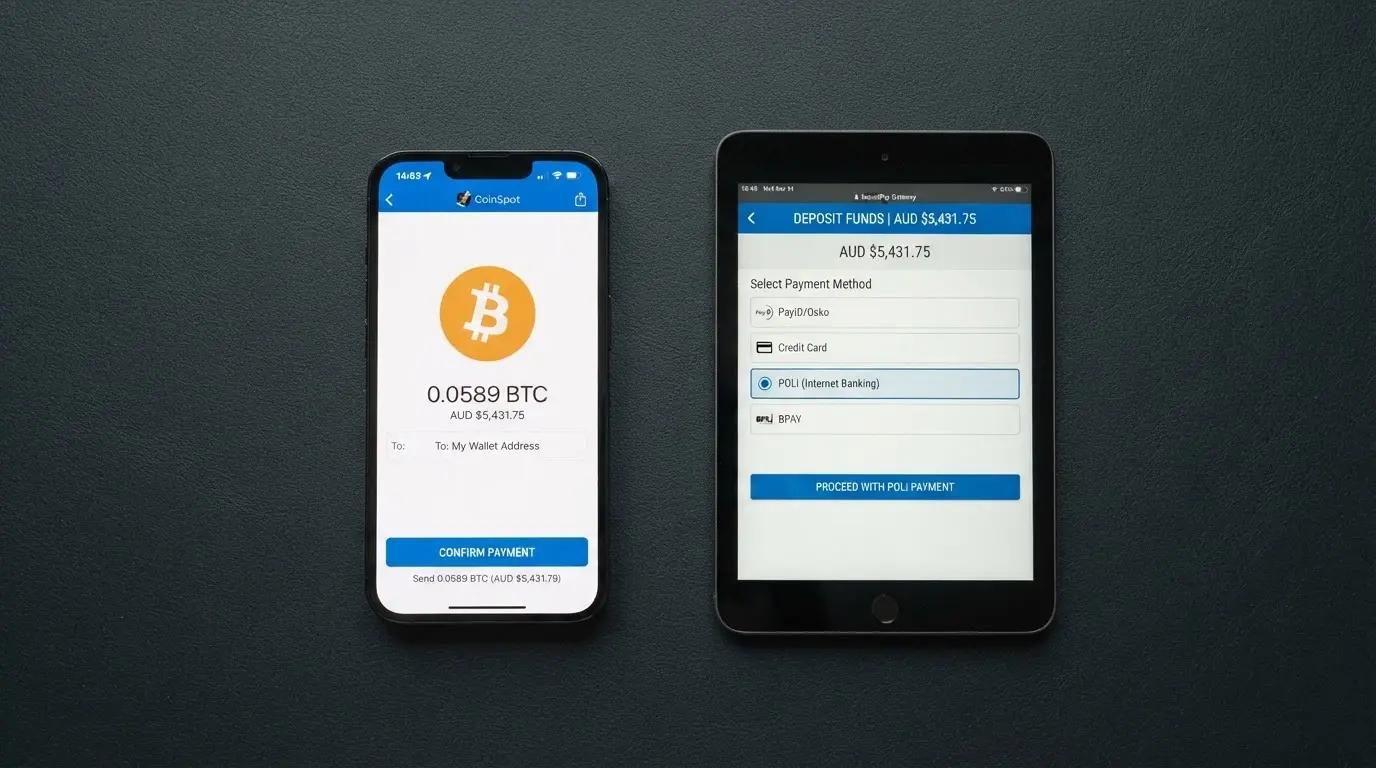
The payment methods a casino accepts are the quickest tell of its legal status. Credit cards and crypto have been banned as payment for online wagering in Australia since 11 June 2024, with penalties of up to A$247,500 for operators that accept them. A player who sees Visa, Mastercard or Bitcoin on a cashier page is therefore looking at an offshore site. From 1 January 2027, banks and payment providers gain express authority to block transactions to illegal gambling operators under the Interactive Gambling Amendment (Gambling Reform) Bill 2026.
Crypto and Bitcoin: The Offshore Payment Default
Bitcoin and other cryptocurrencies are the standard on-ramp at the offshore casinos on this page. Crypto deposits bypass the Australian banking rails entirely — no Australian bank processes a Bitcoin transaction under the credit/crypto ban because the transaction does not touch the bank. Rainbet accepts crypto alongside its Anjouan licence; RocketPlay, SkyCrown and most of the rest of the table route through similar rails.
The trade-off is not anonymity in the practical sense. Reputable offshore sites run KYC verification before withdrawals regardless of the deposit method, and Bitcoin’s pseudonymous ledger is the wrong tool for a player who wants to keep casino activity private from a future counterparty. What crypto provides is access — a deposit rail that does not require an Australian bank to process the transaction.
From 1 January 2027, the new bank-blocking authority applies to illegal gambling transactions. Crypto is not a bank transaction, so the new rules’ direct reach stops at fiat. The indirect reach — banks refusing to on-ramp or off-ramp crypto linked to gambling operators — is a separate question the reform does not settle.
PayID, Osko and Bank Transfer Through the Offshore Lens
PayID and Osko are legal Australian payment rails — instant transfers using a phone number, email or ABN rather than a BSB and account number. They are designed for licensed Australian wagering, alongside debit card, bank transfer and BPAY. An offshore casino offering PayID is routing through a third-party payment processor that aggregates deposits from multiple end-users, not holding an Australian licence.
The presence of PayID on an offshore cashier page is therefore not a sign the site is licensed. It is a sign the operator has a payment-processor relationship. The deposit reaches the casino via the processor; the player pays through their bank as they would for any other PayID transfer. The bank’s transaction screening may or may not flag the recipient as gambling-related — that depends on the processor’s merchant category and the bank’s own rules.
Bank transfer and BPAY follow the same pattern. The payment rail is legal for licensed wagering; the offshore casino that accepts it is not. A player who reads the payment methods list as a trust signal is reading the wrong column.
High-Roller Casino Apps: What You Actually Get on Mobile
The mobile experience at offshore high-roller casinos is the browser experience. The Apple App Store and Google Play do not carry offshore casino apps under Australian rules, so there is no download-from-store path for any operator on this page. What exists is a mobile-optimised browser version of the desktop site — functionally identical to the desktop lobby — and the occasional Android APK that operators host on their own sites for direct download.
Native App vs Browser: The Offshore Mobile Reality
An iOS native app for an offshore casino cannot list in the Australian App Store. Apple’s guidelines require the operator to hold a licence in the user’s jurisdiction, and no offshore casino on this page holds one. Google Play applies the same restriction under its Real-Money Gambling and Games policy. Any “app” an Australian player installs is therefore either a mobile-browser bookmark or a sideloaded APK from the operator’s own download page.
The APK path works on Android but requires the user to allow installs from unknown sources — a security setting Google disables by default and a friction point that most recreational players do not clear. iOS does not allow sideloading at all outside the App Store. Browser play is the realistic default.
Functionally, the modern casino platform is built mobile-first. The lobby, cashier, bonus activation and live-dealer tables all run in a mobile browser at near-desktop parity. The compromise is the absence of push notifications, biometric login and the small-screen refinement a native app delivers — features that matter more to a daily user than to a high roller who logs in for a session and logs back out.
The Legal Reality: Why Every High-Roller Casino Is Offshore
The Interactive Gambling Act 2001 prohibits online casino games, online pokies and in-play sports betting in Australia. There is no licence for these products anywhere in the country, at federal level or in any state or territory. Online wagering on races and sport placed before the event begins is legal when offered by state- or territory-licensed operators — Licensing NT and the Northern Territory Racing and Wagering Commission are the concentration point. Lotteries and keno are also legal and state-regulated. Online casino is none of those.
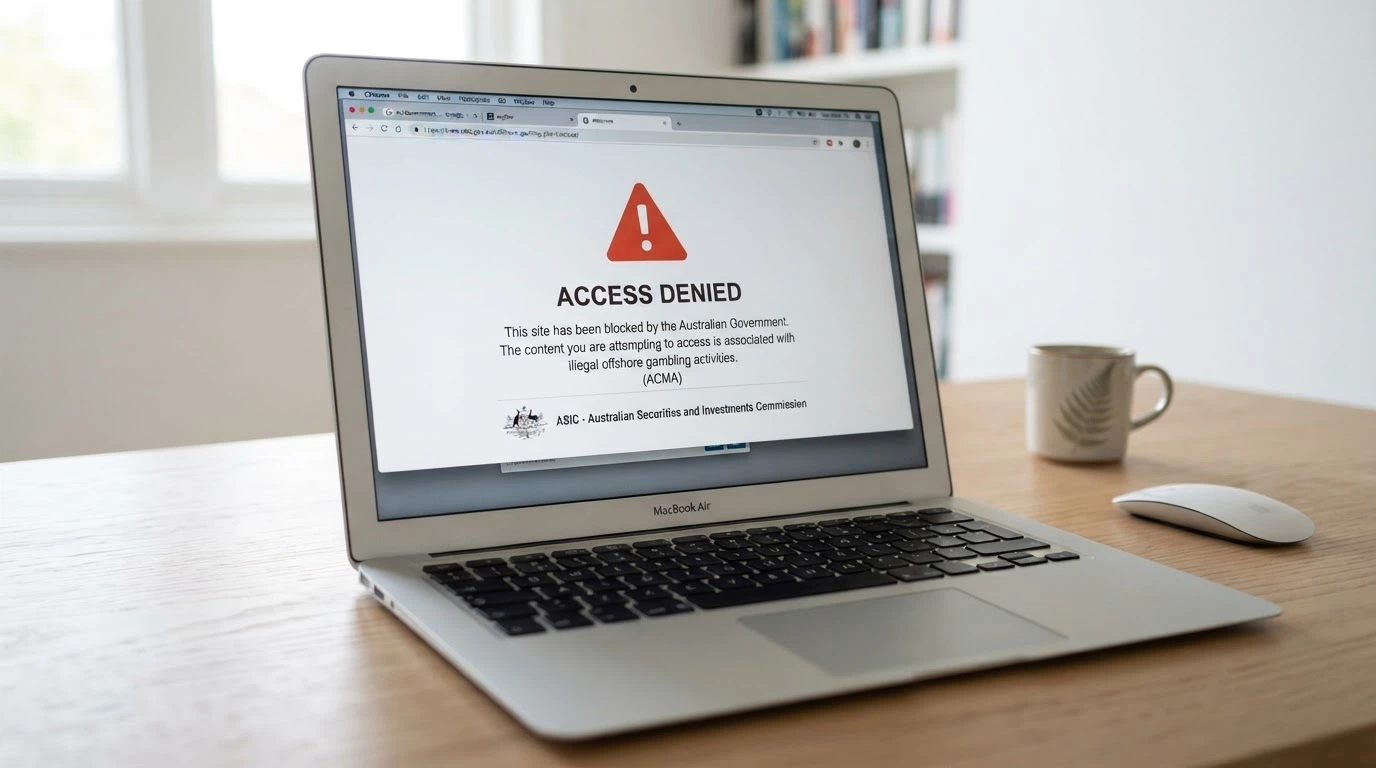
The Australian Communications and Media Authority is the federal regulator that enforces the prohibition. The ACMA investigates complaints, issues formal warnings, commences civil penalty proceedings and directs ISPs to block illegal gambling and affiliate websites under section 313 of the Telecommunications Act 1997. As of August 2026, the ACMA has had 1,788 illegal gambling and affiliate sites blocked since November 2019. Over 230 illegal services have withdrawn from the Australian market since 2017 enforcement was strengthened.
The Interactive Gambling Act: What It Actually Bans
The IGA targets the provider, not the player. The individual punter is not prosecuted under the Act. What the Act does is make it an offence for a company to provide a prohibited interactive gambling service to a person in Australia, with penalties of up to 5,000 penalty units. The scope of “prohibited” includes online casino games, online pokies and in-play sports betting — the products every operator on this page offers.
The gap between licensed wagering and banned casino is the operative detail. A bet on the Melbourne Cup placed before the race starts is legal through a licensed Australian bookmaker. The same bettor’s session at an offshore pokies site is a transaction with an operator that has no Australian licence and is committing an offence by accepting it. The bettor is not liable; the operator is. The ACMA’s enforcement powers run against the operator’s domain, payment processing and Australian marketing presence — not against the individual player.
ACMA Enforcement: 1,788 Sites Blocked and Counting
The ACMA’s blocking programme has taken down 1,788 illegal gambling and affiliate sites since November 2019. The figure climbs monthly, and the domains are not a fixed list: a site can be reachable today and blocked tomorrow. The Leon domain was blocked in February 2025; LEON BET appears in this page’s operator table because it remains one of the offshore brands Australian players reference, but the ACMA direction means Australian ISPs do not resolve the domain to its live server.
In Q4 2025, the ACMA received 483 enquiries and complaints, completed 23 investigations into 45 gambling sites, found 69 breaches of the Interactive Gambling Act and issued 10 formal warnings — including to Dama N.V. (Vegas Now, Rooster Bet, Rocketspin) and NovaForge Ltd (CrownPlay, Spinsy, Cashed, Spinight, King Maker, QuickWin, Vegasino). In June 2026, the ACMA blocked 12 additional sites including 7Signs, Donbet, Freshbet, Slots Gem, Vinyl Casino and Wildsino, with PointsBetz identified as imitating the licensed PointsBet brand.
The blocking record is the visible shape of a market that does not legally exist. A site on a comparison page today may be unreachable from an Australian IP next month. Any balance on the site at the moment of blocking is at the mercy of the operator’s withdrawal process.
What the 2026 Gambling Reform Changes for High Rollers
The Interactive Gambling Amendment (Gambling Reform) Bill 2026 passed Parliament on 19 August 2026. Its measures commence 1 January 2027 — they are not yet in force. The reform does not legalise online casino; it tightens the rules around licensed wagering and gives new tools to enforce the existing prohibition.
From 1 January 2027, banks and payment providers gain express authority to block transactions to illegal gambling operators. The reform establishes AdStop, a national wagering-advertising opt-out register administered by the ACMA. Advertising restrictions tighten: no more than three wagering ads per hour on broadcast between 6:00 am and 8:30 pm; a live-sport blackout from 15 minutes before to 5 minutes after a live event; athletes, celebrities and influencers barred from promoting wagering.
Inducement marketing is restricted across the board: no direct marketing to a new customer for 14 days after account sign-up; no inducements to a person who has come off the BetStop self-exclusion register for three months; no inducements at all to customers identified as at-risk of gambling-related harm. These rules apply to licensed operators. Offshore operators do not follow them by definition.
For a high roller playing at an offshore casino, the reform’s main practical effect is the bank-blocking authority. From 1 January 2027, an Australian bank can refuse a transaction to a known illegal gambling operator. That makes deposit and withdrawal through Australian-issued cards and bank accounts materially harder at the offshore sites on this page.
Playing Big Without Letting the Game Play You
High-stakes play carries significant risk. While Australian harm-reduction tools are robust, they provide no coverage for offshore platforms. Players must verify the limitations of these resources before engaging with an unlicensed service.
BetStop, Deposit Limits and the Offshore Gap
BetStop — the National Self-Exclusion Register — went live in August 2023. One registration excludes a person from every Australian-licensed online and phone wagering service in a single step. As at 31 July 2026, BetStop had 67,480 registrations in three years, of which 41,290 exclusions were still active — over 60% of the cumulative total. Seventy-eight per cent of registrants are under 40, and 38% chose lifetime exclusion.
BetStop does not bind offshore casinos. An Australian player who has registered with BetStop can still deposit, play and lose at every operator on this page. The exclusion register is the most powerful self-exclusion tool Australia has, and it covers exactly zero of the brands in this article.
The offshore gap is the operative limitation. Operator-level deposit limits exist at the offshore casinos — most publish maximum deposit thresholds and let players set their own daily, weekly or monthly caps — but those limits are set by the operator’s own terms and enforced by the operator’s own systems. There is no external regulator checking the operator honours them. A player who self-excludes at an offshore site is excluding themselves from one brand, not from the segment.
- What BetStop covers: every Australian-licensed online and phone wagering service — pre-event race and sport bets, lotteries, keno.
- What BetStop does not cover: any offshore casino, including every operator on this page.
- What an offshore casino’s own limits cover: only that operator’s own site, only while the limit is set, and only at the operator’s discretion to enforce.
Where to Get Help: 1800 858 858 and Beyond
The National Gambling Helpline — 1800 858 858 — is free, confidential and staffed 24 hours a day, 7 days a week. Online chat, self-assessment tools and counselling are available through Gambling Help Online. These services are not gated by geography, by licence status or by which casino a player has been using. They reach the player regardless of where the play happened.
The prevalence figures put the question in scale. Approximately 2.1% of Australian adults — roughly 430,000 people — experience problem gambling. The Australian Institute of Health and Welfare put high-risk gambling at 1.8% in 2022. High-roller play sits at the upper end of the spending distribution but is not the upper end of the harm distribution; harm cuts across stake sizes and is most strongly correlated with chase behaviour, time spent and loss of control rather than dollar volume per spin.
- National Gambling Helpline: 1800 858 858 — free, confidential, 24/7.
- Gambling Help Online: Online chat, self-assessment and counselling available.
- BetStop: betstop.gov.au — National Self-Exclusion Register for licensed AU wagering.
- For high-stakes players: the helpline does not require the player to identify an operator or a stake level. The call is the same whether the play is at A$1 a spin or A$100 a spin.
How We Evaluated and Ranked These High-Roller Casinos
The ranking on this page weighs five criteria in this order: bonus value (matched-deposit ceiling, free-spin volume), wagering fairness (multiplier, max cashout), max-bet ceiling (the dollar cap during playthrough), game-provider depth (how many studios supply the lobby) and regulatory visibility (whether the operator publishes a verifiable licence, even if not Australian). Legal status is uniform — every operator is offshore, unlicensed in Australia, and reachable only because the ACMA has not directed ISPs to block the domain — and is therefore not used to rank rows.
Each operator was checked against the ACMA’s enforcement record, including the Q4 2025 warnings, the June 2026 blocks and the February 2025 blocks. The Australian regulation skill supplied the IGA framework, the Interactive Gambling Amendment (Credit and Other Measures) Act 2023 and the Interactive Gambling Amendment (Gambling Reform) Bill 2026 (passed 19 August 2026, commencing 1 January 2027). Card Player and operator-specific reviews supplied bonus terms and slot specifications. Where research did not confirm a figure this run, the cell is empty in the table — the gaps are the point.
The verification baseline is the same for every operator: no Australian online casino licence exists under the Interactive Gambling Act 2001, so no row can be checked against an Australian register. The figures that fill the table come from the operators’ own published terms, regulator enforcement notices and the Australian regulation skill. No invented percentages or weights were used in the ranking.
Is a High-Roller Casino Bonus Worth the Risk in 2026?
The arithmetic on the table answers this question in numbers. SkyCrown’s A$8,000 welcome at 40x wagering requires A$320,000 in turnover; at the industry-standard 96% RTP, the expected loss on that turnover is A$12,800. The bonus pays A$8,000 in headline value and costs A$12,800 in expected loss. The clearing is a 60% loss on the headline, before any max-cashout cap or session-end variance intervenes. The same calculation at 30x (Fair Go) on A$1,000 gives an expected loss of A$1,200 — A$200 above the bonus — and at 45x (Rolling Slots) on A$1,800, an expected loss of A$3,240 on the high-roller tier.

The legal exposure runs in the other column. Every operator on this page is offshore, unlicensed in Australia and reachable only because the ACMA has not blocked the domain. The ACMA has blocked 1,788 sites since November 2019 and the figure climbs monthly; a site a player deposits at today can be blocked next month with a balance still on it. There is no Australian consumer protection for offshore balances, no BetStop coverage, no recourse if the operator refuses a withdrawal or voids a win. The 2026 reform gives banks new authority to block transactions to illegal gambling operators from 1 January 2027, which adds a second disruption point to the deposit and withdrawal rails.
The practical verdict: a high roller who proceeds should know the bonus’s expected cost before claiming it, fund the bankroll at 250–500 base bets for the volatility tier being played, and read the bonus terms line by line — particularly the max-bet cap, the validity window and the game-weighting rules. The bettor who proceeds on those terms has the data to make the trade. The bettor who proceeds on the headline alone is paying 60% above the bonus to clear it.
The verdict for a player who walks away is the inverse. No bonus has been claimed, so no expected loss has been incurred. The A$8,000–A$50,000 bankroll that would have funded a high-roller session is still in the bank, the deposit that would have triggered a max-bet cap is still in the bank, and the offshore operator that would have held the balance is no longer a counterparty. The walk-away keeps the money. The walk-away also keeps the harm-prevention tools — BetStop, the helpline, Gambling Help Online — out of the conversation that follows a problematic session.
Calculate the expected cost before you deposit. If the numbers don’t add up, the wisest move is often to keep your bankroll in your pocket.
Frequently Asked Questions
What is the difference between a high-roller bonus and a standard casino welcome bonus?
A high-roller bonus is the larger tier of a casino’s welcome package, gated by a higher minimum deposit — typically A$200–A$500 instead of the A$20–A$50 standard. The matched bonus scales up accordingly: A$1,000–A$8,000 in headline value rather than A$100–A$500. Max bet ceilings hold at A$5–A$10, wagering stays in the 30–45x range, validity windows often shorten to 5 days on the largest tiers.
What wagering requirements should I expect on a high-roller casino bonus in Australia?
Wagering requirements on high-roller bonuses at AU-facing offshore casinos commonly run from 25x to 50x the bonus amount, with 40x the most frequently observed figure. Free-spin winnings typically carry a separate 30x–40x multiplier. At 40x on a A$1,000 bonus, required turnover is A$40,000; at 45x it is A$45,000. The wagering multiple is the single biggest determinant of the bonus’s real cost.
Are my winnings from offshore high-roller casinos taxable in Australia?
No. Under section 6-5 of the ITAA 1997, gambling and betting winnings are not assessable income for an ordinary Australian resident, and losses are not deductible under section 8-1. The exception is a person carrying on a business of gambling, which the ATO defines in IT 2655 by reference to whether the activity is systematic, organised and at scale. No Australian case has held an ordinary punter’s winnings assessable.
How does BetStop self-exclusion work if I play at an offshore casino?
BetStop binds Australian-licensed wagering services only. One registration excludes a person from every Australian-licensed online and phone wagering service in a single step. As at 31 July 2026, BetStop had 67,480 registrations and 41,290 active exclusions. BetStop does not cover any offshore casino — including every operator on this page — so a self-excluded Australian can still deposit, play and lose at an offshore site.
What is the maximum cashout limit on high-roller casino bonuses?
Maximum cashout limits on high-roller bonuses at AU-facing offshore casinos typically run from A$150 to A$180 on no-deposit chips, with no published ceiling on most matched deposit bonuses. SkyCrown caps bonus-to-cash conversion at A$5,000 per welcome bonus — the highest published cap on this page. Free-spin winnings carry separate per-batch caps: A$300 at RocketPlay, A$50 at LevelUp.
Will the 2026 gambling reform bill affect high-roller casino bonuses in Australia?
The Interactive Gambling Amendment (Gambling Reform) Bill 2026 passed Parliament on 19 August 2026 and commences 1 January 2027. It does not legalise online casino and does not directly restrict bonuses at offshore sites. Its practical effect for high rollers is new authority for banks and payment providers to block transactions to illegal gambling operators from 1 January 2027.