
Casino Payment Methods for Australian Players: A Working Guide for 2026
 Available in AU
The method you pick shapes more than the deposit screen. It decides how fast your winnings land, whether the casino can hold them indefinitely, whether your bank ever sees the transaction and what kind of trouble you inherit if anything goes wrong. Choosing between PayID, crypto and an e-wallet is not a question of preference; it is a question of which rail survives the cashout, because the deposit side of every casino is engineered to be frictionless and the withdrawal side is engineered to be reviewed.
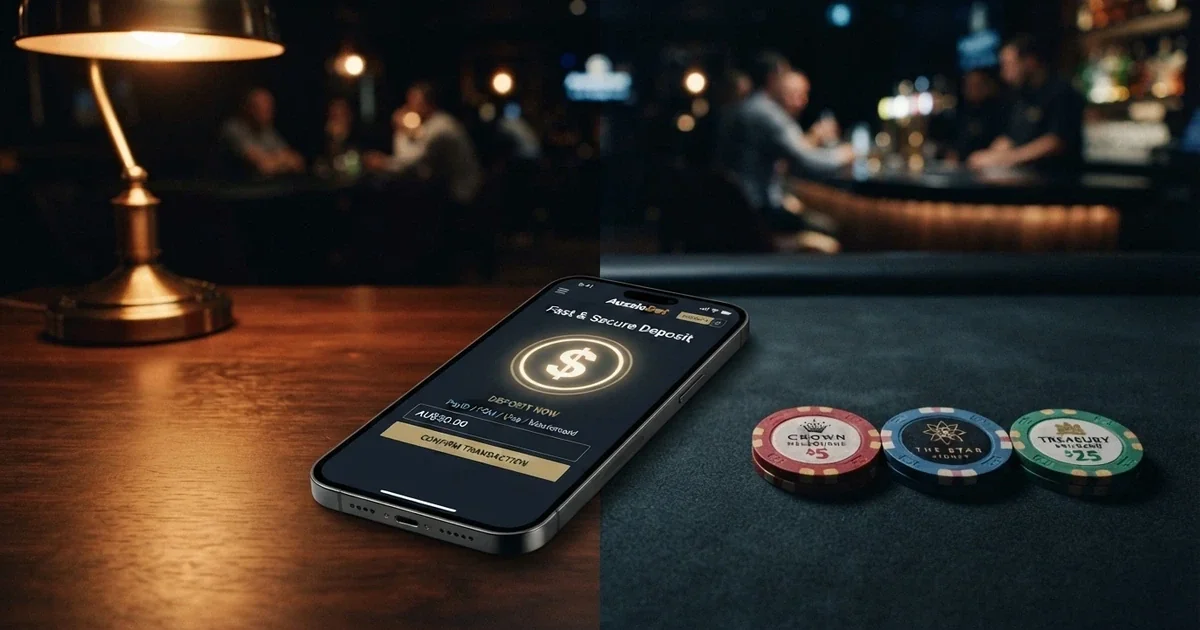
A blunt fact anchors this entire page. Online casino is prohibited in Australia under the Interactive Gambling Act 2001. There is no Australian casino licence, no state-issued casino permit, no regulator a player can complain to if an offshore operator refuses a withdrawal. Every operator named in the table later in this guide is offshore. The payment method is therefore not just a logistical choice; it is a legal and protective one. A credit card or crypto request from a casino is, in the words of the ACMA, “a tell” that the operator sits outside Australian rules.
The data on this page is current as of 18 October 2026 and was checked against operator cashier pages, the ACMA register of blocked services, and the published payment-method data of the operators named here. Where the page is honest about a gap, it is because the operator or the underlying data did not supply the figure.
Table of Contents
- Your Casino Payment Method Is More Than a Deposit Button
- Why Your 2026 Deposit Lands in Seconds but Your Withdrawal Takes Days
- Every Payment Method Australian Casino Players Actually Use in 2026
- The Technology Under the Casino Cashier Nobody Talks About
- Crypto Casino Payments: Fast, Private, and Banned for Licensed Australian Wagering
- How to Pick a Payment Method That Fits Your Play Style
- The Online Casinos Australian Players Are Using in 2026 — and How They Handle Your Money
- How We Evaluated Payment Methods for Australian Casino Players
- Your Next Move: What the Smart Australian Player Does About Casino Payments in 2026
- Frequently Asked Questions
Your Casino Payment Method Is More Than a Deposit Button
Pick a casino, and the brand gets the headlines. Pick a payment method, and you decide the rails underneath. The two decisions are not the same. The brand is the destination; the payment method is the road, the bridge and the customs post. A road that only runs one way is not a road, and a payment method that handles deposits but not withdrawals is exactly that — a deposit rail that forces a second method to be set up the moment a player wants their money back.
The legal frame around this matters more than any individual operator’s offer. Online casino is prohibited in Australia under the Interactive Gambling Act 2001. There is no licence for online casino anywhere in the country — not federally, not in any state or territory. The only wagering that is licensed is pre-event sports and racing, lotteries and keno. The federal regulator, the ACMA, has blocked 1,564 illegal gambling and affiliate websites since November 2019 and more than 225 illegal services have voluntarily withdrawn from the Australian market since 2017. The site a player reaches today can be on a block list tomorrow, with a balance still on it.
A second layer of prohibition sits on top of that. From 11 June 2024, credit cards, credit-related products including digital wallets linked to credit cards, and digital currency (cryptocurrency) are banned as payment for licensed online and telephone wagering under the Interactive Gambling Amendment (Credit and Other Measures) Act 2023. Operators who fail to enforce the ban face penalties of up to A$247,500. The legal deposit routes for licensed wagering are now debit card, bank transfer, PayID/Osko and BPAY. That list is short on purpose; it is what the licensed product is allowed to accept.
The prohibition is product-level, not player-level. The player is not the target of the law — the operator is. A punter accessing an offshore casino commits no offence. The operator offering the product does. That distinction is what makes the AU market look the way it does: licensed Australian wagering brands (Sportsbet, TAB, bet365, Ladbrokes) offer no casino games at all, and the casino brands Australian players actually reach are all offshore, all unlicensed, and all sit outside the protection regime that BetStop, the National Self-Exclusion Register, was built on.
BetStop has had 67,480 registrations since going live in August 2023, with 41,290 exclusions still active as at 31 July 2026. It covers around 150 licensed wagering providers. Offshore casinos are not connected to the register. A self-excluded player can sit down at an offshore casino the morning after their BetStop registration and play, and no one in Australia is funded to stop them. The same gap applies to the National Gambling Helpline on 1800 858 858 — free, confidential and staffed 24/7. The helpline helps regardless of where a person plays, but the operator-side protections, the consumer-law backstop and the dispute-resolution avenues that exist for licensed wagering simply do not reach the offshore brands. Around 2.1% of Australian adults — roughly 430,000 people — experience problem gambling, with another 1.8% in the high-risk band. Those numbers are drawn from the Australian Institute of Health and Welfare’s 2022 survey and have not been displaced by the offshore shift; the population at risk is the same, the protective scaffolding is just thinner.
What a Casino Payment Method Actually Is — and What It Is Not
A payment method is the rail between a bank account and a casino cashier. It is a piece of plumbing: a debit card, a bank transfer protocol, a wallet, a voucher, a cryptocurrency network. A payment provider is the company on the other end of that plumbing — Visa, Mastercard, PayID’s underlying NPP infrastructure, Skrill, MiFinity, Coinbase. The brand a player logs into is not a payment method. The brand is a customer of several payment providers. The two are routinely confused in marketing because the same logo appears at the cashier, but the cashier is the consumer of the rail, not the rail itself.
The distinction matters at the moment of dispute. A complaint to a casino’s support team about a “PayID” withdrawal is not a complaint that PayID can answer; PayID is a protocol, not a counterparty. The complaint is a complaint to the operator, processed by humans the operator pays. Knowing which is which sets the expectations correctly: a payment method’s published speed is the rail’s speed, not the operator’s speed, and a fast rail operated by a slow cashier is just a slow withdrawal dressed in fast-track clothing.
Trusted payment processors in the AU-facing casino space include Visa, Mastercard, Apple Pay, Google Pay, PayID, POLi, Skrill and Neteller, with cryptocurrency running through licensed gateway providers. The security benchmark across the whole stack is the same: TLS 1.2 or higher for every connection, 3-D Secure 2 as the standard for card payments, and PCI-DSS compliance expectations for any operator holding card data. None of these is a marketing badge. TLS 1.2 is the floor, not the ceiling, and 3-D Secure 2 is what pushes the second-factor challenge to the player’s banking app rather than to a one-time code in an SMS — which is materially harder to phish.
Why Your Payment Method Shapes Everything from Deposit to Cashout
The same casino plays differently depending on which method funds it. A PayID deposit can be in the balance inside ten seconds, but the withdrawal back through PayID can take a full day, sometimes two, and is gated by the same Know-Your-Customer review every other method faces. A Bitcoin deposit takes 10–30 minutes for blockchain confirmation, but the withdrawal can clear in the same window once the operator’s internal approval is through — and the limit on that withdrawal can be as high as A$100,000 at some sites, dwarfing anything a bank or e-wallet will offer. The method does not just route the money; it sets the speed, the ceiling, the cost and the protection regime around the cashout.
KYC is where the rubber meets the road. Verification is mandatory at every offshore casino, and 24–72 hours is the typical first-time window. That window is the source of most “slow payout” complaints — not the rail, not the bank, the operator’s compliance team working through a new customer’s documents. Withdrawals under A$5,000 are less likely to trigger an enhanced security review, which is the second-look layer some operators apply to larger sums. The implication is a little uncomfortable: a smaller player gets paid faster, because the operator’s risk threshold for “this might be a problem” sits higher.
Offshore casinos are not connected to BetStop, and ACMA cannot recover money from an operator that decides not to pay. The site itself can be blocked at any time by an ISP-level request from the regulator, with player balances in limbo. None of that is theoretical; it is the structure of the market, and the payment method does not make it safer, only the friction around it slightly different.
Why Your 2026 Deposit Lands in Seconds but Your Withdrawal Takes Days
The asymmetry is built into every cashier on the planet. A deposit is a payment authorisation: a card is presented, a 3-D Secure challenge is passed, and the issuer approves the transaction. The merchant gets the money in seconds, the player sees the balance in seconds, and the whole thing has happened on rails that were designed in the 1990s to be fast. A withdrawal is the opposite — it is a payment initiation from the merchant’s side, and it goes through the merchant’s internal approval queue before it touches a rail. That approval queue is the bottleneck. It is also where KYC, anti-money-laundering checks, source-of-funds reviews and the operator’s own withdrawal-policy gates live.
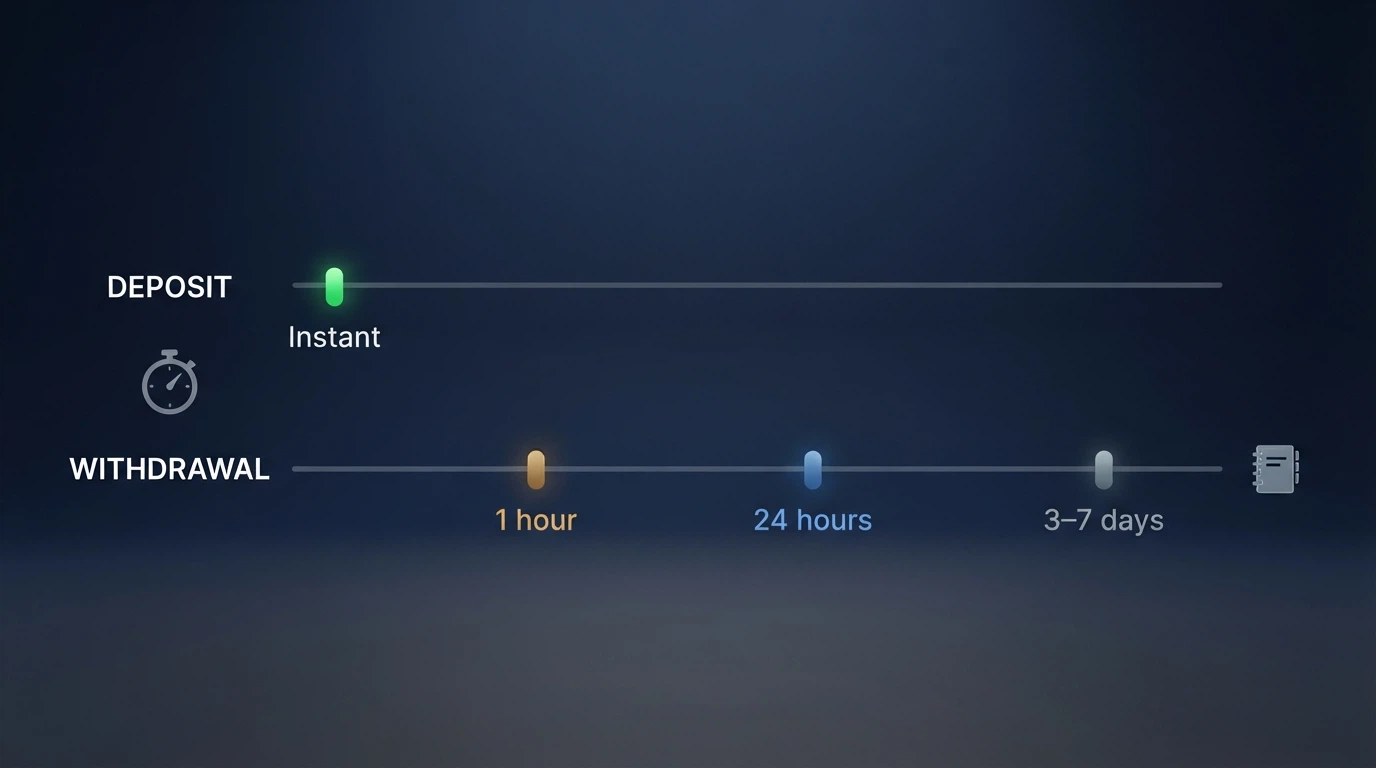
PayID illustrates the gap sharply. PayID deposits are instant, free and accept minimums as low as A$10. PayID withdrawals at most casinos process in minutes to 24 hours, though some operators stretch that to 48 hours. The deposit leg uses the New Payments Platform’s instant settlement; the withdrawal leg uses the same rail but is held by the operator’s finance team for approval first. The rail is identical; the operator is the variable.
Crypto inverts the asymmetry. A USDT TRC-20 deposit clears in under 60 seconds, with network fees under A$0.50; a USDT TRC-20 withdrawal clears in under 15 minutes, with the same fee structure. The bottleneck on a crypto withdrawal is the operator’s internal approval, not the blockchain — a Bitcoin confirmation takes 10–30 minutes and an Ethereum one 5–15 minutes, and the operator’s queue is what the player is actually waiting on. Bank transfers sit at the other end: 3–7 business days for the withdrawal to land, with international wires carrying receiving-bank fees of A$25–40. The deposit side of a bank transfer is no faster than that; it just looks faster because the operator funds it from a float account rather than waiting for the player’s wire to clear.
E-wallets compress both sides. A Skrill or Neteller withdrawal processes within 30 minutes to a few hours at the fast-payout operators, and the deposit is instant. MiFinity performs similarly and is, for Australian players specifically, the more reliable e-wallet choice — Skrill and Neteller apply gambling restrictions to some Australian accounts, blocking the deposit or capping withdrawals from gambling merchants. The phrase “more reliable” is doing quiet work there: the difference is not in the technology, it is in the e-wallet’s own compliance posture towards AU gambling traffic.
Deposit Methods: How Australians Fund a Casino Account in 2026
The deposit side is built to convert. Every method on a modern cashier has been engineered to take a player from “decided to play” to “balance is showing” in the smallest number of seconds. The friction is the operator’s onboarding — account creation, email verification, sometimes an SMS code — and the moment that is past, the money flows.
Debit card deposits through Visa and Mastercard are the default rail for most players and the one licensed Australian wagering brands are constrained to. The 3-D Secure 2 challenge is the visible layer: a banking-app push notification or a one-time code. Apple Pay and Google Pay sit on top of the card rails, presenting the same card data through a tokenised front end; the deposit is instant, but the underlying card is still a debit card, and the operator can see the card network even if the player does not type the number in.
PayID and Osko are the AU-native instant deposit story. PayID maps a mobile number, email or ABN to a bank account, and the New Payments Platform settles the transfer in seconds, twenty-four hours a day. There is no card network in the loop, no interchange fee, and no chargeback exposure on the merchant’s side. The minimum deposit for PayID at most AU-facing casinos is A$10. The cost is paid in privacy: the player’s bank knows exactly which merchant received the money, and the merchant knows which bank the player uses.
E-wallet deposits through PayPal, Skrill, Neteller and MiFinity sit between the player and the bank. PayPal deposits are instant, and PayPal itself does not charge a fee for casino transactions — though currency conversion may apply, since the player is funding a likely-EUR or USD-denominated casino balance from an AUD PayPal account. Skrill and Neteller are similarly fast on the deposit but carry the gambling-restriction risk for some Australian accounts. MiFinity is the cleaner answer for players who have been locked out of Skrill or Neteller’s gambling functionality.
Cryptocurrency deposits — Bitcoin, Ethereum, Litecoin, USDT on multiple networks, plus a long tail of altcoins — settle on the blockchain rather than through a card network. A USDT TRC-20 deposit clears in under 60 seconds, with network fees under A$0.50. Bitcoin takes 10–30 minutes for confirmation. The deposit is fast and the cost is low, but the rail sits outside every Australian consumer protection regime, and the operator is a self-selecting set of brands comfortable with non-bank rails.
Prepaid vouchers — Neosurf, Paysafecard, CashtoCode — let a player buy a fixed-value code at a retail outlet and deposit it as cash-equivalent. There is no bank account in the loop, no card, no e-wallet. The codes are usually deposit-only.
Withdrawal Methods: What Actually Gets Your Money Out and How Long It Takes
The cashout side is where the payment method earns its place. The deposit is the marketing channel; the withdrawal is the product.
PayID withdrawals at most offshore casinos process in minutes to 24 hours, with some operators stretching that to 48 hours. The speed is good but the ceiling is the issue: not every operator supports PayID for withdrawals, and the ones that do typically set withdrawal minimums at A$50–A$100. PayID is the right rail for a player whose winnings are modest and who wants them same-day.
Crypto is the fastest withdrawal rail in the market, full stop. USDT on TRC-20 clears in under 15 minutes. Bitcoin in 10–30 minutes. Ethereum in 5–15. The operator’s internal approval is the bottleneck rather than the blockchain, and at the best operators that approval is automated up to a ceiling, with manual review only above it. The other side of the coin is the highest withdrawal limits in the market — up to A$100,000 on some sites — which is why crypto is the rail of choice for high rollers, and also why the rail is banned entirely for licensed Australian wagering.
E-wallet withdrawals are the second-fastest class. Skrill, Neteller and MiFinity typically process within 30 minutes to a few hours at fast-payout operators. The gambling-restriction problem returns here: Skrill and Neteller apply restrictions to some Australian accounts, freezing gambling transactions or refusing to process them. MiFinity is the more reliable choice for an AU player.
Bank transfer is the slowest option. The withdrawal takes 3–7 business days to land, and an international wire carries A$25–40 in receiving-bank fees on top of any fee the operator charges. Bank transfer is the right rail for a player whose casino is offshore and whose bank is one of the big four, and who is happy to wait a week for a large withdrawal to clear. It is the wrong rail for a player who wants their winnings before the weekend.
Several methods are deposit-only and force a second rail for the cashout. Apple Pay and Google Pay do not support withdrawals at Australian online casinos — the funds route back to the linked card, which is itself a deposit rail. POLi is deposit-only. Prepaid vouchers — Neosurf, Paysafecard, CashtoCode — are deposit-only. A player who funds an account with any of these is committing to a second method for the withdrawal, and the most common second method in the operator-stated data is bank transfer. That is a slower, more expensive cashout than the deposit method, and it is worth knowing before the deposit is made.
Withdrawal Speed and Deposit Speed Compared: Every Method Side by Side
| Payment Method | Deposit Speed | Withdrawal Speed | Deposit or Withdrawal or Both | Typical Fees |
|---|---|---|---|---|
| Debit card (Visa/Mastercard) | Instant | 1–3 business days | Both | No casino fee; issuer may charge cash advance fee on credit-linked products |
| PayID / Osko | Instant (seconds) | Minutes to 24 hours; some up to 48 hours | Both | Free on the rail; operator may set minimums |
| POLi | Instant | Not supported | Deposit only | Free on the rail |
| BPAY | 1–2 business days | Not supported | Deposit only (licensed wagering) | Free on the rail |
| Bank transfer (international wire) | 1–3 business days | 3–7 business days | Both | A$25–40 receiving-bank fee on international wires |
| PayPal | Instant | Within 24 hours | Both | No PayPal fee; currency conversion fee may apply on AUD-to-EUR/USD |
| Skrill | Instant | 30 minutes to a few hours | Both | Operator fee possible; gambling restrictions on some AU accounts |
| Neteller | Instant | 30 minutes to a few hours | Both | Operator fee possible; gambling restrictions on some AU accounts |
| MiFinity | Instant | 30 minutes to a few hours | Both | Operator fee possible; fewer AU restrictions |
| Apple Pay | Instant | Not supported (routes to linked card) | Deposit only | None on the wallet |
| Google Pay | Instant | Not supported (routes to linked card) | Deposit only | None on the wallet |
| Prepaid voucher (Neosurf, Paysafecard, CashtoCode) | Instant | Not supported | Deposit only | Retail purchase fee on the voucher |
| USDT (TRC-20) | Under 60 seconds | Under 15 minutes | Both | Network fee under A$0.50 |
| Bitcoin (BTC) | 10–30 minutes | 10–30 minutes | Both | Network fee variable |
| Ethereum (ETH) | 5–15 minutes | 5–15 minutes | Both | Network fee variable |
| Litecoin (LTC) | 2–10 minutes | 2–10 minutes | Both | Network fee low |
The table does one job — it lines up the deposit speed against the withdrawal speed for the same method — and that lineup is itself the finding. The deposit column is mostly instant. The withdrawal column is mostly not. The methods that match on both sides are crypto, e-wallets, PayID and debit cards, and within that set crypto is the only rail where the deposit and the withdrawal are symmetrically fast. Bank transfer is slow on both sides, but it is the only fiat rail that works for every operator regardless of size, and for very large withdrawals it is sometimes the only rail the operator will allow.
Every Payment Method Australian Casino Players Actually Use in 2026
The full landscape of payment methods available to AU players at offshore casinos does not look like the legal deposit list of four — debit card, bank transfer, PayID/Osko, BPAY. Those four are what a licensed wagering operator is allowed to accept. An offshore casino is not constrained to that list, and in practice the cashier of any AU-facing offshore brand includes a much wider set: e-wallets, crypto, prepaid vouchers, mobile wallets, and several emerging account-to-account rails. The legal split is not between two equivalent menus. It is between a constrained licensed menu and an open offshore menu, and every method an AU player uses is in the second group.
A useful way to think about the split is to ask which methods the ACMA, the federal regulator, has actively restricted. The credit-card and crypto bans from 11 June 2024 cover licensed operators only; they do not bind an offshore casino, which will happily accept a credit card deposit from a Visa or Mastercard. The legal exposure falls on the operator, not the player, but the legal exposure does not change the structural fact: an offshore casino asking for a credit card or a crypto deposit is operating outside the rules the ACMA enforces, and that is the tell the regulator itself names.
E-wallets: PayPal, Skrill, Neteller and MiFinity
E-wallets add a layer between the player’s bank and the casino. The casino never sees the bank account; it sees the e-wallet. The bank never sees the casino; it sees the e-wallet. The privacy is real, and the cost is that the e-wallet becomes a counterparty the player now has to trust.

PayPal is the largest e-wallet in the world, used by over 400 million people globally, and the only one most AU players will already have an account with. Deposits are instant and withdrawals process within 24 hours, with no PayPal fee on the casino transaction. The friction is the currency conversion: an AUD PayPal account funding a likely-EUR or USD-denominated casino balance will trigger PayPal’s FX margin, which is around 3-4% on the day and which no operator rebates. PayPal’s own terms restrict the use of its wallet for gambling in some jurisdictions, but the AU-facing operators in the offshore space generally support PayPal deposits and withdrawals without issue, and PayPal’s buyer-protection policies explicitly exclude gambling transactions, so the wallet’s role is closer to a fast money-mover than to a financial safeguard.
Skrill and Neteller are the e-wallets the AU-facing casino industry was built on, and they remain the fastest fiat withdrawals most players will see — 30 minutes to a few hours at the better operators. The problem is geographic. Skrill and Neteller apply gambling restrictions to some Australian accounts, and a player who finds their account locked from gambling transactions is not going to unlock it through customer support. The restriction is the policy, and the policy is bilateral — it affects the operator as well, which is why a casino that advertises Skrill and Neteller support may still reject a deposit from a flagged AU account.
MiFinity is the e-wallet of choice for AU players who have hit the Skrill/Neteller wall. It performs to the same speed — 30 minutes to a few hours on withdrawals — and its compliance posture towards AU gambling accounts is materially more permissive. The downside is name recognition: a player who has never used MiFinity has to onboard, verify, and fund it before the first deposit, and the onboarding is its own KYC experience with its own delays.
EcoPayz sits further down the list, used at a handful of operators and offering a similar instant-deposit, hours-fast withdrawal profile. It is a useful fallback for a player who wants a layer between bank and casino but cannot get Skrill, Neteller or MiFinity to work.
Debit Cards: Visa and Mastercard — and Why Credit Cards Are Out
Debit card deposits through Visa and Mastercard are the workhorse of the AU-facing casino cashier. They are instant, they are universal, and they do not need a separate account. The 3-D Secure 2 standard pushes the authentication step into the player’s banking app, which is materially harder to phish than the older SMS-code model and which has driven a measurable drop in card-not-present fraud across the industry.
The credit-card side of the same network is the part the IGA amendment banned. From 11 June 2024, credit cards, credit-related products and digital wallets linked to credit cards are prohibited as payment for licensed wagering. The penalty is on the operator — A$247,500 for non-compliance — but the practical effect is that the licensed product is funded by debit, bank transfer, PayID or BPAY only, and a player reaching for a credit card at a licensed brand is going to be declined at the cashier. The same card at an offshore casino will not be declined, because the offshore operator is not bound by the IGA. That is the gap the ACMA names in its own communications: a credit-card or crypto request at a gambling site is a tell that the operator sits outside Australian rules.
Debit card withdrawals are supported at most offshore casinos but rarely fast. The rail takes 1–3 business days to settle, the operator usually runs the withdrawal through a manual approval queue, and the result is a method that is excellent on the way in and slow on the way out. The right pattern is to deposit on debit and withdraw on PayID or e-wallet, treating the debit card as the funding rail rather than the cashout rail.
Bank Transfer, PayID and POLi: The Australian Local Options
The AU-local payment story has three methods, and they are not equal.
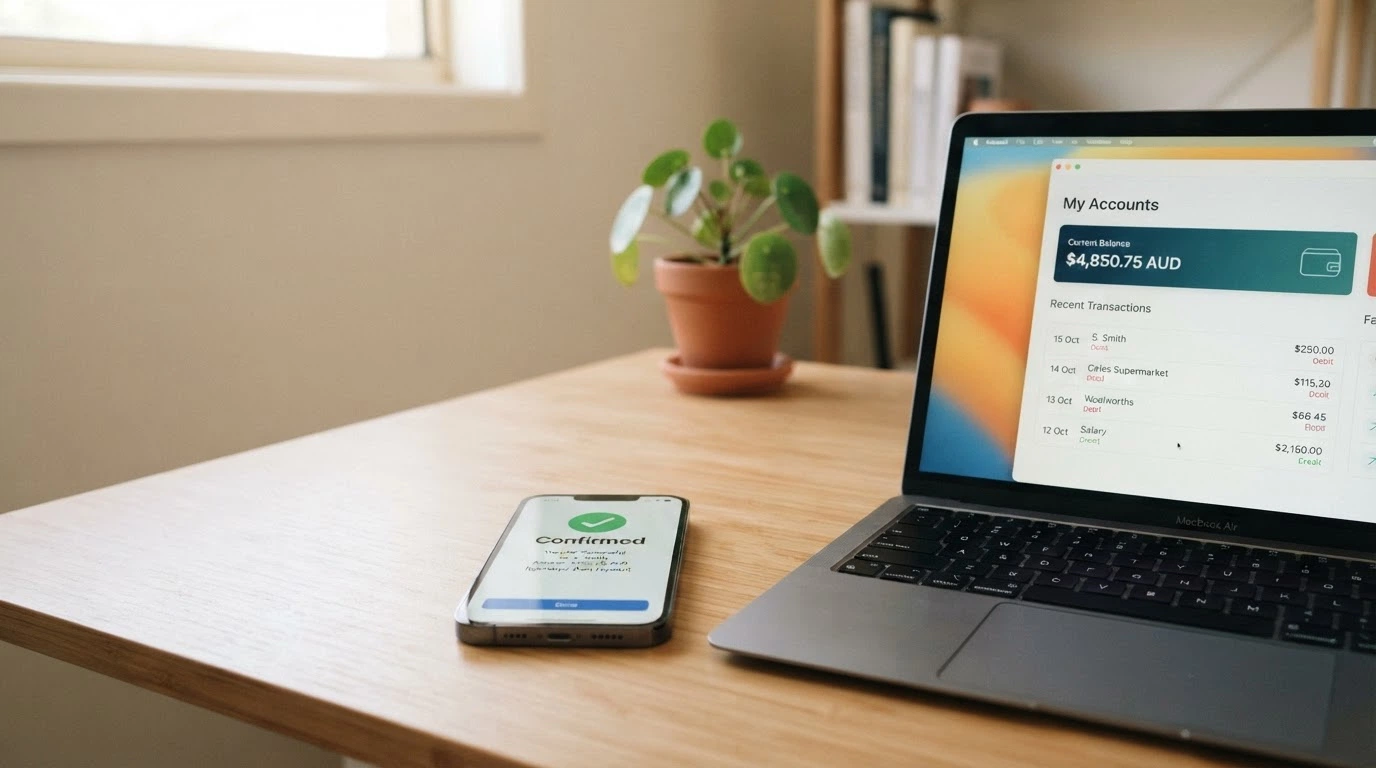
PayID is the rising star. Built on the New Payments Platform, PayID maps a mobile number, email address or ABN to a bank account, and the transfer settles in seconds, 24/7, with no interchange fee. For a casino deposit, PayID is instant and free at most operators, with minimum deposits from A$10. For a casino withdrawal, PayID processes in minutes to 24 hours at most operators, with some taking up to 48 hours. The combination — instant deposit, same-day withdrawal, no fees — is what the licensed Australian wagering market was redesigned to support, and the offshore market has followed. PayID is the right default for an AU player who wants a fiat rail that works on both sides.
POLi is the fading option. POLi was built as a deposit-only method, and it remains deposit-only: POLi withdrawals do not exist, despite what some affiliate pages still claim. The big four Australian banks — CBA, Westpac, NAB, ANZ — have never officially endorsed POLi for gambling use, and POLi’s market share among AU casino depositors in 2026 is smaller than five years ago, eroded by PayID, crypto and prepaid cards. The reason to know POLi at all is to recognise it on a cashier and to know that it is a one-way rail: any winnings deposited via POLi will have to come out via a different method, and the most common second method is bank transfer.
Bank transfer is the slow lane. A bank transfer deposit at an offshore casino takes 1–3 business days to clear and is the only fiat rail that works for a player whose bank has blocked the card rails. A bank transfer withdrawal takes 3–7 business days to land, with international wires carrying A$25–40 in receiving-bank fees per transfer. The bank transfer is not a fast method and never has been; its value is universality, not speed.
BPAY is a licensed-wagering deposit route. It is not in the cashier of any offshore casino. It belongs in the licensed-product picture — debit card, bank transfer, PayID/Osko, BPAY — and is named here so the licensed and offshore lists do not blur together.
Cryptocurrency: Bitcoin, USDT, Ethereum and More
Crypto is the fastest rail in the market, on both sides. USDT on the TRC-20 network clears in under 60 seconds for a deposit and under 15 minutes for a withdrawal, with network fees under A$0.50. Bitcoin takes 10–30 minutes for blockchain confirmation. Ethereum 5–15 minutes. Litecoin 2–10. The bottleneck on a crypto withdrawal is the operator’s internal approval, not the blockchain — once the operator’s finance team releases the transaction, the network does the rest in single-digit minutes.

The ceiling is the draw for high rollers. Crypto methods have the highest withdrawal limits at AU-facing casinos — up to A$100,000 on some sites. Rainbet, named in the operator table below, has no maximum withdrawal limit on crypto at all. The combination of fast settlement, high ceilings and no card-network intermediary is why crypto is the rail of choice for players moving serious money, and it is also why crypto is the rail the ACMA has singled out for prohibition in the licensed market.
From 11 June 2024, digital currency is banned as payment for licensed wagering. The ban sits on top of the existing online-casino prohibition, so for an AU player there is no licensed casino product to fund with crypto in the first place. The ban’s effect is on licensed sports and racing wagering brands, which can no longer accept Bitcoin deposits. The offshore casino market is unaffected, and the cashier of any major AU-facing brand still lists Bitcoin, Ethereum, USDT, Litecoin and a long tail of altcoins.
The legal frame is about to tighten again. Legislation passed on 19 August 2026 (the Interactive Gambling Amendment (Gambling Reform) Bill 2026) gives banks the authority to block payments to illegal gambling operators, effective 1 January 2027. The bank-blocking provision does not target crypto directly, but the policy intent — to choke the payment flow to offshore operators — is hard to read as anything other than the regulatory direction of travel. A player choosing crypto for the speed and the ceiling should know that the rules around offshore gambling rails are tightening, not loosening.
Prepaid Vouchers: Neosurf, Paysafecard and CashtoCode
Prepaid vouchers work like gift cards for gambling. The player buys a code at a retail outlet or online — Neosurf, Paysafecard, CashtoCode — and deposits the code’s value at the casino cashier. There is no bank account in the loop, no card, no e-wallet. The anonymity is real; the player’s bank never sees a gambling transaction.
The catch is the cashout. Vouchers are deposit-only, full stop. A player who funds an account with a A$50 Neosurf code is committing to a second method for any withdrawal, and the most common second method in the operator-stated data is bank transfer. That is a slower, fee-bearing cashout than the deposit method, and it inverts the privacy story: the bank knows about the withdrawal, even if it did not know about the deposit.
The right use case for a prepaid voucher is a player who wants a hard budget cap — the player buys A$50 of Neosurf, deposits it, plays through it, and stops, because there is no more voucher to deposit. The wrong use case is a player who wants fast withdrawals, because the voucher is the slowest of the cashout options once the deposit method is forced to be a different one.
Mobile Wallets, Carrier Billing and Emerging Methods
Apple Pay and Google Pay are instant on the deposit side and absent on the withdrawal side. The funds settle through the underlying card network, and the wallet is essentially a tokenised front-end for a Visa or Mastercard. The player sees an Apple Pay confirmation; the operator sees a card transaction. The deposit is instant; the withdrawal routes back to the linked card, which is itself a 1–3 business day proposition, or the operator offers no Apple Pay withdrawal at all.
Carrier billing — Boku and similar services that add a deposit to the player’s mobile phone bill — is available at a small number of offshore casinos and is the most expensive rail per dollar deposited. The convenience is paying with a phone, the cost is a 15-30% carrier premium on every transaction, and the right use case is a player making a one-off small deposit who has no other method available.
The emerging rails are the ones to watch. PayTo, a service on the New Payments Platform, lets payers pre-authorise payment agreements directly from a bank account, settling in near-real time. Several platform providers in the AU market are offering PayTo-based deposit flows, with the practical implication that a casino deposit can clear in seconds from a bank account with no card network in the loop. The Consumer Data Right framework enables open banking, which in turn allows direct account-to-account transfers without routing through a card network — cutting interchange fees and reducing chargeback exposure for operators. The early adopters are reporting faster settlement and lower dispute rates, and the direction of travel is clearly from card-network rails to direct account-to-account rails. For an AU player, that means a payment method that is instant, free, bank-to-bank, and that the bank knows about — a method that, for the first time, is competitive with crypto on speed without the regulatory uncertainty of a digital currency.
The Technology Under the Casino Cashier Nobody Talks About
The cashier is the part of a casino a player sees. The payment stack behind it is the part that matters. Every deposit passes through a gateway, a processor and a fraud screen before it lands. Every withdrawal goes back through the same chain in reverse, with a compliance review layered on top.
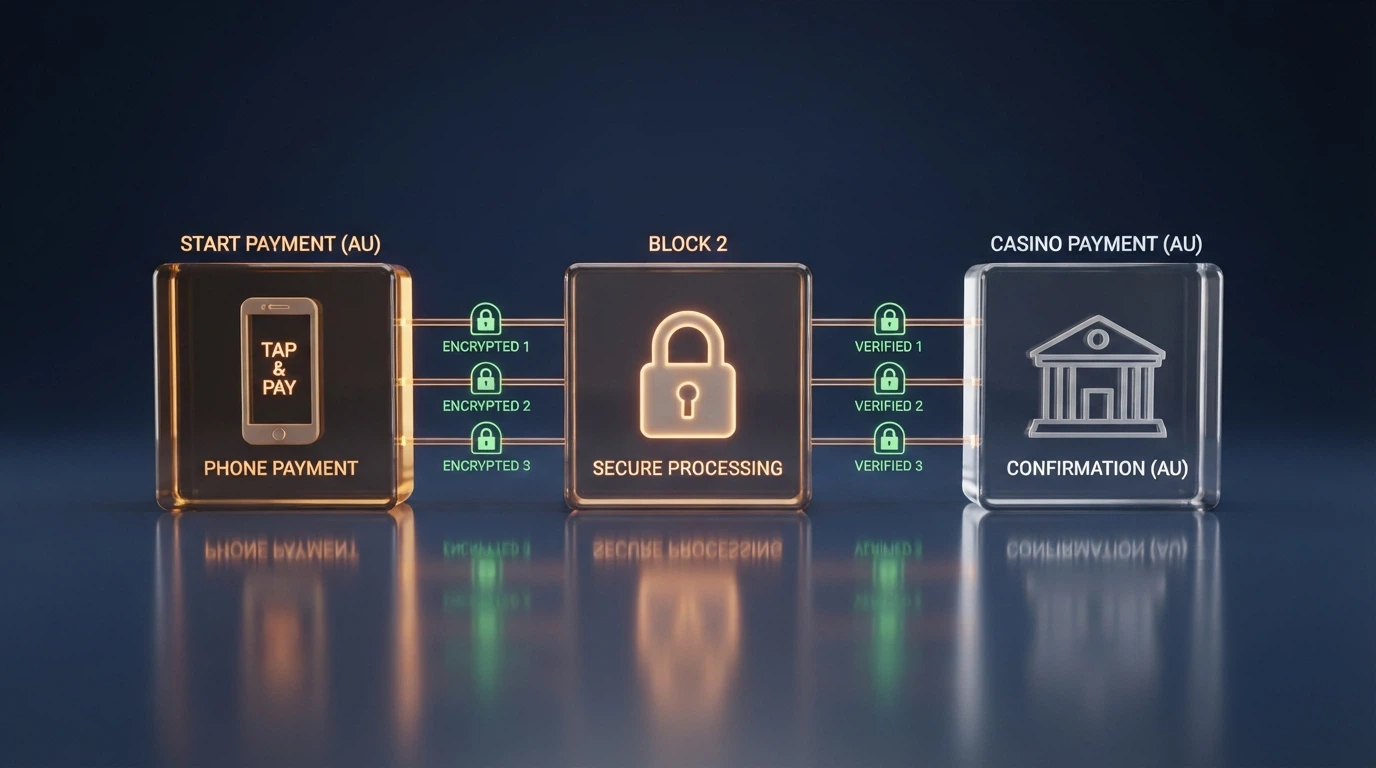
The payment gateway is the front-end integration. It is the piece of software that talks to the cashier, formats the transaction for the relevant rail, and dispatches it. The payment processor is the back-end counterparty — Visa’s network, Mastercard’s network, PayPal’s internal ledger, a crypto node — that actually moves the money. The two are routinely used interchangeably in marketing, but they are different layers with different failure modes. A gateway outage means deposits are not appearing; a processor outage means the money is not moving; the player experiences both as “the site is broken”, but the underlying cause is different and the remediation is different.
The infrastructure decisions an operator makes at this layer are what determines the cashier a player sees. A casino that integrates Visa, Mastercard, PayID, POLi, three e-wallets and six cryptocurrencies has a deeper integration budget than a casino that integrates cards and one e-wallet, and the depth of that integration is what shows up as a longer list of supported methods and a faster deposit-to-balance time. The deposit side is largely automated — tokenisation, 3-D Secure, fraud screening — and the approval takes seconds. The withdrawal side involves a human- or rules-engine review at the operator’s finance team, and the time that review takes is what determines the cashout speed.
Payment Gateways and Processing: How Your Money Actually Moves
A deposit starts with the player clicking a deposit button. The casino’s cashier calls the payment gateway, which formats the transaction for the chosen method. For a card, the gateway tokenises the card data and dispatches an authorisation request to the card network. The card network routes the request to the issuing bank, which runs fraud checks, applies 3-D Secure 2 if required, and returns an approve or decline. The whole thing takes one to three seconds in the happy path. The gateway receives the approval, the casino’s balance service credits the player’s account, and the player sees the money.
A withdrawal starts with the player requesting a cashout in the cashier. The casino’s finance system checks KYC, checks for bonus-wagering completion, checks for any active deposit limits, and queues the request for approval. Once approved, the gateway dispatches the payout to the chosen rail. For PayID, the gateway initiates a New Payments Platform transfer; for crypto, the gateway signs and broadcasts the transaction; for bank transfer, the gateway instructs the operator’s banking partner to push a wire. The settlement time from there is the rail’s settlement time: minutes for crypto, hours for PayID, days for a bank wire.
The CDR framework changes the gateway layer. With open banking, a casino can request a payment directly from a player’s bank account via the bank’s API, with the player’s explicit consent. The transaction bypasses the card network, which removes interchange fees from the operator’s cost stack and removes chargeback rights from the player’s tool kit. That last bit is important for the player to understand: an open-banking deposit is not a card deposit, and the consumer protections that come with a card — chargeback rights, Section 75-style safeguards — do not apply. The speed and the fee structure improve; the protection layer does not.
Security, Risk Management and Why Your Casino Payment Is Safer Than You Think
The encryption floor is TLS 1.2. Anything below that is non-compliant. The card-payment standard is 3-D Secure 2, which pushes authentication to the banking app. PCI-DSS compliance is the operating expectation for any operator storing card data, and the trend is to not store it at all — tokenisation means the card number is held by the gateway, not the casino, and a breach at the casino does not yield card data.
KYC is the security layer the player experiences most directly. The first verification takes 24–72 hours typically, and the player submits ID, proof of address and sometimes a payment-method ownership document. The review is manual at smaller operators, automated at the larger ones, and the result determines whether the first withdrawal goes through in an hour or a week. Subsequent withdrawals re-use the verified profile and clear faster.
The fraud screen is what the player does not see. Every transaction is scored by the gateway and the processor against a model that looks at device, IP, transaction size, velocity, geographic location and a long list of behavioural signals. A deposit from a new device, a new IP, a new payment method, in a different currency, within an hour of account opening, gets a higher score and may trigger a manual review. The same logic applies to withdrawals. Withdrawals above A$5,000 are more likely to trigger an enhanced security review, which adds a second layer of identity and source-of-funds checks.
The layered design is the point. TLS 1.2 protects the channel. 3-D Secure 2 protects the card payment. Tokenisation protects the stored data. KYC protects the operator. The fraud screen protects both sides. None of it is infallible, and an offshore operator that goes rogue is not held to the same standard as a licensed one, but the architecture is sound and a player who uses a trusted processor and a strong password is materially safer than the marketing suggests.
Crypto Casino Payments: Fast, Private, and Banned for Licensed Australian Wagering
Cryptocurrency is the fastest payment rail in the market and the most legally exposed. It deserves its own section because the trade-off is sharp in a way no other method’s trade-off is.
The technical case for crypto is clean. A USDT TRC-20 deposit clears in under 60 seconds with a network fee under A$0.50. The same rail for a withdrawal clears in under 15 minutes. The operator’s internal approval is the bottleneck, and at the best operators that approval is automated. Bitcoin confirmation is 10–30 minutes; Ethereum is 5–15; the network does not slow down for the operator, and the operator cannot slow down the network. The withdrawal limits are the highest in the market — up to A$100,000 on some sites — and Rainbet, named in the operator table below, runs no maximum limit on crypto at all.
The legal case is the other side. Cryptocurrency is banned as payment for licensed Australian wagering from 11 June 2024. The ban does not bind offshore operators, which is why the cashier of every major AU-facing offshore brand lists Bitcoin, Ethereum, USDT, Litecoin and a long tail of altcoins. But the ban is a signal of regulatory direction, and the direction has not been towards greater permissiveness. Effective 1 January 2027, the Interactive Gambling Amendment (Gambling Reform) Bill 2026 empowers banks to block transactions to illegal operators. The bank-blocking provision is not aimed at crypto, but it sits inside a regulatory frame that has already named crypto as a rail the licensed market must not use, and the cumulative signal is that the legal status of crypto for gambling is moving in one direction.
The privacy case is the part the marketing loves. Crypto keeps bank details off the casino server. The casino sees a wallet address, not a bank account. The bank sees an on-chain transaction to a wallet address, which most banks do not yet classify as a gambling transaction. The result is a layer of separation between the player’s identity and the gambling activity that no fiat method provides.
Bitcoin and Crypto Deposits: How They Work at an Offshore Casino
The flow is the same for every cryptocurrency: the casino generates a deposit address, the player sends funds from their wallet, the blockchain confirms the transaction, and the casino credits the balance.
For Bitcoin, the confirmation window is 10–30 minutes. The casino will typically credit after a certain number of confirmations — one or two for smaller amounts, three or more for larger ones. The network fee is variable and depends on congestion; in quiet periods it is a few dollars, in busy periods it can spike. For Ethereum, the confirmation is faster — 5–15 minutes — and the network fee is the gas cost, which is similarly variable. USDT on TRC-20 is the cleanest rail for cost predictability: under A$0.50 per transaction regardless of size, and under 60 seconds for a deposit, under 15 minutes for a withdrawal. USDT on ERC-20 inherits Ethereum’s gas costs and is materially more expensive.
The casino’s internal approval is the real bottleneck, not the blockchain. A Bitcoin confirmation that takes 20 minutes is irrelevant if the operator’s finance team holds the withdrawal for 12 hours before releasing it. The fastest operators in the crypto space are the ones that have automated the approval queue to a ceiling and only escalate to manual review above it.
The withdrawal limit story is what brings high rollers in. Crypto methods have the highest withdrawal limits at AU-facing casinos, up to A$100,000 on some sites, and Rainbet’s no-maximum policy is the most generous in the market. A player moving A$50,000 in winnings out of a casino is not going to do it on a debit card, will not want to wait a week for a bank wire, and will find the e-wallet ceiling restrictive. Crypto is the rail that matches the size of the win.
The Crypto-Anonymity Trade-Off: Privacy vs No Recourse
Crypto’s privacy is real, and the trade-off is real too. The same feature that keeps bank details off the casino server — the wallet address as identity — is the feature that means there is no Australian consumer protection in the loop. If the operator refuses a withdrawal, voids a win, or disappears, the player has no recourse. ACMA cannot recover money from an offshore operator. The operator is not connected to BetStop. The site can be blocked by an ISP-level request from the regulator at any time, with a player balance in limbo.
There is also a market risk. The Australian dollar value of a crypto balance moves with the underlying coin. A player who deposits A$1,000 in Bitcoin and wins, then waits 24 hours for the withdrawal to be approved, can find the AUD value of the win has moved 5% in either direction between deposit and withdrawal. The casino pays out in the same coin, not in AUD, and the conversion happens on the player’s side.
The 2026 reform’s bank-blocking provision is the part to plan around. Starting 1 January 2027, the Interactive Gambling Amendment (Gambling Reform) Bill 2026 grants banks and payment providers express authority to block transactions to illegal gambling operators. The provision is targeted at fiat flows, but the regulatory framing is unambiguous: the AU government is moving to choke the payment flow to offshore gambling operators, and crypto is on the radar. A player using crypto for offshore play is using a rail the regulator has already named, in a market the regulator is actively trying to restrict, under rules that are tightening rather than loosening. That is not a reason to avoid crypto for deposits; it is a reason to know what the trade is.
How to Pick a Payment Method That Fits Your Play Style
The best payment method is the one that matches how a player actually plays. There is no universal answer, and any list that claims to have one is selling something. A high roller moving A$50,000 in a single cashout has a different problem from a casual player withdrawing A$200 on a Friday night, and the right rail for each is not the same rail.

The first filter is universal: safety and security. A method that does not clear the safety bar is not eligible for the rest of the decision, and the safety bar is not negotiable.
- Encryption and authentication: TLS 1.2 or higher on every connection; 3-D Secure 2 for card payments; PCI-DSS-compliant processing.
- KYC as a security layer: every offshore casino requires identity verification before the first withdrawal. KYC is a sign the operator is at least running a real compliance process, not a sign the operator is stalling.
- The payment method is itself a tell: an operator asking for a credit card or crypto is operating outside Australian rules. The licensed product is funded by debit, bank transfer, PayID/Osko or BPAY only. The offshore product asks for everything.
- Trusted processors over unknown ones: Visa, Mastercard, PayID, POLi, Skrill, Neteller, MiFinity, PayPal and the major crypto gateways have brand-level accountability. A no-name processor with no reputation is a risk that does not need to be taken.
Once the safety bar is cleared, the method that wins is the one that matches the priority. Speed, privacy, simplicity, bonus eligibility, and size of withdrawal all point to different rails.
Fastest payout: USDT on TRC-20, with Bitcoin and Ethereum as close seconds. The crypto rail is the only one where deposit and withdrawal are symmetrically fast and the ceiling is high enough for serious winnings.
Most private: Crypto. No bank details shared with the casino; the bank sees an on-chain transaction to a wallet address, not a gambling merchant. The trade-off is the absence of every Australian consumer protection.
Simplest: PayID. Instant deposit, same-day withdrawal, no fees, no separate account to fund, no currency conversion. The minimum friction of any fiat rail.
Best for bonus eligibility: E-wallets and PayID. Most welcome offers accept deposits via any non-restricted method, but Skrill and Neteller are sometimes excluded from bonus eligibility at certain operators. PayID and debit card are the safest defaults for a player who wants the bonus to count.
Best for high rollers: Crypto, specifically USDT or Bitcoin at an operator with high or no maximum limits. The fiat rails all cap out well below what a serious win can produce.
Best for budgeting: Prepaid vouchers. A player buys A$50 of Neosurf, deposits it, plays it, and stops. The hard cap is the feature, not the limitation.
Best for AU-local fiat: PayID. It is the only AU-native rail that is fast on both sides, free, and not subject to the gambling restrictions that have hit Skrill and Neteller accounts.
The Online Casinos Australian Players Are Using in 2026 — and How They Handle Your Money
Every operator named in the table below is offshore. There is no Australian casino licence — none exists. The IGA prohibits online casino, online pokies and in-play betting, and the federal regulator has blocked 1,564 illegal gambling and affiliate websites since November 2019. The brands a player reaches from Australia are the brands that have not yet been blocked, that have not withdrawn from the market voluntarily, and that have integrated payment rails Australian players can actually use. The table ranks them on payment-method range, deposit and withdrawal speed, limits, and bonus terms where confirmed.
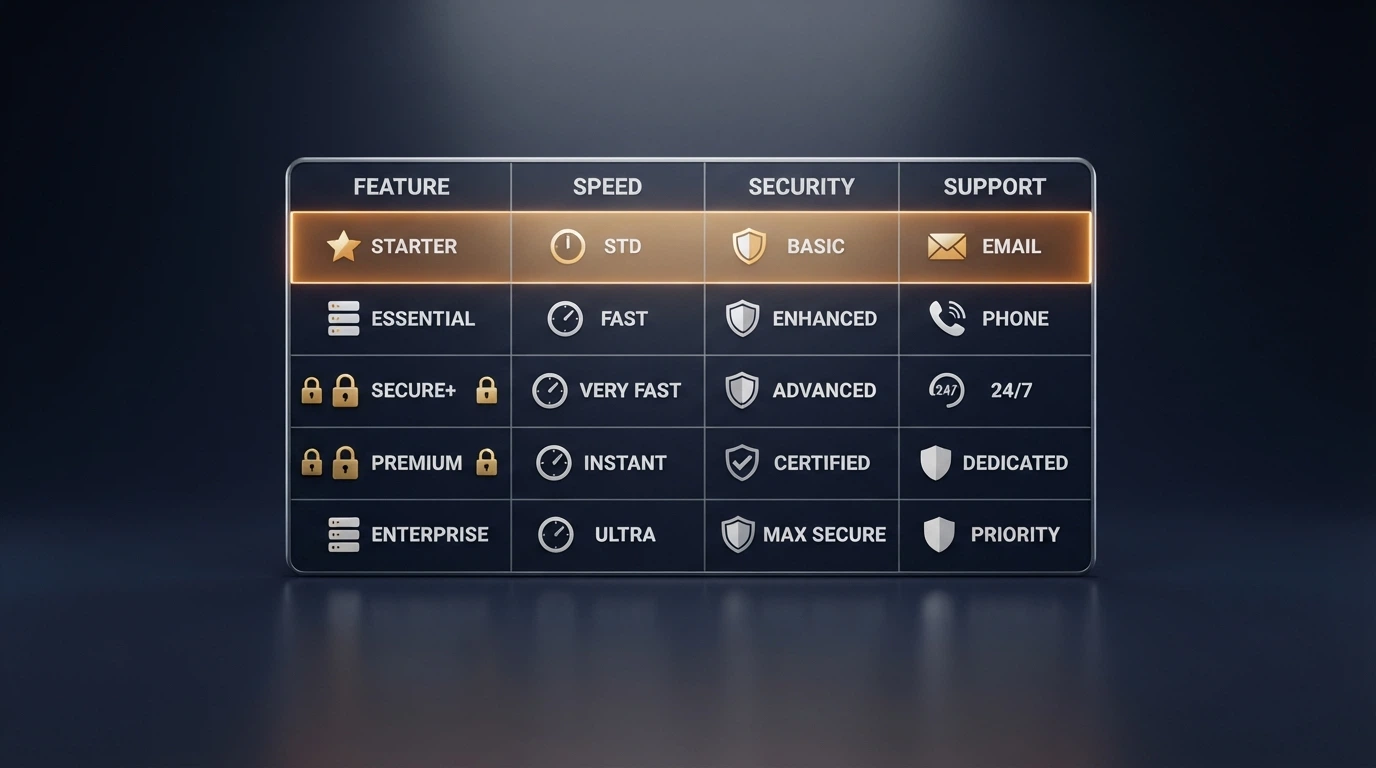
| Operator | Licence Status | Welcome Bonus | Crypto Support |
|---|---|---|---|
| Rocket Play | Offshore (no AU casino licence) | 100% up to A$1,000 + 100 FS (Aztec Magic), x40 wagering, 14-day validity | BTC, LTC, ETH, USDT |
| Skycrown | Offshore (no AU casino licence) | Up to A$3,000 + 350 FS across deposits, 30x wagering | BTC, ETH, LTC, USDT |
| Royal Reels | Offshore (no AU casino licence) | 100% up to A$500 + 50 FS, 35x–40x wagering, 30-day validity | BTC, ETH, LTC |
| Bizzo Casino | Offshore (no AU casino licence) | — | BTC, ETH, LTC, USDT, DOGE, Ripple, Solana, Cardano, Binance Coin |
| WinSpirit | Offshore (no AU casino licence) | — | — |
| Stake | Offshore (no AU casino licence) | — | BTC, ETH, LTC, USDT and more (crypto-primary) |
| Fair Go | Offshore (no AU casino licence; Curacao eGaming, Deckmedia N.V.) | Five-tier package totalling A$1,000 | Bitcoin Lightning, BTC, ETH |
| Rainbet | Offshore (no AU casino licence) | — | 24 cryptocurrencies plus wrapped versions |
| Scream Casino | Offshore (no AU casino licence) | — | — |
| Rocket Casino | Offshore (no AU casino licence) | — | — |
The table leaves gaps on purpose. Where a bonus figure or a payment-method list was not confirmed, the cell carries a dash rather than a guess. A reader who needs that figure should check the operator’s cashier page directly.
Rocket Play
Rocket Play takes a broad spread of payment methods — Visa, Mastercard, Bitcoin, Litecoin, Ethereum, Tether, Neteller, Skrill, EcoPayz, MiFinity, Sofort, Jeton, iDebit — which is the deepest fiat-and-crypto integration of any operator in the table. The welcome offer is a 100% match up to A$1,000 plus 100 free spins (20 per day for 5 days on Aztec Magic), with a x40 wagering requirement, a 14-day bonus validity, a A$30 minimum deposit, and a A$300 maximum cashout on the free-spin winnings.
The x40 wagering on a A$1,000 bonus means A$40,000 of qualifying turnover before withdrawal. At A$1 per spin on a 5-second interval, that is 40,000 spins, or 200,000 seconds, or about 56 hours of continuous play. The 14-day validity is the limit that turns the math into a real constraint: 56 hours of play in 14 days is roughly 4 hours a day, every day, before the bonus expires. Players who treat bonuses as a leisurely add-on will not clear this one; players who can carve out the time will. The A$300 free-spin cashout cap is the figure that quietly caps the upside — the free spins are a small piece of the bonus, but they are the only piece with a hard ceiling, and a player who lands a large free-spin win will see the surplus written off.
The right reader for Rocket Play is someone who wants a single cashier with every fiat and crypto rail they are likely to need, who is comfortable with a high wagering factor in exchange for a large headline match, and who is willing to clear it within the 14-day window. A player who values a large headline bonus and has the discipline to clear it will find a fit here; one who prefers a low-turnover bonus will find the wagering hurdle too high.
Skycrown
Skycrown runs a multi-stage welcome package up to A$3,000 + 350 free spins across the first few deposits, with the first deposit a 100% match up to A$500 plus 225 free spins. Wagering is 30x on the bonus amount, the minimum deposit is A$20, and the payment-method list is the most AU-local in the table: Visa, Mastercard, PayPal, Skrill, Neteller, POLi, Instant EFT, PayID, Bitcoin, Ethereum, Litecoin and USDT.
E-wallet withdrawals process within 24 hours; bank transfers take 3–5 business days. PayID support is built in. The 30x wagering is meaningfully lighter than Rocket Play’s x40, and the multi-stage structure means the player is not trying to clear a single large bonus but a sequence of smaller ones, each with its own timeline.
The right reader for Skycrown is an AU player who wants a single operator that supports PayID and PayPal on both deposit and withdrawal, who is comfortable with a multi-stage bonus structure, and who values the lighter wagering over the headline-grabbing size of a single-deposit offer. A player who likes spreading the bonus effort over several stages will find this package effective, while one who wants a single, straightforward offer may prefer a simpler structure.
Royal Reels
Royal Reels pairs a low A$10 minimum deposit with the fastest stated cashout times in the table — PayID and crypto payouts average 3–4 hours, against the multi-day timelines elsewhere. The welcome bonus is a 100% match up to A$500 plus 50 free spins, with 35x wagering on the match and 40x on the welcome pack with free spins, a 30-day bonus validity, and an A$50 minimum withdrawal. There is also a no-deposit A$10 sign-up bonus with 30x wagering, A$200 maximum winnings and 30 days of validity, which is one of the more player-friendly no-deposit structures in the market.
The payment-method list covers PayID, POLi, Visa, Mastercard, Bitcoin, Ethereum, Litecoin, Skrill and Neteller. The weekly withdrawal cap is A$10,000, which is a constraint a high-stakes player will hit but which is irrelevant for most. The 3–4 hour PayID and crypto cashout times are the real differentiator — most operators quote 24 hours on PayID and a similar ceiling on crypto, and Royal Reels sits at the bottom of that range.
The right reader for Royal Reels is an AU player who values cashout speed above bonus size, who is comfortable with a low headline match in exchange for a fast rail, and who likes the idea of a small no-deposit bonus to test the cashier before committing. A player prioritising speed and a low entry threshold will value this cashier, whereas one hunting for a giant welcome match will likely find the headline figure too modest.
Bizzo Casino
Bizzo Casino’s payment story is the widest in the table. Deposits start from A$10 (A$50 for crypto) and the cashier supports PayID, Visa, Mastercard, Neosurf, Apple Pay, Google Pay, Bitcoin, Ethereum, Litecoin, USDT, DOGE, Ripple, Solana, Cardano and Binance Coin — a fiat-plus-crypto spread of fifteen-plus methods. PayID minimum withdrawal is A$100; bank transfer minimum is A$50. Crypto and e-wallet withdrawals are instant to 24 hours.
The bonus terms vary by operator and should be checked on the operator’s bonus page. What is confirmed is the cashier’s depth, which is the point. A player who wants a single operator with Apple Pay and Google Pay for deposit, PayID for AU-local fiat, Neosurf for voucher deposits, and nine cryptocurrencies for the larger rails, will find that combination here and at very few other places in the market.
The right reader for Bizzo Casino is a player who wants every rail on one cashier, who is happy to verify the bonus terms on the operator’s site, and who values the Apple Pay and Google Pay deposit convenience for mobile play. An AU player who prioritises cashier depth and convenience will find a home here; one needing clarity on welcome offers upfront will likely prefer an operator with public bonus terms.
WinSpirit
WinSpirit is an AU-facing offshore operator with a presence on the affiliate-tracked traffic to Australian players, but the payment methods and bonus terms for this brand were not confirmed in the course of research. A player considering WinSpirit should check the operator’s cashier page directly for the current payment-method list, minimum deposits and withdrawal terms, and bonus conditions. AU-facing casinos at this tier typically offer the standard fiat rails — Visa, Mastercard, PayID, POLi, bank transfer — and one or more of the e-wallet and crypto options, but the specifics vary and the operator’s own cashier is the only source that is current.
The right reader for WinSpirit is a player who has already looked at the cashier, who has confirmed the payment methods and bonus terms, and who is comfortable with the offshore status. The honest read for a player who has not done that yet is that the operator’s cashier page is the next step.
Stake
Stake runs a cryptocurrency-primary model, which means the cashier is built around Bitcoin, Ethereum, Litecoin, USDT and a long tail of altcoins. The fiat off-ramp is bank wire, and the timeline is 4–10 business days — slower than the bank transfer timelines quoted elsewhere, with the same A$25–40 receiving-bank fee on international wires. Bonus terms vary by operator and should be checked on the operator’s terms page.
The right reader for Stake is a crypto-native player who is happy to fund and withdraw in digital currency and who is comfortable with a slower fiat exit when they want to convert back to AUD. A crypto-native user will find the liquidity here unmatched, while a player reliant on fiat channels will find the cashier options limited compared to more traditional operators.
Fair Go
Fair Go’s pitch is the low minimum. Deposits from A$5 are supported via Bitcoin Lightning, Bitcoin and Ethereum, and from A$45 via bank transfer. The five-tier welcome package totals A$1,000 across the first five deposits, which is a long runway for a player who likes to deposit small and build up. The operator runs a Curacao eGaming licence under Deckmedia N.V., with 280 games and 24/7 support.
The withdrawal methods are wire transfer, Bitcoin and eZeeWallet. The wire transfer is the slow lane at 3–7 business days; the Bitcoin and eZeeWallet rails are faster. The game library is smaller than the bigger brands — 280 games is a tight selection — but the A$5 minimum deposit is the lowest in the market for crypto funding and a real feature for a player who wants to test an operator with a small stake before committing.
The right reader for Fair Go is a player who wants a low-deposit entry point, who is comfortable with crypto funding, and who is happy to use a smaller game library in exchange for the small minimums. The wrong reader is a player who wants a single huge welcome bonus, where the five-tier structure dilutes the headline.
Rainbet
Rainbet is the most crypto-dense operator in the table — 24 cryptocurrencies plus wrapped versions, with minimum deposits from $5 (Solana, Litecoin, DOGE) to $15 (BTC, ETH, USDT) and withdrawals from $15 with no maximum limit. The fiat on-ramps are SEPA, Interac, Pix and AstroPay at a $15 minimum with full KYC, plus Kinguin gift cards from $10–$500 funded by Visa, Mastercard, Paysafecard or Trustly.
The no-maximum-limit on crypto withdrawals is the headline. A player who has won a large amount and needs it out without the operator’s withdrawal ceiling biting will find Rainbet’s policy the most generous in the table. The fiat options are limited to a few regional rails — SEPA for Europe, Interac for Canada, Pix for Brazil, AstroPay as a multi-region e-wallet — which means an AU player funding in fiat will likely use AstroPay or a Kinguin gift card, and an AU player withdrawing in fiat will likely go through a bank transfer.
The right reader for Rainbet is a crypto-native high-stakes player who wants no withdrawal ceiling and is comfortable with the operator’s fiat-light cashier. The wrong reader is a fiat-only player, who will find the deposit and withdrawal options too thin to commit to.
Scream Casino
Scream Casino is an AU-facing offshore operator with a presence on the affiliate-tracked traffic, but the payment methods, minimum deposits and bonus terms were not confirmed in the course of research. A player considering Scream Casino should check the operator’s cashier page directly for the current payment-method list, minimum deposits, withdrawal terms and bonus conditions. AU-facing casinos at this tier typically offer the standard fiat rails — Visa, Mastercard, PayID, POLi, bank transfer — and one or more of the e-wallet and crypto options, but the specifics vary and the operator’s own cashier is the only source that is current.
The right reader for Scream Casino is a player who has already checked the cashier, who has confirmed the payment methods and bonus terms, and who is comfortable with the offshore status. The honest read for a player who has not done that yet is that the operator’s cashier page is the next step.
Rocket Casino
Rocket Casino is an AU-facing offshore operator with a presence on the affiliate-tracked traffic, but the payment methods and bonus terms for this brand were not confirmed in the course of research. A player considering Rocket Casino should check the operator’s cashier page directly for the current payment-method list, minimum deposits and withdrawal terms, and bonus conditions. AU-facing casinos at this tier typically offer the standard fiat rails — Visa, Mastercard, PayID, POLi, bank transfer — and one or more of the e-wallet and crypto options, but the specifics vary and the operator’s own cashier is the only source that is current.
The right reader for Rocket Casino is a player who has already looked at the cashier, who has confirmed the payment methods and bonus terms, and who is comfortable with the offshore status. The honest read for a player who has not done that yet is that the operator’s cashier page is the next step.
How We Evaluated Payment Methods for Australian Casino Players
The evaluation on this page draws on three sources: the ACMA’s published positions and enforcement record, the operator cashier pages of the brands named in the table, and the affiliate testing data that has produced comparable withdrawal-speed numbers for the AU-facing market. Each operator was checked against the official regulatory framework — the Interactive Gambling Act 2001, the ACMA enforcement record, the licence register of the offshore regulators that oversee the brands listed — and each payment method was checked against the legal status of the rail in Australia, which is to say against the IGA’s credit-card and crypto prohibition for licensed wagering.
The criteria that ordered the ranking were: payment-method range, deposit and withdrawal speed, minimum and maximum limits, bonus terms where confirmed, and the legal status of each method under Australian law. There is no weighting system here, no percentage score, no quantitative index — the page describes what the data shows, and the ranking is editorial. A reader who weights withdrawal speed above all else will arrive at a different ordering than a reader who weights bonus size, and the page does not pretend that one weighting is correct.
The limits of the evaluation are worth stating. The operators named in the table are offshore, and the bonus terms and payment-method lists that have been confirmed are the ones published on the operators’ own cashier pages or in their bonus terms documents. The unconfirmed figures — the bonus terms for WinSpirit, Stake, Scream Casino, Rocket Casino, and the welcome bonus for Bizzo Casino — are not invented on this page; they are marked as unconfirmed and the reader is directed to the operator’s own page. The payment-method lists for the confirmed operators are the cashier-page lists as of the data check; an operator can add or remove a method between data check and reader visit, and the cashier is the only current source.
The legal status of every operator on this page is the same: offshore, no Australian casino licence, no Australian consumer protection. That is the structure of the market, not an editorial position. The page’s job is to describe it accurately and to name what a player is and is not protected by when they fund an account at any of the brands listed.
Your Next Move: What the Smart Australian Player Does About Casino Payments in 2026
The payment method is the lever a player controls, and the lever is bigger than it looks.

- Pick a method that gives a withdrawal rail, not just a deposit button. Apple Pay, Google Pay, POLi and prepaid vouchers are deposit-only. A player who funds the account with any of them is committing to a second method for the cashout, and the most common second method is bank transfer — the slowest, fee-bearing rail. The default for an AU player should be a method that works on both sides: PayID, debit card, e-wallet or crypto.
- Check the operator’s licence status before depositing. A credit-card or crypto request from a casino is, in the ACMA’s words, “a tell” that the operator is outside Australian rules. The licensed Australian wagering market accepts only debit card, bank transfer, PayID/Osko and BPAY. Any other request is a signal worth reading.
- Use the fastest withdrawal method the operator supports, not the one that was easiest to deposit with. A deposit on a debit card and a withdrawal on PayID is a faster cashout than a deposit and withdrawal both on debit. The cashier allows the asymmetry; the player should use it.
- Set a deposit limit before funding the account. BetStop covers around 150 licensed wagering providers and had 67,480 registrations by 31 July 2026, with 41,290 exclusions still active. Offshore casinos are not connected to BetStop, which means a self-exclusion on the licensed side does not propagate. A player who wants a hard cap needs to set it at the operator level, in the cashier, before the first deposit.
- Keep the helpline number. The National Gambling Helpline on 1800 858 858 is free, confidential, and staffed 24/7, with online chat and email counselling through Gambling Help Online. Around 2.1% of Australian adults — roughly 430,000 people — experience problem gambling. The number is for anyone who needs it, and the help is independent of where a person plays.
- Know that regulation is tightening from 2027. Under the Interactive Gambling Amendment (Gambling Reform) Bill 2026, banks and payment providers gain express authority to block transactions to illegal gambling operators, effective 1 January 2027. This change represents a material shift in the AU gambling payments landscape since the credit-card and crypto bans of June 2024, and it is worth being on the right side of it before it comes into force.
Frequently Asked Questions
Can I use a credit card to deposit at an Australian online casino?
At a licensed Australian wagering operator, no. Credit cards and credit-linked digital wallets were banned as payment for licensed online and telephone wagering from 11 June 2024 under the Interactive Gambling Amendment (Credit and Other Measures) Act 2023, with operator penalties of up to A$247,500 for non-compliance. An offshore casino is not bound by the IGA and may accept a credit card, but doing so signals an operator outside Australian rules, and the consumer protections tied to the licensed product — chargeback rights through the issuer, BetStop coverage, ACMA complaint recourse — do not apply.
What is the minimum deposit at Australian online casinos with PayID?
Most AU-facing offshore casinos set the PayID minimum deposit at A$10, with some operators at A$20 and a few at A$50. The PayID minimum withdrawal is typically higher, in the A$50–A$100 range, and the operator’s cashier page is the current source. PayID is the recommended AU-local fiat rail for both deposit and withdrawal: instant, free, and 24/7 settlement through the New Payments Platform.
What payment methods are banned for online wagering in Australia?
From 11 June 2024, credit cards, credit-related products including digital wallets linked to credit cards, and digital currency (cryptocurrency) are banned as payment for licensed online and telephone wagering. The legal deposit routes for licensed wagering are debit card, bank transfer, PayID/Osko and BPAY. The ban does not bind offshore casinos, which continue to accept credit cards and crypto, but the ACMA names a credit-card or crypto request as a tell that the operator sits outside Australian rules.
Do all casino payment methods qualify for welcome bonuses?
Not always. Some operators exclude Skrill, Neteller and other e-wallets from welcome-offer eligibility, and the exclusion is in the bonus terms, not on the cashier button. PayID, debit card and crypto deposits are the safest defaults for a player who wants the welcome bonus to count. The bonus terms page on the operator’s site lists the qualifying deposit methods, and reading that page before claiming is the difference between a bonus that counts and a bonus that does not.
How do I verify my identity before withdrawing from an Australian online casino?
Every offshore casino requires KYC verification before the first withdrawal. The standard document set is government-issued photo ID (passport or driver’s licence), proof of address (utility bill or bank statement under three months old), and proof of payment-method ownership (a photo of the card used for the deposit, with the middle digits masked, or a screenshot of the e-wallet account). First-time verification takes 24–72 hours at most operators; subsequent withdrawals re-use the verified profile and clear faster. Withdrawals above A$5,000 are more likely to trigger an enhanced security review with a second layer of source-of-funds checks.
Published by the Welcome Bonus Casinos AU team.