
Where Australian Players Can Use Tether (USDT) at Online Casinos in 2026
Casinos that take Tether (USDT) deposits from Australian players are all offshore operators. Online casino is prohibited under the Interactive Gambling Act 2001, no licence exists anywhere in the country, and since 11 June 2024 the credit and crypto payment ban has made the deposit method itself a signal the operator sits outside the Australian rules. This page describes what is on offer — the welcome bonuses, the no-deposit free shots, the TRC-20 versus ERC-20 fee choice, the actual payout speeds — and what an Australian player gives up by playing there. The headline bonus figures are not the issue; the multiplier underneath them is.
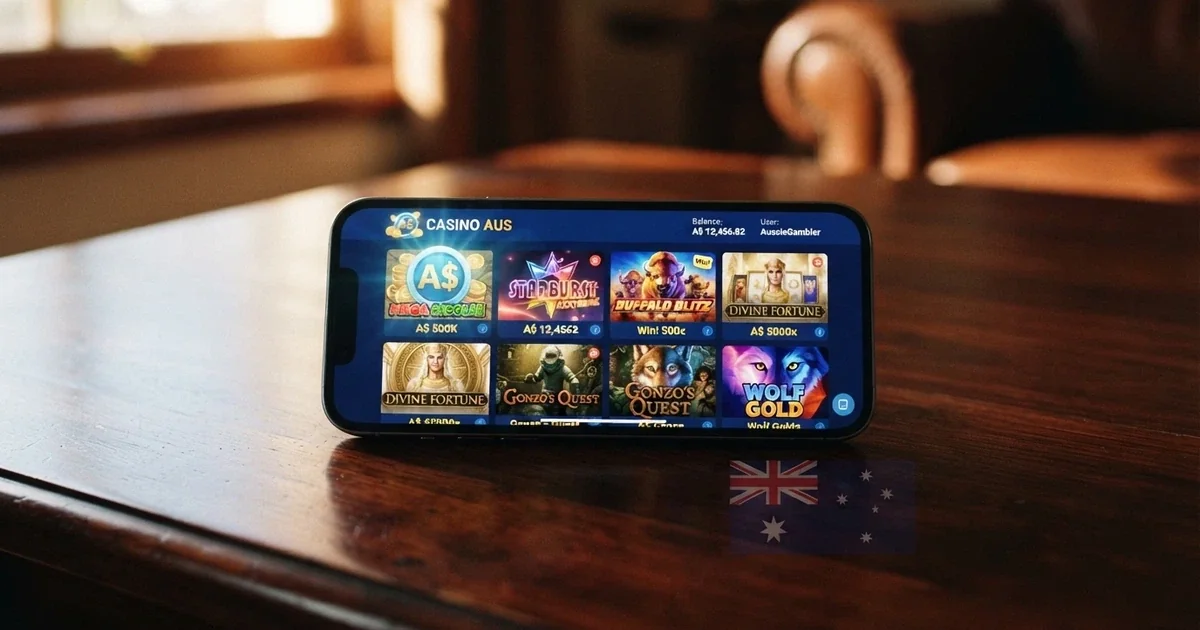
Data current as of 28 October 2026; licence claims verified against operator terms pages and ACMA enforcement records.
Table of Contents
- What a USDT Casino Actually Is — and Why It Matters in Australia
- How USDT Deposits and Withdrawals Work at Offshore Casinos
- Why Your USDT Casino Bonus Looks Bigger Than It Really Is
- The Games You Can Play with USDT at Offshore Casinos
- No-KYC, Provably Fair, and the Real Limits of Crypto Anonymity
- The Top 10 USDT Casinos Reaching Australian Players in 2026
- USDT Pokies on Your Phone: What Mobile Play Actually Delivers
- Every USDT Casino Is Offshore — Here Is What That Costs You
- Staying in Control When the Casino Sits Outside the Rules
- How We Picked and Ranked These Casinos
- What This Means for Your Next Deposit
- Frequently Asked Questions
What a USDT Casino Actually Is — and Why It Matters in Australia
What “USDT casino” actually means
A USDT casino is an online casino that runs its cashier and balance display in Tether rather than in fiat currency. USDT (Tether) is a stablecoin pegged 1:1 to the US dollar, and unlike Bitcoin or Ethereum its price does not move ten per cent between lunch and the evening news. The casino’s house edge, your bets and your running balance are denominated in USDT — one USDT is meant to equal one US dollar at all times, regardless of what the wider crypto market is doing.
That single property changes the bankroll calculus for a player. Deposit AU$300 worth of USDT, win it up to AU$600 over an evening, and you still hold AU$600 of value when you withdraw — provided the peg holds, which the industry treats as reliable. The same session funded with Bitcoin would carry the second risk of a BTC price drop on top of the gambling outcome, and a punter who has ever been paid out in BTC knows the sting of a withdrawal that arrives as fewer dollars than they expected. “Nobody wants to discover their AU$300 withdrawal is now worth AU$240 because BTC dropped 20% overnight,” as one Australian-facing crypto guide put it.
USDT runs on multiple networks — TRON (TRC-20), Ethereum (ERC-20), Solana and BSC (BEP-20). Same token, four different chains, four different fee structures. That detail matters more than the marketing copy suggests, and the section on deposits and withdrawals handles it in full.
Tether vs USDT: why the naming matters
Tether is the company; USDT is the token ticker. Australian casino cashier pages use both interchangeably — a banking tab labelled “Tether” is processing USDT, and a bonus terms page that refers to “Tether deposits” is referring to the same asset. Players who treat them as two different things sometimes end up double-checking a transaction they have already made.
The naming convention is also the easiest way to spot a casino that has only bolted crypto on as an afterthought. Operators that treat Tether as a core payment rail use the ticker (USDT) in their cashier, in their bonus terms and in their internal ledgers. Operators that treat it as a token gesture alternate between names, or refer to “Tether (USDT)” once on a help page and never again.
Crypto casino vs fiat casino: the real difference for Australian players
The difference is not just a payment rail. A fiat online casino that has added a “crypto” tab still runs the same KYC stack it has always run, the same accountant in the same jurisdiction, and the same regulator on the other end of the email. A crypto-first casino — one whose cashier is denominated in USDT and whose entire player journey assumes a wallet-to-casino flow — operates under a different set of incentives. KYC is shallower at registration. Bonus terms are written for crypto deposits. Withdrawal queues are built around wallet addresses rather than bank account numbers.
In Australia the difference is structural for a darker reason: there is no licensed online casino anywhere in the country. Online casino games, online pokies and in-play sports betting are prohibited under the Interactive Gambling Act 2001. Since 11 June 2024, digital currency has been banned as payment for licensed wagering. Any casino accepting a USDT deposit from an Australian player is, by definition, operating outside the Australian rules. The crypto tab is the receipt.
How USDT Deposits and Withdrawals Work at Offshore Casinos
How to deposit with USDT at an offshore casino
The deposit flow runs through four steps. None of them is complicated, and the slowest of them is the part you cannot control.
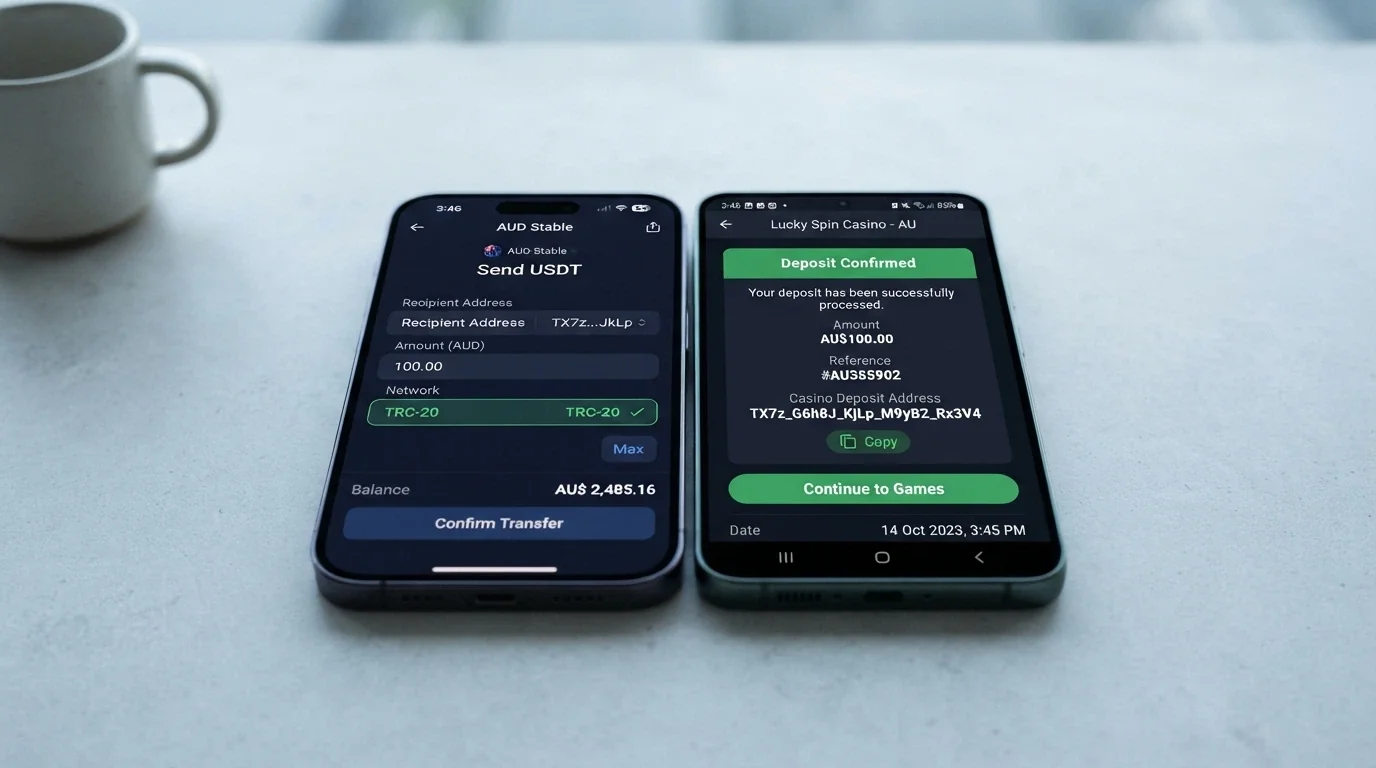
- Open a USDT wallet. Trust Wallet, MetaMask and the TRONLink wallet are the three most common choices for Australian punters. Fund it with AUD by buying USDT on an Australian exchange that supports the asset — CoinSpot, Swyftx and Independent Reserve all do — then withdraw the USDT to your own wallet.
- Pick the network at the cashier. The casino will offer at least TRC-20 and usually ERC-20. Pick TRC-20 unless you have a specific reason not to. A TRC-20 deposit cleared in 47 seconds during an industry test.
- Send to the casino deposit address. Copy the address exactly. The casino will warn you that USDT sent on the wrong network will not be recoverable, and they mean it.
- Wait for confirmations and play. The casino credits your account once it sees enough network confirmations. Casino-side deposit fees were zero at every operator tested during Betsquare’s August 2026 round; the network fee is the only cost.
How withdrawals work — and how fast they actually arrive
The cashout path has three gates: the casino’s internal processing window, any verification the casino still wants to run, and the blockchain confirmation once the casino releases the funds.
Casino-side processing is the bottleneck. Industry figures put it at one to twenty-four hours depending on where the player sits in the verification queue. Once that gate clears, USDT withdrawals are typically processed in under two hours, seven days a week, according to Betsquare’s testing. The fastest verified payout in the set is a SkyCrown USDT TRC-20 withdrawal in twelve minutes during Betsquare’s June 2026 crypto casino test. A standard fiat wire at a licensed wagering operator runs three to five business days by comparison; the speed gap is the headline reason crypto-first casinos are popular.
The next gate is the network. TRC-20 confirms in one to three blocks — three seconds per block on the TRON chain, so the deposit is yours within roughly ten seconds in practice. ERC-20 on Ethereum needs twelve confirmations, which is three to five minutes of waiting. The final gate is the conversion back to AUD, which happens on an Australian exchange and runs a further 0.1% to 1% plus spread.
TRC-20 vs ERC-20: which network saves you money
| Network | Fee per Transfer | Confirmation Time | Best For |
|---|---|---|---|
| TRC-20 (TRON) | ≈US$1 (around A$2) | 1–3 blocks (~3 seconds each) | Casino deposits and withdrawals |
| ERC-20 (Ethereum) | US$15–30 (A$3–15 when busy) | 12 confirmations, 3–5 minutes | Larger transfers where Ethereum tooling matters |
The numbers do not lie. A US$1 fee and a US$30 fee are not competing options; they are different products, and one of them makes sense for a casino deposit and the other does not. TRC-20 was designed for exactly this kind of high-volume, low-fee transfer. ERC-20 was designed for general-purpose smart-contract execution and pays gas fees accordingly. Choosing ERC-20 for a A$200 casino deposit is paying a US$30 toll to cross a bridge that costs US$1.
A third option, BEP-20 on Binance Smart Chain, sits closer to TRC-20 on fees and is supported at a handful of the featured operators. SOL on Solana is the cheapest of all where supported, but the wallet UX is rougher and operator support is patchy. For a punt on a Tuesday night, TRC-20 is the network.
Why Your USDT Casino Bonus Looks Bigger Than It Really Is
Welcome bonuses: what USDT depositors actually get
USDT welcome bonuses at offshore casinos accepting Australian players typically land in the 50% to 200% match range, with multi-deposit packages that split the headline across two to four tiers. Crypto deposits at some operators qualify for slightly better terms than fiat deposits on the same casino — wagering requirements in the 25–35x range versus the 40–50x range a card deposit would carry.
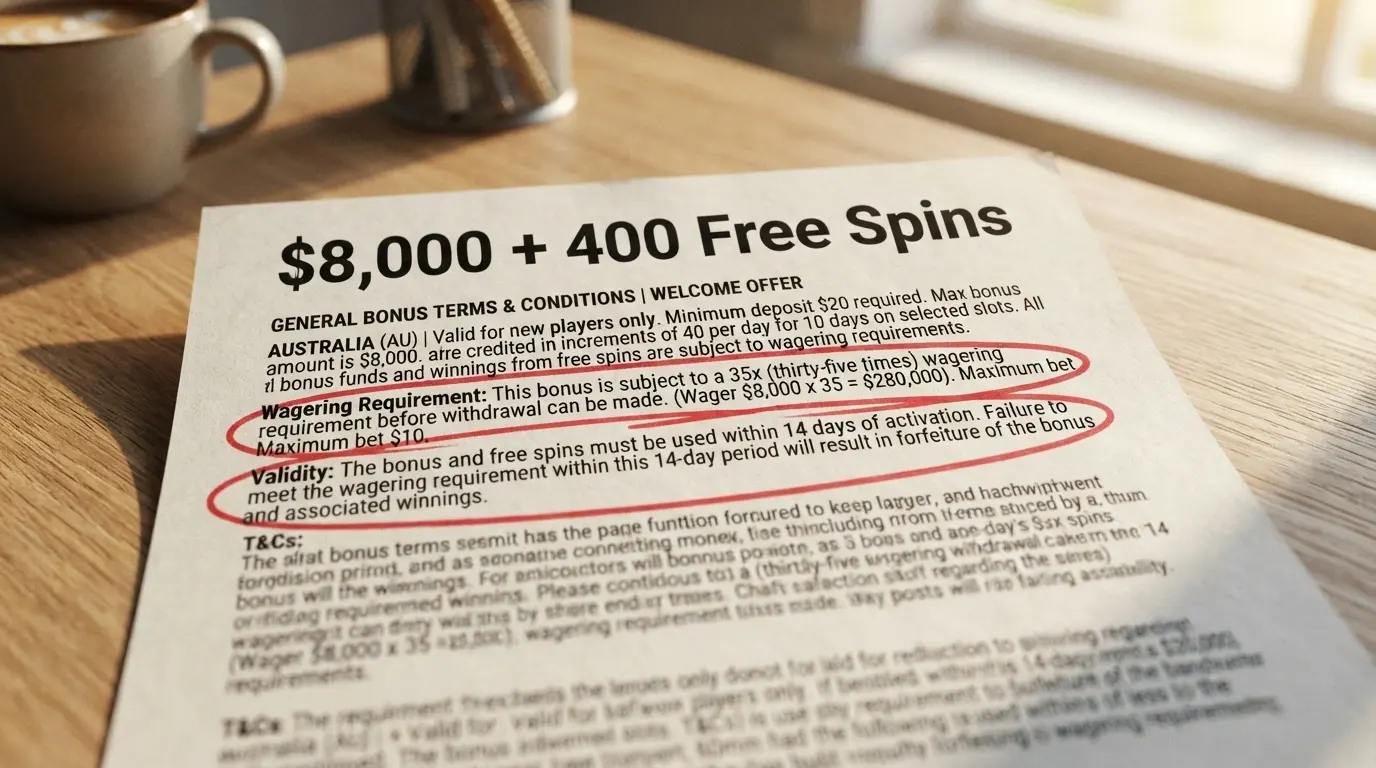
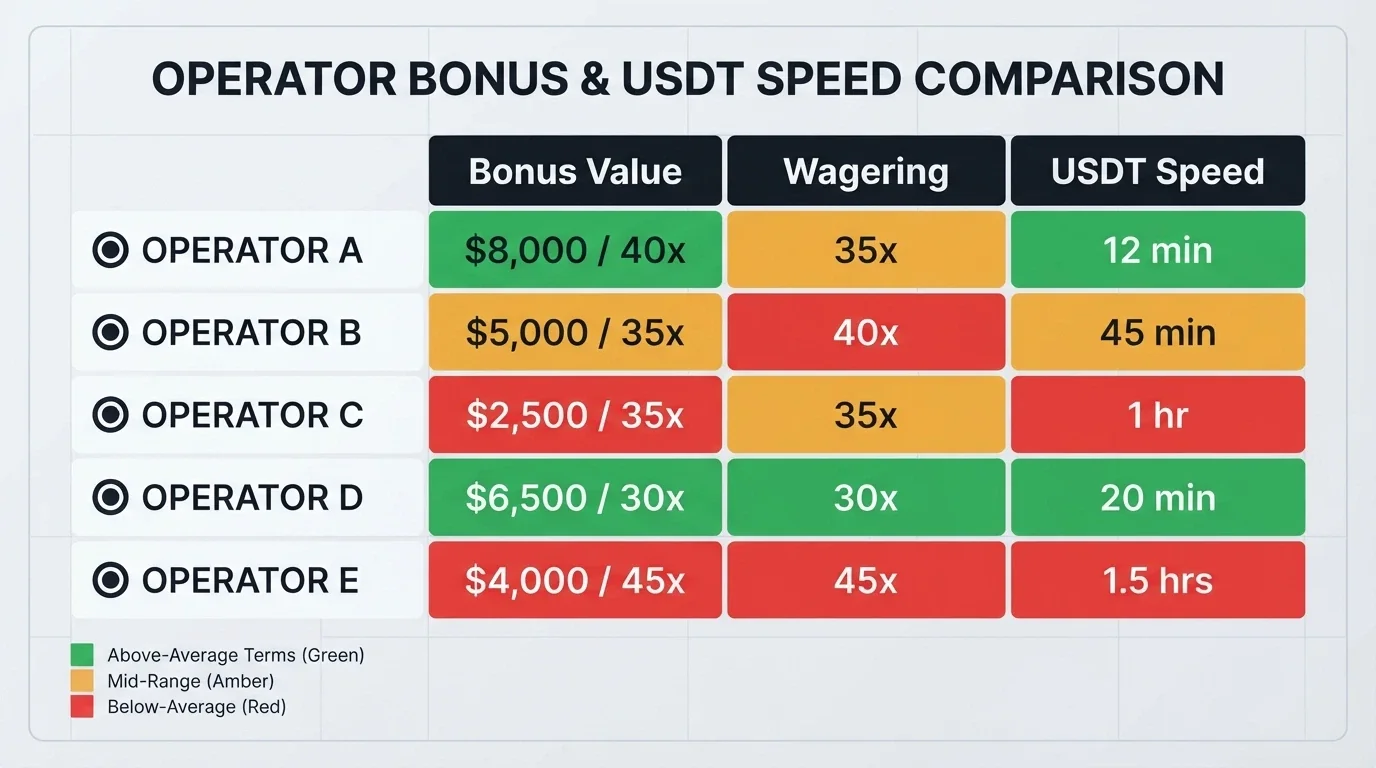
A representative package at the top of the set is SkyCrown’s four-deposit welcome of A$8,000 plus 400 free spins at 40x on the bonus and 30x on free-spin winnings, with 14 days to clear each tier. Royal Reels offers A$2,500 plus 50 free spins across three deposits at 35x on the bonus only, with a A$5 per-spin cap. Bizzo’s package totals up to A$7,250 plus 175 free spins plus a bonus game. The headline figures are not the issue; the multiplier and the clock underneath them are.
The bonus is only as valuable as the wagering requirement makes it. A A$1,000 bonus at 35x means A$35,000 of turnover before any of it is withdrawable. A A$1,000 bonus at 50x means A$50,000. The same headline number is doing very different work at each multiple.
No-deposit bonuses: the rare free shot
A handful of operators offer a no-deposit entry — a small bonus that lands without a deposit. They are useful, but the terms are tight and the cashout caps are low.
Royal Reels offers a A$10 no-deposit bonus after phone verification, with 30x wagering on the bonus. Bizzo gives 10 free spins for downloading and installing its mobile PWA app, with 40x wagering and a seven-day expiry. FairGO runs no-deposit chips and free spins at a steeper 60x wagering. Rocket Casino references up to 125 no-deposit spins, capped at AU$75 maximum cashout — the lowest free-spin ceiling in the set.
The pattern across the no-deposit space is consistent: small upfront value, high wagering, low cashout cap, short expiry. A no-deposit bonus is a way to test a casino’s lobby without funding it, not a way to make money.
Why the wagering makes your bonus smaller than it looks
The headline number on a bonus page is the smallest amount of information that page contains. The wagering multiple is the number that determines whether the offer is worth claiming.
The market norm for USDT bonuses sits between 30x and 40x on the bonus amount, with 30x to 35x considered fair and anything over 50x considered unfavourable. The set across the featured operators runs from Royal Reels’ 35x on bonus only to Rocket Casino’s 45x on free-spin winnings and FairGO’s 60x on no-deposit chips. SkyCrown’s headline-grabbing A$8,000 package carries 40x on the bonus and 30x on free-spin winnings, with 14 days to clear each tier — meaning a punter who claims the full package is committing to roughly A$320,000 of turnover inside a fortnight to unlock the bonus balance.
Wagering on bonus-only is meaningfully kinder than wagering on bonus-plus-deposit. The former scales with the bonus; the latter scales with the bonus and the deposit together, doubling the required turnover before any of it is withdrawable. Where the terms page does not say explicitly which model applies, assume the worse one and read it again.
Then there is the validity window. Fourteen days at SkyCrown, twenty-four hours per batch at RocketPlay, seven days on Bizzo’s mobile-app bonus. A wagering requirement that is mathematically achievable at five hours of play per day becomes punishing if the player takes the bonus on a Friday and only opens the laptop on Sundays.
The Games You Can Play with USDT at Offshore Casinos
Live dealer tables: what you can play with USDT
The live-dealer lobby is where crypto casinos compete hardest, and the categories are familiar from any regulated market: roulette (European, American, Lightning-style variants), blackjack (classic, infinite, speed), baccarat, casino poker (Casino Hold’em, Three Card Poker, Caribbean Stud), and game-show titles (Dream Catcher, Monopoly Live, Crazy Time). The studios powering the tables are the same names that supply the rest of the industry — Evolution, Pragmatic Play Live, Ezugi — and the streams run in real time from studios in Malta, Latvia, Romania and the Philippines.
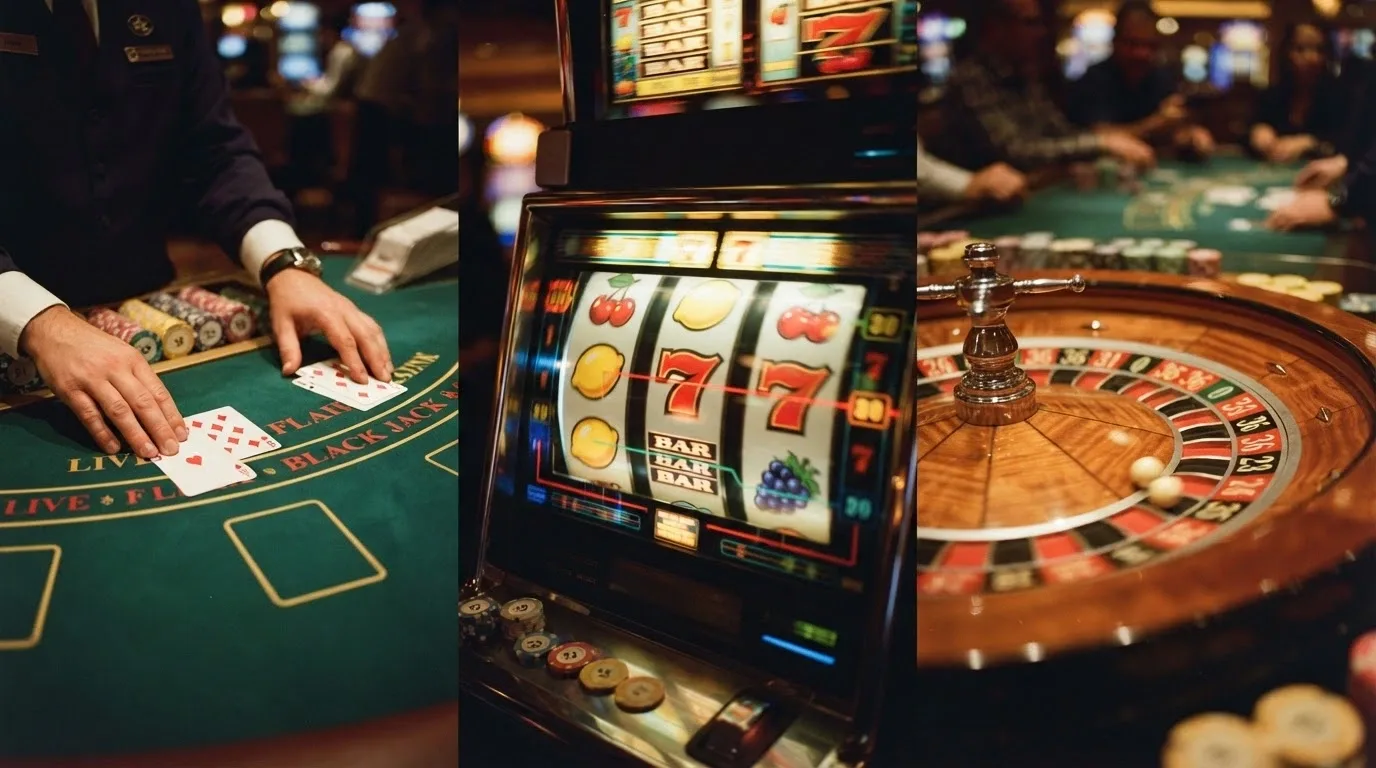
The depth of the live lobby varies sharply by operator. A SkyCrown player can sit at a Lightning Roulette table with hundreds of other punters in real time; a FairGO player is on an RTG-only catalogue that leans heavily on RNG. The lesson for a USDT punter is the same as it is for a fiat punter: check the lobby before you deposit, because the live-dealer offering is the clearest signal of how much a casino is investing in player experience.
Pokies: the Australian player’s main game
Pokies are the volume category at every USDT casino reaching Australian players. The library size is where the spread is widest: SkyCrown lists more than 10,400 games from 50-plus providers; Royal Reels carries 5,400-plus pokies from 40-plus providers; FairGO runs an RTG-only catalogue that is small by comparison but reliably stocked with the Australian-favourite titles RealTime Gaming has been producing for two decades.
The provider mix is the thing worth checking. Pragmatic Play, NetEnt, Microgaming, Play’n GO, BGaming, Hacksaw Gaming and Nolimit City are the names that signal a serious aggregator; their presence indicates the casino is paying for access to a deep game catalogue and is competing on player experience rather than on bonus headline size. An RTG-only operator is a different proposition — narrower, more dated, but predictable.
Pokie RTP and volatility disclosures vary. The larger aggregators publish per-title RTP figures on the game info page; smaller libraries sometimes do not. Volatility (low, medium, high) is a useful proxy for variance, and most modern pokies display it somewhere in the help screen. Where the casino does not surface either figure, the player has no way to verify it short of reading the developer’s own catalogue.
Providers, provably fair, and the demo-mode safety net
The major providers do not differ much between casinos — SkyCrown’s list of Pragmatic Play, NetEnt, Microgaming, Play’n GO, BGaming, Hacksaw, Nolimit City and 40-plus others is representative of what a serious aggregator carries. A casino that lists fewer than ten providers is signalling something about its procurement budget, and the player should not assume the catalogue will fill out later.
Provably fair is the crypto-native trust layer that lets a player verify each spin or hand. The casino publishes a server seed before play; the player supplies a client seed; a hash of both seeds plus a nonce determines the outcome. After the bet, the player can check the hash against the seed pair to confirm the casino did not change the result mid-play. Provably fair is a meaningful check on a crypto-native platform, and the larger operators in the set publish their provably fair methodology somewhere in the help section.
The single smartest pre-deposit move is the demo mode. Every casino in the set lets a registered player open the lobby and launch most pokies in demo play with no deposit. Run a few hundred spins on a title you have never seen. If the game stalls, the mobile web view renders badly, or the help page crashes, you have learned what you need to know without funding the account.
No-KYC, Provably Fair, and the Real Limits of Crypto Anonymity
What “no verification” actually delivers at a crypto casino
No-KYC at a crypto casino means no passport upload and no proof of address at sign-up. The registration form takes an email address and a password, the cashier takes a wallet address, and the player is in the lobby. That is the proposition, and at the smaller crypto-native casinos it is delivered as advertised — at least until the first withdrawal.

The limit shows up at the cashout. Every operator in the set, including the no-KYC brands, has a withdrawal threshold above which it will ask for documents. The threshold varies by operator, but a player who has been depositing with USDT and is withdrawing A$2,000 or more should expect to be asked for ID at some point. AUSTRAC’s Travel Rule kicks in at A$10,000 for any crypto transaction and triggers identity verification on the receiving end regardless of what the casino’s terms say.
A “no-KYC” casino is therefore not a fully anonymous gambling experience. It is a low-friction sign-up that delays the identity check to the first meaningful withdrawal — and that is a useful distinction, but not the same thing as anonymity.
Provably fair and the limits of anonymity under Australian law
Provably fair handles the trust question between player and casino. It does not handle the trust question between player and the wider financial system, which is where the Australian layer comes in.
The blockchain is a permanent public ledger of every transaction. A USDT transfer from an Australian exchange to an offshore casino is on-chain forever, even if the casino never asks for an ID. The off-ramp is the bottleneck: an Australian player wanting to convert USDT back to AUD must do it on an Australian-registered exchange, and every Australian exchange requires identity verification. The 0.1% to 1% plus spread cost is a small one; the identity check it triggers is the real one.
From 1 January 2027, banks and payment providers gain express authority to block transactions to illegal gambling operators. ISPs, DNS providers, app stores and search engines must prevent their services from being used to provide illegal gambling. The reform does not make the player’s situation worse on the identity axis, but it does tighten the noose on the operator — and a tightening noose around the operator is a tightening noose around the balance on the player’s account.
The Top 10 USDT Casinos Reaching Australian Players in 2026
| Operator | Welcome Bonus | Free Spins | Wagering | USDT Accepted |
|---|---|---|---|---|
| SkyCrown | A$8,000 + 400 FS (4 deposits) | 400 | 40x bonus / 30x FS | Yes |
| Royal Reels | A$2,500 + 50 FS (3 deposits) | 50 | 35x bonus only | Yes |
| Rocket Play | 100 FS welcome | 100 | 40x FS winnings | Yes |
| FairGO | — | — | 60x no-deposit / 30x deposit-match | Yes |
| Bizzo Casino | A$7,250 + 175 FS + 1 Bonus Game | 175 | 40x | Yes |
| Rocket Casino | AU$1,500 + 150 FS | 150 | 45x FS winnings | Yes |
| WinSpirit | — | — | 45x | — |
| Scream Casino | — | — | — | — |
| WildFortune | AU$2,000 + 175 FS | 175 | — | Yes |
| BitStarz | AU$10,000 + 180 FS | 180 | — | Yes |
SkyCrown
SkyCrown carries the largest game library in the set — more than 10,400 titles from 50-plus providers, including Pragmatic Play, NetEnt, Microgaming, Play’n GO, BGaming, Hacksaw Gaming and Nolimit City — and the fastest verified USDT withdrawal: a TRC-20 cashout that landed in twelve minutes during Betsquare’s June 2026 crypto casino test. The welcome package is A$8,000 plus 400 free spins across four deposits, with 40x wagering on the bonus and 30x on free-spin winnings, 14-day validity per tier. On top of that, the operator runs a 10% weekly crypto cashback up to 1,000 USDT on net losses from slots and live casino with no wagering requirement and a three-day validity, from a minimum cashback of 1 USDT. SkyCrown is the operator for the player who values library depth and payout speed over bonus gentleness; the A$8,000 headline is a grind that suits a punter who plans to play through the full 40x turnover inside the fortnight.
Royal Reels
Royal Reels is the only operator in the set with a confirmed no-deposit bonus — A$10 after phone verification at 30x wagering. The welcome package is A$2,500 plus 50 free spins across three deposits (100% up to A$500, 75% up to A$750, 100% up to A$1,250), with 35x wagering on the bonus only and a A$5 per-spin cap. The library runs 5,400-plus pokies from 40-plus providers, with a 10-tier VIP program and payment options that include Bitcoin, Litecoin, Ethereum and USDT alongside PayID. Royal Reels has been blocked by the ACMA, which sits awkwardly with the operator’s claim of an active licence — a player who cares about the legality of the venue, and not just the legality of the deposit, should treat that flag as a yellow light.
Rocket Play
Rocket Play runs a free-spins-first welcome: 100 spins on Aztec Magic by BGaming, handed out 20 per day across five days, with 40x wagering on free-spin winnings and a A$300 maximum win from free spins. Each daily batch expires 24 hours after it lands, which is the tightest clock in the set. The headline is “100 free spins”; the reality is a slot-machine-style promotion where missing a day costs 20 spins and forfeits the winnings they would have produced. Rocket Play suits a punter who can log in every day for a week and not much else.
FairGO
FairGO is the single-provider shop in the set — RTG (RealTime Gaming) only — and the wagering terms show a split personality: 60x on no-deposit chips and free-spin winnings, 30x on the deposit-match welcome. The 60x is the harshest no-deposit rate in the set, and the 30x is among the kindest deposit-match rates. Players who already know RealTime Gaming’s catalogue — the Australian-favourite progressive jackpots, the dated 3-reel titles, the loyalty-driven VIP structure — will know what they are walking into. Players who do not should spend an hour in demo mode before funding the account, because the RTG library does not look like a SkyCrown lobby.
Bizzo Casino
Bizzo runs the largest welcome headline in the set by total package value — up to A$7,250 plus 175 free spins plus a bonus game — and the only no-deposit offer tied to a mobile app install: 10 free spins for downloading the PWA app, at 40x wagering with a seven-day expiry. The operator is a multi-provider aggregator that accepts USDT alongside PayID and e-wallets. The seven-day clock is the punishing element; a punter who lets the spins sit for a week has lost them. The package is for a player who deposits on day one, plays through, and never logs out without checking the bonus tab.
Rocket Casino
Rocket Casino’s headline is AU$1,500 plus 150 free spins, with up to 125 no-deposit spins referenced and 45x wagering on free-spin winnings. The number that quietly undoes the appeal of “150 free spins” is the AU$75 maximum cashout from free spins — the lowest free-spin cap in the set. A punter who hits a feature buy on a high-volatility title and lands a five-figure win on free-spin credit will withdraw AU$75 of it. Rocket Casino is for a player who treats the welcome as a tour of the lobby, not as a way to build a bankroll.
WinSpirit
WinSpirit is the thinnest profile in the set: a 45x wagering rate is the only figure confirmed this round, USDT acceptance is not confirmed, and the welcome package, free-spin terms and game-provider list are unconfirmed. Inclusion is for transparency, not endorsement. A player considering a deposit should open the bonus terms page before funding the account — and if the wagering rate, the maximum cashout and the validity window are not all on screen, walk away.
Scream Casino
Scream Casino is the operator in the set about which nothing was confirmed this round — no welcome bonus, no wagering terms, no game-provider list, no USDT support data. Inclusion is for completeness, on the basis of being named in the offshore-USDT pool. A player walking in blind is walking in blind, and the deposit decision should wait until the cashier page, the bonus terms and the licence disclosure are all on screen and all readable.
WildFortune
WildFortune is a Tobique-licensed operator with a mid-range welcome of AU$2,000 plus 175 free spins and a broad crypto cashier (Bitcoin, Ethereum, Litecoin, USDT, XRP, DOGE, Bitcoin Cash). The Tobique licence is a smaller-jurisdiction permit than Curaçao and the wagering rate is not confirmed this round. The “AU$2,000 + 175 FS” figure is the headline; the multiplier is the unknown underneath it. Read the terms page before the deposit.
BitStarz
BitStarz carries the single largest welcome headline in the set — AU$10,000 plus 180 free spins — on a Curaçao licence the operator has held for long enough that it has a track record either way. USDT is accepted alongside Bitcoin, Litecoin, Ethereum, Ripple, DOGE, Cardano, Binance Coin and Tron. The wagering rate is not confirmed this round, and on an AU$10,000 bonus the multiple is the difference between a workable offer and a mathematical millstone. The deposit should wait until the cashier page is open and the wagering figure is on it.
USDT Pokies on Your Phone: What Mobile Play Actually Delivers
App vs mobile browser: what “mobile USDT casino” really means
No featured operator in this set ships through the Apple App Store or Google Play. The reason is policy: Apple and Google prohibit real-money gambling apps from unlicensed operators, and every operator on this page is unlicensed in Australia. A punter searching the App Store for “SkyCrown” will not find it.
What they will find is a browser-based mobile casino that works well. SkyCrown, Royal Reels, Bizzo, BitStarz and the other aggregators run responsive web lobbies that resize cleanly on a phone, load in under five seconds on a normal 4G connection, and serve the full pokie library. The closest thing to a native app is Bizzo’s PWA — a Progressive Web App that installs on the home screen and looks like a standalone app without going through the App Store. Bizzo’s no-deposit bonus is tied to installing it.
For most Australian punters, the mobile web experience is the answer. The browser tab carries every pokie in the lobby, the cashier works on the phone, and the deposit flow from a USDT wallet app to the casino cashier takes under a minute on TRC-20.
Depositing and playing pokies on your phone
The phone-side deposit flow is faster than the desktop flow because the wallet and the casino are in the same multitasking view. Open your wallet app, copy the casino’s TRC-20 deposit address from the cashier page in the browser, paste it into the wallet’s send screen, confirm the network and the amount, and send. The whole sequence takes under a minute and the deposit clears in roughly the same window — a 47-second benchmark from an industry test sets the floor.
Pokie performance on a phone is solid at every operator in the set. The modern HTML5 pokies that power the aggregators’ libraries are designed for touch input, render in portrait or landscape, and switch between mobile and desktop layouts automatically. Where the experience drops is on older titles — classic 3-reel RTG pokies do not always resize cleanly and can require a landscape rotation to read the paytable. Demo mode on the phone is the easiest way to find out before depositing.
Every USDT Casino Is Offshore — Here Is What That Costs You
The Interactive Gambling Act 2001: why online casino is banned in Australia
The Interactive Gambling Act 2001 makes it an offence to provide online casino, online pokies or in-play sports betting to a person in Australia. There is no licence available anywhere in the country — not federally, not in any state or territory. Licensed wagering is permitted under state and territory licences, but it covers pre-event racing and sport, lotteries and keno only. The Australian Communications and Media Authority (ACMA) is the federal enforcer: it investigates complaints, issues formal warnings, refers operators for civil penalty proceedings, and directs Australian ISPs to block illegal sites. Since its first blocking request in November 2019, the ACMA has had 1,564 illegal gambling and affiliate websites blocked. More than 225 illegal services have withdrawn from the Australian market since 2017.
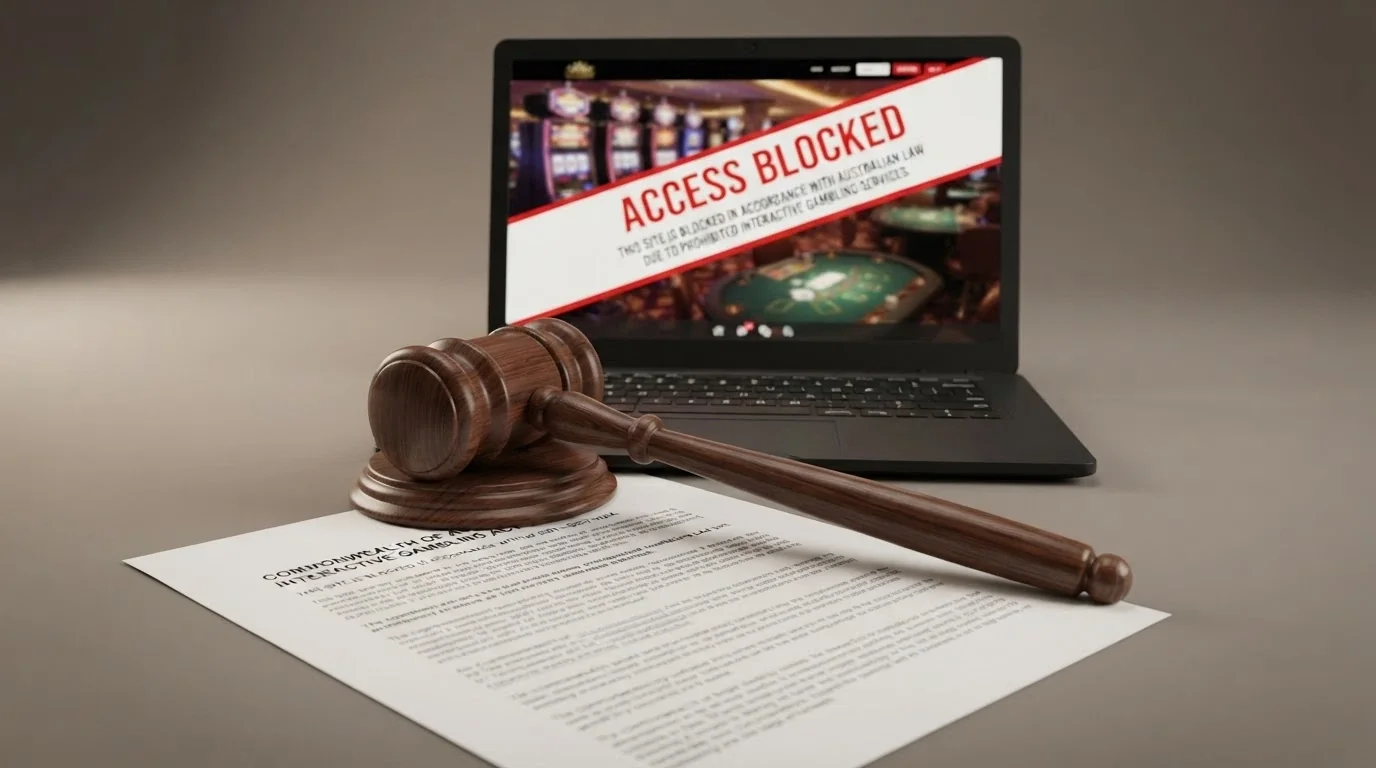
The Northern Territory Racing and Wagering Commission (NTRWC), via Licensing NT, is the de facto national licensor for online wagering — Sportsbet, bet365, Ladbrokes and about fifty others hold NT licences for terms up to twenty years. None of those licences covers online casino. The licensed product is sports and racing pre-event; everything else on this page is the unlicensed product.
The crypto payment ban and what it means for your USDT deposit
Since 11 June 2024, credit cards, credit-related products and digital currency (cryptocurrency) have been banned as payment for online wagering under the Interactive Gambling Amendment (Credit and Other Measures) Act 2023. Penalties for non-compliance are up to A$247,500. The ban applies to licensed wagering — the operators who hold NT licences and accept bets on horses and football.
The practical consequence for a USDT punter is simple: any casino accepting a USDT deposit from an Australian player is, by definition, not a licensed wagering operator. The payment method is itself the tell. “An Australian who is asked for a credit card or a crypto deposit by a gambling site is being served by someone outside the Australian rules” is the line the ACMA’s enforcement record keeps returning to. The crypto tab is the receipt.
From 1 January 2027, the Interactive Gambling Amendment (Gambling Reform) Bill 2026 — passed on 19 August 2026 — extends that logic upstream. Banks and payment providers gain express authority to block transactions to illegal gambling operators. ISPs, DNS providers, app distribution services and search engine providers must prevent their services from being used to provide illegal gambling. The reform does not make the individual player’s situation worse directly; it tightens the net around the operator, which means a tightening net around the balance on the player’s account.
What you give up when you play outside the licensed market
The individual player is not prosecuted under the IGA — the Act targets the provider of the prohibited service, not the customer. That is a real protection, and it is worth being clear about. Beyond it, the protections stop.
- No BetStop. BetStop binds roughly 150 Australian-licensed wagering providers. An offshore casino is not licensed in Australia and is not connected to BetStop. Self-exclusion at an offshore site is a per-operator request, and the operator’s willingness to honour it is the only protection that follows.
- No ACMA complaints body. The ACMA cannot recover money from an offshore operator. If the operator refuses a withdrawal or closes an account, there is no Australian regulator who can compel a payout.
- No Australian consumer law. The Australian Consumer Law does not reach an offshore entity operating from Curaçao or Tobique. The site can be ISP-blocked while a balance sits on it.
- No path to recovery if the operator disappears. The site can withdraw from the Australian market — as 225-plus services have done since 2017 — with the player’s balance inside it.
The minimum gambling age in Australia is 18. Every operator in the set enforces that floor, but the enforcement is the operator’s, not Australia’s.
Staying in Control When the Casino Sits Outside the Rules
Deposit limits and self-exclusion: what works when BetStop does not
BetStop does not cover offshore casinos. That is the single most important responsible-gambling fact on this page for any Australian reader who has self-excluded or is thinking about it. The National Self-Exclusion Register binds roughly 150 Australian-licensed wagering providers; an offshore casino is not on that list, and a BetStop registration does not propagate to it. To the end of Q3 FY 2025–2026, 59,830 people had registered to self-exclude, with 37,247 active exclusions as of 31 March 2026.

The tools that still work are at the casino level. Every responsible operator in the set offers deposit limits, loss limits and session timers inside the account settings — daily, weekly and monthly caps on the amount that can be deposited or staked. Self-exclusion at the operator level is a per-casino request, with terms that vary from six months to permanent. Cooling-off periods are usually available for shorter breaks.
The evidence on self-exclusion is strong where the tool is actually used. ACMA-commissioned research found that 77% of BetStop registrants reported better overall quality of life after self-excluding, 79% experienced improved mental health, and 96% had either completely stopped (81%) or decreased (15%) their betting. The mechanism works; the offshore casino gap means it works for fewer Australians than it could.
The casino-level tools are only as strong as the operator’s willingness to enforce them. A player who has self-excluded at an offshore site and finds themselves back at the cashier a week later has learned something about that operator. The practical answer is to layer the casino-level self-exclusion with a personal decision about which wallets and which devices the casino is reachable from.
Where to get help: the numbers that actually answer
The National Gambling Helpline is 1800 858 858 — free, confidential, staffed 24/7. Gambling Help Online provides free 24/7 chat and email counselling. Both services are Australian, both are free, and neither asks where the caller played. They answer regardless of whether the gambling took place at a licensed bookmaker or an offshore USDT casino.
The harm scale is worth seeing once. Approximately 3.32 million Australians — 15.1% of the adult population — are experiencing some level of gambling harm, with 2.86 million (13.0%) experiencing harm from their own gambling and 1.18 million (5.4%) from another person’s gambling, per the Roy Morgan Gambling Harm Index. An estimated 1.97 million Australian adults are classified as having at-risk or problem gambling. About 2.1% of adults — roughly 430,000 people — experience problem gambling at the clinical threshold. Australians spend approximately A$25 billion on legal forms of gambling each year.
The Problem Gambling Severity Index (PGSI) is the free self-test used by clinicians and is available through Gambling Help Online. A player who answers the nine questions and lands in the moderate-to-high range has answered the question that matters.
How We Picked and Ranked These Casinos
The ten operators in this ranking were drawn from a pool of USDT-accepting offshore casinos reaching Australian players, screened against three filters.
First, USDT support had to be confirmed by testing — not just claimed on a banking page. Betsquare’s August 2026 test round supplied the casino-side fee and processing figures; an industry test supplied the 47-second TRC-20 deposit benchmark; SkyCrown’s 12-minute withdrawal is from Betsquare’s June 2026 round.
Second, the bonus terms had to be sourced from the operator’s own terms page or from an audit-style third party (a casino audit site, AustralianGamblers, and SunVegas). Wagering multiples, validity windows and max-cashout caps were carried forward only where they could be quoted with a source. Three operators in the set — WinSpirit, Scream Casino, and BitStarz on its wagering rate — have terms that were not fully confirmed this round, and those gaps are flagged in the operator write-ups rather than filled in.
Third, the operator had to be reachable from Australia during testing. Stake has geo-restricted Australia since 2022 and Rainbet lists Australia among its restricted countries; both are excluded for that reason, not for any comment on their product.
The ranking order is not a recommendation. It reflects bonus value, USDT support, game library breadth and withdrawal speed as the data allows — and several operators carry caveats that are flagged in their write-ups. Terms change; licences change; the ACMA’s block list grows. The page is current as of 28 October 2026; the operator terms pages are the source of truth the day a player decides to deposit.
What This Means for Your Next Deposit
The core takeaway: every USDT casino reaching Australian players is offshore and unlicensed in Australia. The deposit decision is a calculated risk, not a casual one. The player is not prosecuted, but no Australian authority can help if things go wrong — and the 2027 reform tightens the noose around the operator, not around the player.
The bonus headline is the least important number on the bonus page. The wagering multiple, the maximum cashout and the validity window matter more. A A$8,000 welcome at 40x wagering with a 14-day clock is worth less to most players than a A$2,500 welcome at 35x with a 30-day clock, because the latter is the one the player will actually clear. Read the smaller print before the larger.
The TRC-20 network is the right default for casino deposits and withdrawals. A US$1 fee and three-second blocks beat a US$30 fee and a five-minute wait every time, on every size of transfer a punter is likely to make. BEP-20 is a fine third choice where supported. ERC-20 is the network to avoid unless the punter has a specific reason to use it.
The deposit is a calculated risk. The player accepts that BetStop does not cover the site, that the ACMA cannot recover a refused withdrawal, and that the site can be ISP-blocked while a balance sits on it. That is the price of the bonus, the speed and the library. For a punter who can carry that price and who reads the terms before claiming, the offshore USDT casino is what it has always been: a faster, less-friction product than the licensed alternative — for players who accept the trade.
Frequently Asked Questions
How quickly does a USDT cashout actually land in my wallet?
Casino-side processing runs one to twenty-four hours depending on verification. Then the network adds three to five minutes for ERC-20 or roughly one to three blocks on TRC-20. The fastest verified payout in the set was a twelve-minute TRC-20 transfer at SkyCrown; most sit under two hours once cleared.
Can I self-exclude from offshore crypto casinos through BetStop?
No. BetStop binds roughly 150 Australian-licensed wagering providers. An offshore casino is not licensed in Australia and is not connected to BetStop. Self-exclusion at an offshore site is a per-operator request, and the operator’s willingness to honour it is the only protection that follows.
What happens if an offshore operator refuses to pay your winnings?
No Australian complaints body can recover money from an offshore operator. The ACMA cannot enforce a payout. The site can be ISP-blocked while a balance sits on it. Your only recourse is the operator’s terms and any ADR body it is registered with — typically Curaçao or Tobique.
What does it cost to move USDT in and out of a casino?
Casino-side deposit fees were zero across every operator tested in Betsquare’s August 2026 round. Network fees are where the cost lives: TRC-20 runs about US$1 (around A$2), ERC-20 runs US$15 to US$30 depending on gas. Converting USDT back to AUD at an Australian exchange typically costs 0.1% to 1% plus spread.
Which operators give you a free shot with no deposit required?
Royal Reels offers a A$10 no-deposit bonus after phone verification at 30x wagering. Bizzo gives 10 free spins for installing its mobile PWA app at 40x wagering with a seven-day expiry. FairGO runs no-deposit chips at 60x. Rocket Casino references up to 125 no-deposit spins capped at AU$75 cashout.
How many times do I have to turn over a bonus before I can cash out?
Across the USDT casino market, 30x to 40x on the bonus amount is typical; 30x to 35x is considered fair and over 50x unfavourable. Multipliers in the set range from Royal Reels’ 35x to Rocket Casino’s 45x on free-spin winnings. The turnover applies to the bonus, not your deposit, unless the operator says otherwise.