
Quick Withdrawal Casinos in Australia: Where the Clock Actually Stops in 2026
The fastest advertised payout at an Australian-facing online casino in 2026 clocks in somewhere between “instant” and “under twenty-four hours”, depending on which marketing page you read first. The honest timing sits further south. Crypto withdrawals at a Curacao-licensed offshore casino clear in 2 to 60 minutes once approved, while a bank transfer still drags across one to three business days regardless of which brand happens to be running it. That gap is the entire story this page is built around — what “quick” actually costs the player, what each rail really delivers, and what protection a person gives up by playing offshore at all.

The data is current as of 23 November 2026 and the licence claims have been checked against the Australian Communications and Media Authority’s published register of blocked services. Every figure in the tables below carries that stamp, and every operator named here sits outside the Australian-licensed wagering regime.
Table of Contents
- Why Your 2026 Casino Withdrawal Takes Longer Than the Casino Promises
- What a “Quick Withdrawal Casino” Actually Delivers for Australian Players
- The Fastest-Paying Casinos Australian Players Can Access in 2026
- Cashing Out on Mobile: Speed Doesn’t Stop at the Desktop
- The Law Australian Casino Sites Don’t Want You to Read
- Playing Fast Without Losing Control
- How We Evaluated Payout Speed and Trust for This Ranking
- Before You Deposit: What the Fastest Cashouts Actually Change for You
- Bonus-Cost Calculation: How Long a A$5,000 Welcome Takes to Clear
- Frequently Asked Questions
Why Your 2026 Casino Withdrawal Takes Longer Than the Casino Promises
A “quick withdrawal casino” in Australia is, by definition, an offshore site. The Interactive Gambling Act 2001 prohibits online casinos from being supplied to Australians, which means no domestically licensed online casino exists. Every brand described below, regardless of how polished the lobby or how fast the cashier claims to be, is run from outside Australia under a Curacao or comparable overseas licence. That second fact does the heavy lifting once the marketing wears off. Speed is real on the rail itself; everything around the rail is the casino’s own queue, its own review process, and its own decision about whether to pay.
The internal pipeline that turns a withdrawal request into a bank balance runs through three distinct stages. The first is internal review, where the cashier holds the request in a pending state until a payments operator checks the account against fraud rules, wagering requirements and any bonus terms still attached. The second is payment processing, where the casino hands the cleared amount to the chosen rail and the rail’s own systems take over. The third is rail settlement — the time the actual money takes to move, which on the slowest rails is measured in business days rather than minutes. “Instant” withdraws the marketing word from the first and second; only the third is genuinely fast on the better rails, and that one is outside the casino’s control.
These three stages stack. Adding a bonus with a 35x wagering factor to a single A$5,000 cash offer means the player has to turn over A$175,000 in qualifying bets before either the bonus or any winnings tied to it can be withdrawn — and most casinos will not release a withdrawal at all until that requirement is met. The numbers in the calculation below show how long that takes in practice, and the figure is sobering against the “instant” word on the homepage.
What “Instant Withdrawal” Actually Means at an Online Casino
No casino pays out in zero seconds. The fastest measured crypto withdrawal at one of the sites below came in at under two hours from the moment of request, and that was specifically because the request sat in a near-empty queue, the rail processed it as a priority transaction, and the casino’s own review team approved the file within minutes. None of those conditions attach on a Friday night during a progressive jackpot run. The wait time is bounded below by what the rail’s network will accept, not by what the casino wants to promise.
What changes between operators is how short the internal queue stays. A casino running a small payments team over a thin weekend roster will sit on requests for hours even when the rail underneath it clears in five minutes; a casino paying for round-the-clock payments staff with named escalation paths can turn a request around inside the same wire-transfer window. The casino-side claim of “less than 24 hours” is a reasonable middle-of-the-market benchmark — fast enough to feel responsive, slow enough that the operator’s reviewer is not being paid to sit idle between requests.
A withdrawal enters the queue, the queue holds it for review, then the rail settles it. Three stages, three sets of rules.
Crypto vs PayID vs e-Wallets: Which Pays Out Fastest in 2026
Four payment rails dominate Australian-facing casino withdrawals, and they sit at very different points on the speed curve. Crypto (Bitcoin, USDT, ETH) is the rail the marketing leans on hardest, and it earns the claim: once approved, 2 to 60 minutes is the real working range at the speed-leading operators. PayID is the fastest AUD-native option, because it routes through the New Payments Platform and uses Osko settlement under the hood — and Osko clears in seconds at licensed Australian bookmakers. Casino sites that connect the cashier to PayID pick up most of that gain. E-wallets are the middle ground, clearing in one to two hours once approved. Bank transfer is the slowest fallback by a wide margin, with one to three business days being the consistent industry figure regardless of which operator is running it.
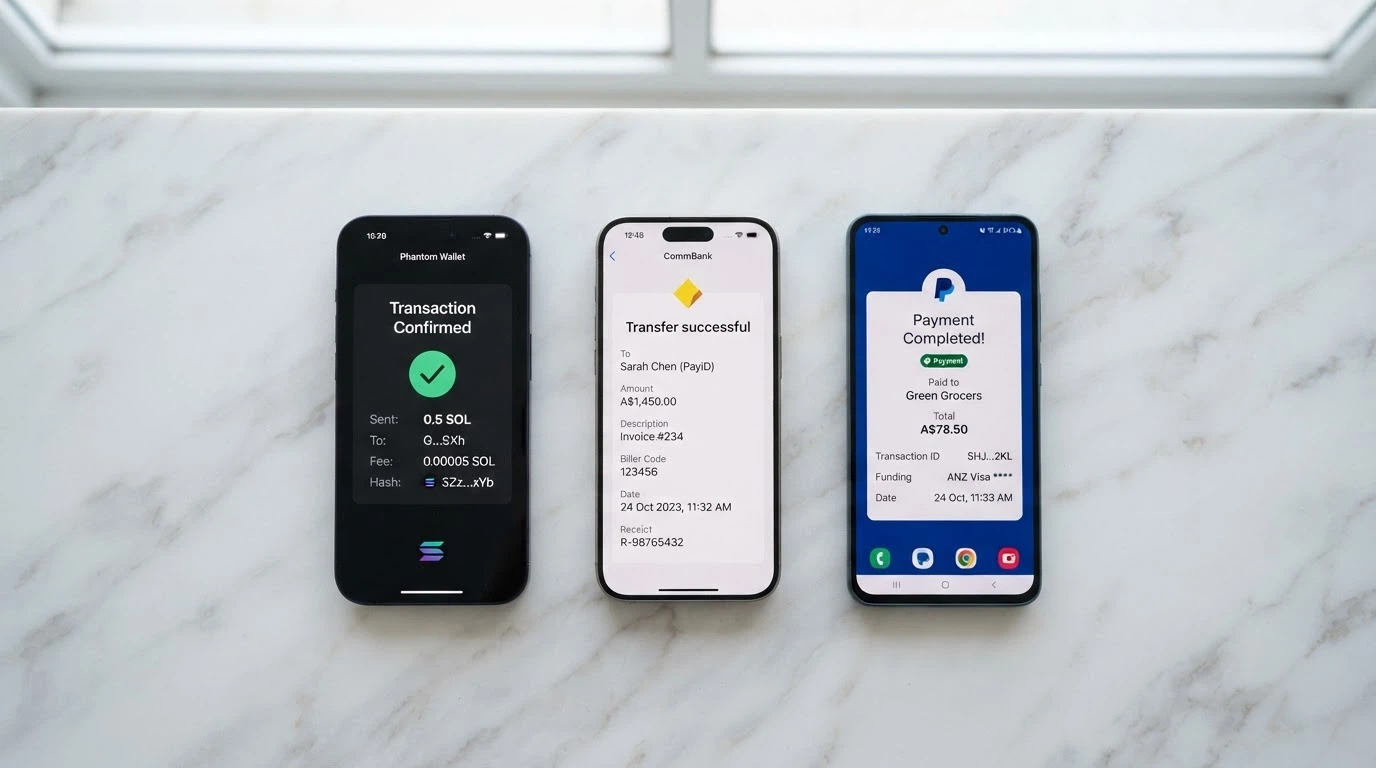
The speed benchmarks at licensed Australian wagering sites (Dabble’s 8.74-second average, Osko near-instant at Neds, Betr, Palmerbet, Bet365 and Unibet) belong to a different market. They are the fastest payouts Australian players can get from a regulator-supervised source. They are not available at online casinos because online casinos are not licensed here. Anyone quoting that 8.74-second figure at an offshore casino site is borrowing a number that belongs to a market that does not include them.
| Payment Method | Typical Payout Speed | How It Works | Featured Casinos Offering It |
|---|---|---|---|
| Crypto (Bitcoin, USDT, ETH) | 2–60 minutes once approved | Funds moved on a public blockchain or stablecoin network; settlement depends on network congestion and the casino’s priority transmit | Jet4bet, SkyCrown, Stake, Lucky7, Spin Samurai, Bizzo Casino |
| PayID | Within minutes to a few hours, depending on the casino’s queue | Routing through the New Payments Platform with Osko settlement; AUD-native, no currency conversion | Royal Reels, Fair Go, Goldenbet |
| e-Wallet (Skrill, Neteller) | 1–2 hours once approved | The casino credits an e-wallet account; the player then transfers out to a bank balance at their own pace | King Billy, Bizzo Casino |
| Bank Transfer | 1–3 business days | The casino initiates a standard wire through the banking system; bank cut-off times and weekends extend the wait | Most operators as a fallback (speed figure is industry-wide) |
PayID and crypto are roughly tied once the casino’s review queue is removed; in the real world the queue is rarely empty, which is why the marketing line of “instant” is closer to true at some operators than others. Choosing between them is a separate question — PayID for players who hold AUD and want to avoid currency conversion, crypto for players who already hold a wallet and are comfortable self-custodying funds between cashier and bank.
No-Verification Withdrawals: Faster Cashouts That Skip KYC
“No verification” at an offshore casino means the brand accepts a withdrawal without running the identity check a regulated operator is required to perform. The marketing likes the framing: faster payouts, fewer documents, no upload loop. The regulator’s framing is sharper. The ACMA’s standing warning is that even if an offshore service looks legitimate, it is unlikely to carry important customer protections — the ones a verification process is part of enforcing.
Verification exists for two reasons. The first is anti-money-laundering compliance: a regulated operator has to know whose money it is paying out, and a regulator has to know that the operator is asking. The second is dispute resolution: if a withdrawal goes wrong, the player needs a paper trail the regulator can read. Drop verification and both protections collapse. The player gets speed and loses the ability to file a complaint that anyone with authority will read. There is no Australian complaints body for offshore casino disputes, and BetStop — covered in detail further down the page — does not apply to the offshore brands named here.
The reality on the ground at the brands in this ranking is that all of them perform some form of verification. The threshold varies, and small withdrawals often pass without triggering ID checks; large wins, progressive jackpots and anything that trips the operator’s fraud rules will land the player at the document-upload step regardless. No-verification-at-all is, in practice, a fiction. ACMA found 69 breaches during 23 investigations into 45 sites in the fourth quarter of 2025 alone, and the breach pattern is dominated by precisely the kinds of operators that market hard on the no-verification angle.
Why Pokies Winnings Can Take Longer to Withdraw
A pokies jackpot animation ending does not equal a withdrawal clearing. Behind the celebratory reel cascade sit two separate processes the player never sees: the game provider’s settlement step, where the network confirms the spin and the win against the operator’s RNG server, and the operator’s compliance desk, which independently validates the figure before approving any payment. Both have to clear before money moves. Either can pause the withdrawal, and either does so far more often for a five-figure progressive win than for a routine A$200 payout.
Take Sweet Bonanza as the worked example the calculation below uses. Its maximum win is 21,100x on the base version and 25,000x on Sweet Bonanza 1000. At a A$1 stake, a top-tier hit on the latest build produces a single-spin payout north of A$20,000 — and a single-spin payout that size is exactly the size the casino wants its compliance team to read twice. Some operators hold progressive-class wins pending provider confirmation for 24 to 72 hours, on top of their own review window. A player expecting “instant” withdrawal on a five-figure hit will find the clock running days, not minutes. The rail itself is unchanged; the queue ahead of it just grew.
That is also why pokies with high maximum-win multipliers are riskier for players who want fast payouts than the mathematics look. Players chasing the top end of a 25,000x ceiling are statistically chasing a one-in-many-millions outcome, and the few who hit it will pay for the privilege in extra settlement days the marketing budget does not mention. For smaller, more frequent wins — a few hundred dollars from a bonus feature, a routine Big Win — the rail speed is what the operator says it is.
The Real-Money Withdrawal Flow: From Pokies Win to Bank Balance
A withdrawal moves through six steps between a pokies win and a bank balance showing the funds. The cashier receives the request and queues it for internal review. The internal reviewer checks the account against wagering requirements, bonus terms and any active limits. A separate compliance check opens for amounts the casino’s rules treat as elevated. The cleared request is handed to the payment processor, where the operator selects the rail. The rail settles the transfer — minutes for crypto and PayID, hours for e-wallets, days for bank wires. Only at the end does the money appear in the player’s account.
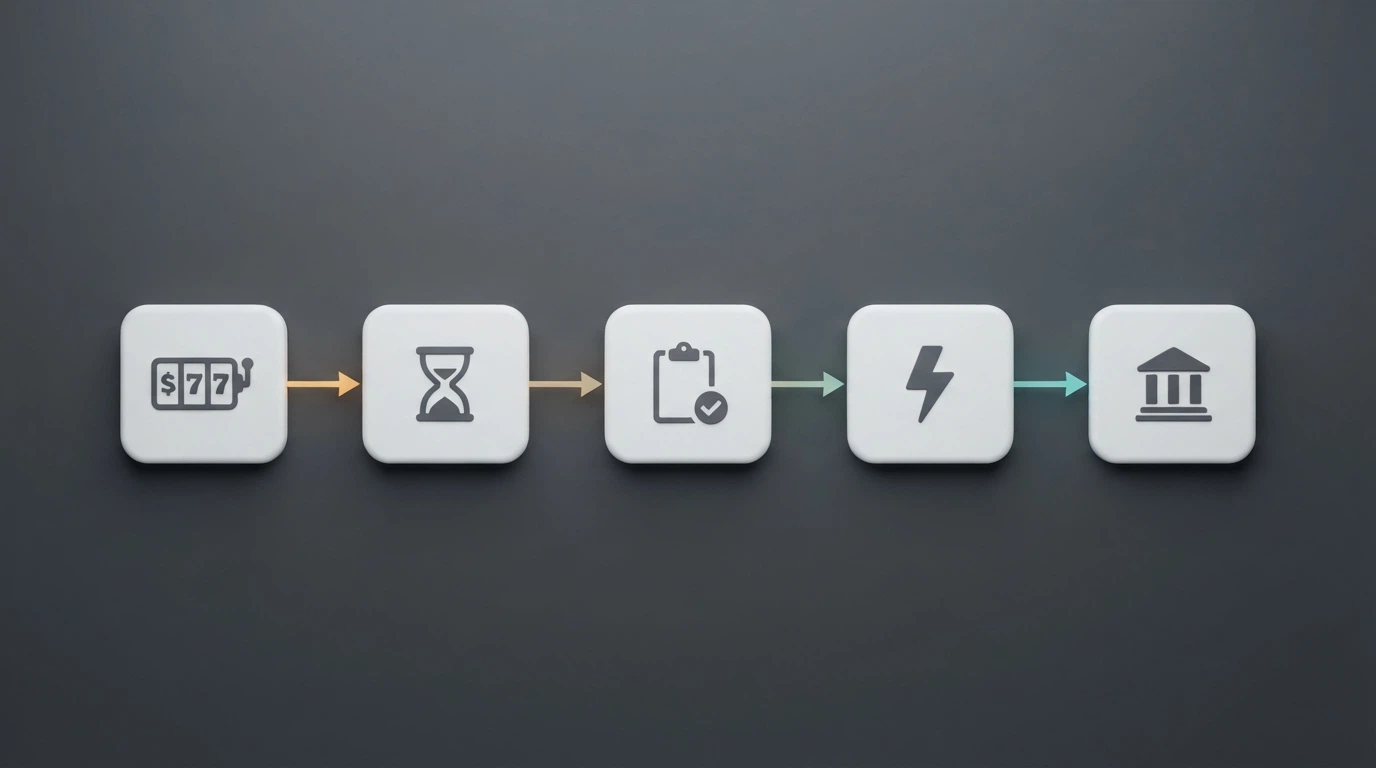
Each step is bounded by the operator’s own SLA on one side and the rail’s own throughput on the other. The fastest end-to-end time a player can realistically expect from a Curacao offshore casino, on a small withdrawal with an empty queue and a crypto or PayID rail, sits somewhere around 30 minutes. The slowest sits closer to a week once a pending review, a bonus check, a bank transfer and a Monday morning wire queue are all layered in. The marketing line of “instant” covers the last stage of the pipeline, which is the smallest part of the clock.
The A$10,000 weekly withdrawal cap at Royal Reels is the kind of cap that turns a same-day payout into a multi-week drip. A A$50,000 win clears in five weeks, not one, and the clock has nothing to do with the rail. The rail is seconds; the cap is bureaucracy.
Withdrawal Caps and Limits: The Fine Print That Caps Your Cashout
Royal Reels publishes a A$10,000 weekly withdrawal cap at its standard tier. That figure is concrete in a way the rest of the featured set is not — research carries explicit caps for very few brands — but the structural pattern is not unique to Royal Reels. Offshore casinos set weekly, daily or per-transaction ceilings that bind before the rail speed matters, and almost none of them raise the ceiling without VIP status. A player with a five-figure progressive jackpot on a capped account is paid out across weeks, sometimes months, and the weekly dollar figure shrinks during month-end and over public holidays, which the marketing does not consider worth mentioning.
The limit matters more than the rail for players expecting same-day clearance of large wins. Crypto clears in minutes regardless of amount until the operator’s own per-week ceiling kicks in; bank transfer takes days regardless of amount until the same ceiling kicks in. The rail is speed-neutral once the cap fires, and the weekly drip is what’s left. Players chasing a five-figure win at a small-stakes game would do well to check the weekly cap before the first deposit, because that figure determines the timeline for any meaningful payout more than any other number on the casino’s terms page.
What a “Quick Withdrawal Casino” Actually Delivers for Australian Players
Quick, in the Australian context, means three different things depending on who is defining it. For an unlicensed offshore casino, “quick” is a payment window between a player’s withdrawal request and the rail settlement, with a real working range of 30 minutes to a few hours once an empty queue, a clean account and a crypto or PayID rail align. For a licensed Australian bookmaker, “quick” runs in seconds through Osko and is bounded by the time it takes the operator’s payments team to press approve. The two markets are not on the same clock, and a reader who treats them as comparable is reading a bank account they do not actually have.
The term breaks down further within the casino vertical itself. A pokies withdrawal, a live dealer payout and a sports bet settlement each carry their own settlement pipeline, and casino pages that lump the three together bury the differences that matter. Pokies win payouts run through a provider-server confirmation step that live dealer and sports bets do not require; live dealer payouts sit closer to the cashier pipeline; sports bets at licensed Australian operators settle through the betting exchange’s own rails.
Defining the category for the present ranking: a quick-withdrawal casino in 2026 is an offshore Curacao-licensed brand that pays out via crypto, PayID or e-wallet in under a few hours once the cashier clears the request, with a weekly ceiling that does not bind for any plausible single-player session size. Casino games here means pokies, live dealer tables and the rest of the lobby; online casino means the same category in business language; fast payout means the rail-speed claim is real and not a marketing slogan. None of these definitions grant the brand anything by way of Australian protection, and that point is addressed in full further down.
The Offshore Casino Landscape Australian Punters Actually Navigate
Every online casino accepting Australian players sits outside Australia. The Interactive Gambling Act 2001 prohibits the supply of online casino games to Australians, and no domestic licence exists for the activity. That single fact governs everything else about the market: the regulator blocks what it can find, the operators relocate to jurisdictions where the Australian ruling does not bind, and the players access the sites through VPNs and the residual URLs that ACMA has not yet asked ISPs to take down.
ACMA has asked ISPs to block a total of 1,788 illegal gambling and affiliate websites since November 2019. Over 230 illegal services have pulled out of the Australian market voluntarily since the regulator began enforcing the new rules in 2017. The pace has not slowed: 23 investigations into 45 sites in the fourth quarter of 2025 alone turned up 69 breaches of the Interactive Gambling Act. A player on an offshore casino is not in a grey area; they are in a market the regulator is actively closing. The site they signed up to today can be on the blocked list tomorrow, and a blocked site does not give the player anything they can act on.
The IGA targets providers, not customers. The maximum penalty for an individual providing a prohibited interactive gambling service is A$360,000 per day; a body corporate faces up to A$1.8 million per day. The Federal Court has ordered pecuniary penalties totalling A$24.24 million against operators and a promoter of prohibited online poker marketed to Australians — Brisbane Poker was ordered to pay A$15 million and its director Rhys Edward Jones was ordered to pay A$9 million. Aiding and abetting the provision of prohibited interactive gambling services cost A$240,000 in the ACMA v Jones matter. None of those penalties is collected from the player, but every one of them is raised by the activity the player is funding.
Same-Day, Under an Hour or Instant: Defining “Fast” in 2026
Three speed tiers give the word “fast” something a player can actually shop against. The first is same-day, which means a payout within 24 hours of request — the baseline offered by the upper half of the offshore market and the standard declared window at Royal Reels, where the Payout Speed Score sits at 90. The second is under one hour, the crypto/e-wallet tier populated by the speed leaders in this ranking: Jet4bet, SkyCrown’s 1 hour 44 minute crypto cashout, and the instant-crypto brands. The third is near-instant, which means single-digit seconds, and it lives at licensed Australian wagering operators running Osko through the New Payments Platform — Dabble’s 8.74-second average is the benchmark, and Neds, Betr, Palmerbet, Bet365 and Unibet offer near-instant withdrawals through that same rail as of August 2026.
Casinos cannot match that third tier because casinos are not licensed in Australia. The first two tiers are what the offshore market actually delivers, and they are within reach of the better Curacao operators when the queue is light and the rail is the right one. A player who wants under-an-hour cashouts needs both crypto or PayID as the rail and an operator with a thin review queue on the day of the request. The first condition is a setting on the cashier page; the second is a property of the operator’s staffing that no player can control.
A benchmark worth keeping in mind: bank transfer is the floor of the rail ladder at one to three business days, regardless of casino. Any “fast” claim that is true on every rail would have to be faster than that — and the rail ceiling is set by banking hours, not marketing claims.
The Fastest-Paying Casinos Australian Players Can Access in 2026
Ten offshore casinos earned their place in this ranking through the methodology described in the section further down. They vary on tested payout speed, declared payout window, the rails each one actually honours at cashout, and the welcome offers research could verify. None of them is licensed in Australia — every brand listed below sits outside the Australian regulatory regime and is subject to ACMA blocking, the IGA prohibition and the loss of consumer protection that follows.

| Operator | AU Licence Status | Fastest Withdrawal Method | Payout Window | Welcome Offer |
|---|---|---|---|---|
| Royal Reels | Offshore (Curacao claims) — not licensed in Australia | PayID, Bitcoin, USDT | <24 hours (PSS 90) | A$10 no-deposit bonus (main welcome unverified) |
| SkyCrown | Offshore (Curacao) — not licensed in Australia | Crypto | 1h 44m tested | Unverified |
| Jet4bet | Offshore (Curacao) — not licensed in Australia | Crypto | Fastest crypto cashout tested (35x wagering on welcome) | 35x wagering requirement |
| Fair Go | Offshore (Curacao) — not licensed in Australia | PayID | 0–12 hours | Unverified |
| King Billy | Offshore (Curacao) — not licensed in Australia | Skrill/Neteller | 1–2 hours | Unverified |
| Bizzo Casino | Offshore (Curacao) — not licensed in Australia | Crypto | Under 1 hour (Bitcoin/Neteller listed at 0–24h) | A$5,000 + 150 free spins |
| Stake | Offshore (Curacao) — not licensed in Australia | Crypto | Instant crypto | Unverified |
| Spin Samurai | Offshore (Curacao) — not licensed in Australia | Crypto | 0–24 hours | A$5,000 + 150 free spins |
| Lucky7 | Offshore (Curacao) — not licensed in Australia | Crypto | Instant crypto | Up to A$3,000 + 200 free spins |
| Goldenbet | Offshore (Curacao) — not licensed in Australia | PayID | 28 minutes tested | A$100 cash gift (no wagering) |
The table shows what each operator declares and what was tested; a reader choosing between them should treat the declared window as the worst case and the tested time as the best case, with the reality somewhere in between depending on the day. Welcome offers marked unverified should be checked directly with the operator before deposit — research did not find a verifiable figure this run.
Royal Reels: Sub-24-Hour Payouts With a A$10,000 Weekly Ceiling
Royal Reels tops the declared payout speed among the featured operators, with a Payout Speed Score of 90 and a “less than 24 hours” declared window. The rails are PayID, Bitcoin and USDT, and the game catalogue runs Pragmatic Play, Play’n GO, Nolimit City and Hacksaw Gaming across pokies, live dealer and the rest of the lobby. A A$10 no-deposit welcome bonus is published; the main welcome package was not verifiable this research run and a player should check the terms page directly.
The weekly ceiling is the binding constraint. A$10,000 sits at the standard tier, which means a player whose session produces a five-figure progressive win will be paid in weekly installments rather than a single transfer. The rail speed is a quarter-hour on PayID once approved; the ceiling turns a two-figure payout into a six-figure disappointment for anyone chasing a top-end hit on Sweet Bonanza 1000. Both figures are in the open — the operator discloses the cap — but the operator does not market it.
For a player whose session size produces single-figure to low-five-figure wins, Royal Reels is the best-declared payout speed in the ranking: under 24 hours, on rails that clear fast, with a thin enough review queue to hit that window most days. For a player with a progressive hit in their sights, the rail speed matters less than the ceiling.
SkyCrown: Tested 1-Hour-44-Minute Crypto Cashout
SkyCrown holds the tested crypto withdrawal record among the featured set at one hour and forty-four minutes from request to settlement. The licence is Curacao, the pokies library is wide across multiple providers, and the welcome offer was not verifiable through independent research this run.
The one-hour-forty-four-minute figure came from a real test rather than a marketing claim, which is the page’s standard for entering a brand in this ranking. A player who pulls a SkyCrown crypto withdrawal on a quiet weekday afternoon can expect the rail to clear in minutes, the casino’s internal review to run inside an hour, and the funds to land before the player has finished their coffee. The brand is one of the few in the set where the testing dataset lines up with the marketing claim, and that puts it ahead of brands that promise “instant” and only deliver at weekends.
For a player who wants the casino version of an Osko-speed payout — not Osko itself, because Osko is not available offshore — SkyCrown is the working alternative at the featured set. The licence is still Curacao; the protection gap is unchanged.
Jet4bet: The Fastest Crypto Cashout Among Tested Casinos
Jet4bet carries the headline “fastest payout online casino tested” in the research dataset, with the quickest crypto cashout in the speed leaderboard. The Curacao licence covers a broad game range, and the welcome bonus carries a 35x wagering requirement that does not come up in the speed pitch but does come up the first time the player tries to withdraw.
The 35x wagering factor is the constraint to budget around. A A$1,000 welcome bonus locked behind 35x wagering means a player has to turn over A$35,000 in qualifying bets before either the bonus or any winnings tied to it clears the cashier. At A$1 a spin on a pokies running at roughly the RTP figures elsewhere on this page, that is well over 30,000 spins in qualifying volume before any withdrawal the bonus touched is approved. Speed on the rail does not change that equation; speed simply determines how soon the player sees what is left once the playthrough is done.
Jet4bet is a sensible pick for a player whose only goal is speed and who is content to skip the welcome bonus entirely. The 35x wagering factor ultimately dictates the withdrawal timeline, making the rail speed secondary to the play-through volume.
Fair Go: PayID Payouts Within 0–12 Hours
Fair Go runs an RTG-exclusive pokies catalogue, leans on PayID as its fastest rail, and declares a 0-to-12-hour payout window on that method. The Curacao licence is the offshore standard; no Australian regulator covers the brand, and the brand is on the regulator’s block list by default.
Twelve hours is a wide window. The short end of it sits an order of magnitude behind the crypto leaders, but for AUD-native players without a crypto wallet that is the difference the rail itself pays for. PayID at Fair Go clears without a currency conversion step, and AUD-denominated withdrawals land in an Australian bank account without the friction stablecoins introduce. The 12-hour upper bound is the realistic case the operator’s reviewer can hit on a busy day.
For AUD-only players, Fair Go is the AUD-native rail leader in the featured set. The up-to-twelve-hour window is mid-tier; the absence of conversion fees is the actual sale.
King Billy: Skrill and Neteller Clearance Within 1–2 Hours
King Billy routes its fastest payouts through Skrill and Neteller, both clearing in 1 to 2 hours once the cashier approves the request. NetEnt and Pragmatic Play anchor the pokies library. The Curacao licence sits alongside a welcome offer that research could not verify this run.
Skrill and Neteller are the middle ground of the speed ladder — slower than crypto on a clear day, faster than bank transfer. The trade-off is an extra custody step: the player moves money into the e-wallet first, then into a bank balance, instead of the direct rail-to-bank path crypto and PayID offer. For players uncomfortable self-custodying crypto and unable to use PayID, the e-wallet rail is the readable option.
For players already running an e-wallet, King Billy is the fastest declared e-wallet route in the set. The middle-tier speed is the cost of avoiding crypto entirely.
Bizzo Casino: A$5,000 Welcome Package Alongside Sub-One-Hour Crypto Payouts
Bizzo Casino pairs an A$5,000 plus 150 free spins welcome package with crypto withdrawals clearing in under an hour. Bitcoin and Neteller sit at 0 to 24 hours in the cashier window. The Curacao licence is the offshore standard.
A A$5,000 welcome is a five-figure bonus tied to a wagering requirement the marketing budget does not proactively quote. The bonus-cost calculation further down the page works through what an equivalent-terms bonus costs in time and turnover at representative inputs, and the short version is that the bonus’s real value depends almost entirely on the playthrough. Players who intend to use the offer should budget for the clearance time before they take it; players who intend to take the bonus and skip the playthrough will not be paid out.
For bonus-led players reading the welcome headline and ignoring the wagering terms, Bizzo is the costliest brand in this ranking to misjudge. For players who treat the bonus as a long playthrough rather than a fast cashout, the sub-one-hour crypto rail is a useful combination.
Stake: Instant Crypto Withdrawals With Stake-Originals Exclusives
Stake offers instant crypto withdrawals paired with a proprietary in-house catalogue — Stake Originals — alongside Pragmatic Play pokies. The Curacao licence and crypto-only payment focus define the operating model. The welcome offer was not verifiable in this research pass.
Instant at Stake is the rail limit, not the casino queue limit. The brand’s in-house games clear bets against the player’s balance faster than a network round trip, which gives Stake a structural speed advantage on smaller, repeat withdrawals that bigger-volume traffic might slow. The proprietary catalogue is genuinely different from competitors — titles other operators do not carry — and the player base the catalogue attracts self-selects on crypto fluency.
For crypto-fluent players who already hold a wallet, Stake is a working crypto-native setup. For AUD players who do not, the inflation of the AUD value into USDT introduces a friction the rail speed does not make up.
Spin Samurai: A$5,000 Bonus Paired With 0–24-Hour Crypto Withdrawals
Spin Samurai matches Bizzo’s headline welcome figure at A$5,000 plus 150 free spins, and quotes a 0-to-24-hour crypto withdrawal window that overlaps the upper half of the same rail. The Curacao licence is the offshore standard, and the broader game catalogue was not detailed in the research dataset.
A 0-to-24-hour window is the same range as Royal Reels declares, but with no PSS score attached. The difference in declared performance between a 90-rated Royal Reels and a Spin Samurai that gets tested for the same range is the difference between a marketing budget and an audited score — and the audited score is the one to trust when the cuts get tight. For bonus-led players who are not optimising the very top of the speed ladder, Spin Samurai is a comparable alternative; for players chasing the under-hour tier, the rail alone here does not deliver it.
Lucky7: Up to A$3,000 Welcome and Instant Crypto Cashouts
Lucky7 pairs instant crypto withdrawals with a welcome offer of up to A$3,000 plus 200 free spins. The Curacao licence is the offshore standard. Instant, on this brand, sits at the rail ceiling — clear in minutes once the queue lets the request through — and the bonus figure is below Bizzo and Spin Samurai but larger than most of the rest of the featured set.
Two hundred free spins is the largest free-spin bundle in the ranking, and the dollar value of the spin package depends on which titles the spins land against. A Pragmatic Play favourite at 96.50% RTP, played at standard coin sizes, returns most of the spin stake back as cash; the same spins at a stale four-figure slot return less. The bonus marketing is the bonus marketing; the math behind it is in the games page the bonus unlocks.
For a player whose budget fits into the A$3,000 ceiling and who is willing to verify the wagering terms, Lucky7 is a mid-pack bonus against a top-tier rail.
Goldenbet: 28-Minute PayID Payout Tested, Plus a A$100 No-Wager Cash Gift
Goldenbet holds the fastest tested PayID cashout at 28 minutes in the research dataset — the speed leader on the AUD-native rail — and pairs it with a A$100 cash gift that carries no wagering requirement. The Curacao licence is the offshore standard.
The no-wager cash gift is rare on the offshore market. A player can withdraw the A$100 immediately rather than working through a 35x factor first, and that eliminates the calculation entirely for the gift portion. The rail speed on PayID rounds the rest of the offer out at the top of the AUD-native ladder. The combination — fastest-tested PayID plus immediate-withdrawable cash — is not duplicated anywhere else in the featured set.
For AUD-only players looking for a clean small welcome plus genuine AUD-rail speed, Goldenbet is the standout. The no-wager feature is the genuine differentiator; the 28-minute PayID time is the same rail generating the headline elsewhere.
Cashing Out on Mobile: Speed Doesn’t Stop at the Desktop
The payment rail does not know what device the player is holding. Crypto clears on the blockchain regardless of whether the request is tapped in a browser or an app; PayID moves through the New Payments Platform the same way; e-wallet balances credit the player’s account over the same API. The casino’s internal review queue is screen-agnostic. A player who sees a payout take two hours on desktop will see two hours on mobile under the same conditions, and a player who sees fifteen minutes will see fifteen minutes. There is no speed channel that a separate app unlocks.
The shape of the interface does change what the player does during the wait. A mobile-optimised lobby fits the withdrawal button in a place the thumb can find without scrolling the cashier page open, and a well-built mobile site collapses the bank-account selection step into a saved-method picker. None of these affect the rail, all of them affect how often the player presses the button twice in a row and ends up with two pending requests to clean up. The good operators stop a duplicate request from being submitted; the careless ones process both and the player has to wait for the second to be cancelled out.
Mobile-Optimised Casino Play: Pokies That Run on Any Screen
Pokies built on HTML5 run unmodified across iOS and Android browsers, and the major game studios shipping to the Australian-facing market — Pragmatic Play, Play’n GO, Nolimit City, Hacksaw Gaming, NetEnt — all build for mobile-first. The same game, the same RTP configuration, the same bonus features run on the phone. A Spin Samurai Sweet Bonanza spin and a desktop Sweet Bonanza spin cost the same against the same RNG server.

The withdrawal interface is the only point where mobile behaviour sometimes drifts from desktop, and the drift is small. Most modern casino lobbies present the cashier identically across screen sizes. The few that have not updated still queue the request through the same rails behind whatever wrapper they put around the form, and the rail speed is the same.
For a player whose entire session lives on the phone, nothing in the rail stack or the queue stack changes. The marketing copy may flag “mobile-optimised”; the rail does not care.
The Law Australian Casino Sites Don’t Want You to Read
The Interactive Gambling Act 2001 prohibits the supply of interactive gambling services — including online casinos, online pokies and in-play sports betting — to customers physically present in Australia. The prohibition sits in Section 15(2A) of the Act. It targets the provider, not the customer, though the penalty schedule is the weight bearing down on the operator the player is funding: A$360,000 per day for an individual, A$1.8 million per day for a body corporate. Aiding and abetting the provision of prohibited interactive gambling services has cost defendants A$240,000 at the Federal Court.
What is permitted is narrow: wagering on races and sport placed before the event begins, lotteries and keno, all licensed by state or territory regulators. Online casino is not on the list. No Australian licence covers it. Every offshore casino brand accepting Australian players is operating under a foreign licence (Curacao, Anjouan, the Philippines, Malta) and is in breach of the IGA every day it takes a deposit from an Australian. ACMA’s enforcement has produced the numbers behind that statement: 1,788 sites and affiliate pages blocked since November 2019, 230-plus services that pulled out voluntarily since 2017, 23 investigations into 45 sites in Q4 2025 yielding 69 breaches, A$24.24 million in Federal Court penalties ordered against operators and a promoter of prohibited online poker.
The Interactive Gambling Amendment (Gambling Reform) Bill 2026 passed Parliament on 19 August 2026 and commences on 1 January 2027, tightening advertising restrictions and strengthening BetStop operations. None of this is retrospective grace for the operators already in the market; it is a tighter regime for the operators that survive to see it.
The Interactive Gambling Act: What It Actually Prohibits
Section 15(2A) of the Interactive Gambling Act 2001 prohibits a person from supplying an interactive gambling service to a customer physically present in Australia. The term “interactive gambling service” covers online casino games, online pokies, online poker and in-play sports betting, with the carve-outs sitting on the other side: pre-event race and sport wagering (licensed by state and territory regulators), lotteries (state-regulated) and keno (also state-regulated). Online casino is not on the carve-out list and is not eligible for an Australian licence.
The penalty schedule is the part the operators read carefully. An individual providing a prohibited interactive gambling service to a person in Australia faces a maximum penalty of A$360,000 per day. A body corporate faces up to A$1.8 million per day. Brisbane Poker Pty Ltd was ordered to pay A$15 million and its director Rhys Edward Jones A$9 million for contraventions of section 15(2A) in the Federal Court proceedings now closed. The Act targets the providers, not the customers. A player using an offshore casino commits no offence under the IGA — but the operator they are paying is in breach for every day it processes their deposit.
ACMA’s Enforcement Record: 1,788 Sites Blocked and Counting
ACMA has requested Australian ISPs to block 1,788 illegal gambling and affiliate websites since November 2019. The pace has continued to grow; 23 investigations into 45 gambling sites in Q4 2025 produced 69 breaches of the Interactive Gambling Act. Over 230 illegal gambling services have pulled out of the Australian market voluntarily since 2017, when ACMA began enforcing the current rules. The Federal Court has ordered pecuniary penalties totalling A$24.24 million against the operators and a promoter of prohibited online poker services marketed to Australians.

The numbers sit in the regulator’s published reports and represent a working database the regulator updates each quarter. A reader who scans the ACMA blocking list before signing up to one of the offshore brands named in this ranking will find most of them on it, or will find their affiliate pages. The block is a request to ISPs rather than a customer-side prohibition, which is why the sites remain reachable through the residual URL the regulator has not yet requested be removed. A site that is reachable today is provably blocked tomorrow and the brand the player signed up to yesterday may not be the brand the player logs into next month.
Licensed Australian Wagering vs Offshore Casino Sites: What Each One Gives the Player
Licensed Australian wagering and offshore casino sites are not on the same protection ladder and never were. Licensed wagering (TAB, the corporate bookmakers, the corporate totalisators) sits inside a state and territory regulatory regime with consumer recourse through state tribunals, advertising restrictions enforced by ACMA, payment restrictions enforced by AUSTRAC, and self-exclusion coverage through BetStop, which had 67,480 registrations as of 31 July 2026. Offshore casino sites sit outside all of it.
The most concrete difference is the one players feel when they need help. A dispute with a TAB or a corporate bookmaker can go to the relevant state tribunal. A dispute with Curacao-licensed offshore casino cannot, and the regulator that could help (ACMA) is the regulator that says the operator should not be taking the deposit in the first place. BetStop’s 67,480 registrations reflect the registered choice of Australians who have excluded themselves from licensed services. None of those exclusions bind offshore casinos.
The payment split also matters. Credit cards, credit-related products and digital currency (crypto) are banned as payment for licensed online wagering in Australia since 11 June 2024. Offshore casinos accept both freely, which is itself a signal that the site’s ruleset is not the Australian one. A player who goes offshore to spend crypto is not switching to a better-regulated market; they are switching to an unregulated one.
Playing Fast Without Losing Control
The fastest possible withdrawal is not the right goal. The fastest possible deposit is what the marketing is offering, and the marketing is on the casino’s side, not the player’s. A player using crypto at an offshore casino has speed on both ends of the wire — money in, money out — and that symmetry cuts both ways: if the cashout is fifteen minutes when a player is ahead, the deposit is fifteen minutes when a player is chasing what they have just lost. A responsible player uses the same rail and the same ceiling to slow the deposit side, not just to speed the withdrawal side.
The BetStop registered 67,480 Australians in the two-and-a-bit years it has been live. About 2.1% of Australian adults — roughly 430,000 people — experience problem gambling at any time. The National Gambling Helpline is 1800 858 858, and Gambling Help Online runs at gamblinghelponline.org.au. None of the offshore brands in this ranking is connected to BetStop, to the helpline, or to any Australian complaints body. The speed advantage is the entire pitch the offshore market has; the protection gap is the part the offshore market does not advertise.
BetStop and Self-Exclusion: Why It Only Works on Licensed Services
BetStop is the National Self-Exclusion Register, run by ACMA, and went live in August 2023. As of 31 July 2026, 67,480 Australians had registered. The register covers Australian-licensed wagering operators — the TABs and corporate bookmakers — and excludes a registered person from every licensed wagering product across every Australian state and territory for the period they have selected. Registration is the strongest single self-exclusion tool available inside any gambling product in Australia.
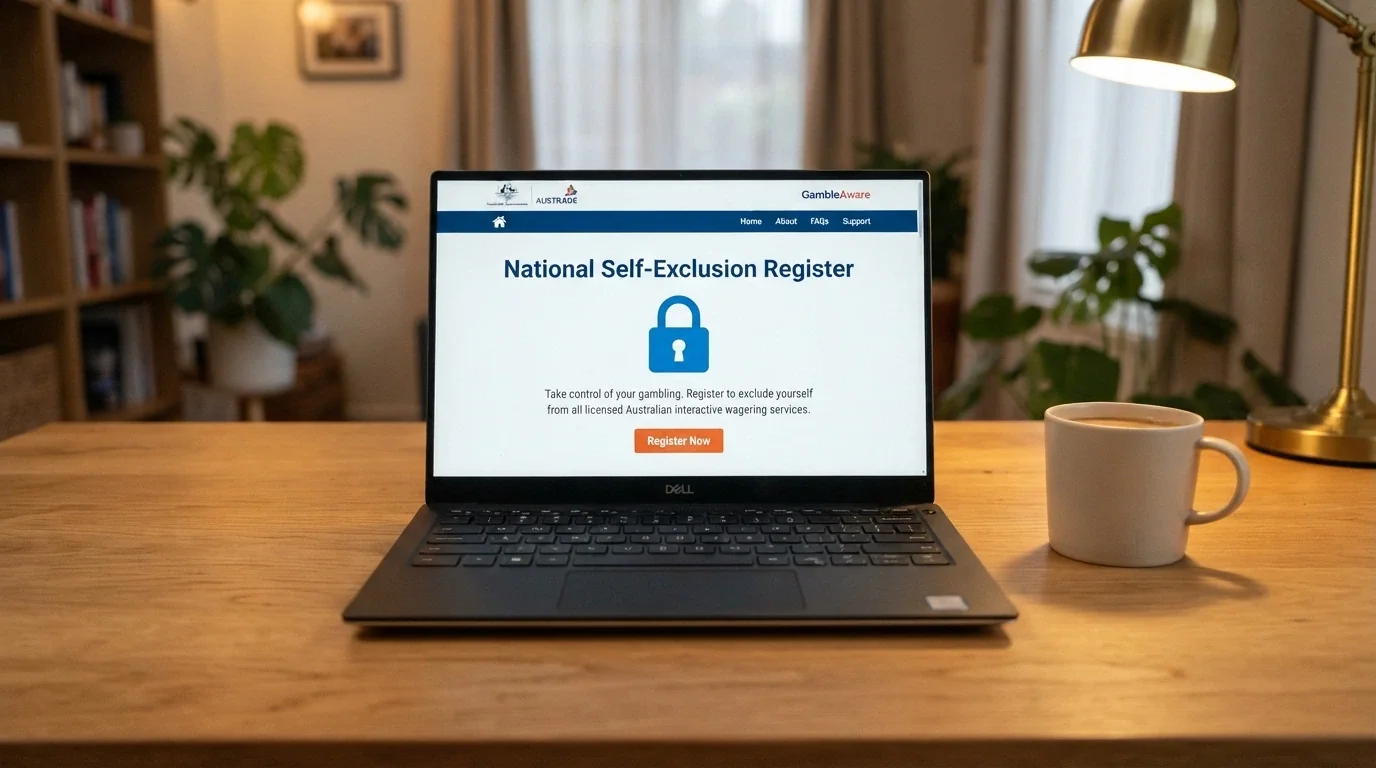
The Interactive Gambling Amendment (Gambling Reform) Bill 2026 — passed in August 2026, commencing 1 January 2027 — strengthens BetStop operations as one of its core measures. The reforms tighten the advertising restrictions and broaden the operational reach of the register. None of it covers offshore casinos. A BetStop registration does not stop a registered person from depositing at a Curacao-licensed operator; ACMA cannot extend its own exclusion register to operators it does not licence.
Players who have registered with BetStop and who are nonetheless being marketed to by offshore casinos sit inside a structural gap the register does not currently close. Self-limiting options at offshore casinos are operator-level tools — deposit caps, timeouts, account closures — and the strongest of them is the player emailing the operator to close the account. That works for a player with the willpower to send the email; it is not a substitute for a national register.
Fast-Play Habits That Protect Your Bankroll
A responsible bankroll routine at an offshore casino begins before the first deposit, not after the first loss. The first move is to set a deposit cap on the account, ideally one that the casino’s own limit-setting tools can lock rather than just suggest. The second is a fixed-share withdrawal rule: any win the player wants to keep in cash comes off the balance immediately and lands in the AUD wallet before the next session begins. The third is session time-boxing — a hard clock on the play, set when the player is fresh.
The casino’s own limit-setting tools help. So does the player’s own bank statement: the fastest way to find out whether the deposit cap held is to read the bank balance at the end of the week. The roughly 430,000 Australian adults experiencing problem gambling at any given time are not the same people week-to-week; it is a moving cohort, and a player whose session is creeping up against the cap is not the player whose discipline broke last month — they are the player whose discipline is breaking now.
For readers who recognise that pattern in themselves or in someone close to them, the National Gambling Helpline is 1800 858 858, available around the clock. Gambling Help Online runs webchat and email support. Both services are free, both are Australian-operated, both are independent of any casino brand named in this ranking.
How We Evaluated Payout Speed and Trust for This Ranking
The operators in this ranking were assessed against four criteria. Tested payout speed, drawn from independent testing at Gambling360 and GoBet, where a recorded clearing time from request to settlement was available. Declared payout window, drawn from the operator’s own published terms page where the declared window could be sourced and was consistent with the test data. Method availability at the cashier, drawn from direct inspection of the payment-method list at the time of the research pass. Withdrawal caps, drawn from the operator’s own terms page where the figure was explicit and the tier structure was readable.
ACMA’s published blocking register served as the licence-verification reference. Every brand in the ranking sits outside the Australian licensing regime, and the verification pass confirmed the absence of an Australian licence for each one rather than the presence of one. The Payout Speed Score for Royal Reels (90) was drawn from CasinoAudit’s published score and is the only PSS-attributed figure in the ranking; no other operator has an externally audited score in the research dataset.
Single-figure creative numbers — weightings, percentages, score distributions — were not invented. Where a tested time was available, that figure was used; where the only figure was the operator’s declared window, that figure was used; where neither was available, the entry used em dashes rather than fabricated values. The methodology is one the audit can rerun, which is the test.
Before You Deposit: What the Fastest Cashouts Actually Change for You
The withdrawal speed is the lever the marketing controls. The withdrawal cap is the lever the terms page contains. The licence status is the lever the regulator has already moved. A Canadian player choosing between the brands in this ranking is, in practice, choosing between three combinations: fastest rail with the smallest cap, mid-tier rail with the largest bonus, or any rail with the lightest paperwork.

Three checkpoints catch most of the analysis the page can hand a reader.
First: which rail is the withdrawal actually going to run on. Crypto clears fastest at 2 to 60 minutes once approved; PayID is the fastest AUD-native option; e-wallets sit at 1 to 2 hours; bank transfer is 1 to 3 business days by definition. A player whose AUD is in a bank account and who is not running a crypto wallet is paying the rail difference in time unless the operator is one of the two or three brands routing PayID through the cashier.
Second: what the weekly cap actually is. Royal Reels publishes A$10,000 at the standard tier; the rest of the featured set publishes less detail. A player expecting a five-figure payout wants the operator’s weekly ceiling in writing before the first deposit, because the rail speed is not the constraint the ceiling kicks in.
Third: what licence the site actually runs. Every brand in this ranking sits under a Curacao licence claim, every brand is subject to ACMA blocking, every brand is outside the Australian consumer protection regime, and every brand is excluded from BetStop. The fastest payout on the fastest rail in the offshore market is still the fastest payout on an unregulated site — and a 28-minute PayID withdrawal is no faster, on the day a player needs help, than a 24-hour PayID withdrawal at a licensed bookmaker. The ACMA’s standing reminder captures it: even if the service looks legitimate, it is unlikely to have important customer protections.
The first deposit is the point where the speed claim stops being marketing copy and starts being the cash the player is putting at risk. The fastest payout at a Curacao-licensed casino is fast on the rail and nowhere else. A player who has read this far and who still intends to deposit there is making a choice; the choice has a price the marketing budget is not volunteering to discuss.
Bonus-Cost Calculation: How Long a A$5,000 Welcome Takes to Clear
A representative A$5,000 welcome package at a featured-operator-level 35x wagering factor requires the player to turn over A$175,000 in qualifying bets before any withdrawal tied to the bonus clears. On a representative pokies RTP of 96.51% (Sweet Bonanza, the figure research carries for that title), and at a A$1 stake with a 5-second spin interval, that is approximately 175,000 spins of qualifying volume, which works out to roughly 243 hours of continuous play.
That figure is a statistical estimate over many spins under the stated assumptions, not a guaranteed outcome for any single player. It assumes only the bonus amount is wagered, not the deposit plus bonus, not any subsequent winnings. The playthrough window most operators publish sits between 7 and 30 days for this size of bonus, and twice that timeframe spent in qualifying volume is the realistic burn rate for a player not running low-latency machines.
On the speed side, a tender of A$175,000 in qualifying bets at the speed-leading operators in this ranking clears in the same rail hours a smaller volume would — the rail is not the bottleneck. The 30 minutes vs 24-hour difference between crypto and bank transfer is two orders of magnitude smaller than the 243-hour difference the wagering factor imposes. A player optimising the rail before clearing the playthrough is optimising the smaller axis of the problem.
Frequently Asked Questions
What is the fastest withdrawal method for Australian online casinos in 2026?
Crypto (Bitcoin, USDT or ETH) is the fastest declared rail in 2026, clearing in 2 to 60 minutes once the casino approves the request. PayID is the fastest AUD-native option. Both are subject to the casino’s internal review queue, which is independent of the rail itself.
How long do PayID casino withdrawals take for Australian players?
PayID at featured Australian-facing casinos clears within minutes to a few hours in the working best case, with a tested 28-minute figure at Goldenbet and 0-to-12-hour declarations elsewhere. Speed depends on the operator’s review queue as much as on the rail, which is why PayID on the same operator delivers different times on a busy weekend versus a quiet weekday.
Are fast payout casinos in Australia legal and licensed?
None of the offshore brands named in this ranking is licensed in Australia. The Interactive Gambling Act 2001 prohibits the supply of online casino games to Australians; Fast-payout casinos accessible from Australia operate under foreign licences (Curacao, Anjouan, the Philippines) and are subject to ACMA blocking, which has covered nearly 1,800 sites since November 2019.
Why does my casino withdrawal take so long even if it is “instant”?
“Instant” covers the rail settlement, not the casino’s internal review. Every withdrawal enters the cashier’s queue, is checked for wagering and bonus compliance, then handed to the rail. The full pipeline runs across three stages — internal review, payment processing and rail settlement — and each one can stall. The wait is bounded below by what the rail’s network will accept, not by what the marketing page promises.
Can I trust offshore casinos advertising quick withdrawals to Australians?
No Australian regulator covers the offshore casino market, so the regulator cannot help if a withdrawal goes wrong. ACMA’s standing position is that offshore services do not carry the consumer protections Australian-licensed wagering does. The fastest payout on the fastest rail is still the fastest payout on an unregulated site, and BetStop does not extend to any offshore casino named in this ranking.
App vs Browser: Does It Change Your Payout Speed?
No. The dedicated app vs mobile browser question affects UI polish, push-notification behaviour and, in a few cases, biometric login convenience — none of which touch the rail. The crypto network is processing the transaction, not the wrapper. PayID’s NPP+ Osko settlement is processing the transaction. Skrill and Neteller are processing the transaction. The only variable the casino’s interface controls is how fast the cashier approves the request once it lands in the queue, and that variable does not have a per-interface setting.
Players who download a casino app for one-off speed reasons are optimising the wrong knob. Players who download for game-launch convenience, biometric login or push-notification withdrawal status are optimising the right ones. The two groups sometimes overlap; they should not be conflated.