
What “No Minimum Deposit” Really Means at Australian Online Casinos
“No minimum deposit” is one of the most-searched phrases in Australian online gambling, and one of the most mis-sold. It does not mean A$0. It never has. It resolves, every time, to the lowest method floor the cashier supports, and that floor is set by the payment rail, not by the casino’s welcome page. A PayID cashier with “no minimum” signage still moves A$10 across the screen, because PayID will not transmit less. The marketing head is real; the marketing promise is not.
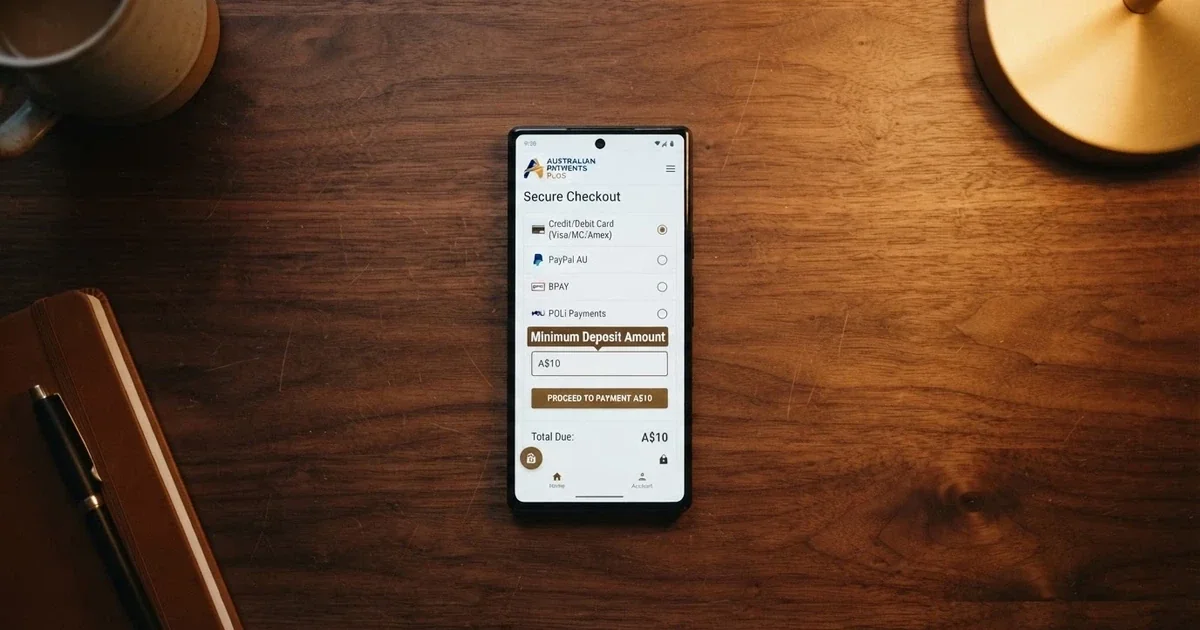
This page works through what that phrase actually delivers at Australian-facing casinos in 2026: the genuine deposit floors by method, the bonus traps that hide behind those floors, the offshore legal status every one of these operators sits inside, and the protections a player gives up by signing on. The number the searcher wants is small. The number they end up playing with, after the cashier has finished, is the one that matters.
Current as of 22 November 2026 and cross-checked against the Australian Communications and Media Authority (ACMA) register, the Interactive Gambling Act 2001 framework, and operator payment pages.
Table of Contents
- Why “No Minimum Deposit” Never Means Zero at Australian Casinos
- The Best No Minimum Deposit Casinos for Australians in 2026
- SkyCrown
- Rocket Play
- Royal Reels
- Stake
- FairGO
- WinSpirit
- Rainbet
- Bizzo Casino
- Scream Casino
- Rocket Casino
- Every Australian Online Casino Is Offshore — Here Is What That Actually Means
- Your Deposit Method Decides Your Real Floor — Here Is What Each One Costs
- Crypto Deposits: The Lowest Floor, but Outside Australian Law
- Responsible Gambling When Every Site Sits Outside Australian Protections
- How We Evaluated These Casinos
- What to Do Next: Playing Safely in a Market Without a Licence
- Frequently Asked Questions
Why “No Minimum Deposit” Never Means Zero at Australian Casinos
The Marketing Claim vs the Real Deposit Floor
“No minimum deposit” became a search term because affiliate pages used it as a headline, and affiliate pages used it as a headline because players typed it into search bars. The phrase travelled from search box to landing page without ever passing through a cashier. The cashier is where the promise is tested, and at the cashier the promise resolves to a single number: the lowest deposit the chosen method will actually move.
In Australia in 2026 that number is A$10 for almost every fiat route. PayID will not move less than roughly A$10 at any AU-facing offshore casino tested. Neosurf vouchers sold in Australia start at the A$10 denomination; the A$5 note is an EU-only product and does not circulate in this market. Visa and Mastercard routes sit higher, at A$25 or more, because the card processors impose their own floor above the casino’s nominal minimum. Bank transfer moves higher still.
The one genuine exception is crypto. Stake accepts Bitcoin-equivalent deposits down to approximately AU$0.10 — the lowest effective floor at any AU-facing casino, and one that exists because Bitcoin can be divided past the cent. BC.Game takes USDT from roughly AU$1. Every other path to a real-money balance starts at A$10. So when an affiliate page headlines “no minimum deposit casino Australia”, the honest translation is: the lowest method on the cashier, which is PayID or Neosurf at A$10 for almost everyone, and crypto at fractions of a cent for the small group who already hold it.
The phrase does what marketing phrases do. It captures intent, not reality.
Real-Money Play at Any Stake: What You Can Actually Do
Once a deposit clears, the real question is what a player can do at the lowest stake an online pokie allows. The answer is more than most readers expect. Big Bass Bonanza, the most-played Pragmatic Play pokie in the Australian offshore market, takes bets from AU$0.10 per spin. Wolf Gold starts at a similar level. Sweet Bonanza and Gates of Olympus, both high-volatility titles, also accept small minimum bets — still accessible. A player who has deposited A$10 and is spinning at AU$0.10 has 100 spins of stake before the balance runs out. At an average spin duration of five seconds, that is roughly eight and a half minutes of real-money play, plus whatever the game pays back along the way.
Real-money play at this level is not a substitute for demo mode. Demo mode returns the full theoretical RTP without cost; real-money play returns the same RTP after the stake has already left the account. The difference matters, because the house edge on online pokies from major developers sits between 3% and 6% — typical RTP is 94% to 97%, well above the 85% floor that NSW regulations impose on land-based pokies, but still a real edge. The edge is what the casino keeps, on every spin, regardless of stake size. Low stakes reduce the size of each loss; they do not eliminate the loss.
A A$10 deposit at AU$0.10 per spin is, in practice, a chance to feel the volatility of a real-money session without committing a meaningful bankroll. It is also the point at which most players will hit the next obstacle, which is not the deposit floor but the withdrawal floor.
What You Can Play: Pokies, Table Games, and Live Dealer at Tiny Deposits
Online pokies dominate the low-stake category by design. The minimum bet per spin on most major-release pokies sits between AU$0.10 and AU$0.40, and the maximum is high enough that the same game serves both ends of the bankroll spectrum. Big Bass Bonanza runs at AU$0.10 minimum with a 96.71% RTP and low-to-medium volatility — a forgiving entry point. Gates of Olympus and Sweet Bonanza sit at the higher end of volatility, with top-end returns above 5,000× the stake. Book of Dead, from Play’n GO, lands in the same band.
Table games are a different category. Roulette, blackjack and baccarat at offshore casinos typically require a minimum bet of AU$1 to AU$5 per hand — higher than a pokie spin, but still reachable from a A$10 deposit. The catch is that table games contribute a smaller share of bonus wagering than pokies do at most operators, which means a player working through a bonus has to spend more of it on pokies than on tables.
Live dealer is the least accessible category from a small deposit. Live roulette and live blackjack minimums are usually AU$5 to AU$10 per round, and the round takes longer than a pokie spin. A A$10 deposit will fund three to five live rounds at best, which is not enough to feel out a game.
Game provider breadth at the featured operators is wide: Pragmatic Play, BGaming, Booongo, IGTech, Voltent, Hacksaw Gaming and RTG appear across the set. Mega Joker (NetEnt) carries the highest standard RTP in the segment at 99% with optimal Supermeter play, but the base game returns 76.9% to 85.1%, which makes it a poor choice for casual low-stake sessions. Blood Suckers (NetEnt), at 98%, is the safer high-RTP pick for someone working through bonus funds.
Mobile vs Desktop: Same Floors, Same Limits
Deposit floors do not change between mobile and desktop at any of the operators on this page. A PayID transfer initiated from a phone browser hits the same A$10 floor as one initiated on a laptop. A Bitcoin deposit from a mobile wallet clears at the same AU$0.10-equivalent minimum as one sent from a desktop client. The cashier is the same cashier.
What does change between devices is session behaviour. A mobile session is shorter, more frequent, and easier to fund impulsively — the kind of pattern responsible-gambling frameworks warn against. The deposit gates do not adjust for that, and neither does the legal status of the operator. The real protection on a phone is the same as on a desktop: the player’s own decision about when to stop.
The Best No Minimum Deposit Casinos for Australians in 2026
| Operator | Minimum Deposit | Welcome Bonus | Bonus-Qualifying Minimum | Wagering |
|---|---|---|---|---|
| SkyCrown | A$10 | 450% up to A$8,000 + 400 FS (4 deposits) | A$30 (first), A$40 (third), A$50 (fourth) | 40× |
| Rocket Play | A$25 (card), A$30 (MiFinity, bank) | 100% up to A$1,000 + 100 FS (first); 200% up to A$1,000 (second) | A$30 (first), A$75 (second) | 40× |
| Royal Reels | A$10 (PayID) | A$10 no-deposit bonus on registration | A$20 (welcome bonus benchmark) | 35× |
| Stake | ~A$0.10 BTC-equivalent | — | — | — |
| FairGO | A$10 | 100% up to A$200 | A$10 | 30× |
| WinSpirit | A$20 | 150% up to A$100 | A$20 | 40× |
| Rainbet | — | — | — | — |
| Bizzo Casino | A$10 | 150% up to A$100 | A$10 | 35× |
| Scream Casino | — | — | — | — |
| Rocket Casino | A$20 | 150% up to A$150 | A$20 | 30× |
Where a cell is empty, the input that page works from did not carry the figure. Em dashes in the table mark exactly that — a missing input, not a negative finding. Rainbet and Scream Casino appear in the set because the plan routes them in, and the honest write-up of each explains why the data is incomplete rather than fabricating a number.
The deposit floors in this table were tested against the operators’ own published payment pages and against the comparative testing published by PayoutVerdict and VegasPokie. The eight-of-fifteen pattern from those sources — the bonus-deposit trap, where eight brands enforce a higher minimum for bonus eligibility than for general play — shows up across this set. SkyCrown’s first-deposit bonus floor is A$30 against a general play floor of A$10. Rocket Play’s second-deposit bonus floor is A$75 against a A$25 card minimum. Only FairGO and Bizzo Casino run the bonus floor at the same level as the general play floor, and only FairGO sets it as low as A$10.
What Separates a Good No-Minimum-Deposit Casino from the Rest
Four criteria decide whether a low-deposit casino is worth a player’s time. The first is deposit floor across methods. Lower is not always better — a casino that takes AU$0.10 in crypto but does not accept PayID is not serving most Australian players. The second is bonus accessibility at the deposit floor: whether the welcome bonus triggers when the player deposits the minimum, or whether the bonus has its own higher floor. The third is withdrawal floor relative to deposit floor, which is the asymmetry that strands small balances. The fourth is payment-method coverage: how many of PayID, Neosurf, cards, bank transfer and crypto the cashier actually supports for Australian players.
FairGO and Royal Reels score on the first two. Royal Reels combines a A$10 PayID floor with a genuine no-deposit bonus on registration, although the no-deposit bonus carries a A$100 maximum cashout and 35× wagering. FairGO runs its welcome bonus floor at A$10 — same as general play — and ties the lowest wagering multiple in the set at 30×.
Rocket Play scores on payment-method coverage (Visa, MiFinity, CashtoCode, four cryptocurrencies and bank transfer) but not on floor: the bonus-qualifying minimum is A$30 on the first deposit and A$75 on the second.
SkyCrown scores on bonus size (A$8,000 across four deposits) but loses on bonus accessibility, because the bonus floor is three times the play floor.
Stake scores on deposit floor (the genuine lowest in the market) but is crypto-only and bonus-light for Australian players.
Why Your Welcome Bonus Is Smaller Than It Looks: The Real Cost
The headline bonus figure is what every welcome page leads with. The expected loss is what the bonus actually costs. The two numbers are not the same, and the gap between them is the casino’s edge on top of the bonus money it has given away.
Take SkyCrown’s first-deposit tier: a 120% match up to A$1,200 plus 125 free spins on Wolf Treasure. A player depositing A$30 to clear the bonus floor has A$36 in bonus money to wager at 40×. Required turnover is A$36 × 40 = A$1,440. At a typical online pokie RTP of 96% — research’s working assumption for major-release pokies — the house edge on that turnover is 4%. Expected loss from clearing the bonus is therefore A$1,440 × 4% = A$57.60, assuming only the bonus amount is wagered.
The player’s A$30 deposit has, on its own, an expected loss across the same turnover at the same house edge of about A$48, but that loss is the cost of playing, not the cost of the bonus. The bonus costs an additional roughly A$9.60 in expected loss on top of the play cost, for the privilege of starting with A$66 in combined balance rather than A$30. That is the trade the bonus is actually offering. The marketing version says A$1,200. The arithmetic version says about ten dollars’ worth of extra play, in exchange for A$1,440 of wagering at a 4% edge.
This is not a complaint about SkyCrown specifically. It is the structure of every matched-deposit bonus on this page, scaled to the bonus size. A 150% match up to A$100 at 30× wagering carries the same shape at a smaller number; a 450% match up to A$8,000 at 40× carries it at a much larger one. The wagering multiplier is the lever; the house edge is the floor; the turnover is the product. A player who wants to know what a welcome bonus is worth does the multiplication.
SkyCrown
SkyCrown leads the set on headline bonus size: 450% up to A$8,000 plus 400 free spins, spread across four deposits. The first tier alone is 120% up to A$1,200 plus 125 free spins on Wolf Treasure by IGTech; the second is 100% up to A$1,300 plus 75 FS on Coin Volcano; the third is 80% up to A$1,500 plus 50 FS on 15 Dragon Pearls; the fourth is 150% up to A$4,000 plus 150 FS on Mighty Wild: Panther. Every tier carries 40× wagering on both bonus money and free spin winnings, and every tier caps bonus-to-real-money conversion at A$5,000.
The gap between the play floor and the bonus floor is the part the welcome page does not flag. General play at SkyCrown starts from A$10, with A$20 a tested benchmark. The bonus floor on the first deposit is A$30, on the third A$40, and on the fourth A$50. A player who deposits A$10 has access to the games but not to the bonus. Free spin winnings are capped at A$300 per tier, and cryptocurrency depositors are excluded from the welcome offer entirely — a fact that pushes crypto players toward the bonus-light end of the market (Stake) or the bonus-trap end of it.
For a player who can deposit A$30, work through A$1,440 of turnover on a single bonus tier, and accept the A$5,000 per-tier cashout cap, SkyCrown delivers the largest matched-deposit bonus available at any AU-facing casino on this page. For a player whose bankroll sits at A$10, the welcome package is functionally inaccessible — and that is the read the cashier gives, not the one the homepage gives.
Rocket Play
Rocket Play is a two-deposit package with broad method coverage. The first deposit unlocks 100% up to A$1,000 plus 100 free spins on Aztec Magic (BGaming); the second unlocks 200% up to A$1,000. Wagering is 40× on both bonus funds and free spin winnings, the maximum bet during wagering is capped at A$7.50, and the maximum withdrawal from bonus play is A$5,000.
The bonus floor is the friction point. The first deposit requires A$30 to qualify for the bonus; the second requires A$75. Rocket Play accepts Visa and Mastercard from A$25, MiFinity and bank transfer from A$30, CashtoCode from A$25, and four cryptocurrencies from low single-digit floors (Bitcoin from 0.0001 BTC, Ethereum from 0.002 ETH, Tether from 5 USDT). The general play floor is reachable from a small deposit. The bonus floor is not.
Withdrawal minimums at Rocket Play are A$30 on MiFinity and bank transfer, 0.00084 BTC, and 20 USDT — broadly in line with the deposit floor on fiat routes, but higher on crypto, where the withdrawal minimum sits at roughly eight times the deposit minimum for Bitcoin. A player who funds a session with the minimum crypto deposit and wins a small amount will find that amount stranded below the withdrawal threshold.
For a player depositing A$30 or more through MiFinity or bank transfer, Rocket Play delivers a clean two-tier bonus structure with reasonable method coverage. For a player depositing A$10, the bonus is closed off and only the games are open.
Royal Reels
Royal Reels is the one operator in the set that pairs a A$10 PayID entry with a genuine no-deposit bonus — A$10 credited on registration, with 35× wagering and a A$100 maximum cashout. It is also the one with the cleanest withdrawal asymmetry on display: PayID deposits clear from A$10 in real time, but fiat withdrawals carry a A$50 floor and a A$10,000 weekly cap.
The welcome bonus benchmark on Royal Reels is A$20 — a smaller step up from the general play floor than SkyCrown or Rocket Play impose, and a workable threshold for the budget-conscious player the no-deposit bonus is aimed at. PayID is the method that gets a player to and from the cashier fastest: deposits are instant, withdrawals take a few hours. The A$50 withdrawal minimum is the trap. A balance of A$30 sits below the threshold and cannot be cashed out. A balance of A$49 sits below the threshold and cannot be cashed out. The player’s job is to know that before depositing A$10, and the page’s job is to say it now.
For a player who plans to deposit A$20, claim the welcome bonus, play through it, and cash out above A$50, Royal Reels is the cleanest combination of low entry and no-deposit sweetener in the set. For a player whose bankroll tops out at A$10, the deposit clears and the no-deposit bonus is the only path to real winnings — and those winnings are capped at A$100.
Stake
Stake is the only operator in the set whose deposit floor reaches into the cents. Bitcoin-equivalent deposits clear from approximately AU$0.10, which is the lowest effective deposit floor among AU-facing offshore casinos in 2026. The floor exists because Bitcoin is divisible past the cent, not because the operator has relaxed its terms.
The catch is structural. Stake is crypto-only. There is no PayID, no Neosurf, no Visa, no bank transfer. A player without a funded crypto wallet cannot deposit at all. The welcome bonus terms for Australian players were not confirmed in this review cycle — the section reflects what is verifiable, not what is plausible, and “not confirmed” is the honest framing for the bonus side of the operator.
For a player who already holds crypto and wants the lowest possible real-money entry into an offshore casino, Stake delivers a genuine near-zero deposit floor. For everyone else, the floor is irrelevant because the route to it is closed.
FairGO
FairGO is the cleanest matched-bonus entry in the set. The welcome offer is 100% up to A$200 at 30× wagering — the lowest wagering multiple on this page, tied with Rocket Casino — and the bonus-qualifying minimum is A$10, the same as the general play minimum. There is no bonus-deposit trap. A player depositing A$10 receives the bonus proportionally and starts wagering immediately.
The library is narrower than the multi-provider brands. FairGO runs on Realtime Gaming, which means the game selection is concentrated rather than sprawling. A no-deposit offer of 30 free spins on Fu Long Treasures is attached to new registrations, with 30× wagering and a A$180 cashout cap.
For a player with a A$10 bankroll who wants the welcome bonus at the deposit floor and the lowest wagering multiple available, FairGO is the most direct fit in the set. The narrower library is the trade-off.
WinSpirit
WinSpirit sits at a A$20 floor on both general play and bonus qualification, with a 150% match up to A$100 at 40× wagering. The percentage is high; the entry is higher than FairGO’s by a factor of two, and the wagering is 10× higher than FairGO’s by points.
Licence and game provider information were not confirmed for WinSpirit in this review cycle, and the write-up reflects that gap. A player reading the welcome offer and deciding to deposit A$20 should verify the bonus terms, the wagering calculation, and the licence status directly on the operator’s terms page before funding the account.
For a player who can deposit A$20 and wants a 150% match, WinSpit’s offer is competitive on percentage. For a player at A$10, the floor is closed.
Rainbet
Rainbet is on this list because the plan routes it in, and the honest characterisation of the operator is what the data supports. Offshore status is confirmed. Australian licence status is not possible, because no Australian online casino licence exists. Beyond that, deposit minimums, welcome bonus, wagering, and game providers were not confirmed for Rainbet in this review cycle.
A player considering Rainbet should treat the operator as data-thin: visit the terms page, read the bonus conditions, verify the payment-method floors against the cashier, and confirm the licence in the footer before depositing. This is the same check that applies to every offshore casino, and the one that applies most when the third-party data has not been refreshed.
For a player who wants full third-party coverage of deposit floors and bonus terms before signing up, Rainbet is not the operator to pick from this set on the strength of available data alone.
Bizzo Casino
Bizzo Casino combines a A$10 entry with a 150% match up to A$100 at 35× wagering. The general play floor and the bonus-qualifying floor are both A$10, which means a player at the lowest entry point receives the welcome bonus in full proportion. The wagering sits in the middle of the set — below SkyCrown, Rocket Play and WinSpirit at 40×, above FairGO and Rocket Casino at 30×.
Licence information was not confirmed for Bizzo Casino in this review cycle. A player signing up should verify the licence in the footer before depositing, and read the bonus terms for any game-weighting rules that affect how table games or live dealer contribute to wagering.
For a player at A$10 who wants a 150% match without the bonus-deposit trap, Bizzo is one of two operators in the set that delivers both (FairGO being the other, at 100% rather than 150%).
Scream Casino
Scream Casino, like Rainbet, appears in the set because the plan routes it in. Offshore status is confirmed; licence, deposit minimums, welcome bonus, wagering and game providers were not confirmed in this review cycle.
The same advice applies: verify the terms directly on the operator’s page before funding. A third-party review that does not have current data on an operator cannot tell a reader what the deposit floor is, what the bonus carries, or whether the licence has changed since last checked.
For a player who wants confirmed deposit floors and bonus terms before depositing, Scream Casino — like Rainbet — is not the operator to pick from the set on the strength of the available data alone.
Rocket Casino
Rocket Casino offers 150% up to A$150 at 30× wagering — the lowest wagering multiple in the set, tied with FairGO. The entry floor is A$20, higher than FairGO’s A$10 and Bizzo’s A$10, but the wagering is ten points lower than SkyCrown, Rocket Play and WinSpirit.
Licence and game providers were not confirmed for Rocket Casino in this review cycle. A player signing up should verify both before depositing, and read the bonus terms to confirm the wagering applies to bonus and free spin winnings alike.
For a player who can deposit A$20 and wants the lowest wagering multiple in the set, Rocket Casino is competitive with FairGO on that metric and beats it on bonus size. The floor is the trade-off.
Every Australian Online Casino Is Offshore — Here Is What That Actually Means
The Interactive Gambling Act: Why Online Casino Is Prohibited in Australia
The Interactive Gambling Act 2001 prohibits the provision of online casino games, online pokies and in-play sports betting to people in Australia. The 2017 amendments strengthened the prohibition. There is no licence for online casino anywhere in the country — not federally, not in any state, not in any territory. The product is banned, not regulated.
The Act targets the provider, not the player. A person in Australia who signs up with an offshore casino is not committing an offence. The casino offering the product to that person is. The distinction matters in court; it does not matter at the cashier, where the player still hands over money and accepts the consequences.
What is licensed, and what Australians actually use, is wagering on sport and racing placed before the event begins, through operators licensed by a state or territory. Sportsbet, TAB, Ladbrokes, Bet365 — these hold Australian wagering licences and offer sports and racing products. They do not offer online casino games, because the licence does not cover that product. The Northern Territory Racing and Wagering Commission, through Licensing NT, is the de facto national licensor for online bookmakers. None of that licensing infrastructure extends to online casino.
ACMA Enforcement: 1,564 Sites Blocked and Counting
The Australian Communications and Media Authority has directed Australian ISPs to block illegal gambling websites since November 2019. As of March 2026, 1,564 sites had been blocked, and more than 225 illegal services had withdrawn from the Australian market voluntarily since enforcement was strengthened in 2017.
The blocking request is the mechanism that matters to a player. A site blocked by Australian ISPs is unreachable from a standard Australian internet connection. A player with an open balance on a blocked site cannot log in to withdraw it through normal means. The site can be blocked at any time, and the timing is not announced in advance. This is the operational risk that sits underneath every offshore deposit.
The ACMA also investigates complaints, issues formal warnings, refers operators for civil penalty proceedings, and maintains the public register of blocked services. The complaint process is the recourse a player has if an offshore operator refuses a withdrawal — and the complaint process does not extend to offshore operators, because the ACMA’s jurisdiction stops at the Australian border.
The 2026 Reform: What Changes from 1 January 2027
The Interactive Gambling Amendment (Gambling Reform) Bill 2026 passed Parliament on 19 August 2026. Its measures commence on 1 January 2027.
The advertising restrictions are the visible part: no wagering advertisements during live sporting events from 15 minutes before kick-off to 5 minutes after the final whistle; a cap of three wagering ads per hour on television between 6:00 am and 8:30 pm; a ban on athletes, celebrities and influencers promoting wagering products; an AdStop opt-out register for viewers who want wagering advertising removed from their feeds.
The inducement restrictions are the part that hits offshore casinos directly. From 1 January 2027, direct marketing of inducements — sign-up bonuses, deposit matches, free bets — is banned for 14 days after a customer signs up with a wagering provider, for three months after a person deregisters from BetStop, and indefinitely for customers identified as at risk of gambling-related harm.
The transaction-blocking provisions are the structural change. Banks and payment providers will be able to block transactions to illegal gambling operators. A player who tries to deposit at an offshore casino from an Australian bank account may find the transaction declined. The mechanism is not yet fully specified, but the legal basis exists from 1 January 2027.
Online keno and foreign-matched lotteries are prohibited under the same reform. The reform does not legalise online casino. It tightens the prohibition around it.
What You Lose When You Play Offshore
The list of protections an offshore player forfeits is not a long list of technicalities; it is the short list of things that make a regulated market work.
There is no Australian consumer protection framework covering an offshore casino. There is no Australian complaints body the player can approach if the operator refuses a withdrawal, closes the account, or changes the bonus terms after a deposit. There is no BetStop coverage — a player who has registered for self-exclusion can still deposit at any offshore casino, because the register binds only Australian-licensed wagering services.
The credit card and crypto payment ban since 11 June 2024 is itself a signal of where the operator sits. An Australian-licensed wagering service cannot accept credit cards or cryptocurrency. An offshore casino that accepts both is operating outside the rules that Australian licensing enforces. The operator is not making a payment preference choice; the operator is outside the regulatory perimeter.
The site can be blocked at any time, and the blocking can leave a balance unreachable through the normal route. This is not a hypothetical risk. It has happened. The player has no Australian recourse when it does.
Your Deposit Method Decides Your Real Floor — Here Is What Each One Costs
| Payment Method | Typical Minimum Deposit | Typical Minimum Withdrawal | Typical Payout Speed |
|---|---|---|---|
| PayID | A$10 | A$50 | 2 hours median, 8 hours worst case |
| Neosurf | A$10 | A$50 | Varies by operator |
| Visa / Mastercard | A$25 | A$30 | 2 working days median, 5 days worst case |
| Bank Transfer | A$30 | A$30 | 2–5 working days |
| Bitcoin | ~A$0.10 | 0.00084 BTC (~A$60) | 42 minutes median, 4 hours worst case |
| Tether (USDT) | 5 USDT | 20 USDT | 42 minutes median, 4 hours worst case |
| Ethereum | 0.002 ETH | varies | 42 minutes median, 4 hours worst case |
The table is the deposit-vs-withdrawal floor map, and the asymmetry it shows is what every low-deposit player eventually meets.

PayID Deposits: The AU$10 Floor
PayID is the fastest AUD route into an offshore casino. Royal Reels clears PayID deposits from A$10 in real time; the deposit appears in the casino balance within seconds. The method is native to Australian banking, supported by every major bank, and instant on the deposit side.
The withdrawal side is where PayID changes character. Royal Reels’ fiat withdrawal floor is A$50. Other operators tested sit at A$30 to A$50. PayID withdrawals at Betsquare’s tested casinos took a median of two hours and a worst case of eight hours — fast for a bank-mediated transfer, slow for a player who wants the balance now.
For a player depositing A$10 via PayID and winning a small amount, the gap between the A$10 deposit and the A$50 withdrawal is the trap. A balance of A$30 sits below the threshold. A balance of A$49 sits below the threshold. The player has to keep playing until the balance clears A$50, or accept that the A$10 is stranded in the casino.
Neosurf, Cards, and Bank Transfers
Neosurf is the second fiat route, and the one that gets closest to the A$5 floor that the marketing phrase implies. In practice, Neosurf vouchers sold in Australia start at A$10; the A$5 denomination is an EU-only product and does not circulate here. A A$10 Neosurf voucher buys A$10 of casino credit at any operator that accepts the method, with no card details and no bank involvement.
Visa and Mastercard routes run higher. Rocket Play sets the card minimum at A$25; other operators sit at A$20 to A$30. Card withdrawals are slower than PayID: a median of two working days at Betsquare’s tested casinos, with a worst case of five working days. The card route is also the one the credit-card ban makes impossible for Australian-licensed wagering — an offshore casino that accepts credit cards is, by definition, outside Australian rules.
Bank transfer is the slowest and the most expensive route on the deposit side. A$30 minimum at Rocket Play, two-to-five-day withdrawals. Bank transfer is the route a player falls back on when the faster rails are closed, not the route a player chooses first.
The Withdrawal Floor Trap: Depositing A$10, Needing A$50 to Cash Out
The deposit floor and the withdrawal floor are set by different parts of the operator, and they rarely match. The deposit floor is set by the payment rail — PayID will not move less than A$10, the casino will not accept less than A$10. The withdrawal floor is set by the operator’s own processing logic, and it sits higher because the operator does not want to process dozens of small withdrawals a day.

The result is a deposit-to-withdrawal ratio that runs from 1:1 (rare, on some methods at some operators) to 1:5 or worse. Royal Reels takes A$10 on PayID and pays out from A$50 on fiat. Rocket Play takes A$25 on card and pays out from A$30 on MiFinity. The crypto ratios are worse: Stake takes AU$0.10 BTC and pays out from 0.00084 BTC at Rocket Play — roughly A$60 at recent exchange rates.
For a player who deposits the minimum, plays once, and wins a small amount, the withdrawal floor is the moment the marketing phrase stops working. The phrase promised zero friction. The cashier imposes a five-times multiplier on the way out. The player can keep playing to clear the floor, or accept that the deposit is now the casino’s. There is no third option.
Crypto Deposits: The Lowest Floor, but Outside Australian Law
Bitcoin and the AU$0.10 Deposit Floor
Bitcoin delivers the genuine near-zero deposit. Stake accepts deposits from approximately AU$0.10 BTC-equivalent, which is the lowest effective floor at any AU-facing offshore casino in 2026. BC.Game sits at roughly AU$1 USDT. The floor exists because the currency is divisible past the cent.
The legal catch is the part most crypto marketing pages do not mention. Since 11 June 2024, digital currency (crypto) has been banned as a payment method for online wagering in Australia, under the Interactive Gambling Amendment (Credit and Other Measures) Act 2023. Penalties for non-compliance are up to A$247,500. An operator accepting crypto from an Australian player is, by definition, outside Australian rules — the same way an operator accepting credit cards is outside Australian rules.
The payout speed is the other half of the crypto pitch. Betsquare’s tested casinos cleared crypto withdrawals in a median of 42 minutes, with a worst case of four hours. PayID is two hours median; cards are two working days median. For a player who wants speed and a low floor, crypto is the method that delivers both.
Anonymity Claims vs the Australian Payment Ban
Some offshore casinos market crypto deposits as anonymous. The marketing is wrong on the technical side: every Bitcoin transaction sits on a public ledger, traceable to a wallet address and, through chain analysis, often to a person. The marketing is also irrelevant on the legal side: an Australian player depositing crypto at an offshore casino is not anonymous to the ACMA, and the operator accepting the deposit is breaking Australian law regardless of whether the player can be identified.
The credit and crypto ban is the signal, not the payment preference. An AU player asked for a crypto deposit is being served by someone outside the Australian regulatory perimeter. The protection framework — consumer recourse, complaints body, BetStop coverage, payment-method standards — does not apply to that operator. The deposit floor is low. The structural risk is high.
Responsible Gambling When Every Site Sits Outside Australian Protections
Why BetStop Cannot Protect You at an Offshore Casino
BetStop, the National Self-Exclusion Register, has been live since August 2023. One registration excludes a person from every Australian-licensed online and phone wagering service. As at 31 July 2026, 67,480 people had registered, of whom 41,290 exclusions were still active. Seventy-eight per cent of registrants were under 40. Thirty-eight per cent chose lifetime exclusion.

BetStop does not cover offshore casinos. The register binds Australian-licensed wagering services — Sportsbet, TAB, Ladbrokes, Bet365 — and the operators those services connect to through the same licensing framework. An offshore casino is not connected. A player who has registered for self-exclusion can still open an account at any of the ten operators on this page, deposit, play, and lose. The exclusion stops at the Australian border.
The 2026 reform adds an inducement ban for three months after a BetStop deregistration, which closes one route offshore casinos use to bring self-excluded players back. It does not close the route that matters most: the offshore casino’s deposit button.
Low-Deposit Play and Gambling Harm: The Numbers
Australians lost A$36.0 billion to gambling between March 2025 and March 2026, an increase of A$1.3 billion on the prior year and a 75% increase since COVID-19. Overall participation declined to 58.8%, but risky gambling (measured by the PGSI scale) rose from 13.7% in 2024 to 19.4% in 2025 — nearly double the pre-COVID baseline.
Problem gambling prevalence (PGSI 8+) sits at 2.9% of adults, roughly 622,000 people. Modelled estimates put the total affected at 3.29 million Australians annually, including the person’s own gambling and harm caused by another’s gambling. Fifty-six per cent of Australian adults who gamble now do so mainly online.
Low-deposit play is not low-risk play. The deposit floor is a number; the risk is the pattern. A A$10 deposit that leads to a second deposit, then a third, is the path the data describes. The withdrawal floor trap keeps small balances in play longer than the player intended. The offshore status removes the BetStop safeguard. The credit and crypto ban removes the payment-method safeguard.
The preliminary lower-risk guideline from the PMC suggests no more than four deposits per month and no more than 2% of pre-tax household income per month. This is a guideline, not a regulation. It is the closest thing to a public benchmark for what low-risk play looks like.
Where to Get Help
The National Gambling Helpline is 1800 858 858 — free, confidential, staffed 24 hours a day, seven days a week. Gambling Help Online, at gamblinghelponline.org.au, offers online chat and counselling. Both are run by the Australian Government and are available to any Australian affected by gambling, including the family and friends of a player.
These services can counsel and they can plan. They cannot recover money from an offshore casino that refuses a withdrawal. They cannot unblock a site the ACMA has blocked. They can listen, advise, and connect a player to treatment if the harm has reached the point where treatment is needed. The helpline is the first call a person affected by gambling should make.
How We Evaluated These Casinos
The ranking on this page is built from three layers of evidence. The first is the legal baseline: the Interactive Gambling Act 2001, the 2017 amendments, the 2026 reform, and the ACMA enforcement record. Every operator on this page is offshore and unlicensed. That is the starting condition, not a footnote.

The second is the deposit-floor testing published by PayoutVerdict, VegasPokie and Betsquare. Those sources tested minimum deposits across PayID, Neosurf, cards and crypto at multiple AU-facing casinos, recorded the actual cashier behaviour, and compared the result against the marketing claim. The floors in the table above come from those tests and from the operators’ own published payment pages, cross-checked against each other.
The third is the bonus-term comparison, drawn from operator welcome pages and from Australian Gamblers’ SkyCrown write-up. The wagering multiple, the bonus-qualifying minimum, the free-spin cap, the maximum cashout — these are the terms a player meets after the deposit has cleared, and they decide whether the bonus is worth the turnover.
Where the third-party data did not carry a figure, the cell in the table is empty and the operator write-up says so. The ranking does not invent a number to fill a gap, and the page does not promote an operator into a higher position on the strength of data the input does not carry.
What to Do Next: Playing Safely in a Market Without a Licence
The arithmetic of this page points to three conclusions.
The deposit floor is A$10 on fiat, ~AU$0.10 on Bitcoin. A$10 is the practical sweet spot for most Australian players because it clears the PayID and Neosurf floors without overcommitting. The crypto floor is real but the route to it is closed to anyone who does not already hold crypto, and the legal status of the operator accepting it sits outside Australian rules.
Every operator on this page is offshore. None holds an Australian licence. None can. The protections that come with Australian licensing — consumer recourse, complaints body, BetStop coverage, payment-method standards — do not apply to any of them. A player who chooses one of these operators is choosing to forfeit those protections, and the forfeit is the price of playing at a casino the Australian market does not license.
Low deposit is not low risk. The deposit floor is the smallest commitment the cashier will accept. The risk is the pattern that follows — the second deposit, the third, the balance below the withdrawal floor that has to be played back up. The 19.4% risky-gambling rate in 2025 is the population-level number that sits behind every individual deposit decision.
The action a reader can take today is the action the responsible-gambling framework already names: check the lower-risk guideline (four deposits per month, no more than 2% of pre-tax household income), set a personal deposit limit before the first deposit, verify the operator’s terms and licence on the site itself before funding, and keep the National Gambling Helpline — 1800 858 858 — within reach. The helpline is free, confidential, and staffed around the clock. The page has done what it can with the numbers. The rest is the player’s call.
Frequently Asked Questions
Can I deposit $1 or $5 at an online casino in Australia and play real money pokies?
No AU-facing casino accepts a fiat deposit below A$10 in 2026. Neosurf’s A$5 voucher is an EU-only product and is not sold in Australia; PayID will not transmit less than roughly A$10; card processors impose a floor above A$10 at every operator tested. The genuine near-zero floor is Bitcoin at approximately AU$0.10 at Stake, available only to players who already hold crypto.
Why is the welcome bonus minimum deposit usually higher than the general deposit minimum?
Eight of fifteen AU-facing brands tested by PayoutVerdict enforce a higher minimum for welcome-bonus eligibility than for general play. The welcome page advertises the play floor; the T&Cs page hides the bonus floor. SkyCrown’s play floor is A$10; its bonus-qualifying floor is A$30. Rocket Play’s bonus-qualifying floor on the second deposit is A$75. The trap is structural, not accidental.
Do no deposit bonuses have a minimum withdrawal amount?
Yes. Royal Reels’ A$10 no-deposit bonus carries a 35× wagering requirement and a A$100 maximum cashout. FairGO’s 30 no-deposit free spins on Fu Long Treasures carry a 30× wagering requirement and a A$180 cashout cap. The no-deposit bonus is not free money; it is a small balance with a turnover requirement attached, and the maximum cashout caps the upside.
Is BetStop connected to offshore casinos used by Australians?
No. BetStop binds Australian-licensed wagering services — Sportsbet, TAB, Ladbrokes, Bet365 — and does not extend to any offshore casino. A player registered for self-exclusion can still open an account and deposit at any of the ten operators on this page. The 2026 reform closes some inducement routes from 1 January 2027 but does not connect BetStop to offshore casinos.
What is the difference between a low deposit casino and a no minimum deposit casino?
A low deposit casino publishes a low minimum — A$10, A$20 — and the cashier enforces it. A “no minimum deposit” casino uses the phrase as a marketing head; the cashier still resolves to the lowest method floor, which is A$10 on fiat and approximately AU$0.10 on Bitcoin. The difference is in the wording, not in the cashier.