
The Highest Payout Online Casino Question, Honestly Answered for Australia
Australian players searching for the highest payout online casino are chasing two different numbers at once. One is the return-to-player percentage printed beside a pokie thumbnail. The other is the hours a withdrawal takes to clear. Most affiliate pages mix them into a single “payout” score and let the higher number carry the brand. That is the first thing this page refuses to do.

The second thing is softer but no less important: no online casino is licensed in Australia. None. The Interactive Gambling Act 2001 makes it an offence to provide online casino games or online pokies to a person in Australia, and there is no licence available anywhere in the country for the product this page is about. Every operator ranked below is offshore. The page does not pretend otherwise, and it does not recommend a place to play — it lays out what the data says and lets the reader decide.
Currency and regulatory state: figures current as of 22 November 2026, verified against the Interactive Gambling Act 2001 (Cth), ACMA enforcement records and the regulation backbone for Australia.
Table of Contents
- What “Highest Payout” Actually Means at an Online Casino in 2026
- Why the Highest-RTP Pokies in 2026 Still Leave You Short
- 10 Offshore Casinos Australian Players Use — Compared Honestly
- The Legal Reality: Online Casino Is Prohibited in Australia
- Responsible Gambling: Tools That Work and Tools That Don’t
- How We Evaluated These Casinos
- What the Australian Player Should Actually Do With This Information
- Frequently Asked Questions
What “Highest Payout” Actually Means at an Online Casino in 2026
RTP — return to player — is the share of money a game returns to its players over the long run. PayoutVerdict’s definition is the cleanest one going around: “the percentage of prizes that will be returned to a player depending on funds deposited.” It is not a guarantee of what a session pays. It is an asymptotic average.
That last word is the one affiliate pages drop. A 96% RTP pokie does not mean a player keeps $96 of every $100 deposited across a Friday-night session. As PayoutVerdict puts it plainly: “across an asymptotic infinity of spins, the game’s payout function returns 96 cents on the dollar.” The infinity is the catch. A real session — a few hundred spins, a few thousand at the outside — sits well short of infinity and lands somewhere on a wide variance distribution around that 96%.
Three things follow from this, and they shape every comparison on the rest of the page:
- A higher published RTP shifts the long-run average in the player’s favour by a small, real margin. It does not protect a single session.
- The house edge is the inverse of RTP — a 96% RTP carries a 4% house edge, which compounds across every spin and never resolves.
- The casino selling the higher RTP is also the one that controls which RTP version of a given title a player actually loads.
This last point is the one offshore players most often miss, and it is covered in detail below.
AU Payout Rate vs Payout Speed — Two Different Promises
“Payout” in Australian casino content splits along a fault line. One side is the RTP percentage — the theoretical return of a game. The other is the withdrawal-processing window — the hours between requesting a cashout and seeing the money land.
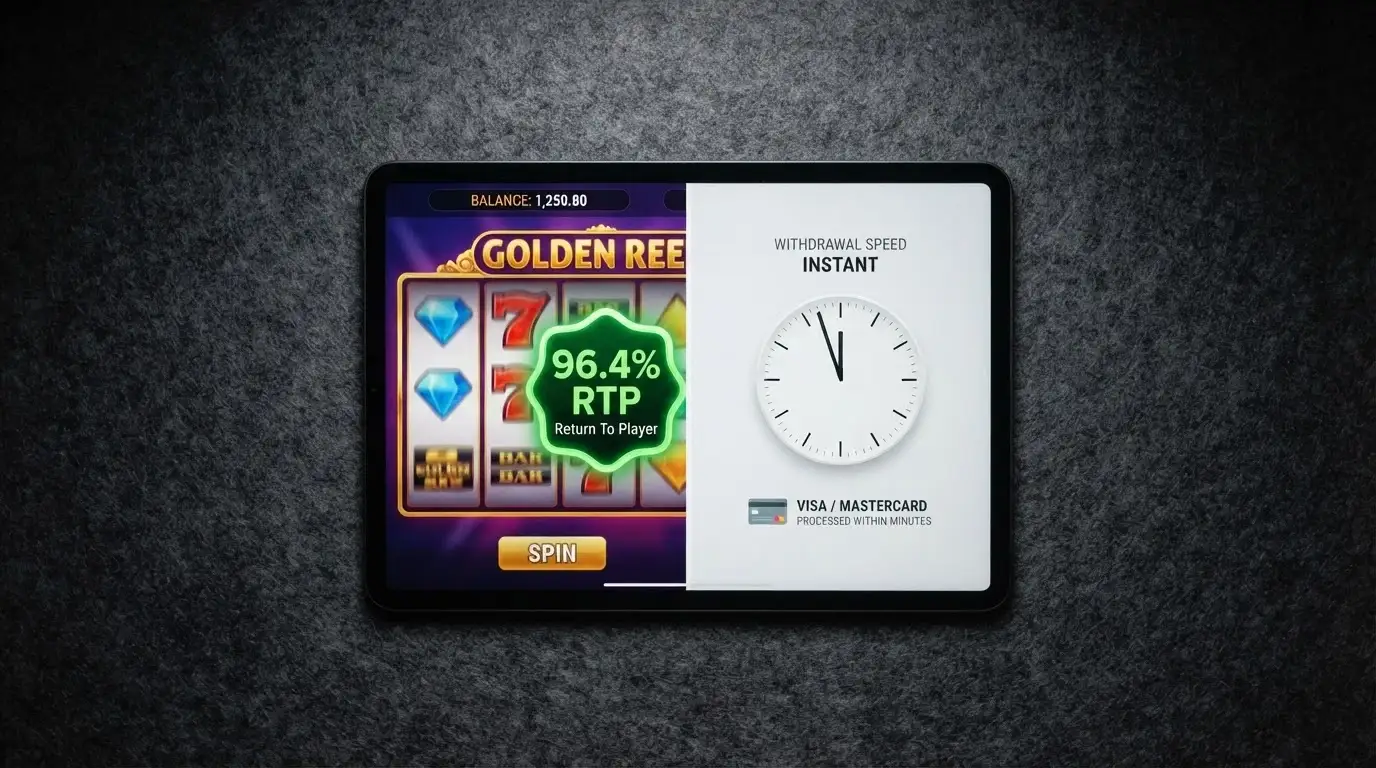
Casinos blur the two on purpose. A brand whose games return 96.4% on average can call itself “high payout.” A brand whose e-wallet withdrawals clear within 24 hours can call itself “fast payout.” Both are selling something real, and neither is what the reader usually means when they search.
The split matters because the trade-offs are different. A casino running a fast e-wallet payout window — Skycrown, for instance, with e-wallet withdrawals processed within 24 hours and card withdrawals at 2 to 3 business days — is making a claim about operations and banking. A casino running a 96.4% average RTP across its top 50 pokies — Royal Reels — is making a claim about game selection and provider mix. The reader who wants speed should weigh the first number; the reader who wants theoretical return should weigh the second.
Royal Reels additionally declares a payout window under 24 hours alongside its 96.4% top-50 RTP average. That is the rare case where one operator covers both ends. It is also why Royal Reels appears further down this page with the most detail.
The House Edge — Why Every Casino Wins in the Long Run
A 96% RTP is a 4% house edge. The maths is subtraction, and it is unforgiving. Across a session of 500 spins at A$1 — the standard benchmark for the calculation on this page — the expected loss sits around A$20. The house takes its 4% of every dollar that crosses the felt, and over volume it never gives that back.
Royal Reels’ average RTP across its top 50 most-played pokies is 96.4%, in line with published Pragmatic Play and Play’n GO figures. Take the 0.4 percentage point difference between that average and a pokie’s published ceiling — it sounds small, but compounded across thousands of spins it is the difference between losing A$18 and losing A$40 over a 500-spin session. The edge is small enough to ignore on a single spin and large enough to matter across an afternoon.
Wagering requirements multiply the effective edge against a bonus player. A 35x bonus-only playthrough forces the player to spin through the bonus amount 35 times before any winnings become withdrawable. Every spin carries the house edge; the bonus structure simply adds more spins to the runway. A “A$500 bonus” with 35x wagering is in practice a commitment to A$17,500 of wagered volume — and the house edge across that volume is what the bonus really costs.
Who Audits an Offshore Casino’s RTP — And Who Doesn’t
The independent testing houses — eCOGRA, iTech Labs, GLI and others — audit licensed operators and certify per-game RTP figures against the math the provider designed. The certificate sits on the regulator’s record and is auditable.
Offshore casinos do not publish audited figures the same way. The 96.4% RTP at Royal Reels, for instance, is the operator’s own claim from its top-50 calculation, not a per-game audit certificate a reader can pull. Provider-published RTPs — what the game studio prints on its own page — are real, but they assume a specific configuration of the game.
This is where operator-set RTP versions come in. Sweet Bonanza ships with at least four RTP versions — 96.51%, 95.45%, 94.51% and 91.51% — and the operator picks which one to load. The provider’s published 96.51% may be the title’s ceiling, but the casino may run it on the 94.51% configuration. The player has no way to know which version is live without inspecting the game’s internal configuration, and offshore casinos have no obligation to publish that detail.
The practical test is straightforward: does the operator’s site list its games with a published RTP figure? If yes, treat that figure as the provider’s data — useful as a ceiling, not a guarantee of the live configuration. If no, treat the casino’s “average RTP” claims as marketing copy. Neither is independently verified at most offshore brands.
Real-Money Play vs Demo Mode — Why the Payout Figure Only Matters With Real Stakes
Demo-mode RTP is identical to real-money RTP at legitimate game providers — the same maths runs the same way, just with fictional currency. What demo mode hides is everything around the spin: the wagering requirement when a bonus is attached, the maximum cashout cap on bonus winnings, the verification delays before a withdrawal is approved, and the pressure of real losses.
That last point is the one demo mode teaches badly. A player who runs 500 spins at A$1 in demo mode and ends ahead learns nothing about how they will react when the same 500 spins end A$20 down. Free-play confidence is not real-money behaviour.
The pragmatic use of demo mode is to test a title’s feel — bonus-feature frequency, base-game pacing, the rhythm of its dry stretches — before committing real funds. It is a poor predictor of session outcomes. The player who treats it as such will arrive at the real-money session with expectations the maths cannot meet.
Why the Highest-RTP Pokies in 2026 Still Leave You Short
The theoretical ceiling on published RTP among pokies available to Australian players at offshore casinos sits at 99.32% — Goblin’s Cave, by Playtech. Ugga Bugga by Playtech follows at 99.07%. Book of 99 by Relax Gaming and Mega Joker in Supermeter mode (by NetEnt) tie at 99.00%. Those are the title-level ceilings; the operator-level ceiling is more modest, because the operator picks the version of each title it runs.
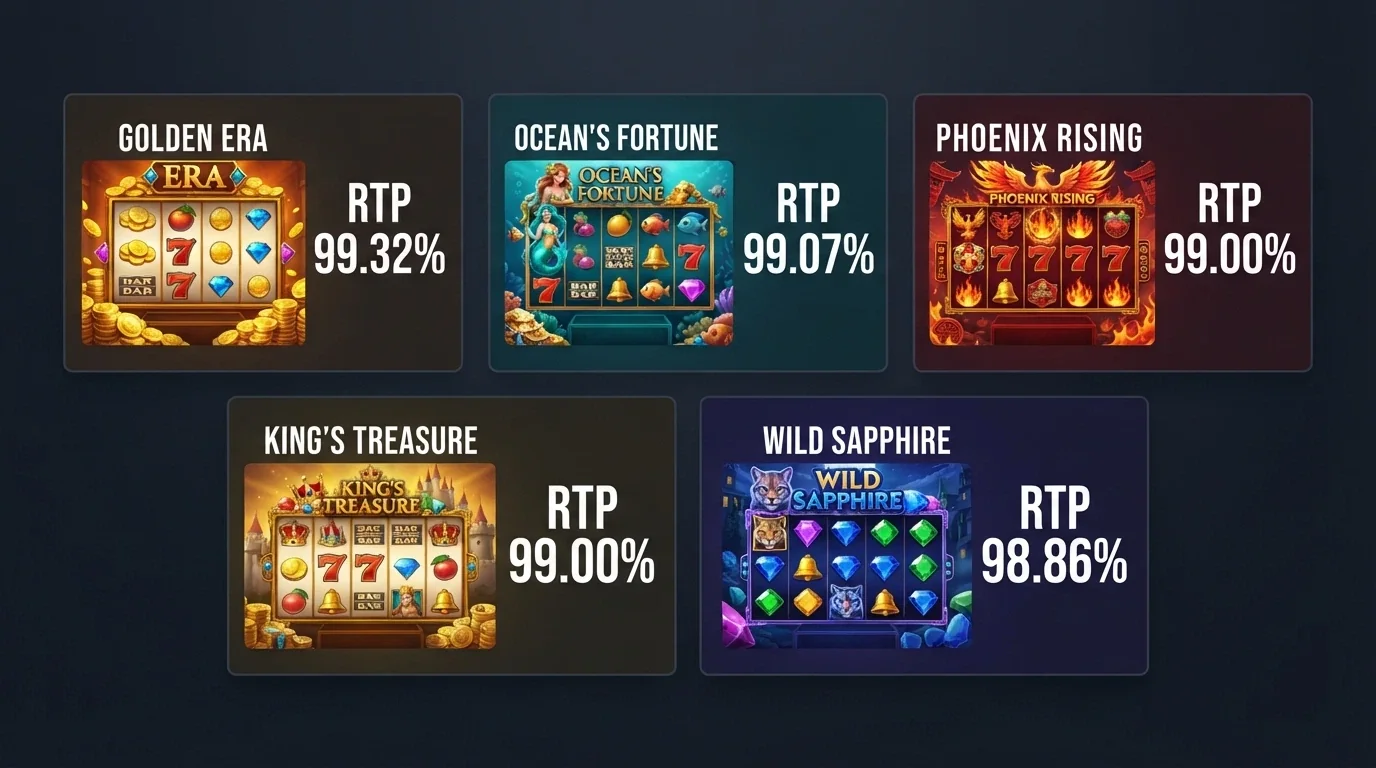
Below is the highest published-RTP set research was able to confirm for Australian players at offshore casinos. The volatility column is filled where research confirmed it; where research did not, the cell carries the no-data marker rather than a guess.
| Pokie Title | Published RTP | Provider | Volatility |
|---|---|---|---|
| Goblin’s Cave | 99.32% | Playtech | — |
| Ugga Bugga | 99.07% | Playtech | — |
| Book of 99 | 99.00% | Relax Gaming | High |
| Mega Joker (Supermeter) | 99.00% | NetEnt | — |
| Jackpot 6000 (Supermeter) | 98.86% | NetEnt | — |
| 1429 Uncharted Seas | 98.60% | Thunderkick | — |
| Blood Suckers | 98.00% | NetEnt | Low |
| Money Cart Bonus Reels | 98.00% | Relax Gaming | — |
| Jokerizer | 98.00% | Yggdrasil | — |
| Lightning Link | 96.10% | — | — |
Two reading notes before the prose. First, Mega Joker’s 99% RTP applies only in Supermeter mode — base play returns 76.9% to 85.1%, a gap wide enough to swallow the theoretical advantage on the wrong bet size. Second, volatility and RTP are independent. Blood Suckers’ 98.00% with low volatility and a 35%+ hit frequency makes it a different proposition from Book of 99’s 99.00% at high volatility, where hundreds of dry spins precede a 1,000x multiplier. The RTP number alone does not pick between them.
How RTP Actually Works — And Why a 99% Figure Doesn’t Mean You’ll Win
The maths of RTP is a ratio: total money returned to players divided by total money wagered, measured across an effectively infinite spin sample. The “infinite” part is not editorial exaggeration — it is the only condition under which the ratio converges. Across 500 spins, the observed return on a 99% RTP pokie can land anywhere on a wide distribution around 99 cents on the dollar, with a meaningful probability of finishing below 100% return even when the long-run average is the highest in the market.
The session-loss calculation that follows illustrates the gap. Take a 500-spin session at A$1 per spin on a pokie running at the 96.4% average RTP Royal Reels reports across its top 50 titles. The expected loss sits at A$18, give or take the standard deviation of variance across 500 spins. The reader who walked in expecting to keep 96 cents on the dollar will leave A$20 lighter than the deposit implied. The maths was always going to win.
A 99% RTP pokie shifts that expected loss to around A$5 across the same 500 spins. It is a real improvement — about A$15 retained per session on average. It is not a profit. The house edge on a 99% RTP pokie is 1%, half the market’s typical 2–4%. The expected loss is half the market’s typical session cost. Both are still losses.
Pokies vs Slots — What Australians Actually Call the Games
Australian players call them pokies. The term comes from “poker machines” — the original Ainsworth and Aristocrat one-armed bandits in pubs and clubs — and it has stuck through five decades. “Slots” is the international and offshore-casino term. A page that uses “slots” repeatedly, or mixes the two, signals either an offshore operator that has not localised or an affiliate page written by someone who has not played in Australia.
The terminology matters because it is a low-cost trust signal. A casino that uses “pokies” in its own lobby and its own promotional copy is at least aware of the market it serves. A casino that calls them “slots” may be running an identical template across thirty jurisdictions. Neither is dispositive, but the first is the better starting position.
Free-Play Pokies — High RTP Without the Risk, But Without the Win Either
Most offshore casinos serving Australian players offer demo-mode access to their pokie catalogue, including the high-RTP titles above. The point of free play is exactly what it says: play the game without risking real money, learn the bonus-feature mechanics, test the volatility profile, and decide whether the title is worth a real deposit.
The point free play does not serve is winning. Demo winnings are not withdrawable, not redeemable and not a forecast of what real money will do. A player who runs Mega Joker in Supermeter mode at demo and ends 20% ahead has learned nothing about whether the same 500 spins at A$1 will end ahead on Monday.
Use demo mode for what it teaches — feel, frequency, feature rhythm — and stop using it the moment the aim shifts from learning to earning.
Casino Table Games and Their Payout Rates vs Pokies
Table games carry a different RTP structure. Blackjack with basic strategy returns above 99.5% — the highest theoretical return available in any casino game, and the reason card counters have existed since the 1960s. Baccarat’s banker bet carries a house edge around 1.06%, the player bet around 1.24%. Single-zero roulette sits at 2.7% house edge; double-zero roulette at 5.26%.
Offshore casinos rarely publish per-table RTP the way providers publish per-pokie RTP. The blackjack rule set in use at any given live table is not always disclosed — number of decks, dealer hits or stands on soft 17, double-down rules, surrender availability — and those rules change the house edge enough to matter. A blackjack game that pays 6:5 on a blackjack instead of 3:2 lifts the house edge by roughly 1.4 percentage points, which is more than the entire edge on the player-bet at baccarat.
Pokies dominate the “highest payout” conversation because per-pokie RTP is published, comparable and searchable. Table games are higher-returning on average but lower-transparent — the player has to read the rule card, and offshore operators do not always make that easy.
Volatility, Hit Frequency and the Session That Feels Nothing Like the RTP
Volatility describes how RTP is distributed across a session. A low-volatility pokie returns its long-run average through many small wins — Blood Suckers’ 35%+ hit frequency means more than a third of spins return something. A high-volatility pokie returns its long-run average through rare large wins — Book of 99’s 99% RTP sits behind hundreds of dry spins before a 1,000x multiplier lands.
The two experiences are not comparable on RTP alone. A 98% low-volatility pokie across 500 spins will feel like a steady, modest drain — many small wins, slow bleed. A 99% high-volatility pokie across the same 500 spins will feel like a disaster until the rare payout lands — or worse, until it does not. The high-RTP title can produce the worse session of the two.
Hit frequency sharpens this further. Blood Suckers’ 35%+ hit frequency means roughly one in three spins returns any amount at all, which keeps the bankroll moving in small increments and gives a player using bonus funds something to grind against. A high-volatility, low-frequency title does not give a bonus player that runway — the wagering requirement hangs over a session of dead spins until the wagering clock runs out.
A session-loss calculation makes the comparison concrete. Two pokies, both played at A$1 per spin for 500 spins. The 96.4% average-RTP pokie loses A$18 in expectation, give or take variance. The 98.0% low-volatility pokie loses A$10 in expectation. The 99.0% high-volatility pokie loses A$5 in expectation. The order is right — higher RTP means lower expected loss. But the standard deviation on that high-volatility title is wider, so the realised session loss is more likely to deviate further from the expectation in either direction.
10 Offshore Casinos Australian Players Use — Compared Honestly
The 10 brands below are the offshore casinos Australian players actually reach. Every one is offshore. None holds an Australian licence, because no online casino licence exists in Australia. The table summarises what current data confirmed; cells that could not be filled carry the no-data marker rather than an estimate.
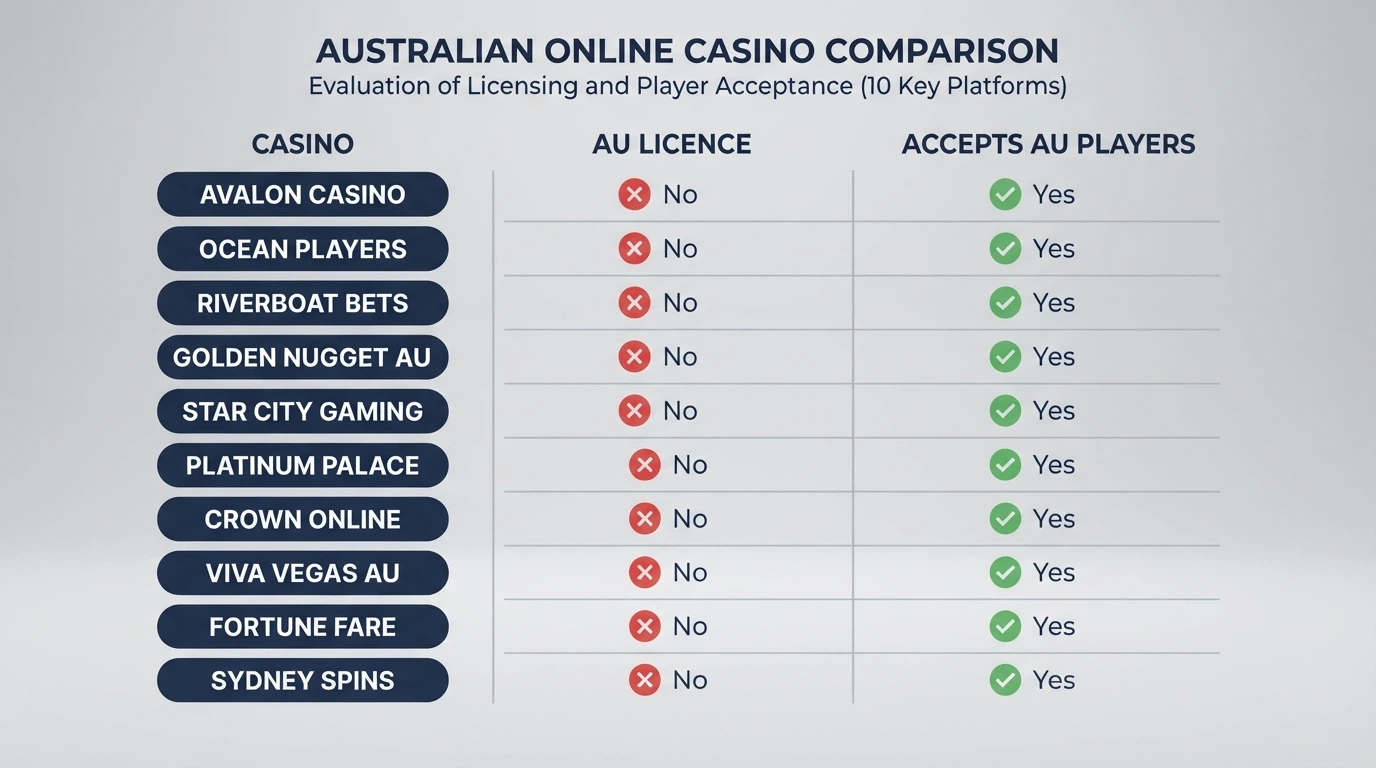
| Operator | AU Licensed | Accepts AU Players |
|---|---|---|
| Rocket Play | No | Yes |
| Skycrown | No | Yes |
| Royal Reels | No | Yes |
| Stake | No | Yes |
| WinSpirit | No | Yes |
| Rainbet | No | Yes |
| Scream Casino | No | Yes |
| FairGO | No | Yes |
| Bizzo Casino | No | Yes |
| Rocket Casino | No | Yes |
A note on what “accepts AU players” means here. It means the operator does not block Australian IP addresses at the door and accepts Australian dollar deposits or equivalent crypto. It does not mean the operator is licensed, regulated or protected under Australian law. The legal section below makes that distinction explicit; the operator profiles that follow keep the offshore status visible in every line.
Rocket Play — 100% Match to 1,000 USDT + 100 Free Spins, 40x Wagering
Rocket Play’s welcome offer is a 100% match up to 1,000 USDT plus 100 free spins, with 40x wagering on the bonus amount. Dama N.V. operates the brand and the game library runs to 3,000+ pokies from Pragmatic Play, Play’n GO, NetEnt and Evolution for live tables. The live table limit is set at A$750 — higher than many Dama N.V. casinos, which matters for players who want to spread a bankroll across table play rather than grind pokies.
The 40x wagering multiple is steep. Across a 1,000 USDT bonus, the required turnover is 40,000 USDT before any winnings become withdrawable. That is not a small commitment — it is the player wagering forty times the bonus amount across the games catalogue. A player who treats the bonus as “free money” has not read the wagering line. A player who treats the bonus as a commitment to volume has, and should still weigh whether 40x is the multiple they want to commit to.
Crypto-denominated bonuses also sit outside Australian rules. From 11 June 2024, digital currency is a banned payment for online wagering in Australia, which means a casino accepting USDT deposits operates outside the licensed system. That is the same tell as a casino accepting credit cards — both are a fast indicator of offshore status.
Players comfortable with crypto who value high-volume pokies play may find the 40x wagering requirement acceptable given the large library, but it remains a steep hurdle for casual play.
Skycrown — AU$200 Match + Free Spins, 30x Wagering, AU$500 Cashout Cap
Skycrown’s typical welcome offer is a 100% match up to AU$200 plus free spins spread across the first three deposits, with 30x wagering on the bonus amount, a 7-day expiry and a maximum cashout limit of AU$500 per bonus. The wagering multiple is lower than Rocket Play’s 40x, which is friendlier; the expiry is tighter, which is unfriendlier.
The AU$500 maximum cashout per bonus is the clause worth reading twice. A bonus player who runs the wagering to completion and builds a balance above AU$500 will see anything beyond that ceiling forfeited at withdrawal. The cap turns a promising bonus run into a bounded one — the player is not playing for an unlimited payout, only for whatever sits below AU$500 when the wagering clears.
Withdrawal speed is the second story. E-wallet withdrawals process within 24 hours; card withdrawals take 2 to 3 business days. That places Skycrown on the faster end of the offshore payout spectrum, which matters for players who value cashout time over bonus size.
Skycrown offers a balanced package: moderate wagering and fast e-wallet payouts, but the AU$500 cap limits the upside of any bonus run. It suits players prioritising withdrawal speed over maximum bonus cash.
Royal Reels — A$2,500 Across Three Deposits, 35x Bonus-Only Wagering, A$5 Spin Cap
Royal Reels runs the largest welcome package among the featured set at A$2,500 across three deposits: 100% up to A$500 on deposit one, 75% up to A$750 on deposit two, 100% up to A$1,250 on deposit three, plus 50 free spins. The structure rewards a player willing to commit across three deposits rather than walk away after the first. Wagering is 35x on bonus only — not on deposit plus bonus — which is the better of the two common structures.
The 50 free spins land on a featured pokie at a fixed A$0.20 stake. That puts the headline spin value at A$10, with winnings subject to the same 35x wagering before withdrawal. The A$5 per-spin cap during bonus clear-down is the operational limit on how fast the wagering can be ground down — higher-stake spins do not count, so the player must spread the wagering across smaller individual bets.
The library runs to 5,400+ pokies from 40+ software providers, including Pragmatic Play and Play’n GO. The average RTP across the top 50 most-played pokies sits at 96.4% — in line with the providers’ published figures. PayID deposits clear in under 90 seconds, which is the fastest deposit claim on the page. The declared payout window is under 24 hours.
With the largest welcome package and confirmed highest average RTP, Royal Reels is data-rich, though the three-deposit commitment and A$5 spin cap demand patience. It is designed for players building a long-term library experience.
Stake — Crypto-Native, Rakeback Model, No Traditional Welcome Bonus
Stake runs on a Curaçao licence and a crypto-native payment model. The brand does not run a traditional match-deposit welcome offer; it operates on a rakeback and reload structure, returning a percentage of house edge to active players on an ongoing basis. The exact current rakeback rate could not be confirmed this run; the operator’s own terms page is where the live figure sits.
The crypto-native model places Stake firmly outside Australian rules. Since June 2024, digital currency is a banned payment for online wagering in Australia — any casino accepting it operates outside the licensed system. The crypto deposits and crypto withdrawals Stake runs are precisely the activity the Australian ban is structured around. The player who values fast crypto settlement over regulated deposit routes will find Stake structured for that trade.
Stake’s rakeback system rewards frequent activity rather than upfront cash, making it a distinct choice for players who prefer long-term incentives over traditional deposit matches.
WinSpirit — Offshore Casino, Limited Confirmed Data This Run
For a player considering WinSpirit, the only honest advice is to check the operator’s own terms page for current bonus, licence and payout information before depositing. WinSpirit is an offshore casino that holds no Australian licence. The IGA prohibits online casino products to Australian players; WinSpirit is among the offshore brands that accept AU sign-ups regardless. That places it in the same legal category as every other operator on this page.
Rainbet — Offshore Casino, Limited Confirmed Data This Run
Like other offshore operators, Rainbet lacks an Australian licence and provides no local consumer safeguards. Players should verify all terms directly on the casino site, as data on bonus structures and payout times remains unconfirmed.
Scream Casino — Offshore Casino, Limited Confirmed Data This Run
Scream Casino operates without Australian licensing or local protections. We list it based on current accessibility, but advise players to treat all bonus or licence claims as unverified until checked against the operator’s latest terms.
FairGO — RealTime Gaming Casino, AU-Facing, Limited Confirmed Data This Run
FairGO is a recognised AU-facing casino running on RealTime Gaming’s pokies library — a provider whose catalogue is built around RTG’s house style. The AU-facing positioning is the brand’s distinguishing feature in the offshore market. The operator’s own terms page is the live source for current bonus, licence and payout information. For a player who prefers the RTG style, FairGO is an option among the offshore set; for a player who wants the modern bonus-feature catalogue, Royal Reels above is the more data-rich fit.
Bizzo Casino — Offshore Casino, Limited Confirmed Data This Run
Bizzo Casino is offshore, holds no Australian licence, and accepts Australian players. The operator’s own terms page is where any of those fields live. The legal position is identical to every other operator on the page — prohibited product offered from outside Australia, no Australian consumer protection, no BetStop coverage. For a player comparing Bizzo Casino against the documented brands above, the live terms page is the deciding document.
Rocket Casino — Offshore Casino, Limited Confirmed Data This Run
Rocket Casino is offshore, holds no Australian licence, and accepts Australian players. The operator’s own terms page is where the live data sits. For a player shortlisting Rocket Casino against the brands this page could document in more detail, the live terms page is the only current source for bonus, licence and payout information.
The Legal Reality: Online Casino Is Prohibited in Australia
The Interactive Gambling Act 2001 makes it an offence to provide online casino games, online pokies or in-play sports betting to a person in Australia. There is no licence for online casino anywhere in the country — not federally, not in any state, not in any territory. The ACMA, the federal regulator, has had 1,564 illegal gambling and affiliate websites blocked by Australian ISPs since November 2019, and more than 225 illegal services have withdrawn from the Australian market since enforcement was strengthened in 2017.

The Act targets the provider, not the player. The individual punter is not prosecuted under the IGA. That is the legal reason offshore casinos continue to accept Australian players without facing the player with consequences. It is also the reason this page can describe those operators without crossing into advice to commit an offence — what the player does at an offshore site is between the player and that site.
What the ACMA does not do for a player using an offshore site is also worth being clear about. ACMA can direct ISPs to block the site, and has done so at scale. ACMA cannot recover money a player deposited at an offshore casino. ACMA cannot compel a payout. ACMA cannot refer a complaint to a regulator with jurisdiction over the operator. The protections an Australian player has at a state-licensed wagering operator — complaints bodies, fund recovery, mandatory responsible-gambling tools — do not exist at any offshore casino.
That gap is what the offshore category costs. The RTP figures may be competitive. The bonus terms may be generous. The payout speed may be fast. None of it comes with Australian consumer protection, and that is the line the rest of this section draws.
What the Interactive Gambling Act Actually Bans — And What It Doesn’t
The IGA prohibits online casino games, online pokies and in-play sports betting to Australian customers. The 2017 amendment closed the offshore loopholes that previously allowed operators to argue they were not “providing” to Australians and gave ACMA its blocking powers.
What the IGA does not ban is the wagering it permits — pre-event race and sports betting, lotteries, keno — through state and territory licensed operators. Sportsbet, bet365, Ladbrokes, TAB and others hold Northern Territory or state licences and operate within Australian law. Online casino is not on that list. The product this page is about is the product the IGA bans.
The line is sharper than most Australian players realise. A licensed AU wagering operator can offer a sports multi, a racing exotic, a sports total. It cannot offer a pokie, a blackjack hand, a roulette spin — not online. The offshore gap is the gap the IGA leaves, and the gap is the entire market this page describes.
What a Curaçao Licence Means for an Australian Player — And What It Doesn’t
A Curaçao Gaming Control Board licence is real. Operators like Bruce Bet Casino carry one — OGL/2024/1056/0702 is an example licence number visible on operator pages. The licence reflects regulatory work on the operator’s corporate structure, its anti-money-laundering compliance and its dispute resolution process.
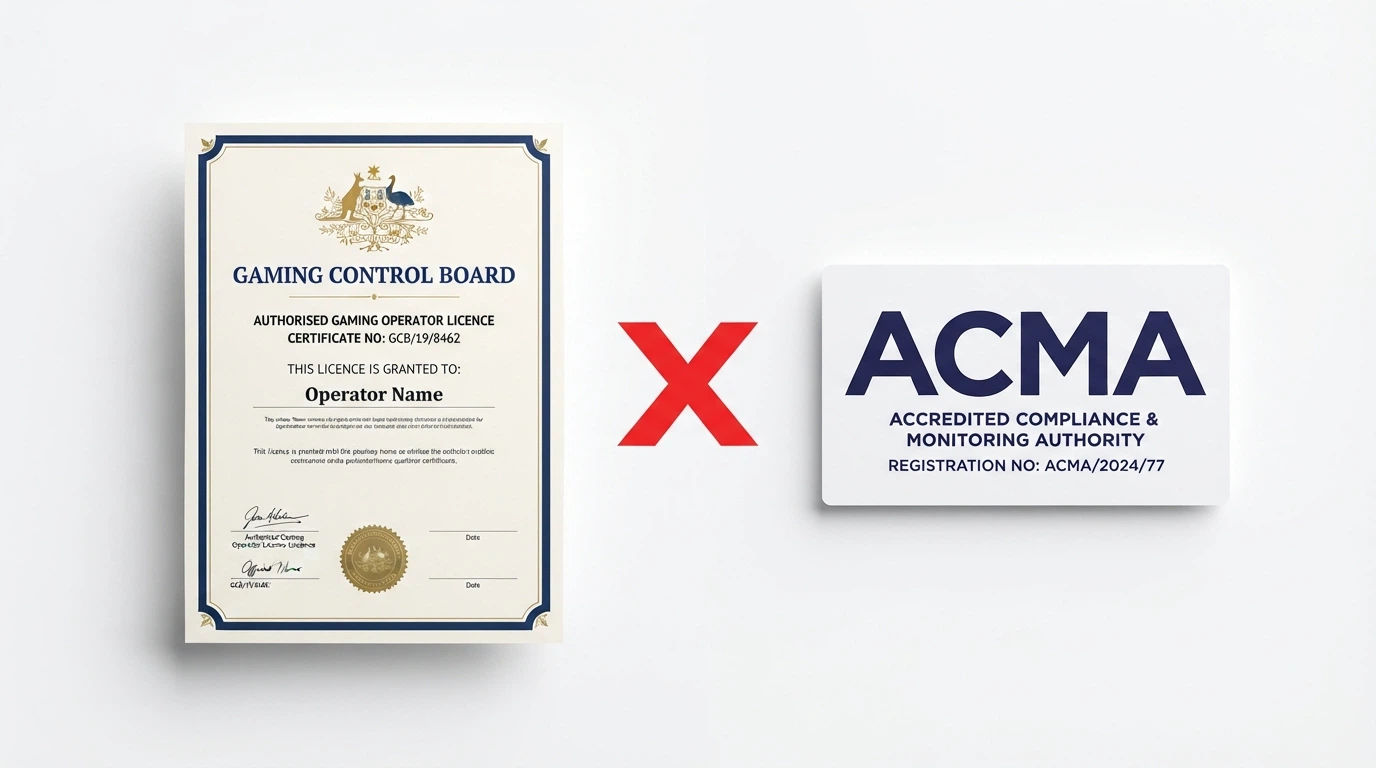
What it does not reflect is any Australian consumer protection. The Curaçao GCB has no jurisdiction over complaints from Australian players. There is no Australian complaints body a player can escalate to. There is no fund recovery mechanism if an offshore casino refuses a withdrawal. There is no BetStop coverage — BetStop binds Australian-licensed wagering services, and an offshore casino is not in that set. The site can be blocked by ACMA at any time, and the player’s balance can be sitting on it when the block lands.
A Curaçao licence is a real licence. It is not an Australian licence, and it is not a substitute for one.
How the Credit Card and Crypto Ban Tells You Which Sites Operate Outside Australian Rules
Since 11 June 2024, credit cards, credit-related products and digital currency are banned as payment for online wagering in Australia. The Interactive Gambling Amendment (Credit and Other Measures) Act 2023 brought the ban in, with penalties up to A$247,500 for operators breaching it. Legal deposit routes for licensed Australian wagering are debit card, bank transfer, PayID/Osko and BPAY.
That list is the fast identifier. A site asking for credit card deposits is outside Australian rules. A site asking for crypto deposits is outside Australian rules. POLi was decommissioned on 30 September 2023, so a site still routing through POLi is running on outdated payment infrastructure. Every operator on this page accepts deposits the licensed system has banned, which is the clearest single signal of offshore status.
From 1 January 2027, banks and payment providers gain express authority to block transactions to illegal gambling operators. That closes one more path the offshore market currently uses. The 2027 reform section below covers the rest of the package.
The 2026 Reform — What Changes on 1 January 2027 and Why It Matters Now
The Interactive Gambling Amendment (Gambling Reform) Bill 2026 passed Parliament on 19 August 2026, and its measures commence on 1 January 2027. The reform is the most significant tightening of the offshore environment in nearly a decade.
Three changes matter for this page. First, from 1 January 2027, banks and payment providers can block transactions to illegal gambling operators at the payment layer. That cuts off a route that has kept the offshore market accessible to Australian players. Second, the inducement-marketing prohibition extends further: direct marketing is banned for 14 days after a customer signs up, for three months after a person deregisters from BetStop, and indefinitely for customers identified as at-risk. The marketing runway shrinks sharply. Third, wagering advertising is capped at three ads per hour between 6:00 am and 8:30 pm, with a live-sport blackout running from 15 minutes before a live event to 5 minutes after it ends. Athletes, celebrities and influencers are barred from promoting wagering products. Broadcasting sporting odds is banned outright.
The reform does not legalise online casino. It does not licence offshore operators. It tightens the conditions under which the offshore market operates, and the tightening lands four months after this page is published. A reader looking at an offshore casino in late 2026 is looking at a market the federal government is actively constraining.
Responsible Gambling: Tools That Work and Tools That Don’t
Australia runs one of the more developed responsible-gambling infrastructures in the world. The National Gambling Helpline — 1800 858 858 — is free, confidential and staffed 24 hours a day, 7 days a week. Gambling Help Online runs online chat and counselling at gamblinghelponline.org.au. BetStop — the National Self-Exclusion Register — went live in August 2023 and, as at 31 July 2026, had 67,480 registrations, of which 41,290 exclusions were still active; 78% of registrants were under 40, and 38% chose lifetime exclusion.

About 2.1% of Australian adults — roughly 430,000 people — experience problem gambling, with the Australian Institute of Health and Welfare putting high-risk gambling at 1.8% in 2022. Those figures describe the licensed wagering system’s population, not the offshore casino population. The offshore set has no equivalent data because offshore operators do not report into Australian harm surveillance.
The architecture works for licensed wagering. It does not extend to offshore casinos, and the next two sections make that distinction explicit.
BetStop Self-Exclusion — What It Covers and What It Leaves Unprotected
BetStop excludes a registered person from every Australian-licensed wagering service with a single registration. The Northern Territory-licensed brands, the state-licensed brands, the national brands — all of them are bound by a BetStop registration. The 67,480 registrations and 41,290 active exclusions as at 31 July 2026 show the register is in active use.
What BetStop does not cover is any offshore casino. The register binds Australian-licensed services, and offshore casinos are not licensed in Australia. A person who has registered with BetStop can still deposit at every offshore casino on this page, and those casinos will still accept the deposit. From 1 January 2027, the inducement-marketing prohibition runs for three months after a person deregisters from BetStop, which tightens the marketing side of the gap; the operational gap — that the offshore casino can still accept a self-excluded person’s money — remains.
For a person who has registered with BetStop and is looking for additional protection, the offshore set is the wrong place to look. The licensed wagering system is where BetStop bites; offshore casinos sit outside its reach.
Deposit Limits, Help Resources and the Real Numbers
Licensed Australian wagering operators offer customer-set deposit limits and activity statements under state and territory conditions — the rules differ by jurisdiction but the structure is universal. A customer can set a daily, weekly or monthly deposit ceiling, and the operator is required to enforce it. Activity statements summarise the customer’s wagering and time-on-site over a chosen period, giving a player an honest view of their own play.
Offshore casinos may offer deposit-limit tools; none are required to. The Australian deposit-limit architecture is built into the licensed system’s compliance regime, and that regime does not reach offshore operators. A player using an offshore casino and looking for a hard deposit ceiling is depending on the operator’s voluntary compliance.
The help resources work regardless of where the gambling is happening. The National Gambling Helpline (1800 858 858, free, confidential, 24/7) and Gambling Help Online (gamblinghelponline.org.au, online chat and counselling) serve any Australian, at any operator, with any product. If gambling stops feeling like a choice, those numbers are the first call.
How We Evaluated These Casinos
The operators on this page were selected based on presence in the Australian market. The ranking reflects the order Australian players actually reach these brands. Bonus terms, payout speed and licence details are populated where confirmed; unconfirmed fields carry the no-data marker.
The limits of this review are the limits of any review of an offshore market. No online casino holds an Australian licence. Offshore operators do not publish audited per-game RTP the way licensed operators do; the published figures on this page are provider-level, not operator-audited. Bonus terms change. Payout speeds vary by payment method. The reader who treats this page as the live source is reading stale data within weeks.
What this page can do is show which operators are confirmed offshore, which bonus terms were verifiable, which RTP figures came from provider data, and which fields could not be refreshed. The reader who wants the live figure on a specific operator’s current bonus is reading the operator’s own terms page. That division of work is the honest one.
What the Australian Player Should Actually Do With This Information
The honest takeaway from the RTP data on this page is that the theoretical ceiling exists. Ugga Bugga at 99.07% is the highest single confirmed published RTP. Goblin’s Cave at 99.32% sits at the top of the published set on a different source. Royal Reels’ 96.4% average across its top 50 pokies is the highest confirmed operator-level average. The numbers are real, and they are reachable at the offshore brands above.
The honest takeaway from the legal data is that every one of those brands sits outside Australian licensing. No online casino holds an Australian licence. No online casino can. The RTP ceiling is reachable, but only through operators that ACMA can block at any time, that have no obligation to publish audited figures, that have no Australian complaints body a player can escalate to, and that sit outside BetStop coverage.
The gap between those two takeaways is what the decision sits in. A reader who chooses to play at an offshore casino is choosing the higher theoretical return over Australian consumer protection. The choice is real, and the trade-off is real. This page does not recommend the choice, because the page is analysis and not advertising, but the page does describe what each side of the trade costs.
The decision framework that the data on this page supports is straightforward. If the reader chooses to play, check the operator’s current licence and terms on the operator’s own terms page before depositing. Use demo mode first — feel the game, learn the bonus-feature rhythm, but do not treat demo outcomes as a forecast of real-money results. Never deposit more than the reader can afford to lose across the worst session variance will produce. Know the helpline number — 1800 858 858 — before the first deposit, not after the session that did not go as planned.
The reform on 1 January 2027 tightens the conditions under which the offshore market operates. Banks gain payment-blocking authority. The inducement-marketing runway shortens. The advertising cap lands. None of it changes the underlying legal position — no online casino is licensed in Australia, and the IGA prohibition stands — but the practical environment for the offshore set narrows from four months after this page is published.
The figures on this page are what research could confirm this run. The reader who treats them as the starting point of their own research — not as the final word — is reading the page the way it is written.
Frequently Asked Questions
Which casino gives Australian players the best return in 2026?
No online casino is licensed in Australia, so the question turns on the offshore set. Within that set, the highest confirmed operator-level average RTP sits at Royal Reels, where the top 50 most-played pokies return 96.4% on average. The highest confirmed per-pokie published RTP is 99.32% on Goblin’s Cave by Playtech. Both figures come from provider data and the operator’s own calculation, not from an independent audit. Every casino on this page is offshore, and none carries Australian consumer protection.
Is it legal to play at online casinos in Australia under the Interactive Gambling Act?
Under the IGA, providing online casino games or pokies to anyone in Australia is prohibited, but the Act targets the provider rather than the individual player. The punter is not prosecuted. What is not available is Australian consumer protection at any offshore site — ACMA can block the site but cannot recover a player’s money, and no Australian complaints body covers offshore operators. Playing at an offshore casino is not a criminal offence for the player; it is also not an activity with Australian regulatory cover.
What does RTP mean for online pokies and does a high RTP guarantee I will win?
RTP — return to player — is the share of money a pokie returns to its players across a long-run average. A 96% RTP pokie returns 96 cents on the dollar across an effectively infinite spin sample, not across a single session. A session of 500 spins sits well short of infinity and lands on a wide variance distribution around that 96%. High RTP shifts the long-run average in the player’s favour by a small, real margin; it does not protect any individual session from losing. The expected loss across 500 spins at A$1 on a 96.4% RTP pokie is roughly A$18.
How do I deposit and withdraw money at online casinos from Australia if credit cards are banned?
Since 11 June 2024, credit cards and crypto are banned as payment for online wagering in Australia under the Interactive Gambling Amendment (Credit and Other Measures) Act 2023, with penalties up to A$247,500. Legal deposit routes for licensed Australian wagering are debit card, bank transfer, PayID/Osko and BPAY. Offshore casinos are not bound by that ban — they accept the payment methods the licensed system has prohibited, which is one of the clearest indicators of offshore status. A site accepting credit cards or crypto sits outside Australian rules.
Does BetStop self-exclusion cover offshore online casinos?
No. BetStop binds Australian-licensed wagering services, and offshore casinos are not licensed in Australia. A person registered with BetStop can still deposit at every offshore casino on this page, and those casinos will still accept the deposit. From 1 January 2027, the inducement-marketing prohibition runs for three months after a person deregisters from BetStop, which tightens the marketing side of the gap. The operational gap — that an offshore casino can still accept a self-excluded person’s money — does not close.
Are online casino winnings taxable in Australia?
Betting and gambling winnings are not assessable income under section 6-5 of the ITAA 1997, and gambling losses are not deductible under section 8-1, unless the person is carrying on a business of betting or gambling. No Australian case has held ordinary punter winnings assessable. The ATO’s IT 2655 sets out the criteria for when gambling activity rises to the level of a business. For a recreational player at any operator on this page, winnings are not taxable and losses are not deductible. The tax position is the same at licensed and offshore operators alike.