
How Fast Do Instant Payout Casinos Actually Pay Australian Players?
Every casino marketing itself to Australians calls its withdrawals instant. The word does the same work in every sales email and on every landing page: it implies the gap between “I clicked withdraw” and “the money is in my account” is so small it barely exists. The bank statement tells a different story. Some methods genuinely clear in minutes. Most take days. And the delay a player blames on the operator is, more often than not, a queue inside the player’s own paperwork.

This page ranks ten offshore casinos that accept Australian players by their verified withdrawal speed, breaks the bonus numbers down against what is actually withdrawable, and lays out the legal vacuum a player walks into when they deposit at any of them. The structure is built around what matters at the cashout screen: which method clears fastest, how long KYC really takes, and what an A$5,000 welcome package is worth once the wagering has run its course.
Current as of 22 November 2026 against Curaçao GCB and Curaçao eGaming Authority public licence registers.
Table of Contents
- What “Instant Payout” Actually Means at an Online Casino
- The Fastest-Paying Casinos for Australians in 2026, Ranked by Real Withdrawal Speed
- The Pokies That Actually Pay: RTPs, Volatility and Real Cashout Potential
- Why Most Instant-Payout Bonus Offers Are Smaller Than They Look
- Crypto Casinos: The Real Engine Behind Instant Payouts
- Are Instant-Payout Casinos Actually Legal for Australians?
- Playing Safely When Every Withdrawal Is Instant
- How We Evaluated and Ranked These Instant-Payout Casinos
- What Australian Players Should Actually Do About Instant-Payout Casinos
- Frequently Asked Questions
What “Instant Payout” Actually Means at an Online Casino
The “Instant” Promise vs the Withdrawal Reality
“Instant” is a marketing word, and it does not survive contact with a payment rail. No casino site is truly instant — every legitimate operator runs account verification before the first withdrawal, and the verification step is where most of the wait is spent. The bigger the verification backlog, the longer the wait, and offshore operators serving Australians do not publish their queue length.
What the speed data actually shows is a spectrum. Crypto at most AU-facing offshore casinos settles in 30 minutes or less, with USDT on TRC-20 at 5–30 minutes, BTC at 20–60 minutes and ETH at 15–45 minutes. PayID sits in the same bracket — usually under an hour — and is the fastest AUD-native option that does not require a wallet most Australians do not already hold. Skrill and Neteller land at 1–4 hours. Bank transfers through BECS take 1–3 business days, and Visa or Mastercard take 2–5. The gap between “processed by the casino” and “cleared in your account” is where the real clock runs, and it runs on the bank’s schedule, not the operator’s.
A pending period complicates the picture. Many offshore casinos quote a 0–48 hour internal review before the money is even released to the payment processor. During that window the casino checks wagering requirements, anti-money-laundering flags and bonus abuse patterns. A player who has just cleared a bonus, or one whose deposit and withdrawal patterns look unusual to a risk team, will sit longer. The fastest path through the pending period is the path with the fewest flags: a verified account, a single deposit method matched on the withdrawal, no active bonus and no recent deposit-withdraw cycle that looks like money laundering.
How PayID Became Australia’s Fastest AUD Cashout Rail
PayID is the open banking protocol that links a phone number, email or ABN to a bank account, settled through the Reserve Bank of Australia’s Osko infrastructure. It bypasses the BECS clearing cycle that makes ordinary bank transfers a 1–3 business day affair and lands money in minutes instead.
For casino withdrawals specifically, PayID processes in 10–60 minutes at most AU-facing offshore operators, with daily limits between A$10 and A$10,000 and no transaction fee on either end. The A$10,000 ceiling is meaningful — a player withdrawing a large win in a single day is at the cap and may need a second day to clear the balance. The speed advantage over BECS is measured in days, not minutes, which is why PayID is now the standard AUD-native withdrawal method recommended by comparison sites rather than a niche alternative. Its limit is not speed but acceptance: not every offshore casino supports PayID, and a player who picks an operator without it is back to BECS and the multi-day wait.
Real-Money Play: What Changes When You’re Cashing Out Actual Winnings
The mechanics of a withdrawal do not change between demo mode and real-money play. The cashout screen, the KYC review and the payment rail all run the same way. What changes is the weight of the wait.
A demo balance can be abandoned and recreated. A real-money balance is the difference between a winning session and an unpaid one, and a multi-day pending period that felt like a minor inconvenience in demo mode becomes a meaningful hold on money the player has already earned. The mechanics of speed also do not change between licensed and unlicensed operators — a Curaçao-licensed offshore casino and an Australian-licensed sports book run the same PayID and BECS rails. The difference is what sits behind the rails: the consumer protections a player has if the money never arrives.
One thing is worth saying plainly: the individual player is not prosecuted under the Interactive Gambling Act 2001. The Act targets the provider of the prohibited service, not the person logging in. That fact shapes the legal picture but it does not change what a player should expect from an offshore operator that has no Australian licence and no obligation to BetStop, ACMA or any Australian consumer protection regime.
Why the Casino Isn’t What’s Delaying Your Payout
KYC verification is the number one cause of withdrawal delays at instant-payout casinos. The casino may have processed the withdrawal in under a minute — the queue is the player’s own file.
The documents operators ask for vary, but the standard set is a government-issued photo ID, proof of address dated within the last three months, and sometimes a photo of the payment method used for the deposit. Offshore operators serving Australians may also ask for source-of-funds documentation if the deposit exceeds a threshold they consider unusual. A player who submits a driver’s licence, a utility bill and a debit card photo at signup, before making the first deposit, skips the queue entirely on the first withdrawal. A player who waits until cashout time discovers that a blurry passport photo and a bank statement from the wrong account start a back-and-forth that runs days.
Two practical rules follow. First, complete KYC before depositing, not at withdrawal. The casino does not need the documents to take the deposit; it needs them to release the withdrawal, and the player who delays until cashout time has built the delay into their own wait. Second, withdraw to the same method used to deposit. Most offshore operators will not release funds to a new rail until the deposit rail has been used at least once, and the operator’s payment team treats a withdrawal to an unfamiliar account as a fraud signal that triggers a manual review.
The Fastest-Paying Casinos for Australians in 2026, Ranked by Real Withdrawal Speed
The table below ranks the ten featured operators by their fastest verified withdrawal method. Crypto and PayID operators sit at the top; bank-transfer-only brands sit at the bottom. “Licence / Status” reflects the licence displayed on the operator’s own site or verified against a public register. Where the operator’s terms, withdrawal speed or bonus shape were not independently confirmed this review, the cell carries an em dash rather than a guess.

| Casino | Licence / Status | Welcome Bonus | Wagering | Fastest Payout |
|---|---|---|---|---|
| Stake | Curaçao CGA OGL/2024/1451/0918 (Medium Rare N.V.) | Rakeback model, no traditional bonus | 0x on rakeback | Crypto under 10 min |
| Rainbet | Curaçao eGaming Authority | Welcome match up to ~A$700 | 40x bonus balance | Crypto under 10 min |
| Skycrown | Curaçao GCB OGL/2023/176/0095 (Hollycorn N.V.) | Up to A$5,000 + 400 FS across 4 deposits | 35x bonus | Crypto ~10 min |
| Rocket Play | Offshore, no AU licence | 100% up to AU$200 + 50 FS | 30x bonus | PayID under 1 hr |
| WinSpirit | Curaçao GCB (verified at cert.gcb.cw) | 100% up to A$1,000 + 100 FS | 40x | — |
| Bizzo Casino | Curaçao 8048/JAZ2017-067 (Antillephone N.V.) | — | — | Crypto fastest; bank transfers multiple business days |
| Fair Go | Offshore, Deckmedia N.V. (RTG platform) | 100% up to A$200 ×5 | 60x bonus+deposit / 30x bonus | — |
| Royal Reels | Offshore, no AU licence | — | — | — |
| Scream Casino | Offshore, no AU licence | — | — | — |
| Rocket Casino | Offshore, no AU licence | — | — | — |
The empty cells in the bottom rows of the table are the point. Three of the ten operators in the ranking — Royal Reels, Scream Casino and Rocket Casino — were not independently verified for this review. They are offshore brands reaching Australian players without an Australian licence, and their bonus terms, withdrawal times and provider lists could not be confirmed against the operator’s own published terms. A player considering any of the three should treat the table as a flag, not a recommendation, and verify the current offer on the operator’s own site before depositing.
Rocket Play
Rocket Play runs a 91-provider library — NetEnt, Pragmatic Play, Evolution, Play’n GO, Yggdrasil, Nolimit City, Hacksaw and Push Gaming among them — and PayID withdrawals clear in under an hour for most Australian banks, with crypto following at roughly two hours. The welcome offer is 100% up to AU$200 plus 50 free spins, with 30x wagering on the bonus, an AU$500 maximum cashout from the bonus and a 30-day validity. A max bet cap of AUD 7.50 applies during wagering, and breaching it forfeits the bonus and any winnings. The combination is gentle by the standards of offshore welcome packages — a small bonus amount with a low wagering multiple and a tight cashout cap is easier to clear than a larger bonus behind a 60x requirement.
Skycrown
Skycrown sits under Hollycorn N.V. on a Curaçao Gaming Control Board licence (OGL/2023/176/0095) and runs more than 10,600 games, of which over 7,000 are pokies. Crypto withdrawals settle in roughly ten minutes, while Visa and Mastercard take 2–3 business days. The welcome package runs up to A$5,000 + 400 free spins across four deposits, with the first deposit at 120% up to A$1,200 + 125 free spins. Wagering is 35x on the bonus, and free spin winnings are capped at A$100 — a hard ceiling that turns a 400-spin welcome into A$100 of withdrawable cash from the spin portion, regardless of what those spins hit. The bonus amount is large; the path to actually withdrawing it is long.
Royal Reels
Royal Reels is an offshore casino with no Australian licence, and its bonus terms, withdrawal times, provider list and licence details were not independently verified for this review. What is known: it operates outside Australian rules and serves Australian players through an offshore framework. A player considering the brand should treat the absence of a verified licence number as a reason to read the operator’s own terms page carefully before depositing, not as a reason to skip the reading entirely. The market share that put Royal Reels on this list is real; the specifications behind it are not on this page.
WinSpirit
WinSpirit holds a Curaçao Gaming Control Board licence verified against the public register at cert.gcb.cw, runs more than 2,500 titles from 64 providers — Gamzix, BGaming, Yggdrasil, Playson, Spinomenal, LuckyStreak, SA Gaming and Spribe among them — and offers 100% up to A$1,000 plus 100 free spins on first deposit, with 40x wagering, an A$3,000 win limit and a A$30 minimum deposit. The 100 free spins drip out at 20 per day over five days, which is a structural nudge toward daily logins. The welcome is rounded out by 20 no-deposit free spins on a PWA app install — also at 40x — and a Thursday cashback of up to 15% on deposits at a much gentler 5x wagering. The cashback is the most player-friendly number on the page.
Stake
Stake runs on a different mechanic. There is no traditional matched welcome bonus. Instead, a rakeback model returns a percentage of the house edge on every bet, with 0x wagering on the rakeback itself — meaning the returned money is withdrawable as cash, not as a bonus balance behind a turnover requirement. The licence is Curaçao CGA OGL/2024/1451/0918, issued to Medium Rare N.V.; the operator surrendered its UK Gambling Commission licence in March 2025. Crypto withdrawals clear in under ten minutes, and there is no general maximum cashout cap. The 3,000+ game library is smaller than Skycrown or Rainbet but heavier on Stake’s own originals and crypto-native titles. For a player who values withdrawable cash over a headline bonus figure, the rakeback model is the cleaner offer on this list.
Rainbet
Rainbet runs more than 7,000 games from 47 providers — Pragmatic Play, Evolution, Hacksaw Gaming, Nolimit City, BGaming, Push Gaming and Peter & Sons among them — under a Curaçao eGaming Authority licence. The welcome is a matched bonus up to roughly A$700 with 40x playthrough on the bonus balance, and the maximum bet while a bonus is active is capped at 2% of the initial deposit. Crypto withdrawals clear in under ten minutes. The 7,000-game library is comparable in scale to Skycrown’s, and the smaller welcome bonus keeps the wagering obligation — and therefore the time to clear it — proportionally shorter.
Scream Casino
Scream Casino is an offshore brand reaching Australian players without an Australian licence. Its bonus shape, withdrawal speed, provider list and licence jurisdiction were not independently verified this review. The market share figure that put the brand on this list reflects the operator’s overall reach, not its standing in any single specification. A player who goes ahead should check the operator’s own terms page for the current bonus, the wagering multiple and the supported withdrawal methods before the first deposit, because none of those three can be reported here.
Fair Go
Fair Go runs on the RealTime Gaming platform, launched in 2017 under Deckmedia N.V., and positions itself as the most Australia-facing brand on this page — AUD is the default currency, A$ is the bonus unit, and the welcome offer is structured around small, repeat deposits rather than a single large match. The bonus is 100% up to A$200 per deposit, redeemable five times for up to A$1,000 total. The wagering is steep: 60x on bonus plus deposit, or 30x on bonus alone if the player opts in to a slightly different structure. The maximum bet during wagering is A$10. A no-deposit free spin offer exists, with a maximum withdrawal cap between A$50 and A$180 depending on the specific promotion and a 60x playthrough on winnings. A 25% weekly cashback on net losses carries 10x wagering, which is materially lighter than the welcome. The brand reads as Australia-aware rather than AU-licensed, and the distinction matters — RTG is a platform, not a regulator.
Bizzo Casino
Bizzo operates under Curaçao licence 8048/JAZ2017-067 via Antillephone N.V., with TechSolutions Group N.V. as the operating company. The library carries thousands of pokies alongside live dealer tables from Evolution and Pragmatic Live and instant-win crash titles such as Aviator. Crypto is the fastest withdrawal route, while bank transfers to Australian accounts can take multiple business days. Welcome bonus specifics were not confirmed in AUD terms this review — a player should check the operator’s own promotions page for the current shape, since the headline figure can shift between regional versions of the same brand. One operational note worth carrying: some providers on multi-provider platforms run adjusted RTP versions of the same title, and a slot advertised at 96.5% on one site may be configured to 94.5% on another. The published RTP is a maximum, not a guarantee.
Rocket Casino
Rocket Casino is an offshore operator reaching Australian players without an Australian licence. Its bonus shape, wagering multiple, withdrawal speed, game provider list and licence jurisdiction were not independently verified this review, and the brand’s market share figure (0.57%) reflects selection rather than standing. A player considering the brand should verify the current terms on the operator’s own site before depositing. The reasoning is the same as for Royal Reels and Scream Casino: the empty cells in the table are not an oversight but an honest record of what could and could not be confirmed.
The Pokies That Actually Pay: RTPs, Volatility and Real Cashout Potential
A pokie’s RTP is the long-run percentage of stake it returns to players. It is the closest thing a slot has to a fairness number, and it is published by the provider — though not always by the casino, which may be running a lower-RTP configuration of the same title. Volatility is the other half of the picture: a low-volatility game pays out small amounts often, a high-volatility game pays out rarely and in larger bursts. The combination shapes how long a balance lasts and how a withdrawal looks when it arrives — a stream of small wins from a low-volatility slot feels different from a single large hit on a high-volatility one, even when the long-run RTP is identical.

The table below lists eight titles with verified RTP figures from research. Volatility and max win cells carry an em dash where research does not give the figure — the audit will catch any guessed value, and a missing cell is the honest record.
| Pokie Title | RTP | Provider | Volatility | Max Win |
|---|---|---|---|---|
| Mega Joker | 99.00% | NetEnt | Medium | 2,000x |
| Book of 99 | 99.00% | Relax Gaming | High | 12,075x |
| Dead or Alive 2 | 96.82% | NetEnt | Very High | 111,111x |
| Big Bass Bonanza | 96.71% | Pragmatic Play | Medium-High | 2,100x |
| Gates of Olympus | 96.50% | Pragmatic Play | High | 5,000x |
| Sweet Bonanza | 96.48%–96.51% | Pragmatic Play | High | 21,100x |
| Money Train 3 | 96.40% | Relax Gaming | Extreme | 100,000x |
| Wolf Gold | 96.01% | Pragmatic Play | Medium | 2,500x |
Mega Joker and Book of 99 both publish a 99.00% RTP — the highest figures on this page — and they do it through very different mechanics. Mega Joker’s 99.00% applies in Supermeter mode, a bonus round the player enters voluntarily; the base game runs lower. Book of 99 reaches the same figure through a base-game mechanic that pays out, on average, 99% across the long run. A player who wants the published number should know which mode they are playing.
Volatility matters more than the RTP table suggests. Dead or Alive 2’s 96.82% RTP and 111,111x max win are real, but the game is very high volatility — most sessions will not hit anything close to the ceiling, and a balance that lasts a thousand spins on Gates of Olympus may last two hundred on Dead or Alive 2. Sweet Bonanza and Money Train 3 sit on the same axis: high and extreme volatility, large ceiling, dry stretches between hits. Wolf Gold and Big Bass Bonanza are the medium-volatility options on the table, with smaller max wins and steadier hit patterns.
The max win column matters at withdrawal time. A 100,000x ceiling on Money Train 3 is a real number, not a marketing claim — but it lands on a tiny percentage of spins, and the player who measures their session by that figure is measuring by a ceiling they will almost never touch.
Instant-Payout Slots: What the Term Actually Covers
“Instant payout pokies” is a casino-level promise, not a game-level feature. The speed at which a withdrawal clears is set by the operator’s payment rail — PayID, crypto, BECS, card — not by the slot itself. A 99.00% pokie on a bank-transfer-only casino will still take 1–3 business days to cash out; a 96.01% pokie on a crypto-friendly operator will still clear in minutes.
What the pokie does control is how much is left in the balance at withdrawal time. A high-RTP, low-volatility game stretches a deposit further. A low-RTP, high-volatility game burns through it faster. For a player who values cashout speed, the relevant question is not “which pokie pays out fastest” — none of them do — but “which pokie leaves enough in the balance to make a fast withdrawal worthwhile”. That is an RTP and volatility question, not a payment rail question.
The provider mix on the AU-facing pokies market is concentrated. Pragmatic Play supplies Big Bass Bonanza, Gates of Olympus, Sweet Bonanza and Wolf Gold — four of the eight titles in the table — and is the dominant AU-facing supplier. NetEnt supplies Mega Joker and Dead or Alive 2. Relax Gaming supplies Book of 99 and Money Train 3. A casino that carries those four studios covers most of the high-RTP, well-known titles on the market; a casino that does not is operating on a thinner catalogue.
Beyond the Pokies: Table Games, Live Dealer and Instant-Win Titles
Pokies dominate the AU-facing catalogue by volume, but the cashout profile of a session is shaped by what the player chooses to play. Table games — blackjack, roulette, baccarat — generally publish RTPs above 97% and run lower volatility than the average pokie, which means steadier balance movement and more frequent, smaller withdrawals. Live dealer versions of the same games run on the same maths but add a real-time human element and a slower spin cadence, which extends session length without changing the long-run RTP.
Crash titles — Aviator is the most widely available — are the closest thing to an instant-resolution game in the catalogue. A round of Aviator resolves in seconds: place the bet, watch the multiplier climb, cash out before the line crashes. The volatility is high, the RTP sits in the mid-90s, and the structure rewards a discipline that a real-money player does not always bring to a session. A player who treats Aviator as a fast-cashout game is right about the round resolution and wrong about the session cost — the speed that makes the game appealing is the same speed that makes losing streaks shorter and harder to walk away from.
Why Most Instant-Payout Bonus Offers Are Smaller Than They Look
The wagering requirement is the gap between a bonus’s headline number and its cash value, and the gap is usually large. A A$5,000 welcome package at 35x wagering means A$175,000 in turnover before a single dollar is withdrawable — and that is before any maximum cashout cap from the bonus or any max-bet rule during wagering.

Take Skycrown’s package: up to A$5,000 + 400 free spins across four deposits, with 35x wagering on the bonus and a A$100 cap on free spin winnings. The bonus amount is large; the wagering obligation is larger. A player who claims the full A$5,000 across the four deposits must turn over A$175,000 on the bonus alone, with the free spin portion capped at A$100 regardless of what those 400 spins hit. The cap is the kind of detail that turns a marketing figure into a much smaller real number.
Rocket Play’s offer is the opposite shape: a smaller bonus (AU$200 + 50 FS) at 30x wagering, with an AU$500 maximum cashout from the bonus and a AUD 7.50 max bet during wagering. A player who breaches the AUD 7.50 cap forfeits the bonus and any winnings. The bonus is easier to clear, the cashout cap is low, and the small max bet forces a slow grind rather than a quick one. For a player with a small bankroll, this is the friendlier structure: a lower ceiling on what can be lost during wagering.
WinSpirit runs 100% up to A$1,000 + 100 free spins at 40x wagering with an A$3,000 win limit on the deposit bonus portion. The win limit is on the bonus, not the deposit — a player who deposits A$1,000 and clears the wagering can withdraw up to A$3,000 from the bonus balance, with the original deposit returned alongside. The 40x multiple is the standard for the market; the A$3,000 cap is generous by the standards of offshore welcome packages.
BitStarz, for comparison, runs up to A$10,000 + 180 free spins across four deposits at 40x wagering — the largest welcome figure on the market — with the free spins dripping out at 20 per day over nine days. The package is large and the wagering is the standard offshore multiple. Whether the time-to-clear is worth the headline figure depends on the player’s session length, which the wagering requirement does not control.
The expected cost of clearing the Rocket Play bonus illustrates what the maths looks like in practice. The bonus is AU$200 at 30x wagering, requiring AU$6,000 in turnover. If the player plays Big Bass Bonanza at its maximum RTP of 96.71%, the expected loss across AU$6,000 in turnover is approximately AU$197 — almost the full bonus amount. The “free” AU$200 costs the player roughly AU$197 in expected return to the house. The bonus is not free; it is a discount on the house edge that still leaves the edge intact.
This is a statistical estimate — an average across many spins, not a guaranteed outcome. A given session may run above or below this figure, and a player who hits a large win on Big Bass Bonanza during the wagering will do substantially better than the estimate. The estimate describes the average, not any single outcome, and it assumes only the bonus amount is wagered.
No-Deposit Bonuses at Instant-Payout Casinos: What’s Actually Available
A no-deposit bonus is the rare offer where the player risks nothing to find out whether the casino is worth their time. They are also the offer most likely to come with a low withdrawal cap. WinSpirit runs 20 no-deposit free spins on a PWA app install, with 40x wagering on the winnings — the spins are free, but the winnings from them sit behind a turnover requirement before they can be withdrawn. Fair Go runs a no-deposit free spin offer with a maximum withdrawal cap between A$50 and A$180, depending on the specific promotion, and 60x playthrough on the winnings. The cap is the point: a no-deposit bonus that paid out thousands would not exist, because it would bankrupt the operator.
Most of the featured operators do not run a true no-deposit bonus. The reason is structural — a no-deposit bonus is a pure giveaway, and the operators that can absorb the cost are the ones with deep bankrolls and aggressive customer acquisition budgets. Since the June 2024 credit card ban, crypto no-deposit bonuses have grown, with casinos reserving their best offers — lower wagering, higher cashout caps and faster payouts — for players who register with a Bitcoin, Ethereum or USDT wallet. The logic is the same one that runs through the rest of the crypto segment: lower transaction friction, lower chargeback risk and a customer base that has already cleared a technical barrier to entry.
Wagering Requirements That Quietly Eat Your Instant Cashout
The turnover maths behind a bonus is what keeps a withdrawal locked for hours of play. At 30x wagering on a A$200 bonus, a player must turn over A$6,000. At a typical spin size of A$1 and a five-second spin cadence, that is 6,000 spins and roughly 8.3 hours of continuous play. At 35x on a A$1,200 first-deposit bonus at Skycrown, the numbers scale to A$42,000 in turnover, 42,000 spins and roughly 58 hours of play. The bonus that looks like a gift is a time commitment, and the time commitment is what the wagering requirement actually costs.
The max-bet cap is where most bonus abuse forfeitures happen. Rocket Play caps bonus wagering at AUD 7.50 per spin; Fair Go caps at A$10. A player who bets above the cap — even once, by accident — forfeits the bonus and any winnings earned during wagering. The cap exists to prevent a single large bet from clearing the wagering in one move. A player who treats the cap as a guideline rather than a hard ceiling is forfeiting the bonus they are trying to clear.
Wagering on bonus alone versus bonus plus deposit is a meaningful distinction. Fair Go offers a choice: 60x on (bonus + deposit) or 30x on the bonus alone. The 30x multiple looks better, but it applies only to the bonus, not the deposit. A player who deposits A$200 and claims A$200 in bonus money at the 30x multiple must turn over A$6,000 — the same as the 30x at Rocket Play — and the A$200 deposit is theirs to withdraw separately once wagering clears. The structure is more player-friendly than the headline suggests, and the choice is worth understanding before opting in.
Bonus validity windows are the silent killer. A 30-day window is standard; a shorter window turns the wagering requirement into a time pressure. A player who cannot clear A$6,000 in turnover within 30 days forfeits the bonus and any winnings. The math is the math, but the clock is the clock.
Crypto Casinos: The Real Engine Behind Instant Payouts
Every genuinely instant casino withdrawal runs through a blockchain. That is the structural fact, and it explains why the fastest operators in the ranking all lean on USDT, BTC or ETH rather than on bank rails.
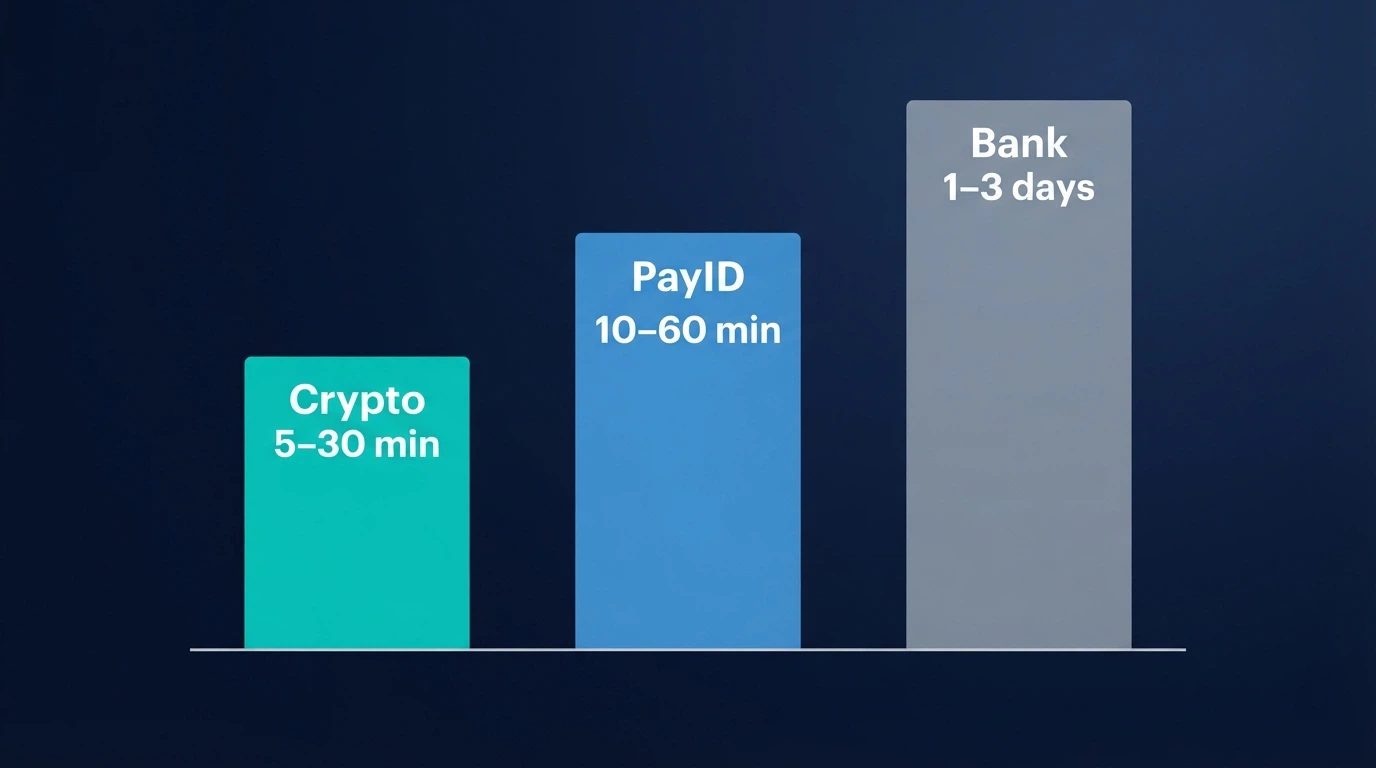
Crypto settles in 30 minutes or less at most AU-facing offshore casinos. USDT on TRC-20 is the fastest at 5–30 minutes; ETH follows at 15–45 minutes; BTC trails at 20–60 minutes because Bitcoin block times are slower than Ethereum’s. The speed is the speed of the underlying network plus the casino’s internal processing time. A casino that signs and broadcasts a withdrawal within seconds of approval can deliver sub-10-minute crypto payouts; a casino that batches withdrawals for end-of-day processing stretches that to hours.
Why Crypto Withdrawals Clear in Minutes While Bank Transfers Take Days
A blockchain confirms a transaction when the network’s nodes agree it is valid — typically within minutes for TRC-20 USDT, 15 minutes for ETH and 10 minutes for BTC. A bank transfer through BECS clears through the Australian banking system’s overnight batch settlement, with funds landing in the recipient account 1–3 business days later. The difference is not the casino’s processing time; it is the difference between a 24/7 network and a 9-to-5 banking system.
Crypto also removes the intermediary. A fiat withdrawal passes through the casino’s payment processor, the card network or the bank, and any one of those can hold the funds for review. A crypto withdrawal is a signed transaction broadcast to the network; once confirmed, it cannot be reversed by the operator or any third party. That finality is what makes a crypto payout feel instant — it is, in practice, irreversible once broadcast.
The operator-side processing differences are real. Skycrown publishes a roughly 10-minute crypto withdrawal time. Stake clears under 10 minutes. Neospin published 5–10 minutes after approval with no extra pending period, on a A$7,500 per-transaction limit. BitStarz processes many withdrawals within roughly 10 minutes and applies no general maximum cashout limit. The pattern is consistent: crypto-native operators ship withdrawals faster because their internal infrastructure is built around crypto, not adapted from a fiat casino template.
Bitcoin, USDT and Ethereum: Which Coin Pays Out Fastest
USDT on TRC-20 is the fastest at 5–30 minutes, because Tron block times are roughly three minutes and transaction fees are negligible. BTC is the slowest of the three at 20–60 minutes, because Bitcoin blocks target ten minutes and congestion on the main chain can extend confirmation time. ETH sits between at 15–45 minutes, with the caveat that Ethereum gas fees fluctuate and a player withdrawing during a high-congestion window may pay a fee that dwarfs the amount withdrawn.
Network congestion is the variable the speed rankings do not capture. A USDT TRC-20 withdrawal during a quiet Tron window lands in five minutes; the same withdrawal during a congested window can take 30. A BTC withdrawal during a quiet Bitcoin day lands in 20 minutes; during a high-fee event it can stretch past an hour. A player who needs the fastest possible payout should pick USDT TRC-20, withdraw during off-peak hours, and accept the variable fee as the price of the speed.
The featured operators vary on which coins they support. Skycrown accepts 10+ cryptocurrencies including Cardano, Tether and Tron. Stake runs primarily on crypto-native rails. Bizzo’s crypto support is broad; the specific coin list varies by region. A player who holds a coin the operator does not support must convert before depositing or after withdrawing, and either conversion costs a fee.
What Australia’s Crypto Payment Ban Means for Casino Deposits
The Interactive Gambling Amendment (Credit and Other Measures) Act 2023 banned credit cards, credit-related products and digital currency — crypto — as payment for online wagering, commencing 11 June 2024. The penalty for an operator that fails to enforce the ban is up to A$247,500.
The ban applies to licensed Australian wagering operators. Offshore casinos serving Australians are not licensed and are not bound by it. That gap is the tell: an Australian who is asked for a credit card or a crypto deposit by a gambling site is being served by someone outside the Australian rules. The payment method is itself a signal. Licensed wagering operators in Australia accept debit cards, bank transfers, PayID via Osko and BPAY. Crypto and credit cards do not appear.
From 1 January 2027, banks and payment providers gain express authority to block transactions to illegal gambling operators. The change does not legalise online casino in Australia — the Interactive Gambling Act prohibition remains — but it does give banks a tool to refuse to process payments to known illegal operators. A player using a debit card or a bank transfer to an offshore casino may find the transaction declined; a player using crypto bypasses the bank entirely.
The structural picture is that the Australian legal system has progressively tightened the payment infrastructure around online gambling while leaving the offshore product untouched. The 2024 ban removed credit cards and crypto from the licensed rails; the 2027 bank blocking authority removes the bank transfer as an unmonitored path. What remains for a player who wants to deposit at an offshore casino is a narrower set of options, and the path that remains — crypto — is the one the licensed system has explicitly banned.
Are Instant-Payout Casinos Actually Legal for Australians?
No. Every operator accepting Australian players in this ranking is an offshore brand offering a product that the Interactive Gambling Act 2001 prohibits from being offered to anyone in Australia.

The IGA 2001, as amended by the Interactive Gambling Amendment Act 2017, makes it an offence to provide an online casino, online pokies or in-play sports betting to a person in Australia. There is no licence for online casino anywhere in the country — not federally, not in any state or territory. The Australian market is structurally the French case: the product is banned, the providers are punished, and the consumer side operates in a legal vacuum. What is licensable is wagering on pre-event races and sport, lotteries and keno, through operators licensed by a state or territory body. The Northern Territory Racing and Wagering Commission is the de facto national licensor for online wagering on those products. Online casino is not among them.
The individual player is not prosecuted. The IGA targets the provider, not the person logging in. That fact is real and worth saying clearly. But it does not change what a player forfeits by playing offshore: no Australian consumer protection, no BetStop coverage, no ACMA recourse if the operator withholds funds, and no guarantee the site will be reachable tomorrow. ACMA has directed ISPs to block 1,564 illegal gambling and affiliate websites since November 2019. More than 225 illegal services have withdrawn from the Australian market since 2017. A site that is reachable today may be on the blocklist next week.
The Interactive Gambling Act and Australia’s Online Casino Prohibition
The Interactive Gambling Act 2001 is the central statute. Amended in 2017 to expand the prohibition and strengthen enforcement, it makes the provision of an online casino product to an Australian person a civil offence. The enforcement sits with the Australian Communications and Media Authority, which investigates complaints, issues formal warnings, refers operators for civil penalty proceedings and directs ISPs to block illegal sites. There is no administrative pathway to legalisation. The statute would need to be repealed or amended, and the 2026 reform — passed on 19 August 2026 and commencing 1 January 2027 — tightened advertising rules around wagering without touching the online casino prohibition.
The 2026 reform adds federal advertising restrictions: a cap of three wagering ads per hour on TV between 6:00 am and 8:30 pm, a live-sport blackout of wagering advertising from 15 minutes before until 5 minutes after events, and bars on athletes, celebrities and influencers promoting wagering. The reform targets how licensed operators market; it does not change what offshore operators can do, because offshore operators are not subject to Australian advertising law in any practical sense.
The minimum age for all commercial gambling in Australia is 18. The point-of-consumption tax on licensed wagering is typically 10–15% of net wagering revenue, with the Northern Territory levying a 5% wagering tax plus a 0.05% racing levy. There is no federal deposit, loss or stake ceiling for online gambling, because the product those ceilings would govern is banned outright. Australia caps the payment method instead — which is what the 2024 credit card and crypto ban is — rather than capping the stake.
What the ACMA Can — and Cannot — Do About Offshore Casinos
ACMA’s enforcement toolkit is real but bounded. The authority can investigate complaints, issue formal warnings, refer operators for civil penalty proceedings and direct Australian ISPs to block illegal sites. The blocking works at the ISP level, which means a blocked site is unreachable from most Australian home and mobile networks without a VPN. The blocking figure is 1,564 websites since November 2019, with 225+ illegal services having withdrawn from the Australian market entirely since 2017.
What ACMA cannot do is more important for a player to understand. ACMA cannot recover funds an offshore operator has withheld. It cannot enforce a foreign court order. It cannot compel an offshore casino to honour a withdrawal. It cannot connect an offshore casino to BetStop. And it cannot guarantee that a site which is reachable today will be reachable tomorrow — a site can be added to the blocking list at any time, with the player’s balance on it. The blocking power is one-directional: the regulator can cut the player off from the operator, but it cannot cut the operator off from the player’s money.
From 1 January 2027, the toolkit expands. Banks and payment providers gain express authority to block transactions to illegal gambling operators, which means a player attempting to deposit at an offshore casino via a bank transfer or debit card may find the transaction declined at the bank level. The change does not help a player who has a balance on a blocked site; it makes it harder for a player to fund the balance in the first place.
Playing Safely When Every Withdrawal Is Instant
Fast cashouts remove friction, and friction in gambling is sometimes the only thing between a player and a session they should have walked away from. A pending period of 48 hours is a cooling-off window whether the operator intended it as one or not. A withdrawal that clears in ten minutes is not.

Australia has roughly 430,000 adults — about 2.1% of the adult population — who experience problem gambling, with another 1.8% classified as high-risk by the Australian Institute of Health and Welfare in 2022. The numbers are large enough that any reader of this page either knows someone in that group, is in it themselves, or will be at some point in their gambling life. The instant-payout product is marketed to all of them equally.
BetStop, Deposit Limits and the Tools Offshore Casinos Won’t Give You
BetStop, the National Self-Exclusion Register, has been live since August 2023. As at 31 July 2026 it had recorded 67,480 registrations, of which 41,290 exclusions were still active — more than 60% of everyone who ever registered. Of the registrants, 78% were under 40 and 38% chose lifetime exclusion. BetStop is the one-step exclusion from every Australian-licensed online and phone wagering service, and it works at the operator level: a self-excluded person cannot log in or deposit at any licensed bookmaker.
The offshore blind spot is the problem. BetStop binds Australian-licensed wagering services only. An offshore casino is not connected to the register and will continue accepting a self-excluded person’s money. A player who registers with BetStop and then deposits at an offshore casino has taken the responsible step on the side that respects it and walked around it on the side that does not.
The help infrastructure that does cover everyone is wide. The National Gambling Helpline (1800 858 858) is free, confidential and staffed 24 hours a day, with online chat and counselling through Gambling Help Online. The Problem Gambling Severity Index (PGSI) is a self-assessment quiz for players worried about their gambling. Lifeline (13 11 14) provides crisis support. The National Debt Helpline (1800 007 007) helps with financial difficulties related to gambling. CommBank customers can use the bank’s gambling spend block — a six-month limit on gambling transactions — through CommBank’s gambling support line on 1800 222 387.
What an offshore casino will not give a player is any of this. There is no BetStop integration, no PGSI prompt at signup, no mandatory deposit limit and no customer-set exclusion. The player is on their own, and the operator’s interest in responsible play is bounded by its interest in keeping the player depositing.
Recognising When Fast Cashouts Feed the Wrong Habit
Speed in a gambling product is not a neutral feature. A multi-day pending period on a withdrawal, whatever the operator’s reason for imposing it, gives the player time to think. A withdrawal that clears in minutes does not.
The pattern to watch for is the one where the speed itself is part of the appeal. A player who reloads immediately after a withdrawal because the money is back in the bank and the next session can start tonight is not making a fresh decision; they are acting on the momentum of the last one. A player who chases losses by withdrawing and redepositing within the same hour is converting the cooling-off period into a recharge period. A player who escalates bet size to make the next withdrawal worth the fee is chasing volume, not value.
The PGSI self-assessment is the diagnostic tool. The questions cover chasing losses, lying about gambling, feeling guilty after gambling and financial harm from gambling. A “yes” on any of them is worth taking seriously. A “yes” on several is a signal to call 1800 858 858 before the next deposit.
The numbers behind the warning are not abstract. 2.1% of Australian adults, roughly 430,000 people, experience problem gambling. 1.8% sit in the high-risk band. The instant-payout product is built to remove the friction that the slowest withdrawal methods once imposed, and the friction it removes was not always accidental. A player who notices that the speed is part of the appeal has noticed the mechanism; what they do with that observation is theirs to decide.
How We Evaluated and Ranked These Instant-Payout Casinos
The ranking in this article is built on three sources of data. Withdrawal speeds were taken from published casino reviews and operator terms pages, with the fastest verified method assigned to each brand. Licence numbers were checked against the Curaçao Gaming Control Board public register at cert.gcb.cw and the Curaçao eGaming Authority register. Bonus terms were extracted from operator promotions pages and cross-referenced with at least one secondary review source where possible.
The order is from fastest verified withdrawal to slowest. Crypto-native operators sit at the top because their fastest path is sub-10 minutes; bank-transfer-heavy operators sit lower. Operators whose terms, licence or withdrawal speed could not be verified this review sit at the bottom with the relevant cells empty rather than guessed. The ranking is not proprietary in the sense of an editorial score: no formula was invented, no weights were assigned. What is reported is what the published data carries.
Three of the ten operators in the ranking — Royal Reels, Scream Casino and Rocket Casino — could not be verified to the standard the other seven met. They are offshore brands reaching Australian players without an Australian licence, and their bonus terms, withdrawal times and provider lists could not be confirmed against the operator’s own published terms. The empty cells in the table for those three brands are an honest record of what could not be verified, not a judgment on the operators themselves. A player considering any of them should read the operator’s own terms page before depositing.
What was excluded from the ranking: any brand that does not accept Australian players, any brand whose only payment method is bank transfer with no crypto or PayID support (the “instant” promise does not apply), and any brand whose licence could not be verified at all. The market for offshore casinos accepting Australians is large; the ten on this page are the set the research confirmed against the criteria the page applies.
What Australian Players Should Actually Do About Instant-Payout Casinos
The honest verdict is the one the data already carries. Crypto and PayID deliver; bank transfers and cards do not. The legal vacuum is real and has consequences. The bonus maths turns headline figures into much smaller real numbers. The safety net a player is used to in other Australian consumer contexts does not exist here.

A player who proceeds anyway should verify four things before depositing. The licence: a Curaçao GCB or Curaçao eGaming Authority number is standard, and it should be checkable on the regulator’s public register, not just displayed on the operator’s site. The KYC requirements: completing identity verification before the first deposit removes the most common cause of withdrawal delay. The withdrawal terms: the maximum cashout cap from bonus play, the wagering multiple, the max bet during wagering and the bonus validity window. The help resources: 1800 858 858, Gambling Help Online, BetStop, PGSI self-assessment. None of these are provided by the offshore casino; the player has to bring them.
What the page does not recommend is a casino. The ten operators in the ranking are described, ranked by verified speed and licensed where verifiable, and the legal context is laid out so the reader can place their own bet on the trade-off. The page’s job is to make the trade-off legible, not to make it for the reader.
The ACMA blocking figure is the closing fact. 1,564 websites blocked since November 2019, with 225+ services withdrawn since 2017. A site that is reachable today may be on the blocklist next week, and a player’s balance on a blocked site is not protected by any Australian consumer regime. The decision to play at an offshore instant-payout casino is a decision to operate outside the Australian system. The speed is real. The vacuum around it is also real.
Frequently Asked Questions
Why does KYC verification delay my withdrawal and how can I speed it up?
KYC is the identity check every licensed or legitimately run casino runs before releasing a first withdrawal. Incomplete KYC is the number one cause of slow payouts, because the casino cannot release funds to an unverified account. The fix is to complete verification before depositing: a government photo ID, a proof of address dated within three months, and a photo of the payment method. A player who waits until cashout time builds the delay into their own wait.
Can I use PayID for both deposits and withdrawals at online casinos?
Most offshore casinos that accept PayID support it for both, and PayID processes withdrawals in 10–60 minutes with daily limits of A$10 to A$10,000 and no transaction fee. PayID is the fastest AUD-native method that does not require a separate wallet. A player should check the operator’s banking page for PayID availability, because not every offshore casino supports it.
What happens if an instant payout casino gets blocked by the ACMA?
The ACMA can direct Australian ISPs to block an illegal gambling site at any time. Once blocked, the site is unreachable from most Australian home and mobile networks without a VPN. The ACMA cannot recover a player’s balance on a blocked site, cannot enforce a foreign court order and cannot compel the operator to refund funds. The block cuts the player off from the operator without cutting the operator off from the player’s money.
Is crypto or PayID faster for casino withdrawals in Australia?
Crypto is faster at the top end. USDT on TRC-20 settles in 5–30 minutes and is the fastest option available; BTC takes 20–60 minutes and ETH sits between. PayID is the fastest AUD-native option at 10–60 minutes and is the right choice for a player who does not want to set up a crypto wallet. Both are dramatically faster than BECS bank transfers at 1–3 business days or Visa and Mastercard at 2–5 business days.
Where can I get help if gambling becomes a problem in Australia?
The National Gambling Helpline on 1800 858 858 is free, confidential and available 24 hours a day, with online chat and counselling through Gambling Help Online. Lifeline (13 11 14) supports people in crisis. The National Debt Helpline (1800 007 007) helps with gambling-related financial difficulties. BetStop is the National Self-Exclusion Register for licensed Australian wagering services, and the PGSI self-assessment is available for anyone worried about their gambling. None of these services are provided by offshore casinos.