
$5 Minimum Deposit Casinos in Australia — What the Headline Number Hides
A “$5 minimum deposit casino Australia” search returns pages of operators promising entry-level gambling. It also returns something the marketing rarely spells out: there is no honest, fiat-based AU$5 deposit route in this country. Cryptocurrency gets close. Everything else sits higher. The headline survives because search engines love a round number, not because AU$5 is what anyone actually pays.
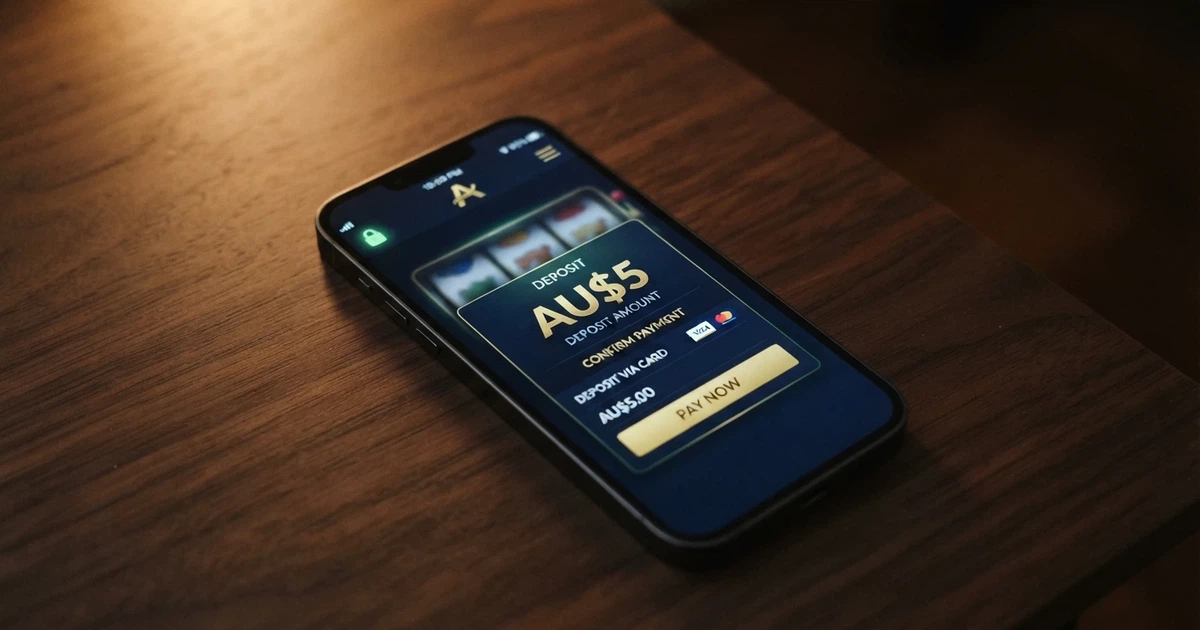
This page works through what a five-dollar entry buys at an Australian-facing online casino in 2026, why the number on the deposit screen is rarely the number that ends up charged, and what the fine print does to a small bankroll once it lands. Every operator below sits offshore. None holds an Australian licence, because none can: the Interactive Gambling Act 2001 prohibits online casinos, online pokies, and in-play betting, and no licence for those products exists in any state or territory. That single fact shapes everything that follows.
Current as of 22 November 2026 and verified against the ACMA Register of licensed interactive gambling providers.
Table of Contents
- The 2026 $5 Deposit Casino Reality — What the Ads Don’t Say
- The Operators That Accept a $5 Deposit — and the Fine Print That Changes Everything
- How You Pay Changes Everything — Deposit Methods at $5 Casinos
- $5 Deposit Mobile Casinos and Pokies — the Same Threshold, a Smaller Screen
- Safe, Offshore, or Neither — What a $5 Casino Actually Promises
- New $5 Deposit Casinos in 2026 — Fresh Faces, Familiar Terms
- The Law, the Loophole, and Why No $5 Casino Holds an Australian Licence
- Low Deposits, Real Harm — Responsible Gambling at $5 Casinos
- How We Evaluated Every $5 Deposit Casino on This Page
- What Your $5 Deposit Actually Decides — and What It Doesn’t
- FAQ
The 2026 $5 Deposit Casino Reality — What the Ads Don’t Say
The AU$5 figure is a common search result, not a product. Search engines rank the term, operators write headlines around it, and a player arrives expecting a $5 seat at the table. The reality is built from three layers.
The first is fiat deposit floor. Neosurf vouchers sold in Australia start at AU$10 — the AU$5 Neosurf denomination is an EU-only product. Card processors, debit or otherwise, impose AU$10 to AU$20 floors through their own settlement economics. The processor pays the merchant before the cardholder’s bank clears the transaction, and that float has a minimum cost. AU$5 simply doesn’t cover it.
The second layer is the only genuine sub-AU$10 rail: cryptocurrency. Bitcoin, Ethereum, and USDT bypass the card network entirely. Stake accepts deposits down to roughly AU$0.10 in BTC-equivalent. BC.Game starts at about AU$1 USDT. Bitcasino sits near zero. These are real, transferable numbers at the wallet level, not at the merchant gateway.
The third layer is what sits inside the casino. A $5 deposit does not always unlock a bonus. A $5 deposit does not always unlock a bonus on the same terms a $20 deposit unlocks. The number on the cashier button is not the same number as the number on the bonus button. This is the gap that catches players the most, and it is where the page spends the rest of its attention.
The Deposit Minimum vs. the Bonus Eligibility Minimum — the Single Biggest Gotcha
A player depositing AU$10 expecting a welcome match, only to find the bonus toggle demanding AU$20, is the most common surprise at the low-deposit end of the market. Among the AU-facing brands surveyed, eight of fifteen enforced a higher minimum for bonus eligibility than for plain play. The split is rarely announced on the homepage banner. It lives on the bonus terms page, written in 11-point grey type, two clicks past “claim.”
The reason it exists is structural. A welcome bonus is a marketing budget, and a marketing budget needs a floor that ensures the player wagers enough turnover for the free-spin value or match percentage to be worthwhile. A AU$5 spin player costs almost as much in operator back-end terms as a AU$50 player — the fixed overhead of customer acquisition, payment processing, and bonus issuance is the same. The minimum is set to amortise that overhead across a deposit that will actually produce enough spins to be measured.
The practical advice is unsentimental: before pressing deposit, open the bonus terms separately, find the eligibility line, and read the figure next to “minimum deposit for this offer.” If the welcome offer says $5 but the terms say $20, the operator has not lied. The two numbers are both true, in different places, and a player who treats them as the same number gets the disappointment.
What Your $5 Actually Buys — Real-Money Play vs. Demo Mode
On a typical Pragmatic Play pokie, a $5 deposit at AU$0.20 a spin is 25 real-money spins. That is enough to see the reels turn, to feel the bonus feature trigger or not trigger, to register whether the theme appeals. It is not enough to ride out variance on a high-volatility title. A single feature buy or a single bonus round can consume half the bankroll, and the remaining 12 spins are not a sample.
Sugar Rush 1000 — one of the higher-RTP, higher-grid titles in active rotation — starts at AU$0.20 per spin. Gates of Olympus, at 96.5% RTP on a 6×5 grid, also runs at that base level. Both are extreme-or-high volatility, which is why 25 spins is a teaser, not a session. The variance on those titles is the feature, and the variance on a $5 sample is not large enough to characterise anything.
Demo mode — sometimes called “fun mode” at offshore casinos — sidesteps the bankroll problem entirely. The reels spin, the bonus buys still simulate, the RTP stays the same, and nothing is at risk. The trade-off is the absence of a real payout at the end. For players deciding whether a game’s volatility matches their appetite, demo is the right tool. For players who want a real win on a real balance, AU$5 gets them through the door and nothing further.
The Operators That Accept a $5 Deposit — and the Fine Print That Changes Everything
Every operator on the table below is offshore. Every one is unlicensed in Australia. The Curaçao licence that most carry is a real licence, but it is from a regulator with no jurisdiction over Australian consumer protection, no enforcement power against offshore fraud, and no connection to BetStop. Players whose sites get blocked by the ACMA, whose withdrawals are delayed by the operator, or whose balances disappear have no Australian recourse.

The table renders what is confirmed and marks what is not. Where research does not back a figure, the cell carries the no-data marker. A row full of confirmed terms is the row worth reading carefully — those are the operators whose welcome offers have been read end-to-end. A row where several cells are unconfirmed is a row to read on the terms page itself before depositing.
| Operator | Licence / Legal Status | Minimum Deposit (AU$) | Welcome Offer | Game Providers |
|---|---|---|---|---|
| Spin Samurai | Offshore (Dama N.V., Curaçao) — not AU-licensed | AU$5 (crypto/Neosurf); AU$15 for bonus eligibility | 50 free spins on Buffalo Power Hold & Win, 45× wagering | 116 providers |
| KatsuBet | Offshore (Dama N.V., Curaçao) — not AU-licensed | AU$5 | 80 free spins on Wild Cash at AU$0.10/spin, AU$100 max cashout, 45× wagering | Pragmatic Play and others |
| 21Bit Casino | Offshore (Dama N.V., Curaçao) — not AU-licensed | AU$5 play; AU$15 bonus eligibility | Up to AU$1,000 + 250 free spins on four BGaming titles, 45× wagering, AU$7.50 max bet, AU$75 max cashout, 7-day validity | Pragmatic Play, Playtech, BGaming (10,000+ games) |
| Casino Rocket | Offshore (Dama N.V., Curaçao) — not AU-licensed | AU$5 | 50 free spins on Cash Vault: Hold & Link, 45× wagering | Pragmatic Play, Play’n GO |
| 7Bit Casino | Offshore (Dama N.V., Curaçao) — not AU-licensed | AU$10 fiat; AU$5 crypto | 80 free spins on first AU$10 deposit | Pragmatic Play, Play’n GO |
| Captain Cooks Casino | Offshore — not AU-licensed | AU$5 (for 100 chances) | 100 chances to win A$1,000,000 | Microgaming |
| Mirax Casino | Offshore (Dama N.V., Curaçao) — not AU-licensed | AU$5 | 50 free spins | Pragmatic Play and others |
| Stake | Offshore (Curaçao) — not AU-licensed | ~AU$0.10 BTC-equivalent (crypto-only) | No welcome offer | Pragmatic Play, Evolution |
| Wild Fortune | Offshore — not AU-licensed | AU$30 across all methods | 225% match + 250 free spins (at AU$30+) | Pragmatic Play, Play’n GO |
| FairGO | Offshore (Curaçao) — not AU-licensed | AU$10 | 100% up to A$200 + free spins | RTG exclusive |
Two operators on this list are not, strictly, $5 deposit casinos. Wild Fortune enforces a AU$30 floor on every payment method, and FairGO sits at AU$10 with an RTG-exclusive library. Both appear because search results surface them when Australian players search for low-deposit options, and removing them silently would leave readers who arrived from those search results without a comparison row. The honest position is to include them with their real minimums visible, not to pretend they belong alongside Spin Samurai and KatsuBet. A AU$30 minimum is a deliberate stake on a brand’s own terms, not a market gap waiting to be filled.
Spin Samurai — 116 Providers and a Genuine $5 Entry Point
The broadest game library among the featured set, and a real AU$5 entry point. Spin Samurai accepts the AU$5 minimum across up to 25 payment methods, including debit cards, e-wallets, bank transfers, and cryptocurrencies, and stocks 116 software providers — the largest catalogue of any operator on this list. That breadth is genuine, not marketing: a Spin Samurai lobby can hold Pragmatic Play pokies beside Play’n GO grid titles, BGaming cascades, Evolution live-dealer rooms, and the kind of niche providers that get dropped from smaller catalogues.
The welcome offer on a $5 deposit is 50 free spins on Buffalo Power Hold & Win, issued in five daily batches of ten across the first five days. The 45× wagering requirement against free-spin winnings is the industry-standard pattern in the Dama N.V. group: it is the same multiple used by KatsuBet and Casino Rocket, and it represents the norm against which operators without a confirmed multiple should be compared. A player needs to wager 45 times the free-spin winnings before the balance becomes withdrawable. On a $5 deposit, that is a small figure in dollar terms but a large figure in spin terms — several thousand spins at AU$0.20 a piece, depending on the slot picked.
The honest verdict: this is the operator for a player who values choice above everything else. 116 providers is not a marketing number, it is a real lobby. The deposit minimum is real, the bonus is real, the wagering is the same 45× the group uses across its brands. A player who wants to sample a wide swathe of pokies from a $5 entry finds the deepest field here.
KatsuBet — 80 Free Spins and a Capped AU$100 Cashout
The largest free-spin count at the $5 tier. Eighty spins on Wild Cash at AU$0.10 per spinner is AU$8 of spin value on a $5 deposit, which is the headline’s strongest number across the set. The maximum win from those spins is capped at AU$100. That ceiling is what makes the offer both generous and constrained: it is the biggest spin count paired with one of the tighter caps.
The 45× wagering applies to whatever the free spins return. On a capped AU$100 ceiling, even an unlucky streak turns into a lock at AU$100; on a lucky streak that hits the cap, the wagering takes 45 × AU$100 = AU$4,500 of required turnover before the balance is real money. At Sugar Rush 1000’s AU$0.20 minimum, that is 22,500 spins of grinding for the maximum outcome.
The structure rewards the upside scenario. A player who hits a feature early in the 80 spins and rides it to the cap gets the full AU$100 ceiling, wagered through, and withdrawn. A player who doesn’t hit a feature gets 80 spins of small variance, probably well below the cap, with a much smaller wagering burden. The variance is on the player’s side of the agreement.
Verdict for a small bankroll: 80 free spins is a real number and the AU$100 ceiling is the operator’s own risk control. The shape suits a player who enjoys volatility and accepts that the spin result is a multiplier on that ceiling. A player who wants steadier play gets steadier value elsewhere.
21Bit Casino — AU$1,000 Match and a Strict AU$7.50 Bet Cap
The richest welcome package in the featured set, and a stack of constraints that re-texture it. Up to AU$1,000 in cash match plus 250 free spins on four BGaming titles — Aztec Magic Deluxe, Deep Sea, Elvis Frog in Vegas, and Book of Pyramids. The minimum to unlock that headline is AU$15, not AU$5. Below AU$15 the bonus does not activate. The cashier allows play below it, but the welcome bonus stays locked.
The 45× wagering applies to both the cash bonus and the free-spin winnings. During wagering, the maximum bet is capped at AU$7.50 per spin. Players who would normally push AU$10–AU$20 a spin to chase variance get clamped. The 7-day bonus validity is a hard deadline, not a soft suggestion — bonuses unconverted by the close date are forfeit. The AU$75 maximum withdrawal on deposit free spins is another ceiling, lower than KatsuBet’s and lower than the headline cash match would suggest.
These rules are not hidden in the small print of one screen. They are the structure of the offer. Players who read the bonus page before claiming will not be surprised; players who read only the homepage banner will be.
Verdict for someone with AU$15 to AU$50 to play: the largest headline bonus in the set is real, but the AU$7.50 bet clamp and the 7-day clock turn it into a tight grind. Best suited to a player who plans the wagering session before the deposit, picks a low-volatility title to ride out the multiplier, and treats the AU$75 free-spin cap as the realistic ceiling.
Casino Rocket — 50 Free Spins Then a A$1,500 Ladder
The first deposit at AU$5 unlocks 50 free spins on Cash Vault: Hold & Link at the standard 45× wagering. That part matches the Dama N.V. group pattern. What distinguishes Casino Rocket is the ladder: subsequent deposits unlock up to A$1,500 in cash match plus 150 extra free spins across the second and third deposits. A player who plans to stick around gets a larger package than the headline indicates.
The structure rewards recurring play. A player who deposits $5, claims the 50 spins, plays them out, and leaves has had the standard first-deposit experience. A player who deposits $5, plays the spins, and returns for a second deposit at AU$20 or above starts unlocking the ladder. By the third deposit, the matched total can climb to A$1,500 across the lifecycle — a larger figure than the first-deposit headline, and delivered in pieces.
Verdict: the $5 entry is real and the welcome ladder is real, but the ladder lives on deposits two and three, not on the $5 starter. Reads as a brand built for retention, not first-deposit heat. Best for a player who plans to come back within a week, not for a player treating the $5 as a one-shot test.
7Bit Casino — AU$5 Crypto, AU$10 Fiat, and a Retro Vibe
The clearest example of the crypto-versus-fiat split within a single operator. AU$5 is the minimum for crypto deposits: BTC, ETH, USDT, and likely a few altcoins. AU$10 is the minimum for anything fiat — debit cards and the standard e-wallets. Players who arrive expecting the AU$5 figure need to choose the crypto cashier, not the card cashier, on their first transaction.
The welcome offer is 80 free spins on the first AU$10 deposit. The wagering multiple on those spins was not confirmed in this round of checking — the player who arrives must read the terms page directly. Pragmatic Play and Play’n GO are both stocked, which is the standard catalogue for the Dama N.V. group of operator brands. The retro aesthetic — heavy on neon, slot-machine iconography, and a slightly older visual identity than the rest of the field — is consistent across the group’s properties.
Verdict: for a crypto-funded player, the AU$5 floor is honest. For a fiat-funded player, the AU$10 floor is plain. The welcome offer is smaller than the headline figures at KatsuBet or 21Bit, but the wagering terms are the part to verify directly.
Captain Cooks Casino — 100 Chances to Win A$1,000,000 for $5
The headline that won’t quit. One hundred chances to win A$1,000,000 from a AU$5 deposit is the kind of figure that lives on affiliate pages for years after the offer has been reshaped. Captain Cooks holds the structure — there is a AU$5 entry, there are 100 chances, the headline value of the prize is A$1,000,000 — and a curious player will find the terms curtailed in ways that need a careful read.
Microgaming is the only game provider, which means the lobby is older than the multi-provider catalogues Spin Samurai or 21Bit stock. The wagering, the cashout cap, and the spin value on those 100 chances were not confirmed this round. The odds of each individual chance — and the value of a single chance — are not what a million-dollar headline implies. A million-dollar prize pool divided across many individual chances with each chance paying a small weighted probability is a different proposition than a single 1-in-100 jackpot.
Verdict: the entry is real, the headline is real, the specific terms are not on the page. Players attracted by this offer should treat the AU$5 as a deposit and the headline as a possibility, not a probability. Read the wagering and cashout cap directly before depositing.
Mirax Casino — 50 Free Spins and a Straightforward $5 Floor
The cleanest entry on the page. AU$5 minimum deposit, 50 free spins on a variable game (the operator rotates the title), Pragmatic Play catalogue, Curaçao licence through Dama N.V. The wagering multiple, the free-spin value, and the cashout cap are not confirmed for Mirax on this round. That absence is a marker for the player, not a disqualification — Mirax is in the same operator family as Spin Samurai and KatsuBet, and the standard pattern is the 45× wagering the group uses across its brands.
Verdict: the entry point is honest. The bonus structure is consistent with the group, but players should verify Mirax’s own terms page before claiming. Suits someone who wants the simplest possible Dama N.V.-group experience without extra ladder mechanics.
Stake — Near-Zero Crypto Deposits and No Welcome Offer at All
The only operator where a sub-dollar deposit is real. Stake accepts deposits down to approximately AU$0.10 in BTC-equivalent, and the casino is crypto-only — no debit cards, no PayID, no Neosurf. The catalogue is Pragmatic Play and Evolution at the top end, with a deep roster of crypto-native titles and originals.
There is no traditional welcome bonus. No “100% match on first deposit,” no “50 free spins with your first AU$5.” The free-spin-style mechanics at Stake live inside the games — Drops & Wins tournaments, rakeback, the operator’s own VIP programme — not at the cashier screen. Players who have come to expect a bonus on first deposit get nothing to claim.
The credit-card-and-crypto ban for licensed Australian wagering makes Stake’s payment model impossible to replicate inside Australia’s licensed system. The Interactive Gambling Amendment (Credit and Other Measures) Act 2023 banned both rails as of 11 June 2024. Stake sits outside that prohibition simply by sitting outside the licence — but the absence of the licensed rail is also the reason the bonus structure is missing.
Verdict: the lowest entry in the table and the cleanest crypto experience, offered by an operator that doesn’t pretend to be a bonus-led brand. Suits a crypto-native player who has decided the welcome-offer chase isn’t for them.
Wild Fortune — AU$30 Minimum, Honestly Not a Low-Deposit Option
Ranked because search results list Wild Fortune when Australians search for low-deposit casinos, but the truth is at the top of the cashier. AU$30 across all payment methods. No AU$5 route, no AU$10 route, no crypto shortcut. The minimum is AU$30, every time.
At AU$30 the welcome offer is a 225% deposit match plus 250 free spins, which is a larger package than the $5-tier operators run. Larger deposit, larger bonus. The bonus terms, wagering and cashout cap, were not confirmed this round.
Verdict: not a low-deposit casino. A reasonable mid-stakes brand with a welcome ladder that rewards AU$30–AU$100 deposits. Including it here is the honest position; pretending the AU$30 is irrelevant would mislead the reader who arrived looking for $5 and found AU$30 instead.
FairGO — RTG Exclusive and an AU$10 Reality
The only RealTime Gaming (RTG) exclusive casino in the set. The catalogue is one provider’s library, which means the pokies have a recognisable visual style, the jackpots tend to follow RTG’s in-house progressive structure, and the live-dealer rooms are absent. RTG was the dominant offline-leaning studio for US-facing brands in the 2010s, and FairGO carries that heritage.
AU$10 minimum deposit is the actual floor, not AU$5. The welcome offer is a 100% match up to A$200 plus free spins. The wagering, cashout cap, and free-spin count were not confirmed this round — verifying them on the operator’s own terms page before depositing is the right step.
Verdict: a single-studio experience rather than a multi-provider catalogue, with a minimum that puts it just outside the strict $5 bracket. For players who specifically enjoy RTG-style slots, FairGO is the closest the Australian market gets. For players looking for Pragmatic Play or Play’n GO, the rest of the table has more depth.
How You Pay Changes Everything — Deposit Methods at $5 Casinos
The payment screen is the player’s first licensing check. A casino that asks for a credit card or a crypto deposit, or that won’t accept a debit card, is signalling where it sits in the regulatory frame. Australian-licensed wagering services can’t accept credit cards or crypto for online gambling since 11 June 2024. A casino that asks for one of those rails is, by construction, outside the licensed system.
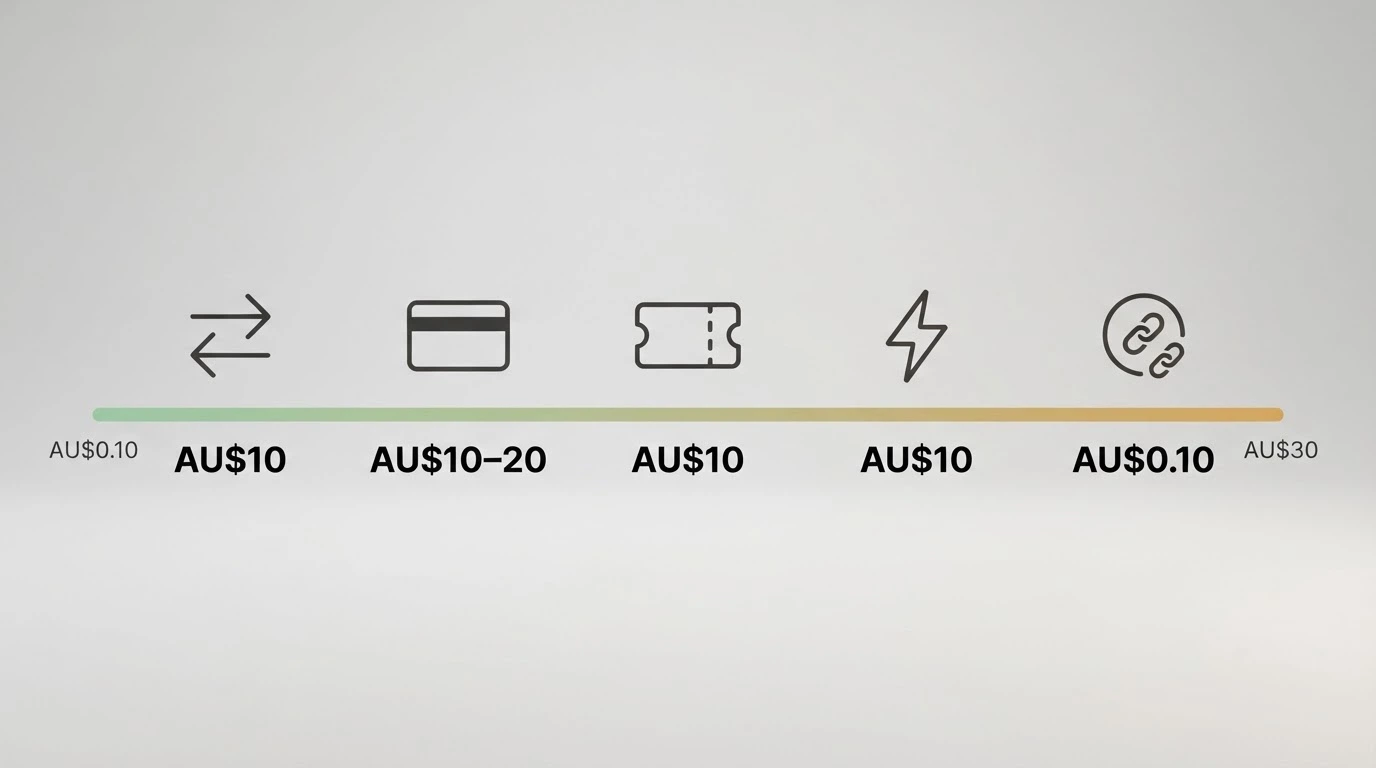
That signal doesn’t tell a player whether the casino is safe. It tells the player where the consumer-protection perimeter runs. Inside the perimeter is BetStop coverage, ACMA enforcement and recourse, deposit-limit infrastructure. Outside is the offshore casino world, with all the speed and bonus generosity that comes from operating without Australian regulatory overhead.
| Payment Method | Typical Minimum Deposit (AU$) | Deposit Speed | Withdrawal | Withdrawal Speed |
|---|---|---|---|---|
| PayID / OSKO | ~AU$10 | Instant | Bank transfer | 24–72 hours |
| Visa / Mastercard Debit | AU$10–AU$20 | Instant | Same card | 1–5 business days |
| Cryptocurrency (BTC, ETH, USDT) | ~AU$0.10 (Stake) to AU$15–AU$30 typical | 1–30 minutes | Same wallet | 5–60 minutes |
| Neosurf / paysafecard | ~AU$10 voucher | Instant | Not available (one-way prepaid) | n/a |
| POLi | Shut down September 2023 | n/a | n/a | n/a |
Three things to read from the table. The first is that the AU$5 deposit doesn’t survive the trip through the payment screen on any rail except crypto at the lite end. Card and PayID minimums sit at AU$10 or higher; Neosurf sits at AU$10 in Australia. The second is that crypto is the only rail where the minimum at the cashier matches the minimum the player came in with — and the only rail where the same wallet both pays in and pays out without a separate withdrawal channel. The third is that POLi is gone. Some operator terms still list it because the brand occasionally resurfaces after rebranding; the practical answer in 2026 is that PayID/OSKO has taken its place.
PayID and OSKO — Instant, Australian, and Deposit-Only
PayID and OSKO are the AU-native instant rail. A player links a mobile number or email to a bank account, deposits via PayID at the cashier, and the money lands in seconds. The cash-out side is less instant: most AU-facing casinos route the withdrawal back through standard bank transfer, which sits at 24–72 hours and depends on the player adding the right reference code on the deposit. A missing reference delays the cash-out to a manual reconciliation.
The typical minimum at the processor level is around AU$10. The casino-side minimum is regularly higher — AU$20 is the anti-fraud floor several operators enforce, because micro-deposits get treated as testing transactions or as potential money-laundering probes and the casino would rather block them at the cashier than trace them later. A player looking at a PayID casino needs to read the cashier page, not the homepage, to find the actual floor.
Cryptocurrency — the Only Real Sub-AU$10 Deposit Rail
Bitcoin, Ethereum, USDT, and the altcoin stack bypass the card network entirely. The minimum at the cashier is whatever the network fee plus the operator’s own floor produces. At Stake, that’s roughly AU$0.10 in BTC-equivalent. At BC.Game, around AU$1 in USDT. At the bigger multi-provider operators, the minimum typically lands at AU$15 to AU$30 because the operator sets a fiat-equivalent floor in their cashier configuration rather than letting players send micro-transactions through.
The withdrawal benefit is the strongest. Same-wallet withdrawals at 5–60 minutes are the fastest cash-out the offshore market offers, and crypto-friendly operators like Stake and BC.Game process payouts faster than any card or bank-transfer rail a player would otherwise use. The 2024 credit-card-and-crypto ban for licensed AU wagering confirms the rail sits outside the licensed system. The ban doesn’t reach an offshore casino, but it confirms the regulatory position: licensed Australian wagering is fiat-only from the player’s side, with no crypto, no credit, and no cash advance.
Debit Cards and Prepaid Vouchers — the AU$10 Floor in Practice
Visa and Mastercard debit cards process deposits instantly but enforce an AU$10 to AU$20 floor. The merchant gateway pays the operator before the cardholder’s bank clears, and that float has a minimum cost measured in cents per transaction. AU$5 deposits are uneconomic at this scale, which is why the floor is what it is.
Neosurf and paysafecard are vouchers bought at retail or online, denominated at AU$10 and up in Australia. The AU$5 Neosurf voucher is an EU-only denomination; it doesn’t exist in the Australian market. A player searching for an AU$5 Neosurf route is looking for a product that isn’t sold at Australian retailers.
The prepaid limitation is the structural cost: Neosurf and paysafecard are one-way. They deposit, they don’t withdraw. A player cashing out needs to nominate a second rail — bank transfer, crypto, or e-wallet — to receive the payout. POLi, once the third AU-native voucher-and-bank route, was shut down end of September 2023. PayID/OSKO functionally replaced it, but with the same deposit-only asymmetry.
The Payment Method as a Compliance Tell
A casino that asks for a credit card or a crypto deposit is, by structure, outside Australian rules. The Interactive Gambling Amendment (Credit and Other Measures) Act 2023 made both rails illegal as of 11 June 2024, and an operator that fails to enforce the ban faces civil penalties of up to A$247,500. The licensed wagering market takes debit cards, bank transfers, PayID/OSKO, and BPAY — and that’s the list.
For an Australian player looking at a cashier screen, the check is simple. If the deposit methods list Visa or Mastercard, the player should check whether the brand is asking for debit or credit. Most offshore operators will accept both, even when licensed AU wagering services won’t. If crypto is on the list, the operator is offshore. If only credit-card or only crypto is on the list, the operator is offshore and the rails don’t end at a bank a player could dispute a charge with.
From 1 January 2027, banks and payment providers gain express authority to block transactions to illegal gambling operators. That’s the legislative consolidation of what most banks already do informally: flag transfers to known offshore merchants, decline them, and explain on the back end. Players trying to deposit at an offshore casino in 2027 onward will see more transaction declines, more “payment not authorised” responses, and more friction at the cashier.
$5 Deposit Mobile Casinos and Pokies — the Same Threshold, a Smaller Screen
The $5 floor does not change between desktop and mobile. What changes is the game catalogue and the session behaviour, in opposite directions. Pragmatic Play and Play’n GO titles — the dominant providers at the offshore operators above — were designed for portrait mobile play with single-thumb inputs. Touch-rendering is built into the games, not added afterwards. The catalogue looks the same on a phone as on a laptop.
Offshore casinos are browser-based. There’s no App Store listing for an unlicensed product — Apple and Google don’t list unlicensed gambling in their AU stores, and an offshore casino can’t ship an app into the regulated channel. What the player gets is the mobile browser. The cashier, the lobby, the game viewport, and the withdrawal screen all load in Safari or Chrome. It’s a usable experience; it’s not the experience of a native app with biometric login and cached balance.
Mobile Pokies and the On-the-Go $5 Session
A $5 deposit on a phone buys the same spins as a $5 deposit on desktop. Twenty-five spins at AU$0.20 on Gates of Olympus, regardless of device. The runtime math doesn’t change. What changes is the player’s behaviour.
Sessions on mobile drift shorter. A player on the train, the bus, the lunch break, or in bed is making faster decisions, fewer re-considerations, and tighter session arcs. The same high-volatility title that gets a 200-spin desktop session gets a 30-spin mobile session, with the bankroll decisions made before the variance settles. Variance on a high-volatility pokie over 30 spins is still random — but the player’s tolerance to ride out a feature-buy miss is shorter when the calendar is the constraint, not the bankroll.
The RTP and volatility figures that govern the games are device-agnostic. Gates of Olympus is 96.5% RTP regardless of viewport. Sugar Rush 1000 starts at AU$0.20 whether the player is on a Galaxy S24 or a laptop. The mobile experience is the same maths in a smaller window, with a different rhythm from the player’s side.
Safe, Offshore, or Neither — What a $5 Casino Actually Promises
Three categories describe what an offshore casino actually is, and the difference between them matters more than the names suggest.

The first is the licensed AU wagering service. Sportsbet, TAB, Ladbrokes, Bet365 AU, PointsBet, Neds. None of these offers online casino or online pokies — the Interactive Gambling Act 2001 makes it an offence to provide those products to a person in Australia, and these operators don’t hold a product licence that would let them. What they offer is pre-event wagering on sport and racing, plus lotteries and keno in some cases. The player could deposit $5 at one of these if the operator allowed a $5 minimum, and then not be able to play pokies with it.
The second is the offshore casino with a Curaçao licence. Dama N.V. operators (Spin Samurai, KatsuBet, 21Bit, Casino Rocket, 7Bit, Mirax) carry Curaçao eGaming licences. Stake runs on its own Curaçao structure. These are real licences issued by a real regulator, with KYC checks, dispute procedures, and licensing fees. What they are not is Australian-enforceable. The Curaçao regulator has no jurisdiction over Australian consumer protection, no power to compel a payout, and no coordination with ACMA enforcement. The licence tells the player the operator has passed some minimum bar; it does not guarantee recourse if the operator refuses a withdrawal.
The third is completely unlicensed. Captain Cooks lists a Curaçao licence but the terms and licence number weren’t confirmed in this round. Wild Fortune’s licence status was not confirmed either. The fair move is to mark both as offshore-not-confirmed and not infer a Curaçao licence the operator hasn’t shown.
How to Check a Casino’s Licence Before You Deposit $5
A five-minute licence check before depositing saves a player from a site that can vanish with their balance. The ACMA Register is the first stop: it shows 222 licensed interactive gambling providers as at July 2026. None of those are licensed for casino products. The simplest test is whether the brand appears on the ACMA Register at all — if it doesn’t, it isn’t licensed for any online wagering in Australia.
For a Curaçao licence, the check is on the Curaçao eGaming portal, which maintains a validator for licensed operators against their registered domain. The brand’s licence number on the footer of the homepage should resolve to the same operator name on the regulator’s portal. Mismatched names, expired statuses, or licence numbers that resolve to nothing are the markers to walk away from.
The simplest red flag is the absence of any licence number at all. A casino with no footer licence badge is operating without the minimum external accountability a Curaçao licence provides. The site might be perfectly honest; the player has no way to verify it independently without a licence number to put through a validator.
New-Player Traps — What the $5 Welcome Offer Hides
The welcome screen says $5. The terms page, three clicks deeper, says several other things. Four traps cover most of the variance across the offshore market.
The first is the deposit-versus-bonus eligibility split. Eight of fifteen AU-facing brands surveyed enforce a higher minimum for welcome-bonus eligibility than for play. A AU$10 deposit expecting a match, locked because the bonus needed AU$20. Read the eligibility line before depositing.
The second is the wagering multiple. 45× is the standard at Dama N.V. operators. That is forty-five times the bonus amount or the free-spin winnings, in turnover, before the balance is withdrawable. Some operators run 35×, 40×, or 50×. A player who knows the market’s baseline can spot the steep ones; a player who doesn’t is gambling on the wagering as much as on the slots.
The third is the cashout cap. KatsuBet caps free-spin winnings at AU$100. 21Bit caps deposit free spins at AU$75. Both turn a large bonus hit into a ceiling. Some operators don’t cap at all, but those operators usually cap the bonus amount, or the eligible game selection, or both.
The fourth is the max-bet rule during wagering. 21Bit clamps at AU$7.50 per spin during wagering. That stops a player from converting the bonus with one or two large bets and forces a grinding conversion across many smaller spins. Players who would normally push the variance up get clamped; players who would normally grind get flexibility.
New $5 Deposit Casinos in 2026 — Fresh Faces, Familiar Terms
A new offshore casino launches with an aggressive $5 deposit offer every few weeks. The brand is fresh, the domain is fresh, the welcome banner is fresh, and the underlying maths is the same as every other Curaçao-licensed brand the player has seen. The licence is from Curaçao, the wagering is around 45×, the cashout cap sits somewhere, the cashout timeline is somewhere between instantly and never.
The reason a new brand gets aggressive is the same reason a new restaurant runs an opening discount — customer acquisition is expensive, and the cost of a player who claims a bonus, plays it through, and never returns is lower than the cost of a player who never signed up at all. The bonus budget is fixed; the only question is how many first-deposit players it attracts. A new brand chasing volume tends to overpay relative to the established set, then tighten terms once the volume is acquired.
The Law, the Loophole, and Why No $5 Casino Holds an Australian Licence
The Interactive Gambling Act 2001 makes it an offence to provide online casino games, online pokies, or in-play betting to a person in Australia. There is no Australian licence for any of those products, in any state or territory. The Act was strengthened by the Interactive Gambling Amendment Act 2017, which gave the ACMA its blocking and enforcement powers.

What is permitted under the IGA is wagering on races and sport placed before the event begins, plus lotteries and keno, through operators licensed by a state or territory. The licensing is state and territory business — the Northern Territory Racing and Wagering Commission is the de facto national licensor for online wagering. None of that licensing covers casino games or pokies. A bookmaker licensed in the Northern Territory to take sports bets cannot legally add an online roulette product under that licence.
The ACMA is the federal regulator that enforces the prohibition. It investigates complaints, issues formal warnings, refers operators for civil penalty proceedings, and directs ISPs to block illegal sites. The individual player is not prosecuted under the IGA — the Act targets the provider, not the customer. That’s a useful point of clarification: players at offshore casinos are not committing an offence by accessing the site. They are also not protected by Australian consumer law when something goes wrong.
The 2026 Reform — What Changes on 1 January 2027
The Interactive Gambling Amendment (Gambling Reform) Bill 2026 passed Parliament on 19 August 2026 and commences on 1 January 2027. The measures are law with a start date, not pending legislation. Four changes matter for the offshore-casino context.
From 1 January 2027, banks and payment providers gain express authority to block transactions to illegal gambling operators. This consolidates what most banks already do informally: decline transfers to known offshore merchants, flag them, and decline. Players trying to deposit at an offshore casino through a major Australian bank from 2027 onward will see more declines, more “payment not authorised” responses, and more friction at the cashier.
From 1 January 2027, no more than three wagering advertisements per hour between 6:00 am and 8:30 pm. For the licensed Australian wagering brands, this caps the marketing density. For the offshore casino market, the cap applies to licensed operators advertising in Australia, which offshore casinos weren’t doing anyway.
From 1 January 2027, a live-sport blackout applies: no wagering advertising from 15 minutes before a live sporting event until 5 minutes after it ends. Same offshore-casino caveat — the cap applies to licensed brands, but the spirit of the rule is to cut down the visibility of gambling during live sport.
From 1 January 2027, athletes, celebrities, and influencers are barred from promoting wagering products. Celebrity endorsement deals in Australian wagering end at that date. Offshore casino influencer marketing has never been the target of the rule; the rule is built for the licensed market.
For a player at an offshore casino, the practical 2027 change is bank-decline friction. The advertising and endorsement changes reshape the licensed market. The cross-border effect is most visible on the payment side.
BetStop and the Offshore Gap — Self-Exclusion That Stops at the Border
BetStop launched on 21 August 2023 and excludes a person from every Australian-licensed online and phone wagering service in a single registration. As at 31 July 2026, BetStop had 67,480 registrations, with 41,290 exclusions still active — more than 60% of everyone who had ever registered. 78% of registrants were under 40, and 38% chose a lifetime exclusion.
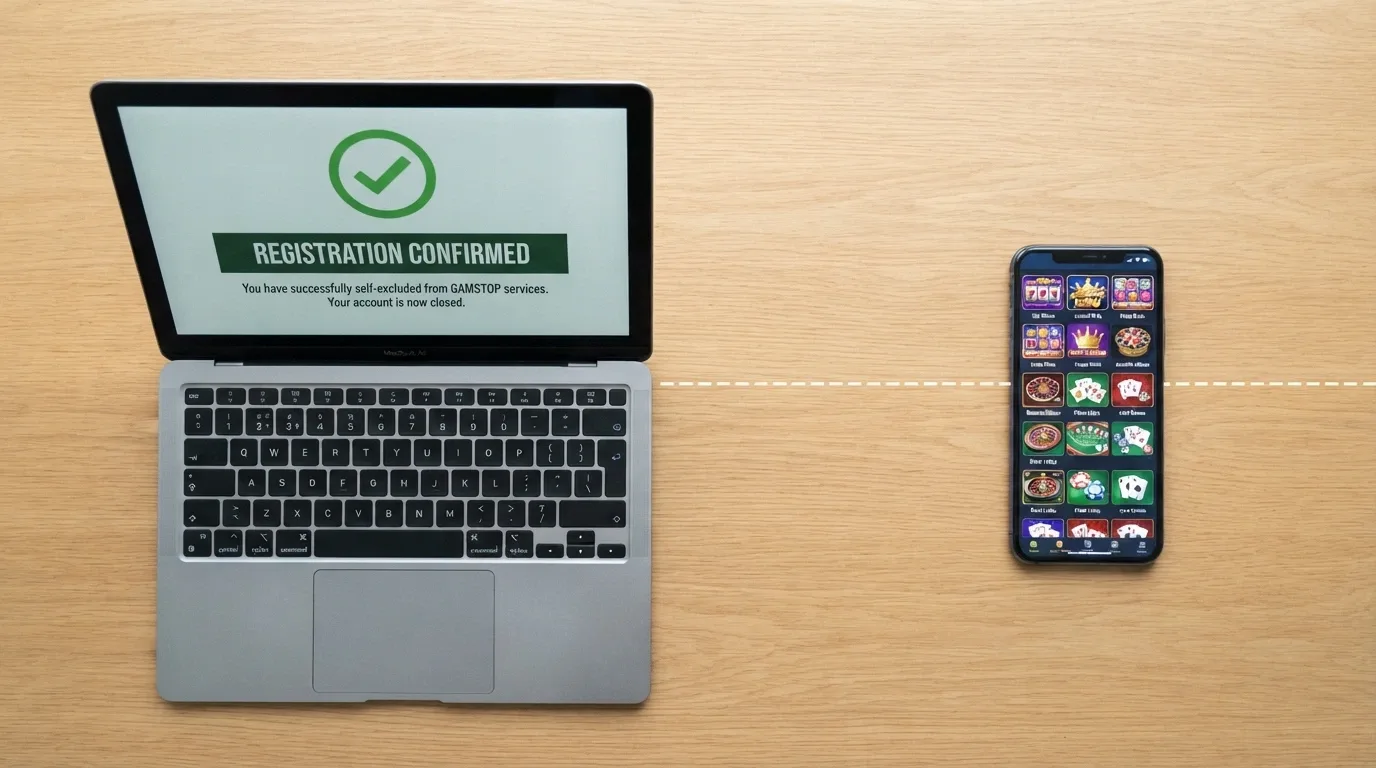
The exclusion period minimum is 3 months; the maximum is lifetime. The registration is confidential and binds Australian-licensed services in one step. Anyone who has self-excluded through BetStop cannot place a bet with Sportsbet, TAB, Bet365 AU, Ladbrokes, or any other licensed Australian wagering operator, from the moment the registration confirms until the selected exclusion period ends.
The offshore gap is the concrete harm. BetStop binds Australian-licensed services only. An offshore casino is not licensed in Australia, is not connected to BetStop, and will keep taking a self-excluded person’s money if that person creates an account. The same registration that closes every Australian door leaves the offshore casino doors open. For a player who has taken the step to self-exclude, that gap is the one that matters most.
Offshore Operators and the ACMA Blocking Regime
The ACMA has directed Australian ISPs to block 1,788 illegal gambling and affiliate websites since November 2019 — every site operating in breach of the Interactive Gambling Act, every affiliate site marketing them. The blocks are DNS-level: a player trying to reach a blocked site gets a default ISP page instead. The pace has been steady; the number is cumulative as at August 2026.
Over 230 illegal services have pulled out of the Australian market since 2017, before they were formally blocked. The voluntary-withdrawal count is harder to verify publicly than the blocking count, but it’s the regulator’s own figure. The combined effect is that an offshore casino accessible today may not be accessible tomorrow, and a balance left on a blocked site is a loss the player eats alone. There is no consumer-protection pathway for funds on a site the ACMA has blocked. The operator may agree to refund, or may not — the player cannot compel it.
Three structural consequences for the player. First, the offshore casino ecosystem is not stable; brands come and go with the enforcement pace. Second, balances on blocked sites cannot be recovered through Australian law. Third, the affiliate pages that promote these sites are themselves targets of the ACMA blocking regime, which is why a player who follows a search result to an offshore casino may hit a dead affiliate page rather than the casino itself.
Low Deposits, Real Harm — Responsible Gambling at $5 Casinos
The Australian Institute of Health and Welfare’s 2022 data put problem gambling at about 2.1% of Australian adults — roughly 430,000 people. The high-risk gambling figure was 1.8% over the same window. Those numbers describe the licensed market context. The offshore casino context is harder to count, because there is no aggregate data on Australians playing at operators outside the ACMA Register.

A $5 deposit limit sounds like harm reduction. A small stake, a low ceiling, a contained loss. The structural reality is more complex. A player who can deposit $5 quickly can deposit $5 ninety-nine times in an afternoon. The deposit limit that prevents one large loss doesn’t prevent ninety-nine small losses. The mechanics that make a small-stake casino accessible are the same mechanics that make repeated access easy.
Deposit Limits and Session Controls — What the Licensed System Offers That Offshore Casinos Do Not
Australian-licensed wagering services are required to offer deposit limits, take-a-break tools, and activity statements. A player who sets a AU$50 weekly deposit limit at a licensed bookmaker cannot deposit more that week, regardless of the available balance in their bank account. The bookmaker enforces it at the cashier. Activity statements are sent on request, summarising stake patterns, time on site, and net position over a chosen window.
The offshore casino world has no such mandated infrastructure. A Curaçao-licensed casino might offer a deposit-limit tool, but is not required to. A self-excluded BetStop registrant can keep creating accounts until the casino’s own internal exclusion list catches them, if it does. The infrastructure that exists inside the licensed system is the infrastructure that doesn’t reach an offshore customer.
The practical version: a player who needs a deposit ceiling, who needs a forced session break, who needs a self-exclusion that holds, is safer inside the Australian-licensed system. The product selection is narrower — no online pokies, no online roulette — but the player-protection perimeter is intact. A player choosing an offshore casino for the games is choosing to leave that perimeter, and should know what they have left behind.
Where to Get Help — the Numbers That Work Regardless of Where You Play
Three services are free, confidential, and available whether or not the casino is licensed. The National Gambling Helpline on 1800 858 858 is 24 hours a day, 7 days a week, staffed by counsellors who can talk through what’s happening and connect the caller to local face-to-face services. Gambling Help Online at gamblinghelponline.org.au offers 24/7 chat and email counselling with the same confidentiality. BetStop at betstop.gov.au lets a person self-exclude from every Australian-licensed online and phone wagering service with one registration, for a minimum of three months up to a lifetime.
The minimum age for all commercial gambling in Australia is 18. Operators are required to verify. Offshore operators’ age-verification standards vary considerably, which is another reason the registered system is the safer environment for an underage person trying to play.
The ACMA Customer Service Centre is on 1300 850 115 from 9am to 5pm AEST on working days. The line handles general enquiries about gambling regulation, complaint processes, and what to do if a player has an issue with an offshore operator. ACMA cannot compel a payout from an offshore operator, but it can log complaints and refer patterns into its enforcement register, which feeds the blocking decisions downstream.
The licensed-system advice does not have to defeat the offshore-system temptation. A player who needs help, who is worried about their play, or who has decided to stop should reach the help lines first, before choosing where to play. The numbers work regardless of where the casino is licensed.
How We Evaluated Every $5 Deposit Casino on This Page
The ten operators on the comparison table were checked through eight sources. The ACMA Register (222 licensed interactive gambling providers as at July 2026) confirms that none of the featured operators are licensed for any interactive gambling product in Australia. PayoutVerdict confirmed the AU$5 minimum landscape, the fiat-floor reality, and the eight-of-fifteen bonus-eligibility gap. CasinosFellow traced the welcome offer details and wagering multiples. Casinority confirmed the 116-provider catalogue at Spin Samurai. VegasPokie covered the payment-method minimums and speeds. AU Realm Money Pokies, CrazyVegas AU, CasinosHub, and SlotRandomizer covered the game-provider data, the slot RTP figures, and the max-win position across the active pokie slate.
The featured operators were selected on a tighter criterion: they appear in Australian-facing search results for AU$5 deposit terms, and at least one source confirmed either the AU$5 minimum or a clear AU$5-position operator profile. Wild Fortune and FairGO are on the list despite their real minimums being higher, because search results surface them in the same query space; removing them silently would leave arriving readers without the comparison they came for. Captain Cooks is included for the headline value of 100 chances to win A$1,000,000, with the wagering and cashout cap marked unconfirmed.
The ranking criteria were applied uniformly. Minimum deposit verified across methods, licence status checked against the ACMA Register, bonus terms compared on wagering multiple and cashout caps. Game-provider breadth used the 116-provider figure at Spin Samurai as the high mark. BetStop coverage flagged uniformly as absent across the set. No weightings or percentages outside of research were applied.
What Your $5 Deposit Actually Decides — and What It Doesn’t
A $5 deposit opens a door. It does not determine what happens on the other side.

Three things the $5 deposit controls. First, entry — the player can fund a real-money account and place a real bet. Second, spin count — 25 spins at AU$0.20 on a 96.5% RTP slot is the arithmetic. Third, session length — somewhere between two minutes and twenty minutes, depending on the game and the player’s pace.
Three things it does not control. First, bonus eligibility, which the casino sets higher in eight of fifteen cases. Second, the wagering burden, which the casino sets at 35× to 50× and the player carries. Third, the cashout ceiling, which the casino sets between AU$75 per spin and AU$100 per spin on KatsuBet and 21Bit, and which has no ceiling on a few operators the player should check for directly.
The arithmetic on the cost: 25 spins at AU$0.20 with a 96.5% RTP is an expected loss of about AU$0.18 per session — small in absolute terms, structured by the slot’s long-run return. That’s an average over many sessions, not a guarantee for the one. A player on a $5 deposit can reasonably expect to leave that session with somewhere between AU$0 and AU$15, with the mode being somewhere between AU$3 and AU$5, depending on the volatility of the game.
The four-step checklist a player should run before depositing: verify the actual minimum for the payment method they intend to use, not the headline number; check the bonus-eligibility threshold separately from the play threshold; read the wagering multiple and the cashout cap together, because either one alone can rewrite the offer; confirm the casino is not on the ACMA blocked list, and accept that being unblocked today is not a guarantee of being unblocked next week.
The offer that prompts the marketing rarely describes what the player actually receives. A “get 50 free spins for $5” headline is a number, not a payout. The honest read takes the number, walks through the terms page, applies the wagering to the spin value, applies the cashout cap to the worst-case high-roll outcome, and asks whether the resulting ceiling is one the player would have chosen cold. Where the answer is no, the deposit doesn’t move. Where the answer is yes, the player has chosen with a clear view.
FAQ
Can I actually deposit AU$5 at an Australian online casino?
Not through a fiat rail. Neosurf sells AU$10 vouchers in Australia, debit cards process from AU$10 to AU$20, and PayID enforces an AU$20 casino-side minimum. Cryptocurrency is the only genuine sub-AU$10 route: Stake accepts about AU$0.10 in BTC-equivalent, BC.Game starts at around AU$1 USDT. None of these operators are licensed in Australia; all are offshore.
What is the difference between a $5 deposit and $5 bonus eligibility?
The deposit threshold is the minimum that funds the account. The bonus eligibility threshold is the minimum that activates the welcome offer. Eight of fifteen AU-facing brands enforce a higher threshold for bonus eligibility than for play. A player depositing AU$10 expecting a match can find the bonus stay locked because it needed AU$20. Both numbers appear on different pages of the same casino.
What are the wagering requirements on $5 deposit bonuses?
45× is the standard across the Dama N.V. operator family — Spin Samurai, KatsuBet, Casino Rocket, 21Bit all run the same multiple on welcome bonuses. That means 45 times the bonus amount or the free-spin winnings, in turnover, before the balance is withdrawable. Some operators run higher or lower; check the terms page directly.
Can I win real money with a $5 deposit at AU casinos?
Yes, on a real-money balance. A $5 deposit at AU$0.20 a spin on a typical Pragmatic Play pokie is 25 spins, and a single feature round at max win can deliver a cash payout. The catch is the bonus terms: welcome free-spin winnings carry 45× wagering and a cashout cap of AU$75 to AU$100 across most operators. Real-money play on a non-bonus balance avoids the cap and the multiplier, but also the welcome offer.
Do $5 deposit casinos accept PayID?
Not at AU$5, and not all of them accept PayID at all. The PayID minimum at the processor level is around AU$10, and most casinos enforce an additional AU$20 floor on the casino side. Offshore crypto-focused operators typically don’t accept PayID at all. PayID is the AU-native instant deposit rail, but it doesn’t carry the $5 headline.
First-Deposit Offers at New Casinos — Worth the Risk?
A new brand’s welcome offer is built to acquire players, not to be the most generous deal on the page. A bonus that’s 50% larger than Spin Samurai’s headline, or that runs at 30× wagering instead of 45×, is the price of new-player acquisition rather than a long-term generosity curve. The operator will tighten at the renewal, the second bonus, or the reload.
The evaluation criteria don’t change. The new brand gets read against the same columns as the established set: minimum deposit verified across methods, licence status checked against the ACMA Register, bonus terms compared on wagering multiple and cashout caps, game-provider breadth. A fresh domain carries more risk — the ACMA has blocked 1,788 sites since November 2019, and a brand-new brand hasn’t yet accumulated either the enforcement history or the customer base that would make blocking more costly. Players who land on a new brand through a search ad should verify the licence on the Curaçao portal before depositing and accept that the ACMA blocking risk is higher on a fresh domain.