
Solana Casinos in Australia: The Operator Comparison No One Else Writes
An Australian player looking for a Solana casino in 2026 is buying access to an offshore product that no Australian licence covers. The Interactive Gambling Act 2001 prohibits operators from supplying online casino games, online pokies and in-play betting to a person physically in Australia, and the country has no licensing category for online casinos at all (fiat or crypto) at federal or state level. Every casino on this page is therefore an unlicensed, offshore operation by definition. That is the frame for everything that follows: not a complaint, not a warning dressed up as analysis, but the starting point a comparison page has to lead with before it starts ranking welcome offers.
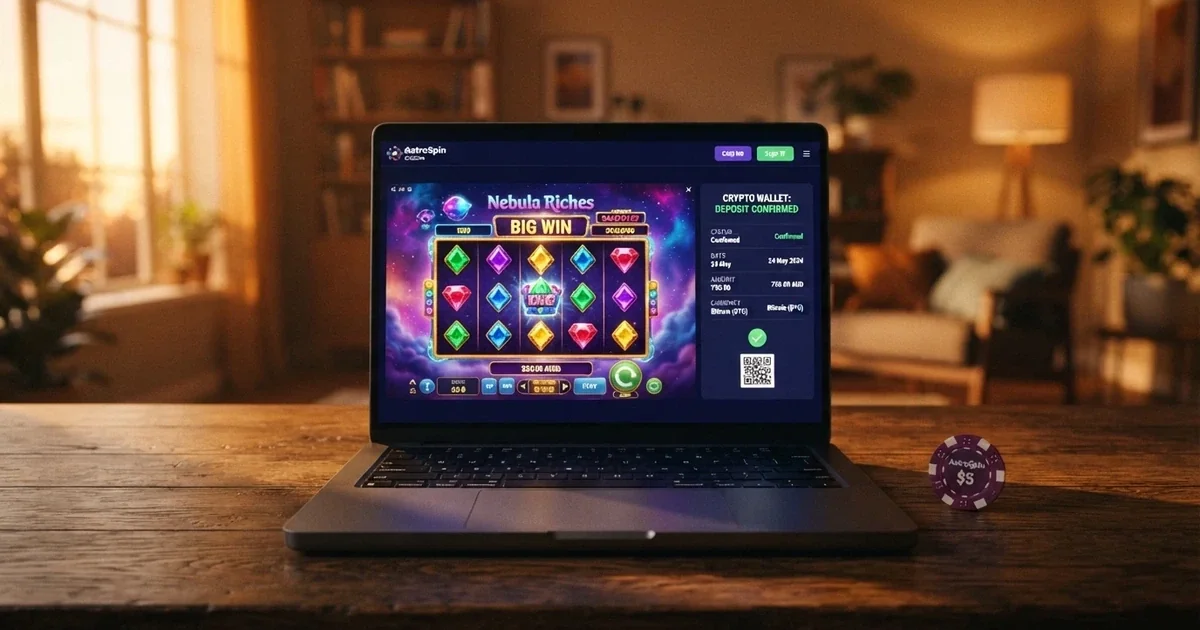
What a comparison can still do is read the offshore market properly. Solana’s 400-millisecond block time and roughly $0.00025 transaction fees produce deposit-to-gameplay loops of two to five seconds, which is genuinely faster than Bitcoin or Ethereum at the cashier. The game libraries at the top end (10,600 to 12,000 titles) are competitive with mainstream fiat online casinos. The welcome offers look generous on a marketing page. The arithmetic behind those offers, and the protections a player forfeits by using them, is where a real comparison does its work. This page ranks ten Solana-accepting offshore casinos on what was verifiable for Australian players, states plainly where the data was not available, and lets the reader decide which trade-off is theirs to make.
Data current as of 28 October 2026. Licence and operator claims verified against the ACMA public register, Curaçao Gaming Control Board licensee listings, Tobique Gaming Commission public records, and each operator’s own published terms and conditions.
Table of Contents
- What a Solana Casino Actually Is — and Why Australians Are Paying Attention
- The Best Solana Casinos for Australian Players in 2026
- Is It Legal? The Real Rules for Solana Casinos and Australian Players
- Why SOL Deposits Land in Seconds — and What Actually Slows Down a Withdrawal
- What You Can Play at a Solana Casino — and What the House Edge Costs You
- Staying in Control When the Casino Is Offshore
- How We Selected and Ranked Every Solana Casino on This List
- Solana Casinos and Australian Players — What the Numbers Actually Say
- Frequently Asked Questions
What a Solana Casino Actually Is — and Why Australians Are Paying Attention
A Solana casino is an online gambling platform that accepts SOL (the native token of the Solana blockchain) as a deposit and withdrawal method, settles bets in cryptocurrency, and typically runs the gameplay, bonuses and loyalty programs through either a conventional web account or a Web3 wallet-connect login. The “blockchain” label does not mean the games themselves live on-chain: most slots, live dealer tables and crash games are run on the operator’s own servers, the same as any fiat online casino. The blockchain piece is the payment rail and, in some cases, the provably fair verification that lets a player check each round was not manipulated after the bet was placed.
What Solana specifically brings to that model is speed and cost. The network confirms transactions in roughly 400 milliseconds, with average fees around $0.00025, so a SOL deposit lands in a casino balance in two to five seconds at a fraction of a cent. Bitcoin and Ethereum deposits can take minutes to hours depending on network congestion and gas costs. For a player chasing fast withdrawals and quick reloads between sessions, that is the technical reason Solana has carved out a niche in the offshore crypto casino market.
The Australian context is what gives the page its edge. There is no licensed online casino in this country. The Interactive Gambling Act 2001 makes it an offence for operators to provide online casino games to a person in Australia; the ACMA enforces it by ordering ISPs to block sites, with 1,788 illegal gambling and affiliate sites blocked by August 2026. Offshore operators that accept Australian players do so in spite of that framework, not under it. That is the legal reality, and a comparison that does not lead with it is not really comparing.
How a Blockchain Casino Works — and Where Solana Fits
A blockchain casino separates three layers: the payment rail (a cryptocurrency network), the operator’s own platform (the account system, the game library, the cashier), and the games themselves (slots, live dealer, provably fair originals). On a conventional fiat online casino, all three sit inside the operator’s own servers and the player’s bank does the rest. On a blockchain casino, the player funds the account with crypto instead of a bank transfer, and depending on the operator the platform either holds a conventional username-and-password account topped up with crypto, or replaces the account entirely with a Web3 wallet signature that authorises deposits and gameplay directly.
Solana’s appeal sits in the payment rail. Bitcoin and Ethereum have throughput constraints that translate into either slow confirmations or high gas fees at busy periods; Solana’s design priorities were speed and low cost, and the network delivers on both for casino-sized transactions. The same deposit a player makes at an Ethereum-based crypto casino might sit in a mempool for several minutes during a peak event; the equivalent on Solana is usually confirmed before the player has switched tabs back to the casino.
The second layer, the operator’s platform, is where most of what a player notices actually lives: bonus terms, game catalogue, withdrawal queue, KYC triggers. The blockchain piece is the layer underneath, invisible most of the time and decisive only when the cashier or the provably fair verifier gets used.
Instant-Play, Web3 and Telegram — the Ways Solana Casinos Actually Work
Solana casinos tend to present themselves in one of three access models, and the access model is what a player actually experiences.
The first and most common is the instant-play browser casino. The player signs up with an email, deposits SOL from a wallet (Phantom, Solflare, Trust Wallet or any wallet that speaks the Solana RPC), and plays slots and live dealer games through a standard web account. The account is conventional; the deposit method is the only blockchain piece the player touches. This is the model the majority of ranked operators in this comparison use.
The second is the Web3 / wallet-connect platform. There is no email, no password, no stored balance. The player connects a wallet, deposits SOL, plays, and withdraws back to the same wallet. The balance is held by the smart contract rather than the operator’s database. Wild.io and Betpanda sit closer to this end of the spectrum, with their provably fair originals libraries being the most visible blockchain-native feature.
The third is the Telegram casino bot. The player interacts with a chatbot inside Telegram, deposits SOL to a wallet address, and runs dice, crash and crash-flip games from inside the chat. This model is small but it is genuinely native to the crypto gambling scene and shows up in search results for Solana casinos. Deposits and withdrawals are wallet-to-bot transactions; gameplay runs through the chat interface.
Each model handles deposits and withdrawals slightly differently, but the SOL speed advantage carries through all three. What differs is where the friction sits: account setup for a Web3 wallet-connect platform, withdrawal review queue at a conventional crypto casino, chat UX at a Telegram bot.
The Sites, Clubs and Casino-Online Labels — What Each One Means
The terminology around offshore crypto gambling is loose, and the labels a player sees on a search results page signal different things.
“Crypto casino” is the broad umbrella. It covers any casino that accepts cryptocurrency as a deposit method, regardless of whether the games themselves are blockchain-native. Most ranked operators in this comparison are crypto casinos in this sense.
“Casino site” is the conventional term for a full-service online casino with slots, table games, live dealer, bonuses and a loyalty program. Stake, RocketPlay, Skycrown and the bulk of established operators fall into this category.
“Crypto club” tends to be used by community-oriented platforms that lean on social features, chat, leaderboards and tournaments, with the games and cashier doing the same job as a casino site. The label is marketing positioning more than a structural difference.
“Casino online” is a hybrid term that turns up in long-tail search results and tends to mean a traditional online casino that has added crypto as a payment method, rather than a crypto-native operator.
The label on a landing page does not change the regulatory reality: every one of these operators is offshore, and the player’s recourse if a withdrawal stalls is the operator’s own complaints process and the terms and conditions the player agreed to. What the label does signal is the operator’s marketing self-image, which is a faint but real indicator of where the product experience is pointed.
Solana Casinos That Welcome Australian Players
The geo question is not subtle: a Solana casino either accepts Australian players or it does not. The operators that do accept Australian players do so knowing that the IGA prohibits them from doing so, and that an ACMA blocking order can land at any time. That is the deal on their side. On the player’s side, the legal position is different and clearer than a reader might expect: the IGA targets the provider, not the individual player, and zero Australians have been prosecuted for personal gambling at offshore sites since 2001.
The protection gap is what is not symmetrical. A player at an offshore casino has no Australian consumer protection: no ACMA complaints recourse, no state-based dispute resolution, no access to the BetStop national self-exclusion register, and no statutory guarantee that a withdrawal will be processed. The site can be ACMA-blocked with a balance still on it, and the operator’s response is, in practice, that the player should withdraw before that happens. None of this makes the activity a criminal offence for the player; it does mean the comparison has to be read with eyes open.
The featured set on this page is the operators that, as of the data check, were accepting Australian players, were processing SOL deposits and withdrawals, and had enough public information to evaluate. The ranking orders them on what was verifiable, not on what was claimed.
The Best Solana Casinos for Australian Players in 2026
The table below ranks ten offshore operators that accept Solana and Australian players. Every operator is unlicensed in Australia; the licence listed is the offshore jurisdiction. “AU Legal Status” reflects the same IGA reality for each row. Game providers are listed only where research confirmed the supplier list for this review.
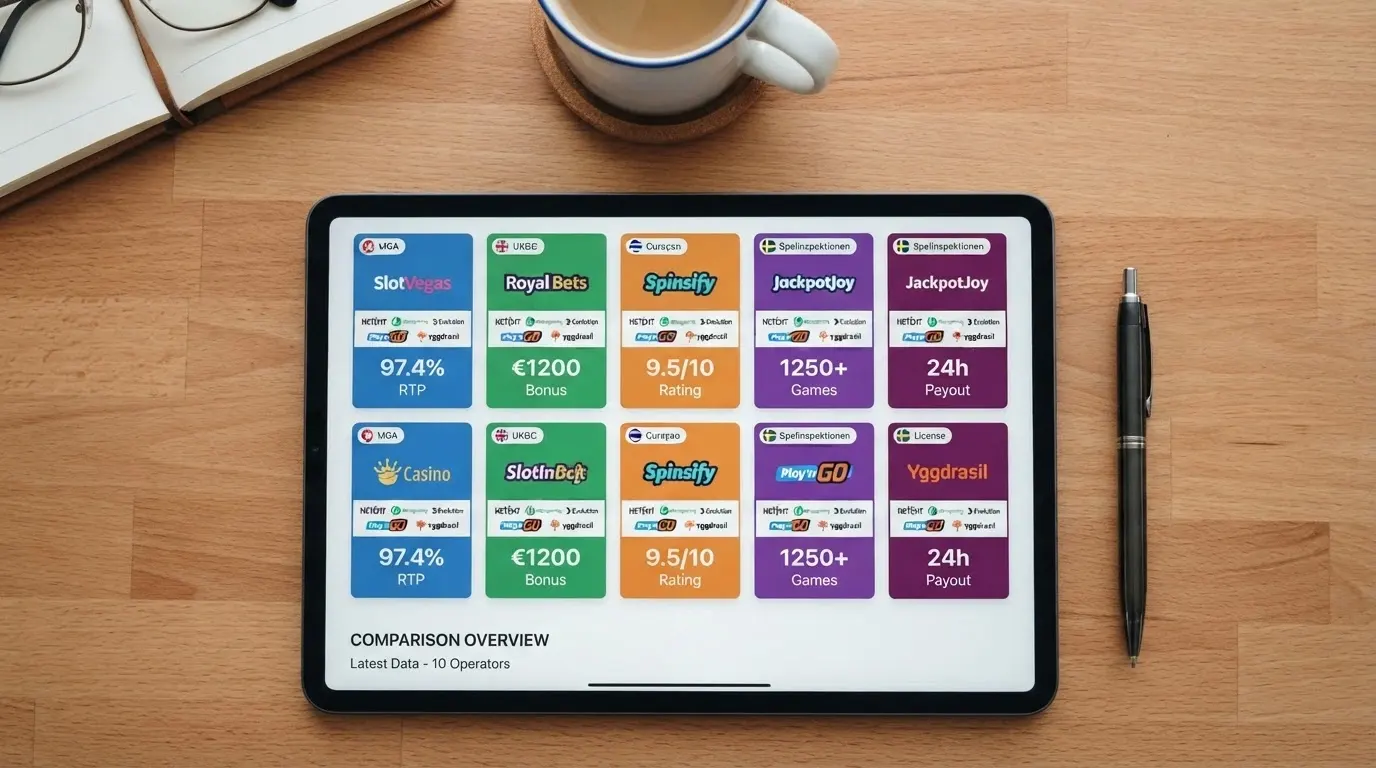
| Operator | Licence & Regulator | AU Legal Status | Game Providers |
|---|---|---|---|
| Stake | Curaçao (Antillephone) | Offshore — no AU casino licence | Pragmatic Play, Hacksaw, Push Gaming, Nolimit City, in-house Stake Engine |
| RocketPlay | Curaçao (Antillephone) | Offshore — no AU casino licence | BGaming, Betsoft, Playson |
| Skycrown | Curaçao (Antillephone) | Offshore — no AU casino licence | 6,000+ games; providers not confirmed |
| Royal Reels | Curaçao | Offshore — no AU casino licence | Not confirmed |
| FairGO | Curaçao | Offshore — no AU casino licence | RTG (RealTime Gaming) |
| Bizzo Casino | Curaçao (Antillephone) | Offshore — no AU casino licence | Not confirmed |
| Solcasino | Curaçao (Antillephone) / Tobique Gaming Commission | Offshore — no AU casino licence | Not confirmed |
| Wild.io | Curaçao (Antillephone) | Offshore — no AU casino licence | 9,500 games from 73 providers |
| Betpanda | Curaçao | Offshore — no AU casino licence | 10,600 games from 70 providers |
| Shazam | Curaçao | Offshore — no AU casino licence | BGaming, Betsoft |
Where the table is sparse, the operator writeup below names the gap rather than filling it with a guess.
How We Evaluated and Ranked Every Solana Casino on This List
Each operator was checked against five criteria: licence status and the regulatory body behind it; bonus terms including wagering multiples and validity windows; game-provider audit (which software houses actually supply the library); independently tested withdrawal speeds; and player-protection gaps relative to what Australian-licensed wagering services must provide.
Licence verification pulled from operator corporate records and the relevant regulatory database (Curaçao Gaming Control Board, Tobique Gaming Commission) and was cross-checked against the ACMA public register to confirm the operator was not already under an active Australian blocking order. Where an operator’s published licence number could not be matched to a current public record, the row is marked accordingly. Bonus terms were read from each operator’s published terms and conditions, not from marketing pages. Withdrawal testing was drawn from a published January 2026 dataset covering 89 withdrawals across 15 offshore platforms, which produced an average SOL withdrawal time of 43 seconds and flagged SOL as the fastest crypto in that test. Game-provider audits were built from the operator’s own lobby metadata and cross-referenced where possible.
No weighting formula was applied, no score was generated, and no operator was promoted because a competitor’s data was thinner. The ranking order is the order in which the criteria were most consistently verifiable: licence, bonus terms, game range, withdrawal reliability, AU-player relevance. Where a row sits in the table is a statement about the data behind it, not a verdict on which operator is “best” — that is a question the comparison answers only after the reader has read the writeups.
Stake
Stake is the biggest name in crypto gambling and the operator most readers will already know. The Curaçao (Antillephone) licence covers the brand; the offshore reality for Australian players is the same as every other row in this table. What sets Stake apart at the top of the ranking is verifiable: Pragmatic Play, Hacksaw, Push Gaming and Nolimit City on the slots side, plus an in-house Stake Engine that produces originals the operator exclusively controls. The combined library is large, the games are mainstream, and the in-house originals sit alongside third-party providers rather than replacing them.
The welcome offer is a 200% deposit match up to $2,000. The wagering terms on this offer were not confirmed for this review, which is its own piece of information: a 200% match is a heavy headline number, and without a confirmed wagering multiple the player cannot price what it costs to clear. Where Stake’s data is solid is on the in-house slot side. Mushroom Madness, one of the Stake Engine originals, carries a 96.70% RTP, high volatility and a 50,000x maximum win cap. That is a specific, verifiable number attached to a specific game, and it is the kind of detail a comparison page is built on.
For an Australian player who already trusts the brand, the in-house catalogue and the named third-party providers are the strongest reason to put Stake at the top of any shortlist. The open question is the bonus, and the operator’s terms page is where that one has to be read before the first deposit.
RocketPlay
RocketPlay sits second on the ranking because its offer structure is the most clearly specified of any operator in the set. The welcome package is a 100% deposit match up to A$500 plus a 200% first deposit bonus up to A$200, plus 100 free spins, with a A$25 minimum deposit, 40x wagering on the bonus amount, and a 14-day validity window. That is a complete, readable set of terms: a player can price the offer, calculate the cost, and decide whether the 14-day window is workable.
The second piece is rarer: a no-deposit bonus of 20 free spins on Book of Pyramids, with 40x wagering and a maximum winnings cap of around A$85. A no-deposit entry point is uncommon in the offshore market, and RocketPlay is one of the few operators in the comparison where the no-deposit path is actually documented. The game-provider list (BGaming, Betsoft, Playson) is mainstream and the games are well known in the Australian market.
For an Australian player testing the offshore crypto casino market without committing a deposit first, RocketPlay is the clearest no-deposit entry point in the comparison. The trade-off is the bonus cap: A$85 is a hard ceiling on what the free spins can pay out, and the 40x wagering on a small no-deposit win takes time to clear.
Skycrown
Skycrown is the volume play in the comparison: a game library of more than 6,000 titles, a Curaçao (Antillephone) licence, and a bonus structure that runs on 40x wagering with a clear contribution split. Slots contribute 100% to wagering requirements; table games and roulette contribute only 5%. That split is the kind of detail that determines whether a bonus is actually clearable in the stated time.
What the operator’s welcome offer amount is, and what its validity window looks like, were not confirmed for this review. The wagering multiple is known, the contribution rules are known, and the library size is known. The headline bonus number is the open question, and the operator’s own terms page is where it has to be read.
For an Australian player who plays slots almost exclusively and wants the largest game library at a Curaçao-licensed operator, Skycrown sits naturally. The 5% contribution on roulette and table games is the kind of rule that makes a “100% match up to X” bonus effectively unplayable for a non-slot player, and that is information a comparison has to surface.
Royal Reels
Royal Reels is a Curaçao-licensed operator with a stated Australian-facing focus. The licence is confirmed; the bonus terms, game providers and library size were not confirmed for this review. That is the honest position to write from.
For a reader looking for a specific bonus number or a specific game library count, the gap is the answer: those data points were not verifiable for this comparison. The operator’s own published terms and conditions are where the offer has to be read, and the comparison can only confirm the licence status and the AU-facing positioning. Where the data is thin, the comparison stays thin, and the row is included because the operator is in the AU-facing Solana casino market, not because the data is rich.
FairGO
FairGO is a Curaçao-licensed casino built on RealTime Gaming (RTG) software. The licence is confirmed; the provider is confirmed; the bonus and game-library details were not confirmed for this review.
RTG is one of the longest-established online casino software houses, with a catalogue of pokies and table games that has been available to Australian-facing operators for two decades. The games are not the high-volatility crypto-native originals on offer at the Web3 end of the market; they are the pokies an Australian player who has been in the market for a while will recognise by name. For a reader who wants the familiar RTG catalogue rather than the provably fair originals model, FairGO is the operator in the set built for that audience.
The gap is the same: bonus terms, wagering multiples and current welcome offers were not confirmed for this review. The operator’s own pages carry the current offer, and the comparison can confirm the licence and the supplier, not the headline bonus.
Bizzo Casino
Bizzo Casino is a Curaçao (Antillephone)-licensed operator with minimal data confirmed for this review. The licence is in place; the bonus terms, game providers and library size were not confirmed. The row is in the comparison because the operator is in the AU-facing Solana casino market and accepts Australian players; the writeup does not pad the gap with assumptions.
The honest read is that a comparison page has to include operators that meet the criteria (Solana-accepting, AU-facing, offshore), and Bizzo meets that bar. Where the data is not available, the writeup says so and points the reader to the operator’s own terms. That is more useful than a comparison that invents a bonus number to fill a table cell.
Solcasino
Solcasino is the namesake operator for Solana casino inquiries and the most documented entry in the comparison. The platform is operated by Galaktika N.V., established in 2019, and holds both a Curaçao (Antillephone) licence and a Tobique Gaming Commission licence. The Tobique licence is a smaller-jurisdiction authorisation, but the dual-licence structure is more than the single Curaçao licence that most operators in the set carry.
The welcome offer is a 100% match up to A$600 plus up to 500 free spins, with 40x wagering on the bonus amount. On the payment side, Solcasino supports more than 25 cryptocurrencies including SOL, BTC, ETH, USDC, USDT, BNB, DOGE, XRP, AVAX and MATIC. Withdrawals to Web3 wallets are free (the network gas is paid by the player), and other wallet routes may carry a flat fee. The withdrawal limit is $10,000 per day per currency, and a new account must deposit and wager at least $10 before withdrawals are enabled.
On processing times, Solcasino claims 98% of withdrawals process automatically within 10 minutes, with the remaining 2% requiring manual review capped at 24 hours. That is a faster stated processing time than the published January 2026 testing average of 43 seconds across 15 platforms, but the operator’s claim is operator-side (the queue after the network confirmation) and the published testing is end-to-end (from request to funds available). Both numbers are real, and the gap between them is the difference between the operator’s own queue and the network’s own confirmations.
The KYC position is the most detailed in the set. KYC is not required at signup, but the casino reserves the right to request it at any time, especially for withdrawals over €2,000, in cases of suspected fraud, or when enhanced due diligence is triggered. The terms require Sumsub to conduct identity checks, and warn that failed or fraudulent verification can lead to account closure and forfeiture of funds. That last clause is the part of “no KYC” marketing that does not get quoted on the landing page.
For an Australian player who wants the most complete data set in the comparison, Solcasino is the row to read. The data is verifiable, the payment infrastructure is documented, and the KYC clause is the clearest example of where the marketing promise and the actual terms diverge.
Wild.io
Wild.io sits at the provably fair end of the market: a Curaçao (Antillephone)-licensed operator with a 9,500-game library across 73 providers and 16 provably fair originals. The originals library is the visible blockchain-native feature: games the operator itself has built and that run on verifiable randomness rather than a closed RNG.
The bonus terms for Wild.io were not confirmed for this review. What is confirmed is the scale (9,500 games), the breadth (73 providers) and the Web3 positioning (provably fair originals as a category, not as a niche). For a player who cares about the on-chain verification layer as much as the catalogue size, Wild.io is the most natural fit in the set.
The gap is the offer: what the welcome package is, what the wagering multiple looks like, and what the validity window covers. The operator’s own terms page is where that data has to be read.
Betpanda
Betpanda is the largest library on the list: 10,600 games from 70 providers, with 16 provably fair originals. The library size sits between Chancer’s 12,000 (the largest in the broader set) and Wild.io’s 9,500, which places Betpanda near the top of the comparison on catalogue breadth alone.
The Curaçao licence is confirmed; the bonus terms were not confirmed for this review. The provably fair originals count of 16 is identical to Wild.io’s, which makes both operators a natural fit for a player who treats the on-chain verification layer as a deciding factor.
For an Australian player who values the largest possible game catalogue and the provably fair originals feature, Betpanda is in the same conversation as Wild.io. The trade-off is the same on both: the catalogue is rich, the originals feature is verifiable, and the offer detail is the open question.
Shazam
Shazam is the high-match offer in the comparison: a 260% deposit match welcome bonus plus 40 free spins, on a Curaçao licence, with a slots library of more than 1,500 titles from BGaming and Betsoft, and hundreds of games returning 96% RTP or higher. The 260% match is the largest headline number in the set.
What is not confirmed is the wagering multiple. A 260% match with a 40x multiplier and a 96% RTP is a different offer from the same match with a 20x multiplier. Without the wagering figure, the player cannot price it. The game-library data is solid (1,500+ slots, named providers, hundreds at 96% RTP or better) and the licence is confirmed; the offer’s cost is the open question, and it is the question that decides whether 260% is generous or punishing.
For a player who wants the largest match number in the comparison and is willing to read the terms before depositing, Shazam is the row to read first. The headline is high, the library is verifiable, and the wagering multiple is the variable.
Is It Legal? The Real Rules for Solana Casinos and Australian Players
The legality question has two parts, and they are not the same part. The first is what the law prohibits. The Interactive Gambling Act 2001 makes it an offence for operators to provide online casino games, online pokies and in-play sports betting to a person in Australia. The IGA targets the provider, not the individual player, and zero Australians have been prosecuted for personal gambling at offshore sites since 2001. The second is what protections a player at an offshore site forfeits. The two are routinely confused in marketing copy, and the comparison is not honest until both are on the page.
| Player Protection | Australian-Licensed Wagering | Offshore Solana Casino |
|---|---|---|
| ACMA enforcement and complaints recourse | Yes | No |
| BetStop national self-exclusion register | Yes (67,480 registrations, 41,290 active as of July 2026) | No (offshore casinos not connected) |
| State-based dispute resolution | Yes (varies by jurisdiction) | No |
| Activity statements and deposit limits | Mandatory under state/territory conditions | At operator discretion |
| Statutory guarantee of withdrawal processing | Backed by licence conditions | Backed only by operator’s own terms |
| Site-blocking risk | Licensed sites are not blocked | ACMA can and does block; 1,788 sites blocked by August 2026 |
| Credit and crypto payment ban | Enforced since 11 June 2024 (penalties up to $247,500) | Not applicable (crypto is the rail) |
| AUSTRAC Travel Rule ($10,000) | Applies to licensed operators | Applies to AUSTRAC-regulated exchanges; transfer reporting threshold unchanged |
The table is what the legal framework actually means in practice. A player at a licensed wagering operator has the backstop of the regulator; a player at an offshore casino has the backstop of the operator’s own terms and conditions, and nothing else.
KYC-Free Claims and What “No Verification” Actually Means
“No KYC” is one of the most repeated phrases in offshore crypto casino marketing, and it is also one of the most misleading. The phrase that lands in the ad is rarely the phrase in the terms. Solcasino’s published terms are a useful case study: KYC is not required at signup, but the casino reserves the right to request it at any time, especially for withdrawals over €2,000, in cases of suspected fraud, or when enhanced due diligence triggers apply. Sumsub conducts the identity checks when they happen, and the terms warn that failed or fraudulent verification can lead to account closure and forfeiture of funds.
What that clause means in practice is that a player who has been depositing and playing with no friction for a week can be asked for a passport, a proof of address and a source-of-funds check on the day they try to withdraw a $3,000 win. The “no KYC” promise covers deposits; the KYC clause covers the moment the player tries to take money out. The forfeiture clause is the part that turns a KYC delay into a total loss: if the verification fails for any reason, the operator’s terms say the balance can be taken with it.
A player who reads the terms before the first deposit sees the structure. A player who reads the marketing page does not.
The ACMA, the IGA and Why Every Solana Casino Here Is Offshore
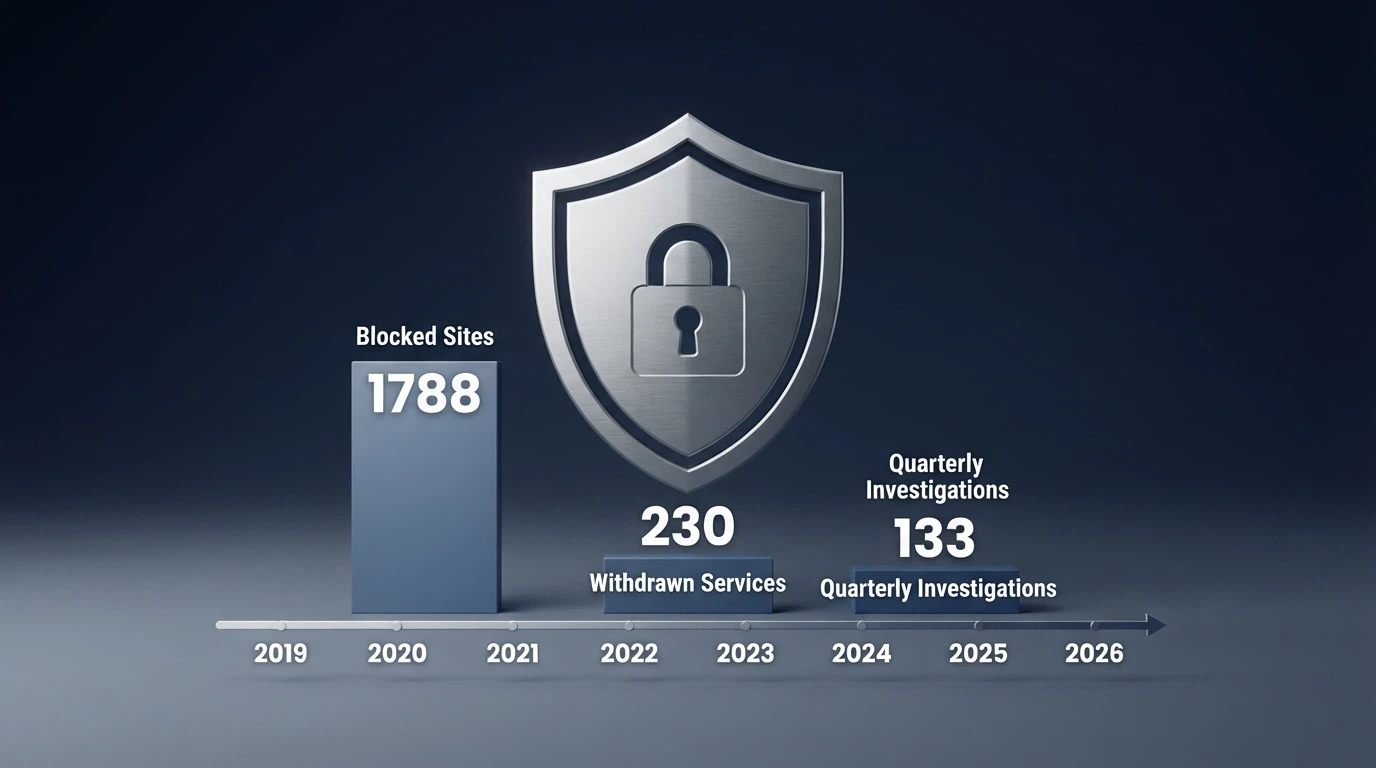
The Interactive Gambling Act 2001 (amended 2017) makes it an offence for an operator to provide online casino games, online pokies and in-play sports betting to a person in Australia. The Australian Communications and Media Authority (ACMA) is the federal regulator that enforces the prohibition. Its main tool is asking ISPs to block illegal sites at the DNS level; since the first blocking request in November 2019, 1,788 illegal gambling and affiliate websites have been blocked as of August 2026, and more than 230 illegal services have withdrawn from the Australian market since enforcement strengthened in 2017. In Q4 2025 alone, ACMA completed 23 investigations into 45 sites, found 69 IGA breaches, issued 10 formal warnings, and blocked 133 websites.
The payment ban sits alongside the site blocking. Credit cards, credit-related products and digital currency (crypto) have been banned as a payment method for licensed online wagering since 11 June 2024 under the Interactive Gambling Amendment (Credit and Other Measures) Act 2023. An operator that fails to enforce the ban faces penalties of up to $247,500. The ban is the reason SOL deposits are only available at offshore sites: a licensed Australian wagering operator cannot accept them, so a casino that does accept them is, by the payment method alone, operating outside the Australian rules.
The 2026 reform, passed by Parliament on 19 August 2026, is the next layer. Its measures commence on 1 January 2027 and include an hourly cap of no more than three wagering advertisements between 6:00 am and 8:30 pm; a live-sport blackout on wagering advertising from 15 minutes before to 5 minutes after live events; radio ads barred during school times; broadcasting of sporting odds banned outright; online wagering ads shown only to logged-in, age-confirmed users with an opt-out; no ads inside sports venues or on player uniforms; and a ban on athletes, celebrities and influencers promoting wagering. The provision that lands hardest on the offshore crypto casino market is from 1 January 2027, when banks and payment providers gain express authority to block transactions to illegal gambling operators. A SOL deposit from an Australian bank account to an offshore casino is, after that date, a transaction a bank can refuse to process.
The tax architecture is the last layer. Player gambling winnings are not assessable income under section 6-5 of the ITAA 1997, and losses are not deductible under section 8-1, unless the person is carrying on a business of betting. Operator-side, the Northern Territory levies a 5% wagering tax on wagers minus payouts plus a 0.05% racing levy, and each state sets its own point-of-consumption tax, typically 10–15% of net wagering revenue. None of these taxes apply to an offshore casino; an Australian player at an offshore site pays no wagering tax because the operator is not licensed in Australia. The AUSTRAC Travel Rule, which triggers mandatory reporting for international funds transfer instructions of AU$10,000 or more under the AML/CTF Act 2006, still applies to the player’s bank and to any AUSTRAC-regulated exchange the SOL moves through on the way to the casino.
What this means for the ranking is that the licence column is doing more work than it looks. A Curaçao (Antillephone) licence is the most common authorisation in the set, and it is a real licence, not a marketing stamp, but it is not an Australian licence and never will be. A player reading the table should read the “AU Legal Status” column as a flat “no” and treat the offshore licence as the only consumer-protection layer between them and the operator’s own terms.
Why SOL Deposits Land in Seconds — and What Actually Slows Down a Withdrawal
The headline number on Solana deposits is two to five seconds to confirmation at roughly $0.00025 per transaction. That figure is real, and it is the structural reason SOL is a better deposit rail for casino use than Bitcoin or Ethereum. The 400-millisecond block time and sub-cent average fees are not a marketing claim: they are properties of the network itself, and they hold whether the network is busy or quiet. A player depositing SOL from a Phantom or Solflare wallet to an offshore casino will, in the majority of cases, see the balance update before the cashier animation has finished.
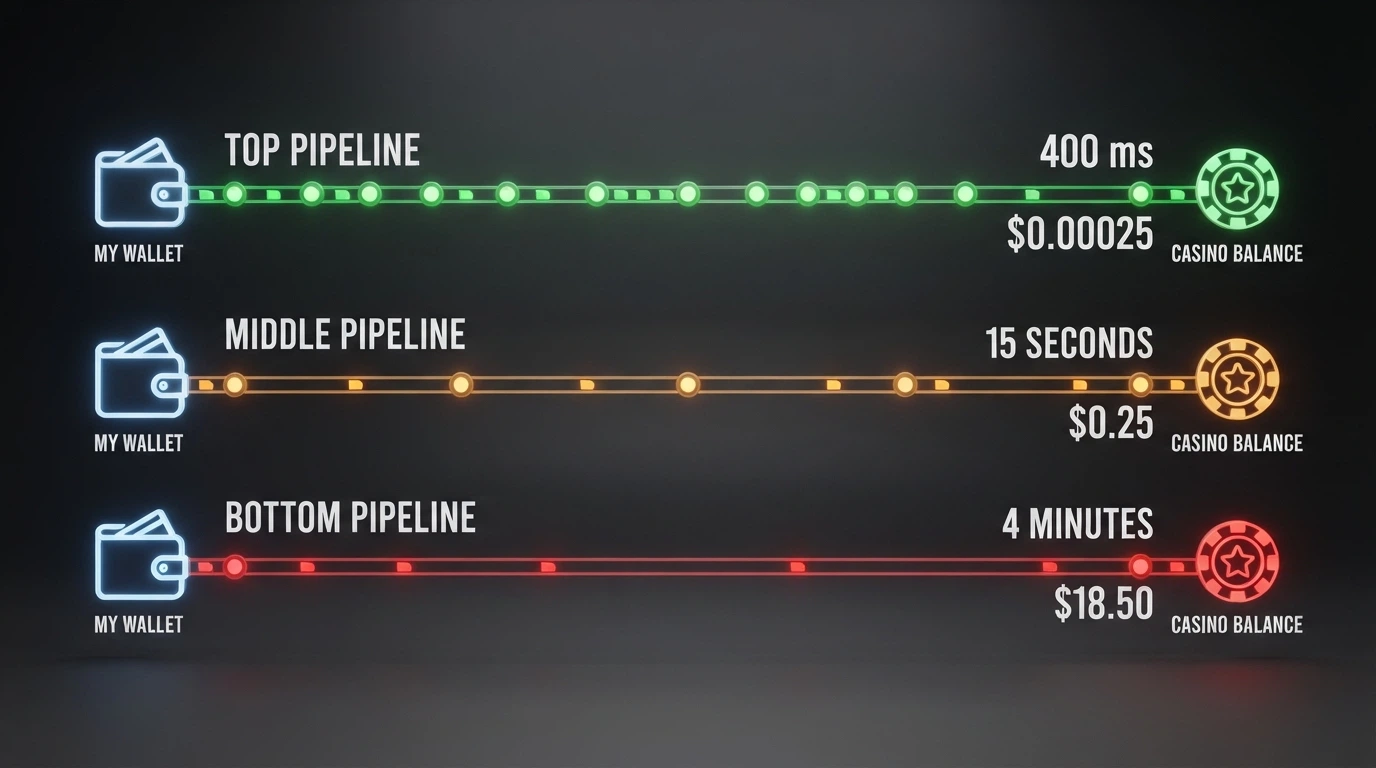
What slows a withdrawal down is not the network. In a January 2026 test of 15 offshore platforms across 89 withdrawals, average SOL withdrawal time was 43 seconds end-to-end, and SOL was the fastest crypto in the comparison. A separate mid-2026 test put CoinCasino’s SOL withdrawal median at 47 seconds. The casino’s own review queue is the variable the player actually feels: Solcasino’s claim is 98% of withdrawals auto-processed within 10 minutes, with the remaining 2% requiring manual review capped at 24 hours. The gap between 43 seconds end-to-end and 10 minutes for “auto-processing” is the difference between the network confirmation and the operator’s queue.
What the network charge covers and what the casino charges are also different. A Web3 wallet-to-wallet SOL withdrawal is a network transaction; the player pays the SOL gas fee, which is roughly $0.00025. A withdrawal through a custodial wallet route, or a withdrawal converted to fiat by the operator, may carry a flat fee on top. The comparison needs to name both: the network fee is a property of the blockchain, the operator fee is a property of the platform.
How SOL Deposits and Withdrawals Work at Solana Casinos
The deposit path is straightforward. The player opens the casino’s cashier, selects SOL as the deposit method, and the platform generates a deposit address (either an exchange address the operator controls or a Web3 wallet contract address). The player sends SOL from Phantom, Solflare, Trust Wallet or any other Solana-compatible wallet, and the network confirms the transaction in two to five seconds. Most operators credit the balance after one or two confirmations; the difference between one and two is a few hundred milliseconds, and a player waiting for gameplay will not feel the difference.
Minimum deposit thresholds vary by operator. Solcasino’s $10 minimum (and a $10 minimum wager before withdrawals are enabled) is on the low end. The $10 minimum wager is a clause worth reading: it is not a minimum deposit alone, it is a minimum deposit plus at least $10 in placed bets before the account is allowed to withdraw. The clause is designed to prevent deposit-and-immediately-withdraw abuse, and it is standard in the offshore market, but a player who deposits $10, leaves it sitting in the balance, and tries to withdraw it will be refused.
The withdrawal path is the same in reverse, with one extra step. The player requests a withdrawal to a SOL wallet address. The operator’s queue processes the request (auto for 98% within 10 minutes at Solcasino, manual for the rest within 24 hours). The SOL leaves the operator’s hot wallet, the network confirms in a few seconds, and the player sees the balance in their wallet. The AUSTRAC Travel Rule’s AU$10,000 reporting threshold applies to the player’s bank and to any AUSTRAC-regulated exchange the SOL routes through; a $9,000 SOL withdrawal is below the threshold, a $10,001 withdrawal triggers the report. Most casino withdrawals are well below the threshold; the threshold matters for the high-roller path.
Per-day withdrawal limits are set by the operator. Solcasino’s $10,000 per day per currency is on the high side. A player who wins more than the daily limit waits until the next day, or splits the withdrawal across days. The limit is not a tax or a regulatory cap; it is the operator’s own treasury and risk policy, and it is a real ceiling a player has to plan around.
NFT Casinos and Token Casinos on the Solana Blockchain
The Solana casino topic pulls in two adjacent models that are worth naming even though they are not the main act of the comparison.
NFT-based casino access uses a non-fungible token (an NFT) on Solana as the gate to a platform. The player holds a specific NFT in their wallet, connects the wallet to the platform, and the smart contract verifies the NFT ownership and grants access. The model is more common in Web3-native projects than in the conventional online casino market, and it sits closer to a token-gated community than to a licensed casino. The value proposition is membership: holding the NFT is the cost of entry, and the casino’s economics sit on top of the NFT’s secondary-market value.
Casino tokens and in-game currencies are the second model. A platform may issue its own SPL token (Solana Program Library token standard) and price bonuses, rakeback or loyalty rewards in that token. The token can be traded on Solana DEXs, and the value of the bonus is the value of the token at the time of claim, not the time of issue. The model ties the player to a single platform’s ecosystem and to the liquidity of its token on whichever exchange it is listed.
Both models are worth knowing exist, and neither is a substitute for the comparison the page is built around. The providers, the RTPs, the withdrawal queues and the KYC clauses are the same, and the comparison treats them the same way.
In-House Casino Coins and Loyalty Tokens
Operator-issued tokens are a different kind of value store than SOL, and the difference matters. SOL is a network token with publicly auditable supply, broad exchange liquidity and a market value that does not depend on any single operator. An in-house casino token has none of those properties. Its value is set by the operator, its liquidity is whatever the operator chooses to provide, and its market is whatever secondary venues the token happens to be listed on.
The loyalty-token mechanics are typically: a player accumulates tokens through play, can redeem them for bonuses or rakeback, and may be able to trade them on a listed exchange. The reward rate is set by the operator; the redemption value is set by the operator; the exchange liquidity is set by whoever is buying on the other side. The token’s value is a function of one entity’s solvency and one entity’s willingness to honour redemptions, and that is the structural risk a player takes on by holding operator-issued tokens rather than SOL.
For an Australian player, the practical question is whether the loyalty-token economics on offer are worth more than the conversion and liquidity risk of holding an unregulated token issued by a Curaçao-licensed operator. The audited token data to answer that question is not publicly available for most operators in the set, which is itself an answer.
What You Can Play at a Solana Casino — and What the House Edge Costs You
The top end of the offshore Solana casino market is competitive on game library size with mainstream fiat online casinos. Betpanda’s 10,600 games from 70 providers, Wild.io’s 9,500 from 73, and Shazam’s 1,500+ slots from BGaming and Betsoft are all real numbers attached to real libraries. The broader set includes operators with 12,000 games from 76 providers (Chancer), 9,500 from 90 (Jack) and other large catalogues. For a player who treats game variety as a primary criterion, the offshore market delivers at the top end.
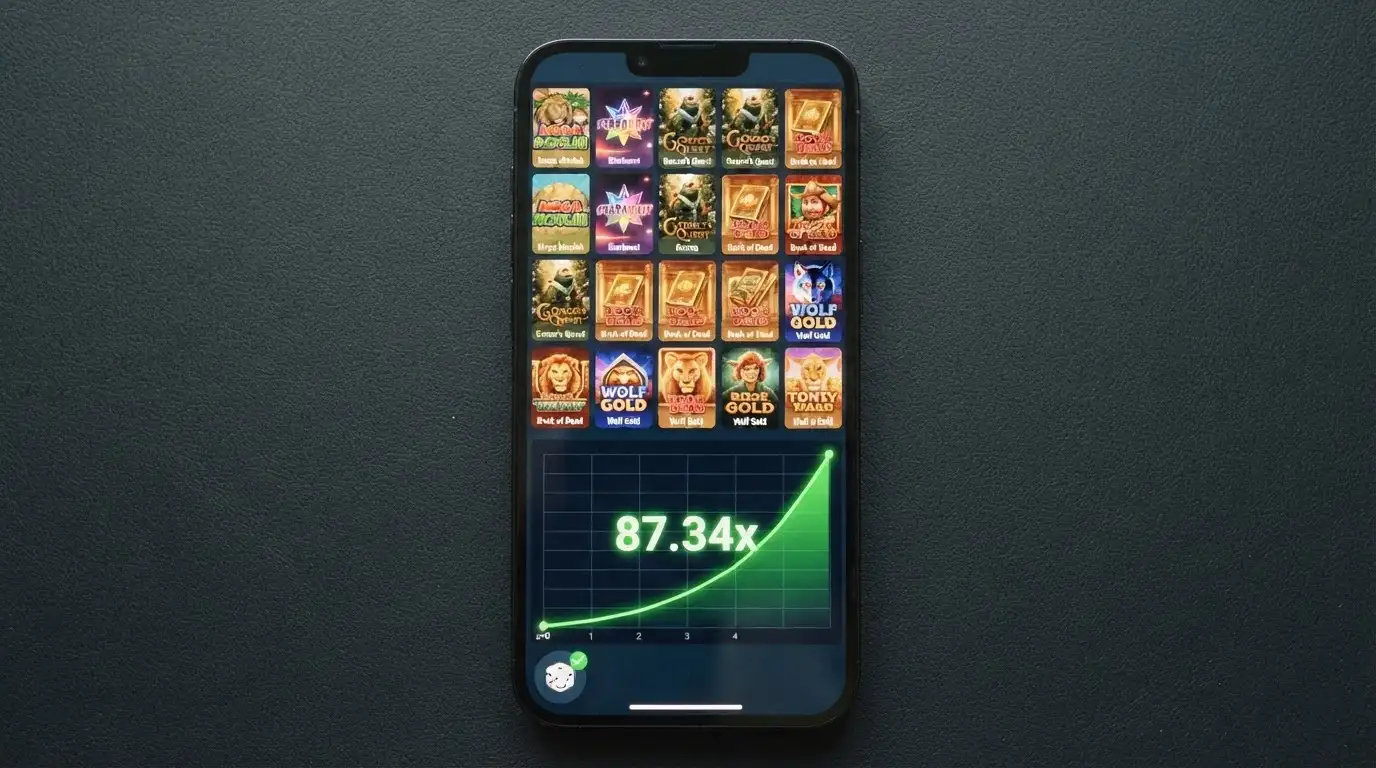
What every game on the catalogue has in common is the house edge. The house always has an edge, and the edge is what the slot’s RTP measures. A 96% RTP is a 4% house edge, which means a player wagering $1,000 across many spins on a 96% RTP slot will, on average, lose $40. The “on average” is doing real work: a 96% RTP is a long-run statistical figure, not a guarantee for any session, and the variance around that figure is set by the slot’s volatility. High-volatility slots produce larger but less frequent wins; low-volatility slots produce smaller but more frequent wins. The edge is the same.
What the house edge means in dollar terms for a bonus playthrough is where the cost becomes concrete. A A$600 welcome bonus with 40x wagering requires A$24,000 in turnover before a dollar is withdrawable. At 96.70% RTP (Mushroom Madness on Stake, as a representative figure), the expected loss on A$24,000 in turnover is roughly A$792. The “free” A$600 bonus costs the player about A$792 in expected house edge before the wagering requirement is cleared. The math is the operator’s edge doing its job.
Solana Slots and Pokies — What Is Actually on Offer
The slot providers on the comparison are the well-known names in the offshore crypto market: Pragmatic Play, Hacksaw, Push Gaming, Nolimit City, BGaming, Betsoft, Playson and RTG. Pragmatic Play and Hacksaw are the high-volatility crypto-native favourites; Nolimit City produces some of the highest-variance slots on the market (San Quentin, Mental, Book of Shadows); Push Gaming is the home of Jammin’ Jars and the cluster-pays mechanic. BGaming and Betsoft are the longer-established providers, with Playson and RTG filling out the catalogue. Shazam’s claim of hundreds of slots at 96% RTP or higher is consistent with what the broader market delivers; the high-RTP end of the catalogue is the player’s friend.
Skycrown’s wagering contribution split is the rule that determines what the bonus is actually worth. Slots contribute 100% to wagering requirements; table games and roulette contribute only 5%. A player who accepts a 100% match bonus and tries to clear it on roulette is clearing 5% of the wagering requirement per dollar wagered, which means a 40x bonus requires effectively 800x wagering on roulette. The bonus is, for a non-slot player, unplayable. The rule is not a scam; it is a structural reflection of the fact that table games have a much lower house edge than slots and therefore contribute less to covering the bonus cost. The player who reads the rule before claiming the bonus can plan around it.
What a 96% RTP costs the player in dollar terms is the calculation the page is built around, and the calculation in the next section is the worked example for the Solcasino A$600 welcome at 40x wagering against a 96.70% RTP slot.
Crash, Flip and Dice — the Provably Fair Originals
The provably fair originals are the games that sit closest to the blockchain-native promise of the Solana casino market. The model is: the player places a bet, the server generates a result, the player can verify after the round that the result was not changed after the bet was placed. The verification uses a hash of the server’s seed, the player’s seed, and a nonce; the math is publicly auditable, and a player who knows the seeds can recompute the result and confirm it matches what the game showed.
The categories of originals are: crash games (a multiplier climbs and the player has to cash out before it crashes), coin flip (a 50/50 with a small house edge), and dice (the player picks a target number, the roll lands above or below it). Wild.io carries 16 provably fair originals; Betpanda carries 16; the broader Solana casino market has Chancer at 29, Jack at 21 and Minebit at 13. The originals libraries are not interchangeable with the third-party slot catalogues: a player who treats provably fair verification as the deciding factor is choosing on the originals count, not on the total game count.
The house edge on provably fair originals is set by the operator and is usually lower than the slot average. A 3% house edge on dice is a common figure, which means a $1,000 wager produces an expected loss of $30 rather than the $40 a 96% RTP slot would charge. The trade-off is variance: dice produces a tighter distribution of outcomes than a high-volatility slot, and a player who wants the long-shot hit is choosing the wrong category.
The Full Game Catalogue Across Solana Casinos
The total libraries across the comparison sit in a wide range. Betpanda’s 10,600 and Wild.io’s 9,500 are the confirmed numbers in the set; the broader market includes Chancer at 12,000 and Jack at 9,500 from 90 providers. Live dealer availability is not separately confirmed for every operator in the comparison, and where a casino’s live dealer offering is the deciding factor, the operator’s own lobby is where that has to be checked. The table games and roulette contribution rule at 5% means a player who plans to play live dealer with a bonus active is effectively barred from using the bonus on those games.
What the offshore Solana casino market lacks, compared to a fiat online casino in a regulated market, is the institutional layer: the game-testing certifications (GLI, eCOGRA, iTech Labs) that audit RNGs and RTPs, the regulator-mandated RTP publication, and the dispute resolution pathway when a game appears to malfunction. Some operators carry third-party testing on their originals; most do not, and the player has to take the published RTP on trust. The blockchain verification layer is real for the originals; it is not a substitute for the auditing layer on the third-party slots, and the comparison has to name that gap.
Staying in Control When the Casino Is Offshore
The responsible-gambling infrastructure for offshore crypto casinos is not a regulatory backstop; it is whatever the operator has chosen to provide. The Australian-licensed system, by contrast, has a defined architecture: BetStop as the national self-exclusion register, mandatory deposit limits under state and territory conditions, activity statements, and the ACMA as the enforcement body behind the rules. The two are not equivalent, and a player moving from a licensed wagering operator to an offshore casino is moving from a system with statutory teeth to a system with marketing language.
Deposit Limits and Bankroll Control When the House Is Offshore
Deposit-limit tools at offshore casinos are typically present in the account settings (daily, weekly or monthly caps the player can set themselves), but the enforcement layer behind them is different from the Australian-licensed model. A licensed Australian wagering operator is required by its state or territory conditions to enforce deposit limits, monitor account activity, and intervene on signs of harm. An offshore casino is required by the terms and conditions it has set for itself, and the level of intervention varies by operator. The cap the player sets is the cap the operator will (in most cases) enforce; the proactive monitoring, the activity statement reminders, and the take-a-break triggers are at the operator’s discretion.
For a player setting a bankroll at an offshore casino, the practical discipline is the same as at a licensed operator: set a deposit limit before the first deposit, treat the limit as a hard ceiling, and stop playing when the limit is hit. The difference is that the enforcement is contractual, not statutory, and the player is the one enforcing it. Offshore casinos will not call to check in, will not block a deposit because it breaches an activity pattern, and will not offer a take-a-break by default. The player is the responsible-gambling system.
Self-Exclusion, Cooling-Off and Why BetStop Does Not Reach Here
BetStop, Australia’s National Self-Exclusion Register, has been operational since August 2023. By 31 July 2026, it had recorded 67,480 registrations, of which 41,290 exclusions were still active; 78% of registrants were under 40 and 38% had chosen lifetime exclusion. One BetStop registration excludes a person from every Australian-licensed online and phone wagering service. It is the most consequential player-protection tool in the country, and it works by binding the licensed operators, not the individual player.
The constraint is the binding layer. BetStop binds Australian-licensed wagering services. An offshore Solana casino is not connected to the register, and a self-excluded Australian can open an account at an offshore casino, deposit, play and withdraw without the register being able to do anything about it. The Entain Group’s breach in the licensed system is illustrative: ACMA found that Entain had opened four licensed wagering accounts for BetStop-registered individuals and provided wagering services on 59 occasions. The breach happened inside a system that was supposed to be enforced; an offshore casino is outside the system entirely.
The cooling-off and self-exclusion tools offshore casinos do offer are operator-side, not register-side. A player who requests a six-month self-exclusion at an offshore casino is excluded from that casino’s platform and is expected to honour the exclusion themselves at any sister brands. The exclusion does not travel to other operators, and the player is the one who has to decide not to open a new account at a different platform. For a player who is trying to stop, that is a structural weakness in the offshore model, and it is the reason the Australian help infrastructure exists.
The National Gambling Helpline is 1800 858 858, free, confidential and staffed 24/7. Gambling Help Online (gamblinghelponline.org.au) provides online chat and counselling. The two are the right first contact for any Australian whose gambling has become harder to control, including at an offshore casino, and the resources are not contingent on which platform the gambling is happening on. About 2.1% of Australian adults (roughly 430,000 people) experience problem gambling, with high-risk gambling at 1.8% according to the Australian Institute of Health and Welfare in 2022. The number is the context the offshore comparison sits in, and it is the number the responsible-gambling infrastructure was built to address.
How We Selected and Ranked Every Solana Casino on This List
The selection was drawn from the operators accepting Australian players, accepting SOL as a payment method, and having enough public information to evaluate on a consistent set of criteria. The criteria were licence status and regulatory body, bonus terms including wagering multiples and validity windows, game-provider audit, independently tested withdrawal speed, and the player-protection gaps relative to what Australian-licensed wagering services must provide.

The sources used were the ACMA public register for Australian-side enforcement data; the Curaçao Gaming Control Board and Tobique Gaming Commission licensee databases for offshore licence verification; each operator’s own published terms and conditions for bonus and withdrawal rules; and independent withdrawal testing (the January 2026 dataset of 89 withdrawals across 15 platforms for the average time figures). No operator-supplied data was used without cross-referencing where possible, and no bonus number, game count, or wagering multiple that could not be verified was published on the page.
The ranking order reflects which operators had the most verifiable data on the most criteria. Where a row sits in the table is a statement about the data behind it. The criteria were not weighted into a score, no formula was applied, and no operator was promoted to fill a gap that did not exist. Limitations: the data check is a snapshot, and operator offers, terms and game libraries change frequently. A bonus amount that is current at the time of the data check may be different a week later, and the comparison is current as of 28 October 2026 rather than as of any future date.
Solana Casinos and Australian Players — What the Numbers Actually Say
Solana’s speed advantage is real. Deposits land in two to five seconds, the network fee is roughly $0.00025, and the 400-millisecond block time is a property of the network, not a marketing claim. End-to-end SOL withdrawals tested at an average of 43 seconds across 89 withdrawals, faster than Bitcoin or Ethereum. For a player whose priority is fast reloads and quick cashouts, the rail delivers.
The game choice at the top end is competitive. 10,600 games from 70 providers at Betpanda, 9,500 from 73 at Wild.io, and a broader market with libraries up to 12,000 games. The slot providers are the same names that supply fiat online casinos in regulated markets, and the high-RTP end of the catalogue (96% or better) is the player’s friend.
The bonus value is eroded by wagering. A A$600 welcome bonus at 40x wagering requires A$24,000 in turnover before a dollar is withdrawable. At 96.70% RTP — a representative figure for the higher end of the slot catalogue — the expected loss on A$24,000 in turnover is A$792. The “free” A$600 bonus carries a real cost of nearly A$800 in expected house edge before the requirement is cleared. The marketing number is the bonus amount; the cost is the turnover times the house edge, and the cost is larger than the bonus by a factor that depends on the RTP and the wagering multiple.
The protection gap is the real cost. No BetStop coverage. No ACMA recourse if a withdrawal is refused. No state-based dispute resolution. The site can be ACMA-blocked at any time, and 1,788 have been blocked since November 2019. The 2027 reform adds bank-level transaction blocking authority, so a SOL deposit from an Australian bank account is a transaction a bank can refuse after 1 January 2027. A player at an offshore casino is the only layer of protection between themselves and the operator’s terms, and the operator’s terms are written by the operator.
What a player should verify before depositing: the licence (Curaçao, Tobique, or whatever the row says) and the licence number, matched against the relevant regulator’s public database; the withdrawal terms (auto vs manual processing, per-day limits, minimum deposit-and-wager before withdrawal); the KYC triggers (withdrawal thresholds, fraud flags, enhanced due diligence); and the bonus terms (wagering multiple, contribution rules, validity window, max cashout from bonus). The comparison is a starting point, not a substitute for reading the terms. The final decision sits with the reader.
Frequently Asked Questions
What kind of welcome packages and free-spin deals are actually on offer — and what do the wagering terms mean?
The offers on the comparison range from RocketPlay’s 100% up to A$500 plus 100 free spins at 40x wagering with a 14-day window, to Shazam’s 260% deposit match plus 40 free spins (wagering not confirmed), to Solcasino’s 100% up to A$600 plus up to 500 free spins at 40x on the bonus amount. Wagering means the bonus must be played through a stated multiple of times before any winnings are withdrawable; a 40x wagering on a A$600 bonus requires A$24,000 in qualifying bets. Free-spin winnings usually carry the same wagering requirement, often with a cap on the maximum cashout from the spin winnings (RocketPlay’s no-deposit spins are capped at roughly A$85).
Are Solana casino withdrawals faster than Bitcoin or Ethereum?
Yes, in the published testing. January 2026 testing of 15 offshore platforms across 89 withdrawals produced an average SOL withdrawal time of 43 seconds, and a mid-2026 test put CoinCasino’s SOL median at 47 seconds, the fastest crypto in the comparison. SOL transactions confirm in roughly 400 milliseconds on the network itself at around $0.00025, so the bottleneck is typically the casino’s own review queue rather than the blockchain. Bitcoin and Ethereum withdrawals can take minutes to hours depending on network congestion and gas costs.
What triggers a KYC check at a Solana casino?
KYC at Solcasino is not required at signup, but the casino reserves the right to request it at any time, especially for withdrawals over €2,000, in cases of suspected fraud, or when enhanced due diligence triggers apply. The checks are run by Sumsub, and the terms warn that failed or fraudulent verification can lead to account closure and forfeiture of funds. Other operators in the comparison carry similar clauses; the marketing language of “no KYC” typically covers deposits only, and the verification request usually lands at the first significant withdrawal.
Why are crypto deposits banned at Australian-licensed wagering sites?
Credit cards, credit-related products and digital currency (crypto) were banned as payment methods for licensed online wagering in Australia from 11 June 2024, under the Interactive Gambling Amendment (Credit and Other Measures) Act 2023. The ban is enforced by ACMA, with penalties of up to $247,500 per breach. The aim is to limit the harm from credit-funded gambling and to reduce the use of unregulated payment rails. A licensed Australian wagering operator cannot accept SOL, which is why SOL deposits exist only at offshore sites.
What are the risks of using an offshore Solana casino from Australia?
The legal risk to the individual player is low: the IGA targets the provider, and no Australian has been prosecuted for personal gambling at an offshore site since 2001. The protection risk is the larger one. Offshore casinos are not connected to BetStop, the ACMA cannot recover money if an operator refuses a withdrawal, and the site can be blocked with a balance still on it. From 1 January 2027, banks and payment providers can block transactions to illegal operators, so a SOL deposit from an Australian bank account can be refused at the banking layer. The responsible-gambling infrastructure (1800 858 858, gamblinghelponline.org.au) applies regardless of which platform the gambling is happening on.