How Australian Keno Players Pick a Casino Worth Playing at in 2026
 Available in AU
Every “best keno online casino Australia” page treats offshore sites as if they sit alongside a licensed market. They do not. There is no Australian licence for online casino games, online pokies or in-play betting — the Interactive Gambling Act 2001 prohibits the supply, not the play, and the result is that Australians who want keno on a casino platform end up at Curaçao-licensed operators the ACMA can block on any given Tuesday. This page ranks ten of those operators by what they actually deliver on keno — game count, RTP, bonus terms, licence transparency — and then walks through the licensed keno market that does exist, the payment rules that bind it, and the help available when the game stops being a game. Current as of 18 October 2026, licence claims verified against the ACMA register, Curaçao Gaming Control Board records, and VGCCC records.
Table of Contents
- What Online Keno Actually Is — and Why It’s Not the TAB Screen You Know
- Offshore Keno Casinos Australian Players Actually Use in 2026 — Ranked Honestly
- The Keno Variants Worth Your Time — and the RTP Figures That Separate Them
- Free Keno vs Real Money: Why the Demo Button Is Your Best Strategy Tool
- Crypto Keno: Provably Fair Games, Blockchain Deposits, and One Legal Catch
- Why Your Online Keno Casino Almost Certainly Isn’t Licensed in Australia
- When Keno Stops Being a Game: Gambling Harm, BetStop, and Where to Get Help
- How We Picked and Ranked These Keno Casinos
- What Australian Keno Players Should Actually Do With This Information
- Frequently Asked Questions
What Online Keno Actually Is — and Why It’s Not the TAB Screen You Know
Online casino keno is not the KenoGO screen on the TAB. The numbers come from the same idea — pick spots, watch a draw, hope for hits — but the product behind it is different in three ways that matter to anyone comparing options.
The board is an 80-number grid. Twenty balls come out. The player marks anything from one spot to fifteen or twenty, depending on the variant, and gets paid according to how many of the marked spots the draw catches. The paytable shifts as the spot count changes: more spots means a bigger top prize and a lower hit rate. The draw itself runs on a random number generator in nearly every online variant, with one live-dealer exception. Pragmatic Play, IGT and a handful of smaller studios all ship the standard 80-number, 20-ball format, so the experience is recognisable from one operator to the next.
The retail version Australians see in pubs and on TAB screens — the KenoGO lottery product — runs on a similar 80/20 mechanic but with state-level rules, a fixed prize structure and a return to player configured around 75 percent. The house edge sits near 25 percent, no matter how many spots a player marks. Online casino keno runs higher, with most real-money variants sitting between 90 and 97 percent RTP depending on the title. That gap is the reason this page exists: the offshore product is mathematically cheaper to play, but the Australian product is the one that holds a licence.
RNG certification is the bridge between the two. Every credible online keno game is tested by an independent lab — the studios publish RTP figures that an audit has confirmed, and the casino wraps around that tested game rather than running its own draw. The player is not relying on the casino’s word; the player is relying on the provider’s audited math, and the casino is just the wrapper. That is why the “software matters more than the casino brand” beat shows up on every serious keno guide, and why the ranking below weighs provider quality alongside bonus size.
Real-Money Keno vs Play-Money: What Changes When You Bet
Demo mode runs the same RNG as the real-money version. The paytable is identical. The RTP is identical. The pace is identical. The only thing that changes is what each draw costs the player’s balance.
That sounds like a small distinction until a player sits with a play-money balance and watches a hundred draws cost nothing, then sits with real money and watches a hundred draws cost A$100 at A$1 a ticket. The arithmetic does not change, but the decision-making does. In demo mode, a player can chase a “due” number without consequence; in real-money mode, that same behaviour is chasing losses, and it burns through a bankroll faster than any house edge on paper.
Most offshore casinos in the set below offer demo mode without registration. A player can open a keno title, mark ten spots, hit draw after draw, and learn what a ten-spot ticket pays on a zero-spot, three-spot, seven-spot, ten-spot catch before depositing a cent. That is the value of demo mode — not as a way to find a winning system (none exists) but as a way to find out whether the variant’s pace and paytable suit the player’s tolerance for losing sessions.
The Software That Sits Behind Every Certified Keno Game
Pragmatic Play and IGT dominate the traditional keno supply. Their 80-number titles show up across the operator set, often with the same name and paytable from one casino to the next. Smaller studios — Mascot, Bullshark Games, Eurasian Gaming — fill the catalogue with variants the big two do not cover: turbo keno, video keno, themed slot-style keno that borrows the pokie reel presentation but keeps the number-draw mechanic.
Ezugi is the live-draw outlier. Instead of an RNG pulling twenty numbers from eighty, a physical draw machine does the work in front of a camera. Selections are capped at eight spots — a live draw is slower, and the cap keeps the round playable. The transparency is the point: a player can watch the balls tumble.
Stake Originals and Rainbet run a third model, provably fair crypto keno. The draw is computed from cryptographic seeds the player can verify after the fact. Both publish a 96 percent RTP with a 4 percent house edge. The verification model is different from a third-party RNG audit — the player checks the math themselves — and it sits behind the crypto-first deposit infrastructure that defines both platforms.
Offshore Keno Casinos Australian Players Actually Use in 2026 — Ranked Honestly
The table ranks ten offshore operators by keno offering depth, bonus value and licence transparency. None of them holds an Australian licence, because no such licence exists for online casino under the IGA. Five of the ten have at least one specification research did not confirm this run, and those gaps show as em dashes in the cells below — they are the honest answer, not the marketing answer.

| Operator | Licence | Welcome Bonus | Keno Offering |
|---|---|---|---|
| Neospin | Curaçao | Not confirmed | 14 formats, 96.9% claimed RTP |
| Golden Crown | Curaçao | 100% up to A$15,000 | 9 types, Magic & Amaterasu Keno |
| Royal Reels | Curaçao OGL/2024/1307/0748 | A$2,500 + 50 FS | — |
| Sky Crown | Antillephone 8048/JAZ2019-015 | Up to A$8,000 + 400 FS | — |
| RocketPlay | Curaçao OGL/2024/1307/0748 | Up to A$2,000 + 100 FS | — |
| Fair Go Casino | Curaçao | 100% up to A$200 | RTG keno (specialty) |
| Stake | Curaçao | — | Stake Originals Keno, 96% RTP |
| Rainbet | Curaçao | — | Rainbet Keno, ~96% RTP |
| Scream Casino | Curaçao | — | — |
| Bizzo Casino | Curaçao | — | — |
A note on the gaps. The five empty cells above are not a refusal to disclose — they are what research turned up. The bonus headline for Stake is genuinely absent from the current promotional material; the casino is crypto-native and bonuses are not the entry point. Scream Casino and Bizzo carry Curaçao licences but no keno-specific detail that survives a verification pass. The reader gets an em dash rather than a fabricated figure, which is the only honest cell that fits.
Neospin: 14 Keno Formats and a Claimed 96.9% RTP
Neospin carries the deepest keno catalogue in the set. Fourteen formats span Classic, Super, Turbo and Video, with named titles including Book of Keno, Keno 10 (1 Minute) and Across the Universe Keno. The 96.9 percent aggregate RTP is a claimed figure from the operator, not a verified audit number, and a player who wants the math under the headline should ask which providers ship which titles and what each one’s audited RTP is. Across the catalogue it likely sits inside the 90–97 percent band that defines online keno.
The 20 percent weekly cashback for keno players is the offer worth noticing. Cashback at 20 percent of net losses, paid weekly, softens the house edge over a long enough run to make Neospin’s keno lobby more affordable than a flat bonus with a steep wagering multiplier. The licence is Curaçao, with no Australian equivalent, which means an Australian player gets no consumer protection, no BetStop coverage, and no AFCA recourse if a withdrawal is held or voided. Neospin’s catalogue depth makes it a top-tier choice for offshore keno.
Golden Crown: A A$15,000 Welcome Offer and Nine Keno Types
Golden Crown advertises the largest headline bonus in the set: a 100 percent match up to A$15,000 across the welcome structure. The keno side runs nine variants, with named titles including Magic Keno, Amaterasu Keno and Keno Goldencrown — enough variety to keep the format interesting without matching Neospin’s fourteen. The VIP programme converts loyalty points at 5 CP per A$1, which is an industry-standard conversion but worth checking against a player’s typical deposit size.
What research did not confirm is the wagering multiplier attached to the headline figure. The bonus is enormous; the cost of clearing it can be too. The Curaçao licence sits underneath it, and the offshore caveats from the legal section apply. For a high-deposit player who wants the biggest single match in the set, Golden Crown is worth a closer look. For everyone else, the smaller Royal Reels or Fair Go packages are likely better value once the math is done.
Royal Reels: Curaçao-Licensed, 5,400+ Pokies, and a A$2,500 Welcome Pack
Royal Reels is the operator with the most thoroughly verified licence in the set — OGL/2024/1307/0748, issued by the Curaçao Gaming Control Board, with Scores55 Tech B.V. as the named operator. The welcome pack is A$2,500 across three deposits (100 percent up to A$500 on the first, 75 percent up to A$750 on the second, 100 percent up to A$1,250 on the third) plus 50 free spins at A$0.20 stake, with 35x wagering on the bonus only. A A$5 per-spin cap applies during bonus clear-down, which is a strict limit but a fair one — it keeps a player from blowing through the turnover in a few large bets.
The pokes catalogue runs 5,400+ titles from 40+ providers, with an average 96.4 percent RTP across the top 50 most-played games. Keno sits inside that broader catalogue without a dedicated headline, which is the honest way to read it: this is a casino that happens to carry keno, rather than a keno-first operator. The A$10 no-deposit bonus after phone verification is the most accessible entry point in the set — a player can try the casino without depositing, then decide whether to claim the welcome pack. Royal Reels offers the best balance of verified licence data and mid-range bonus value in the ranking.
Sky Crown: ACMA-Blocked Since 2022, Yet Still Offering 6,000+ Titles
Sky Crown is the only operator in the set confirmed as ACMA-blocked, with the block running since mid-2022. The casino has continued operating through alternative domains and offshore access routes, which is how Australians with a VPN or a working mirror can still reach it. The welcome package runs up to A$8,000 plus 400 free spins across four deposits, with 40x wagering on bonus money and free spins, and a A$6.50 max-bet cap during bonus play. The cashout ceiling is A$5,000 per bonus part and A$20,000 cumulative, with a A$300 max win per free-spins part.
The catalogue runs 6,000+ titles — the largest in the set — and the operator structure sits under Hollycorn N.V. with an Antillephone N.V. sub-licence (8048/JAZ2019-015). Antillephone has been a more permissive sub-licensor than the Curaçao GCB in recent years, which is part of the reason ACMA took action in the first place. For an Australian player, the practical risk is real: ACMA can re-block the domain at any time, and a player with a balance on the site has no Australian recourse if access is cut. The bonus is large, the catalogue is the largest in the set, but the blocking history makes Sky Crown a difficult recommendation for any reader who has not already accepted the offshore position.
RocketPlay: A$2,000 Welcome Pack With 100 Free Spins and 40x Wagering
RocketPlay runs under the same Curaçao licence number as Royal Reels — OGL/2024/1307/0748, with Scores55 Tech B.V. as the operator. The welcome package runs up to A$2,000 plus 100 free spins across two deposits, with the first deposit requiring a minimum of A$20 and the second A$75, and 40x wagering on bonus and free spin winnings. An alternative lower-wagering variant exists — 100 percent up to A$200 plus 50 free spins at 30x play-through — which gives a player a choice between a larger bonus with a heavier multiplier or a smaller bonus with a friendlier one.
The keno offering at RocketPlay was not confirmed in detail this run. A player landing on the site would need to check the specialty games lobby for keno variants, and the absence of a dedicated keno section suggests it is not the headline product. RocketPlay remains a solid mid-tier option for those seeking a verified Curaçao licence, though Neospin or Royal Reels offer more keno-centric lobbies.
Fair Go Casino: RTG Keno, 30 No-Deposit Spins, and a A$200 Match
Fair Go Casino is the only RTG-only operator in the set, and RealTime Gaming’s keno sits in the specialty-games category alongside scratch cards rather than as a headline product. The welcome offer is the lowest wagering multiplier in the ranking: a 100 percent match up to A$200 at 30x wagering, which is meaningfully easier to clear than the 35–40x bands that dominate the rest of the set.
The 30 no-deposit free spins on Fu Long Treasures — with a A$180 maximum cashout and an expiry of 25 August 2026 — are the most accessible no-deposit entry in the ranking. A player can register, claim the spins, and play without depositing. The wins are capped, but the cap is what makes the offer sustainable. The licence is Curaçao, with no Australian equivalent, and the offshore caveats apply. Fair Go’s approach prioritizes ease of entry over game variety.
Stake: Provably Fair Keno Originals at 96% RTP
Stake does not run a traditional welcome bonus in the same way the other operators do. The crypto-first platform wraps deposits in cashback and rakeback programmes, but the headline “match your deposit” structure is absent. The trade-off is the keno product itself: Stake Originals Keno runs as a 10-spot classic on the provably fair model, with a published 96 percent RTP and a 4 percent house edge. A player can verify every draw themselves using the client seed, server seed and hash combination Stake publishes per round.
For a keno player who wants provable fairness and is comfortable with crypto deposits, Stake is the strongest single-game offering in the set. The trade-off is the absence of a traditional bonus to soften the house edge over the first sessions, and the legal position on crypto as a deposit method for online wagering in Australia — banned since 11 June 2024, with operator penalties up to A$247,500. The ban targets the operator, not the player, but the practical effect is that an Australian player using crypto at Stake sits inside a contradiction the law has not yet resolved.
Rainbet: Another Provably Fair Crypto Keno at ~96% RTP
Rainbet is the second crypto-native keno option in the set, and the most direct comparator to Stake. The Rainbet Keno format runs on the same provably fair model — verifiable seeds, hash commitment, post-draw verification — with a published RTP around 96 percent and a house edge around 4 percent. The numbers are close enough to Stake that a player choosing between the two is choosing on bonus structure, game variety outside keno, or personal preference for one platform’s interface over the other.
Bonus data for Rainbet was not confirmed this run. Crypto-first platforms typically run cashback and rakeback rather than matched deposit bonuses, and a player landing on Rainbet should expect that pattern rather than a Royal Reels-style welcome pack. The Curaçao licence sits underneath, and the offshore caveats apply in full. Rainbet operates as a direct alternative to Stake for those prioritizing provable fairness.
Scream Casino: What Australian Keno Players Should Know
Scream Casino holds a Curaçao licence, and that is most of what research confirmed this run. The keno offering, the welcome bonus structure, the wagering multiplier, the provider mix — none of those specifications survived the verification pass with enough detail to put on the page. A player landing on Scream Casino would need to inspect the lobby directly to find keno variants, and the absence of keno-specific marketing suggests it is not a featured product.
What this means in practice is that Scream Casino appears in the ranking as a licenced Curaçao operator with no confirmed keno specifics. The honest write-up covers what is known (the licence) and what is not (almost everything else). A player who has already decided to play offshore and wants to add another licenced option to their shortlist can include Scream Casino on that shortlist. Scream Casino is a viable fallback option for those who have exhausted the primary list of audited providers.
Bizzo Casino: What Australian Keno Players Should Know
Bizzo Casino sits in the same position as Scream Casino. The Curaçao licence is confirmed; the keno specifics — game count, variants, RTP, bonus terms — are not. The ranking includes Bizzo because it is part of the operator pool Australian players encounter when looking for offshore keno, and because the honest answer is more useful than silence. The honest answer is: licenced, keno specifics not confirmed, inspect the lobby before depositing.
For a player weighing Bizzo against the rest of the set, the same logic as Scream Casino applies. The named, audited, keno-first operators carry more verifiable information; the ones with empty cells carry less. The page does not pick a winner from this section — it does not pick winners anywhere — but it does flag where the data is thin, and Bizzo’s keno data is thin this run.
The Keno Variants Worth Your Time — and the RTP Figures That Separate Them
Online keno breaks into a handful of distinct families, and the RTP spread between them is wide enough that the variant matters as much as the casino. Classic keno on a standard 80-number grid runs from about 75 percent RTP at the low end to 92 percent at the high end, depending on the studio and the spot configuration. Live-dealer keno from Ezugi runs a physical draw machine with an eight-spot cap. Crypto keno from Stake and Rainbet sits at 96 percent with a 4 percent house edge. Slot-style keno — Book of Keno, Across the Universe Keno, Magic Keno, Amaterasu Keno — borrows pokie presentation and runs the same draw mechanic underneath, with RTP varying by title.
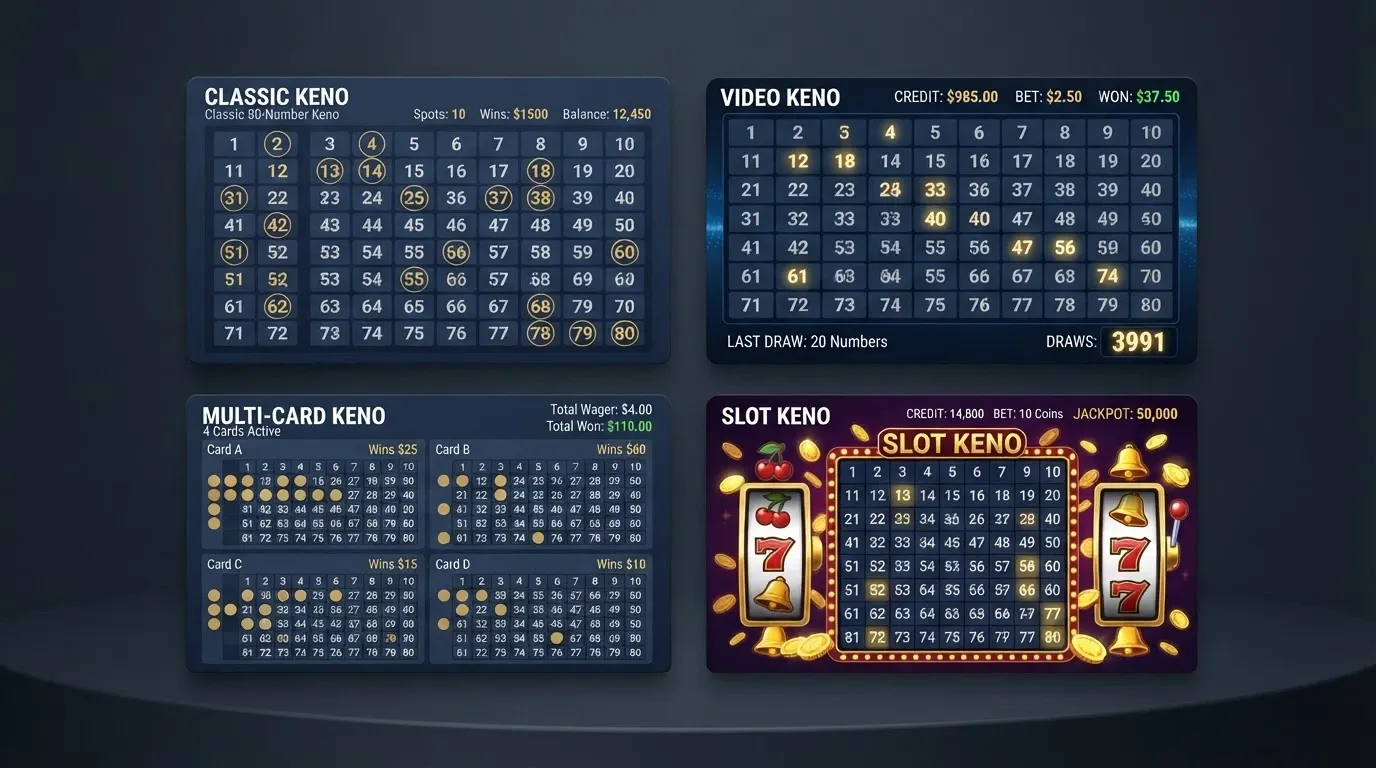
Most online keno variants sit between 90% and 97% RTP. Licensed Australian keno (Tabcorp/KenoGO) runs at about 75% RTP with a 25% house edge, regardless of spot count. The table below compares the typical house edge of key formats.
| Keno Variant | House Edge |
|---|---|
| Licensed AU Keno | ~25% |
| Classic Online Keno | 8–10% |
| Provably Fair (Stake/Rainbet) | 4% |
| Video Keno | ~8% |
The licensed Australian keno product sits in a different band entirely. That is the trade-off: licensed keno is legal and protected under Australian consumer law, but it costs more per draw than nearly every offshore variant. The numbers research carries put licensed AU keno at about 75 percent across spot types 1 to 10, 15, 20 and 40, while offshore real-money keno runs 90 to 97 percent on most titles. A player weighing those two products is weighing a 25 percent house edge against a 3 to 10 percent house edge, and the gap shows up fast.
Classic, Video and Slot-Style Keno: What Each Format Plays Like
Classic keno is the standard 80-number grid with 20 balls drawn, a configurable spot count, and a paytable that scales with the catch. The pacing is the slowest of the three formats — a draw every few seconds, with the result visible across the board — and the RTP range runs from 75 percent on the tighter paytables to 92 percent on the looser ones.
Video keno is a faster solo experience. The board is the same, but the draw runs in quick succession, and the round is a single-player session without the social layer of a casino floor. It sits somewhere between classic and slot-style in pacing, with RTPs that follow the provider’s published math.
Slot-style keno borrows the pokie presentation: themed visuals, animated reels, bonus features, free draw rounds. Book of Keno, Across the Universe Keno, Magic Keno and Amaterasu Keno are the named titles in the featured set, and Neospin and Golden Crown carry them in their lobbies. The mechanics underneath are still keno — pick spots, watch a draw, win on hits — but the presentation makes the round feel closer to a pokie spin than a lottery draw. RTPs vary by title and provider, and a player who wants a specific number should check the game’s information panel rather than assume.
Live Keno vs RNG Keno: A Real Draw Machine or an Algorithm
Most online keno runs on a random number generator. The draw is computed in milliseconds, the result is displayed across the board, and the round is over. The pace is fast, the rounds are continuous, and a player can run dozens of draws per minute.
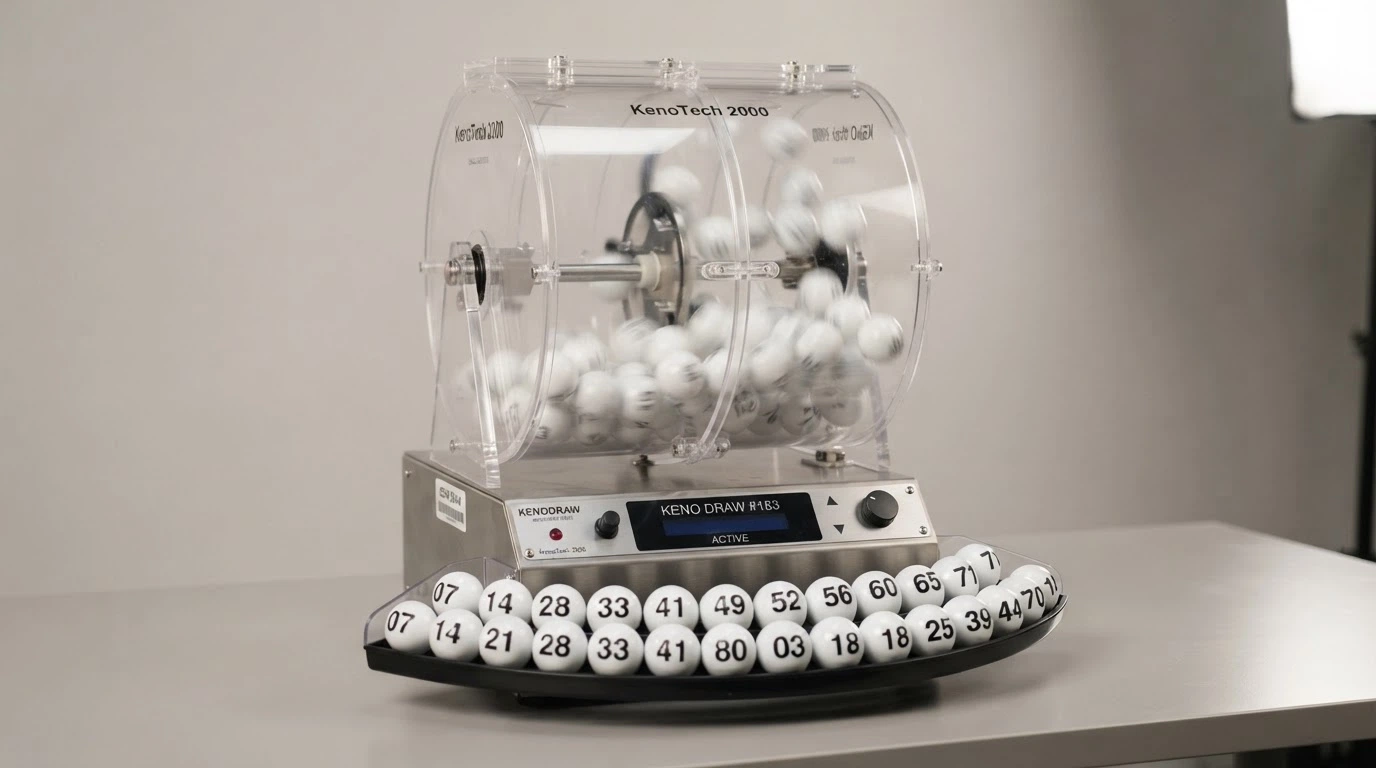
Ezugi’s live keno works differently. A physical draw machine spins twenty balls from eighty, a camera streams the result, and the player picks up to eight spots before each draw. The pace is slower — live draws take longer than RNG pulls — but the transparency is the trade. The player can watch the balls tumble. The eight-spot cap is a design choice: a slower draw with a smaller spot range keeps the round playable, and the RTP follows the published table.
Crypto keno from Stake and Rainbet sits in a third category. The draw is still computed (no physical balls), but the seeds are published before the round and verified after. Provably fair keno is not slower than RNG keno — it runs at RNG speed — but it carries a verification mechanism a third-party audit does not provide. The player can confirm the result themselves.
Multi-Card and 4-Card Keno: Playing More Than One Board at Once
Multi-card keno runs two, four or more boards simultaneously against a single draw. The mechanic is simple: each card carries the same spot count, the draw is shared, and the player wins or loses on each card independently. The RTP per card is identical to single-card keno on the same variant — multi-card does not change the house edge, it changes the session pace.
The effect on bankroll is faster turnover at the same edge. A player running four cards at A$1 per card spends A$4 per draw instead of A$1. At 60 draws per minute, that is A$240 a minute in turnover, against an A$8 house edge per minute at a 4 percent rate. The session burns faster. Budgeting appropriately is recommended, as the variant’s high pace is a significant factor in loss rate.
Keno Rules, Odds and Strategy: What You Can (and Cannot) Control
Spot selection is the only lever a player holds, and it changes the paytable, not the house edge. The licensed Australian keno product — across spot types 1, 2, 3, 4, 5, 6, 7, 8, 9, 10, 15, 20 and 40 — holds near a 25 percent house edge regardless of how many numbers the player marks. Offshore online keno runs the same mechanic but with a tighter edge: most variants sit between 3 and 10 percent, depending on the studio and the spot configuration. Choosing more spots increases the top prize but lowers the hit rate; choosing fewer spots does the opposite. Neither choice changes the expected loss per dollar wagered.
What that means in practice is that no number-picking system beats the game. Hot numbers, cold numbers, due numbers, patterns from previous draws — none of it moves the house edge. The only real lever a player holds is variant choice, because the variant’s RTP is the closest thing to a controllable input. A 96 percent crypto keno costs less per draw than a 90 percent classic keno, and the difference compounds over a session. Bankroll management — deciding how much to wager per draw and how long to play — is the second lever, and the only one a player can actually move.
The Studios Behind the Numbers: Keno Software and Providers
Pragmatic Play and IGT ship the bulk of traditional online keno. Their 80-number, 20-ball titles show up across the operator set, often with identical paytables, and they form the default experience a player encounters when they open a keno game at an offshore casino. Smaller studios — Mascot, Bullshark Games, Eurasian Gaming — fill gaps with turbo keno, video keno, and themed variants the big two do not cover.
Ezugi is the live-draw specialist. The studio streams a physical draw machine rather than an RNG, caps the spot count at eight, and runs a slower round that trades pace for transparency. Stake Originals and Rainbet run the provably fair crypto side, with verifiable seeds and a published 96 percent RTP. The three models — traditional RNG, live draw, provably fair crypto — represent the three ways an online keno draw gets made, and the casino wraps around whichever provider it integrates.
How to Find Keno Inside an Online Casino Lobby
Keno is rarely the first thing a casino surfaces in its lobby. At Fair Go Casino, keno sits in the specialty-games category alongside scratch cards, and a player has to navigate there before seeing it. Neospin and Golden Crown have dedicated keno sections that put the variants within a click or two of the lobby front page, but the design is the exception rather than the rule.
The fastest route is the search bar. Typing “keno” into most casino lobbies returns every keno variant the operator carries, and the search often surfaces titles the categorisation hides. Specialty games and number-draw games get buried under pokies and live casino in most lobbies, so using the search bar is the most efficient way to locate keno titles.
What a Keno Bonus Really Costs You — The RTP Arithmetic
The Royal Reels welcome pack gives a worked example. A$2,500 in bonus money at 35x wagering on bonus only means A$87,500 in required turnover before withdrawal. Plug in a representative online keno RTP — say 94 percent, the midpoint of the 90–97 percent band — and the expected loss on that turnover comes to A$87,500 multiplied by 6 percent, which is A$5,250.
That number is a statistical estimate, not a guaranteed outcome. It assumes the player wagers only the bonus amount, plays a 94 percent RTP keno variant, and runs the full turnover without cashing out early. Under those conditions, the bonus is worth about A$2,500 in real money minus A$5,250 in expected loss, which is a negative number. The bonus costs the player, on average, A$2,750 across the clearing period. A tighter wagering multiplier or a higher-RTP variant narrows the loss; a looser multiplier or a 75 percent RTP licensed-style keno widens it dramatically. Run the same A$87,500 turnover against a 75 percent RTP variant and the expected loss climbs past A$21,000 — the variant matters as much as the bonus.
Free Keno vs Real Money: Why the Demo Button Is Your Best Strategy Tool
Demo mode is the cheapest strategy tool a keno player has. The same RNG runs underneath, the same paytable applies, and the same RTP governs the round. The only thing that changes is what each draw costs.
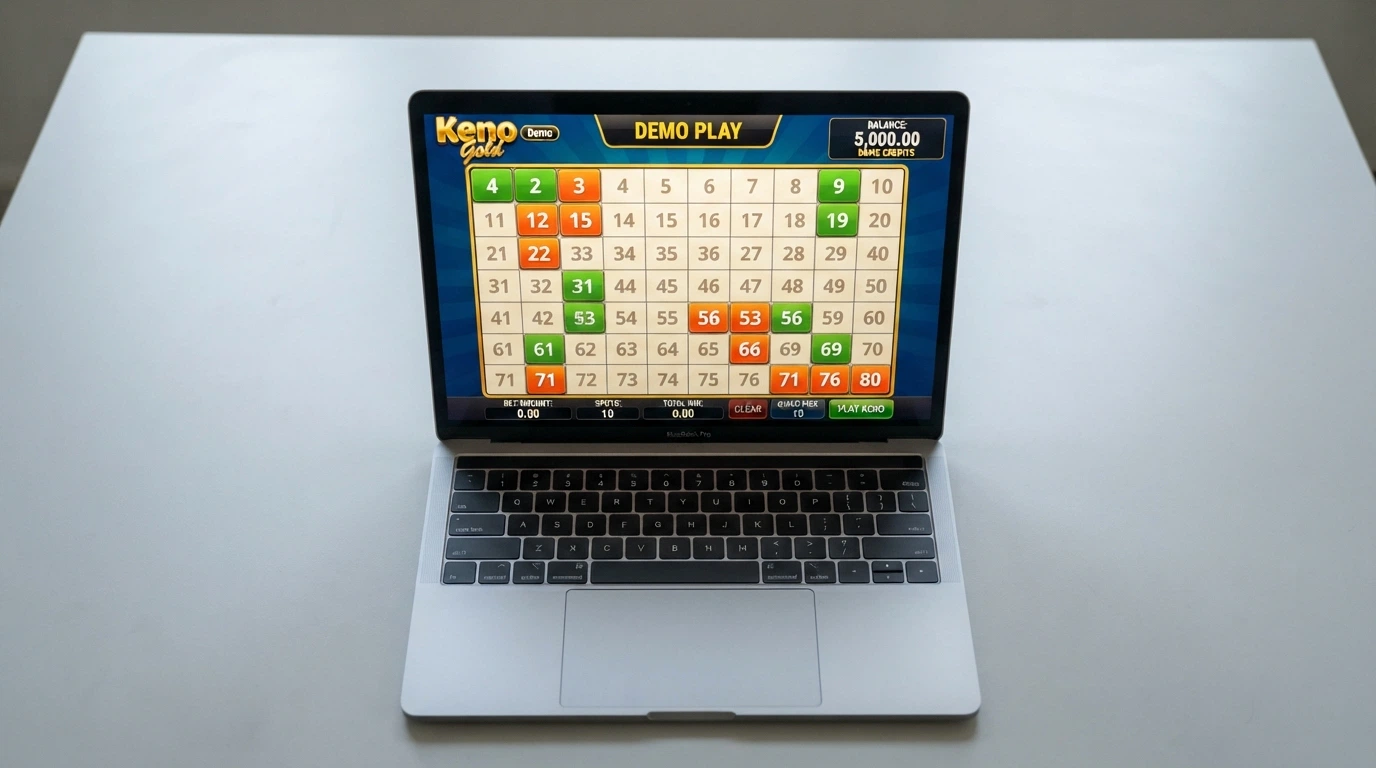
The strategic value is not in finding a winning system — none exists — but in finding the variant that suits the player’s pace and tolerance. A 96 percent crypto keno with a fast RNG cycle plays differently from a 90 percent classic keno with a slower round, and a player who discovers that in demo mode before depositing has saved themselves a session’s worth of mistakes. Most offshore casinos in the set carry demo mode without registration, and a player who has not used it before depositing is leaving free information on the table.
No-Deposit Keno Offers: What Exists and What They Are Worth
Fair Go Casino offers 30 no-deposit free spins on Fu Long Treasures with a A$180 maximum cashout, valid until 25 August 2026. Royal Reels offers a A$10 no-deposit bonus after phone verification. Beyond those two, the featured set does not carry confirmed no-deposit keno-specific offers this run.
The absence is worth stating plainly. The casino marketing pages are full of “free spins” claims, but the ones attached to keno specifically — or to no-deposit entry at all — are thin on the ground. A player who lands on an operator claiming a no-deposit keno offer not in the list above should read the terms page before claiming, as “free” in this market often means “free with a cap, an expiry, and a wagering requirement,” necessitating careful scrutiny of terms.
From Free Play to Real Stakes: What Changes When You Deposit
The RTP is identical. The pace is identical. The paytable is identical. What changes is the consequence.
A demo-mode player can sit through twenty losing draws in a row without flinching, because the balance is play money. A real-money player watching the same twenty draws at A$1 per ticket has lost A$20, and the natural response is to chase it — to mark more spots, to raise the stake, to play one more round than planned. None of that behaviour moves the house edge, but it does change how the session ends. A player who has tested a variant in demo mode knows what a twenty-draw losing streak looks like, and that knowledge is the difference between a session budget and a chase.
Crypto Keno: Provably Fair Games, Blockchain Deposits, and One Legal Catch
Stake and Rainbet both run keno on the provably fair model at 96 percent RTP with a 4 percent house edge. The verification is the point — a player can confirm every draw themselves, using cryptographic seeds the casino publishes before and after the round. No third-party audit required; the math is in the open.
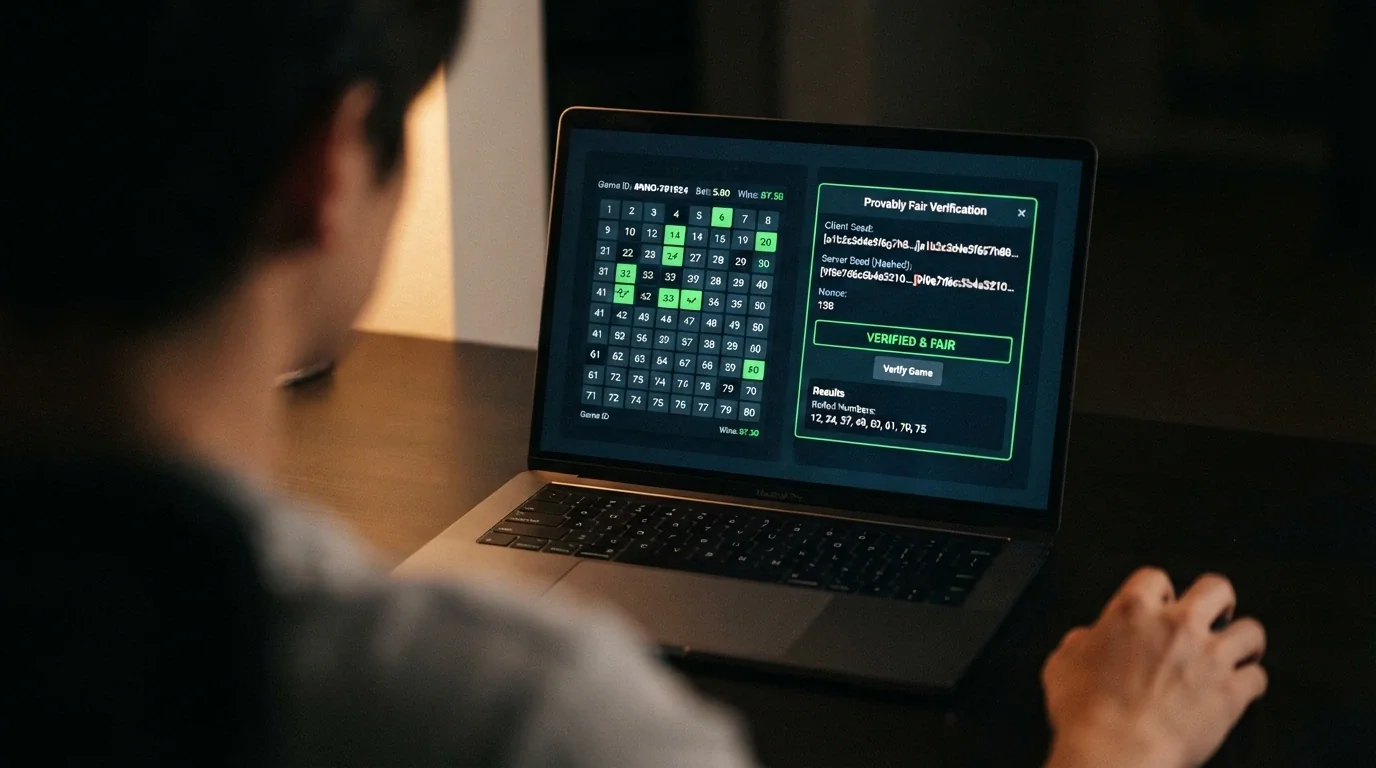
The legal catch is the one Australian players cannot ignore. Credit cards, credit-related products and digital currency have been banned as payment methods for online wagering since 11 June 2024. The penalty for operators is up to A$247,500 per breach. The ban targets the provider, not the player, but the practical effect is that an Australian player using crypto at Stake or Rainbet is sitting inside a transaction the law has explicitly prohibited. The player is not prosecuted, but the player is also not protected — no Australian consumer law, no AFCA, no recourse if a withdrawal stalls.
How Provably Fair Keno Differs From Standard RNG Keno
Standard RNG keno relies on a third-party audit. A lab tests the random number generator, confirms the published RTP matches the math, and certifies the game. The player trusts the audit. Provably fair keno skips the trust step. The casino publishes a server seed hash before the round, the player contributes a client seed, the draw is computed from the combined seeds, and the player can verify after the fact that the result matches the published inputs.
The verification model is not faster than third-party auditing, and it is not a replacement for regulatory oversight. It is a different mechanism: the player checks the math themselves, instead of trusting an auditor’s certificate. For a player who does not trust offshore casinos on their word, provably fair keno is a meaningful shift in who carries the verification burden.
Why Your Online Keno Casino Almost Certainly Isn’t Licensed in Australia
Online casino is prohibited in Australia under the Interactive Gambling Act 2001, strengthened by the Interactive Gambling Amendment Act 2017, which gave ACMA enforcement and blocking powers. No licence exists for online casino games, online pokies or in-play betting anywhere in the country — not federally, not in any state or territory. A page about “the best licensed online casinos in Australia” is describing something that does not exist.
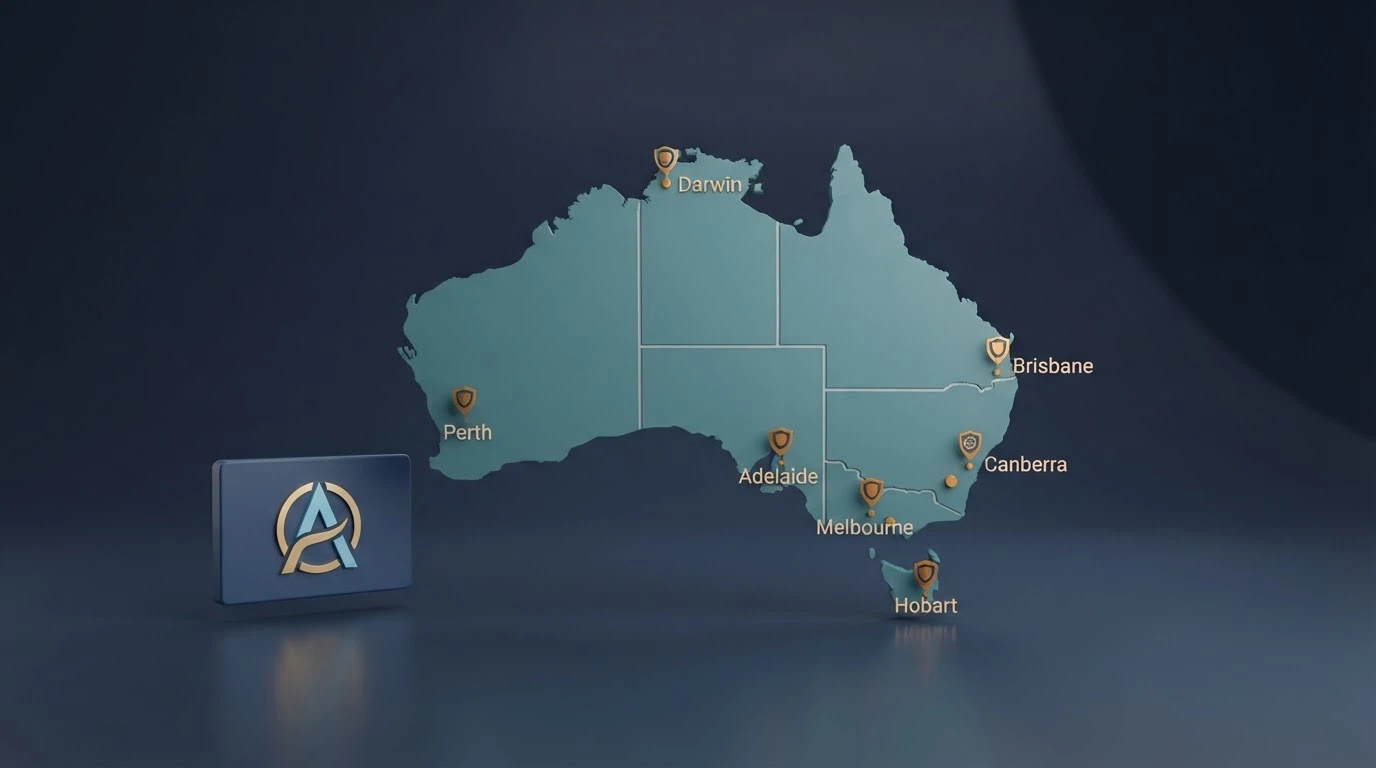
What is licensed is wagering on races and sport placed before the event begins, lotteries, and keno, through operators licensed by a state or territory. The minimum age is 18 for all commercial gambling. For keno specifically, the licensed route runs through Tabcorp and KenoGO in Victoria, with draws every three minutes and a A$40 million headline jackpot.
ACMA has blocked 1,564 illegal gambling and affiliate websites since November 2019. More than 225 illegal services have withdrawn from the Australian market since 2017. From 1 January 2027, banks and payment providers gain express authority to block transactions to illegal gambling operators, and the Interactive Gambling Amendment (Gambling Reform) Bill 2026 passed Parliament on 19 August 2026. The individual player is not prosecuted, but the provider is, and the offshore casino is the provider.
Licensed Keno vs Offshore Casino Keno: Two Completely Different Products
Australia has a real, licensed keno market. Tabcorp and Lottoland were granted Victoria’s keno licences on 21 February 2022 for a 20-year term commencing 15 April 2022. Lottoland Australia changed its corporate entity name to KenoGo Pty Ltd on 9 September 2025. The product runs on a similar 80-number, 20-ball mechanic to offshore casino keno, but the rules, the paytable and the RTP sit in a different band.
Licensed Australian keno is configured at about 75 percent RTP, with a 25 percent house edge. Offshore online keno runs 90 to 97 percent on most variants. That gap is the central trade-off: the licensed product is legal and protected under Australian consumer law, with state regulator oversight and recourse through VCGLR or VCAT if something goes wrong. The offshore product is mathematically cheaper to play, but it carries no consumer protection, no regulator, and no recourse if the operator refuses a withdrawal or voids a win.
A player who wants the cheapest per-draw cost plays offshore. A player who wants legal protection and Australian recourse plays licensed keno. The two products do not compete on the same field, and a sensible player chooses based on which trade-off matters more.
What ACMA Enforcement Means for Your Money
ACMA blocking works at the DNS level. The authority directs Australian ISPs to block the domain, and the site becomes unreachable through normal Australian internet connections. The block is not a takedown — the site keeps running offshore — and a player with a balance on the site at the moment of blocking has no Australian mechanism to recover it.
The 1,564 blocks since November 2019 and the 225+ voluntary withdrawals since 2017 are the track record. From 1 January 2027, the bank-blocking powers take effect, and the enforcement extends to payment providers. A player with a bank account in Australia and a balance at an offshore casino is exposed on two fronts: the site access can be cut, and the transaction history can be flagged.
The absence of recourse is the quiet cost. No AFCA complaint is available for an offshore casino dispute. No Australian consumer protection law covers the transaction. The casino’s own terms page is the only contract, and the casino’s own dispute process is the only remedy. A player who treats offshore play as a one-way street — deposit, play, withdraw quickly, do not leave a balance — reduces the risk. Treating any offshore site as a long-term savings account is ill-advised given the current ACMA enforcement climate.
Payment Methods for Keno Deposits: What Australian Law Allows
- Debit card — the standard legal route for licensed Australian wagering services. Works at every Australian-licensed operator, may be restricted at offshore casinos that prefer e-wallets or crypto.
- Bank transfer — direct deposit from an Australian bank account. Slow but reliable for larger amounts; same offshore caveat applies for player protection.
- PayID and Osko — instant transfer using a phone number, email or ABN. Native to the Australian banking system, widely supported, and the fastest legal option at most licensed operators.
- BPAY — bill-payment style deposit from an Australian bank account. Works at licensed wagering services, slower than PayID but available outside business hours.
- Credit cards, credit-related products and digital currency — banned as payment for online wagering since 11 June 2024, with operator penalties up to A$247,500 per breach. The ban targets the operator, and offshore casinos may still accept these methods, but the legal status of the transaction is contested and the player has no Australian consumer protection on top of it.
From 1 January 2027, banks and payment providers gain direct authority to block transactions to illegal gambling operators. The legal deposit routes today may narrow further as the bank-blocking power takes effect, and the offshore path becomes harder to walk through the Australian banking system.
When Keno Stops Being a Game: Gambling Harm, BetStop, and Where to Get Help
An estimated 3.32 million Australians — 15.1 percent of the adult population — are experiencing some level of gambling harm as of March 2026. About 13 percent of the population, roughly 2.86 million people, are experiencing harm from their own gambling behaviours. Approximately 430,000 Australian adults experience problem gambling. Risky gambling increased from 13.7 percent in 2024 to 19.4 percent in 2025, by more than five percentage points in a single year, according to the ANU POLIS Centre for Social Policy Research. Online gambling now accounts for 56.1 percent of gamblers’ main mode of participation.

Keno’s pace is part of the risk. Draws every few minutes in retail mode, every few seconds in RNG mode, the round is fast enough that a player can run through a session’s bankroll before the hour is up. Chasing losses on rapid draws, escalating stake size to recover, playing longer than planned — these are the behavioural markers research flags, and they map directly onto keno’s format.
BetStop — the National Self-Exclusion Register — launched on 21 August 2023. By 31 March 2026, 59,830 people had registered to self-exclude, with 37,247 active exclusions. Seventy-eight percent of registrants were under 40, and 38 percent chose lifetime exclusion. The register binds every Australian-licensed online and phone wagering service, and one registration excludes a person from all of them. The minimum exclusion period is three months; the maximum is lifetime.
Recognising When Keno Play Becomes a Problem
The signs are behavioural, not statistical. A player who chases losses on rapid keno draws, who escalates stake size to recover a bad session, who plays longer than planned, who hides keno play from family or partners — that player has crossed from recreation into harm. The PGSI (Problem Gambling Severity Index) self-assessment, available through Gambling Help Online, scores these patterns and flags risk levels.
The pace of keno makes the patterns harder to spot. A draw every few seconds is fast enough that a session can run hot or cold without the player noticing the drift, and the absence of a natural pause (a hand of cards ends, a pokie spin lands) means there is no built-in moment to check the balance. The player who sets a session budget and a session time before depositing has built those pauses in advance. The player who does not has none.
BetStop, Self-Exclusion and the Offshore Gap
BetStop’s limitation is the most concrete harm of the offshore route. The register binds Australian-licensed wagering services only — every operator licensed under a state or territory regime, every service the ACMA recognises as legal. An offshore casino is not connected. A self-excluded person who registers with BetStop and then deposits at an offshore casino will be accepted, will play, and will have no recourse through the Australian system if the operator refuses a withdrawal.
Dr Kei Sakata of the Australian Gambling Research Centre has noted that, despite an estimated five million wagerers nationwide and 400,000 high-risk gamblers, only 30,000 individuals had registered with BetStop. The gap between the population at risk and the population registered is the gap the offshore casinos fill, and it is the gap that no Australian consumer protection can close.
A player who has registered with BetStop and is still playing offshore should treat that as a signal, not a workaround. The register’s design assumes the player will not reach an offshore operator; if the player does, the design has failed, and the harm continues.
Where to Get Help: Helplines, Counselling and Self-Exclusion in Australia
- National Gambling Helpline: 1800 858 858 — free, confidential, staffed 24 hours a day, 7 days a week, every day of the year. Call from any Australian phone.
- Gambling Help Online (gamblinghelponline.org.au) — online chat and email counselling, plus self-assessment tools including the PGSI. Available 24/7.
- BetStop — National Self-Exclusion Register (betstop.gov.au) — one registration excludes a person from every Australian-licensed online and phone wagering service. Minimum three-month exclusion, maximum lifetime.
- State-level services — Gambler’s Help (Victoria), Gambling Help (NSW), Gambling Help (Queensland), and equivalent services in every state and territory. Free, confidential, with face-to-face counselling available in metropolitan and regional centres.
- Financial counselling — National Debt Helpline on 1800 007 007, free financial counselling for gambling-related debt. State-level financial counselling services also available.
The services are free, confidential, and staffed by people who understand gambling harm. None of them can recover money from an offshore casino — that is the limitation research flags at every step — but they can help a player who has decided to stop, and they can help a player who is deciding.
How We Picked and Ranked These Keno Casinos
The selection runs from operator websites, the ACMA public register, Curaçao Gaming Control Board licence records, and the published RTP data from provider studios and independent keno guides. State regulator records — VGCCC for the licensed keno route, NTRWC for the Northern Territory wagering licences — provided the cross-checks for the legal sections.
The ranking criteria are keno offering depth, bonus value and wagering fairness, licence transparency, provider quality, and Australian-player relevance. Keno offering depth weights first — an operator with fourteen keno formats ranks ahead of an operator with one. Bonus value is read as effective value once the wagering multiplier and the bonus-only or bonus-plus-deposit terms are factored in; a A$15,000 match at 40x is not necessarily better value than a A$2,500 match at 35x. Licence transparency weighs verified Curaçao numbers above unverified ones. Provider quality weighs audited RTPs above claimed RTPs. Australian-player relevance adds the offshore caveat — every operator in the set is offshore, and the ranking does not pretend otherwise.
The scope is offshore-only. No licensed Australian online casino exists, so the set cannot include one. The ranking is honest about that limit, and the licensed-keno section above is the place a player who wants the legal route should look.
What Australian Keno Players Should Actually Do With This Information
The trade-off is simple and stubborn. Licensed Australian keno costs about 25 percent per draw, regardless of how many spots a player marks, and the player gets legal protection, state regulator oversight, and recourse through Australian consumer law. Offshore online keno costs 3 to 10 percent per draw on most variants, with provably fair crypto keno at 4 percent, and the player gets nothing — no consumer protection, no regulator, no recourse if a withdrawal is held, no BetStop coverage, and a real risk that ACMA blocks the site while a balance sits on it.
The decision is personal, but the information asymmetry this page has tried to close is real. A player who wants the cheapest per-draw cost plays offshore, accepts the risks, sets a session budget, and withdraws promptly. A player who wants legal protection and Australian recourse plays licensed keno through Tabcorp and KenoGO, accepts the 25 percent house edge, and gets state regulator oversight on top. The middle ground — claiming a A$15,000 welcome bonus at an offshore casino and treating the legal position as someone else’s problem — is the worst of both worlds. The bonus costs real money once the wagering multiplier is run against the house edge, and the legal position is the player’s the moment a balance accumulates on a site ACMA might block next week.
The single most important takeaway: know what you are giving up before you deposit. The offshore product is cheaper per draw. It is also unprotected, unregulated, and one DNS block away from inaccessible. A player who has read both sides and decided is in a stronger position than a player chasing a welcome bonus without doing the math, and exercising caution is essential for those who choose to play.
Frequently Asked Questions
Is it legal to play keno online for real money in Australia?
Online casino is prohibited under the Interactive Gambling Act 2001, with no licence for online casino games, online pokies or in-play betting anywhere in the country. The prohibition targets the provider, not the player, so an Australian playing at an offshore casino is not prosecuted. What the player gives up is consumer protection, regulator oversight, and any recourse if the operator refuses a withdrawal. Licensed keno via Tabcorp and KenoGO is legal under state licences, but it is a separate lottery-style product with a higher house edge.
How does licensed Australian keno (KenoGO) differ from offshore online casino keno?
Licensed Australian keno runs on a similar 80-number, 20-ball mechanic but operates with a high house edge compared to offshore alternatives. It is state-licensed, legally protected and overseen by Victorian regulators (VGCCC) with player recourse through Australian consumer law. Offshore casino keno runs 90 to 97 percent RTP on most variants, with provably fair crypto keno at 96 percent, but it is unlicensed in Australia, blocked by ACMA at scale, and offers no consumer protection.
What payment methods can Australian players use to deposit at keno casino sites?
Debit card, bank transfer, PayID/Osko and BPAY are the legal routes at Australian-licensed operators. Credit cards, credit-related products and digital currency have been banned for online wagering since 11 June 2024, with operator penalties up to A$247,500. Offshore casinos may still accept banned methods, but the legal status of the transaction is contested and Australian consumer protection does not apply. From 1 January 2027, banks gain direct authority to block transactions to illegal operators.
How does BetStop self-exclusion work for keno players, and does it cover offshore sites?
BetStop — the National Self-Exclusion Register, launched 21 August 2023 — binds every Australian-licensed online and phone wagering service. One registration excludes a person from all of them, with exclusion periods from three months to lifetime. As of 31 March 2026, 59,830 people had registered, with 37,247 active exclusions. The register does not cover offshore casinos, which are not connected to the Australian regulatory system. A self-excluded person who deposits at an offshore casino will be accepted and will have no recourse through BetStop if the operator refuses a withdrawal.
What is the house edge on online keno, and how does it compare to other casino games?
Most offshore online keno runs 90 to 97 percent RTP, which translates to a 3 to 10 percent house edge depending on the variant. Stake Originals and Rainbet sit at 96 percent (4 percent house edge) on their provably fair crypto keno. Licensed Australian keno sits at about 75 percent RTP with a 25 percent house edge across spot types. For comparison, online pokies typically run 92 to 97 percent RTP, blackjack sits around 99.5 percent with optimal play, and roulette sits around 97.3 percent on European single-zero wheels. Keno’s edge is wider than most table games but tighter than the licensed lottery-style version.
Created by the ”Welcome Bonus Casinos AU” editorial team.