
How anonymous crypto casinos actually work for Australian players
 Available in AU
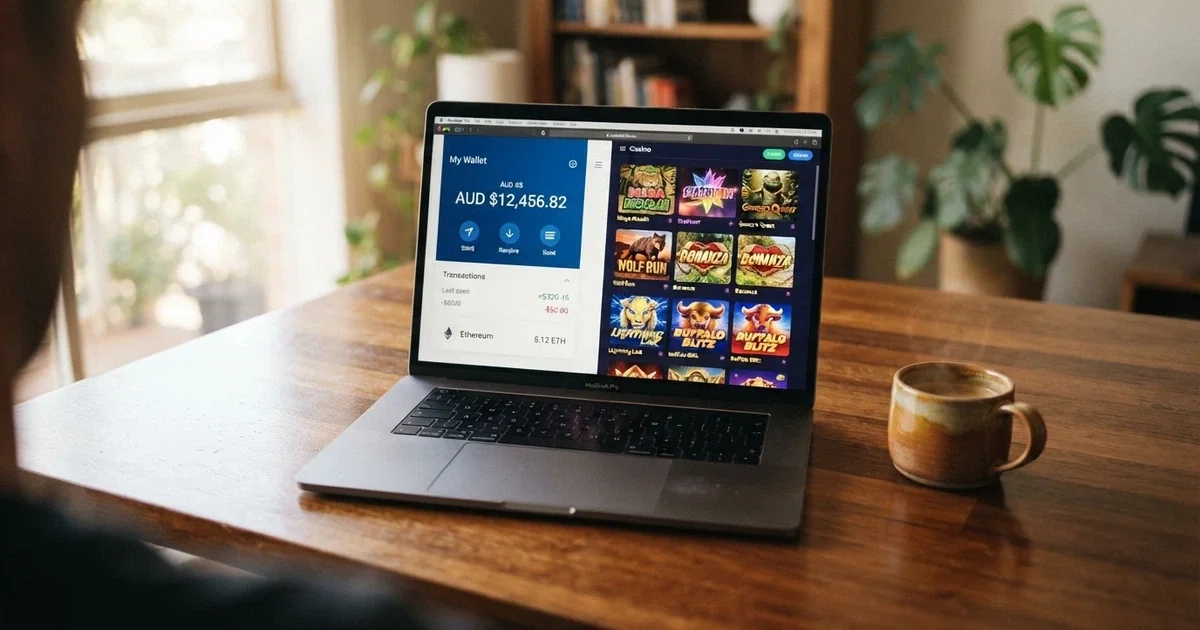
The pitch arrives in your inbox, on a Telegram channel, on a YouTube ad slotted between highlight reels: deposit Bitcoin, skip the passport upload, play within minutes. Australians click through to offshore casinos that serve up pokies, live dealer tables and sports betting without ever asking for a name or a utility bill. The product is prohibited to provide in Australia under the Interactive Gambling Act 2001, but the prohibition targets the operator, not the person on the other side of the screen. This page is for someone weighing that gap — what the no-KYC model is, what it costs, and what the law does and does not do to a player who uses one.
Verified as of 18 October 2026 against the Australian Communications and Media Authority’s enforcement register and the published terms of each operator listed.
Table of Contents
- What an anonymous crypto casino actually is — and what it isn’t
- Australia’s anonymous casino shortlist for 2026 — 10 offshore sites reviewed
- How crypto keeps your identity off the casino’s servers — and where it doesn’t
- Why your 2026 casino bonus is smaller than it looks
- Australian law and anonymous casinos: what the IGA actually says
- Staying safe when nobody knows who you are
- How we chose and ranked these casinos
- What you should actually do with this information
- Frequently asked questions
What an anonymous crypto casino actually is — and what it isn’t
The term describes an offshore online casino that lets you deposit, play and withdraw without uploading a passport, driver’s licence or proof of address. Account creation asks for an email and a password; a crypto wallet address is what funds and pays out the balance. The “anonymous” refers to the casino’s records, not to the underlying blockchain or to the player’s banking trail.
The mechanics depend on what a no-KYC casino is willing to push back on the AML paperwork its licence obliges it to perform. Curaçao and Anjouan licences both require operators to verify identity at some point; the question is when. Industry testing puts the trigger for a “soft KYC” review somewhere between EUR 2,000 and EUR 10,000 in cumulative deposits or withdrawals, with the exact threshold buried in the Terms. For Australian players, the practical range sits around A$2,000 to A$5,000 in lifetime withdrawals before a document request tends to land.
The contrast with a licensed Australian wagering account is total. To open one with a TAB, Sportsbet, Ladbrokes or any NT-licensed bookmaker, you supply your full legal name, date of birth, residential address and verified contact details before you can deposit a cent. Identity is checked against public registers; the operator is bound by the National Consumer Protection Framework for Online Wagering. There is no anonymity on the licensed side, by design.
What “anonymous” does not cover is worth naming. The casino never sees your name — but the Australian crypto exchange where you bought the Bitcoin does, and is required to by AUSTRAC. The blockchain itself is a public ledger; every transaction is traceable to a wallet address that, in turn, is traceable back to a verified identity at the exchange. Anonymity here is a casino-side convenience, not a financial privacy product.
Pokies, real-money play and mobile access
Pokies libraries at offshore casinos are typically the largest single draw. Royal Reels lists more than 5,400 titles from over 40 providers; Bizzo claims 8,000-plus games from 70-plus studios; BC.Game clears 8,000-plus with 150-plus cryptocurrencies accepted alongside them. The depth comes from licensing deals with Pragmatic Play, Evolution, Hacksaw, BGaming, Wazdan, Betsoft and the wider RTG catalogue, plus the provably fair titles the crypto-native operators develop in-house.
Demo play is open at every featured brand — most let you spin without depositing or registering, which is the one honest way to read a game’s hit rate before risking crypto. Real-money play turns on funding the account. Minimum deposits at the featured set sit in a tight band: roughly A$16 to A$32 in AUD terms depending on the coin and the operator, with A$20 a workable middle.
Mobile is where the model has quietly matured. The App Store and Google Play do not host offshore gambling apps in Australia — both stores have removed them since the IGA enforcement ramped up in 2017. The replacement is mobile browser play at a casino’s responsive site, or a Progressive Web App (PWA) install that adds the site to a home screen without going through a store. Bizzo runs a PWA path that offers 10 no-deposit free spins as a reward for installing it — a small sweetener that bypasses the app-store problem entirely. The game itself runs in the browser; the install just gives it a tile on your home screen.
New anonymous casino sites worth watching in 2026
A “new” anonymous casino in 2026 is almost always a brand re-skin rather than a fresh build. The licence, the platform, the game aggregator and the support stack tend to come from one of a handful of white-label operators; what changes is the name, the bonus headline and the marketing buy. Spotting which of these new skins are worth a deposit comes down to four checks a player can run in five minutes.
The licence matters. An Anjouan licence from the Anjouan Gaming Authority, a Curaçao Gaming Control Board licence or a Curaçao sub-licence through a master operator is the realistic baseline; anything claiming a UKGC, MGA or Australian licence for an online casino is either a copy error or a lie. The licence number on the footer should resolve to a public register.
The launch date and the licence date are two different things. Bizzo launched in 2021 under TechSolutions Group N.V.; the platform has been paying out since then. A brand with a freshly registered domain but a licence number that maps to a 2025 or 2026 issuance is by definition newer than its track record suggests, and newer than its domain might imply.
Withdrawal history is the third check. Community forums, watchdog sites and the gambling and cryptocurrency subreddits carry player reports; a brand that has paid out consistently for twelve months is a different proposition from one that has paid out consistently for six weeks. New entrants get this benefit only with time.
Compliance posture is the fourth. If the brand still targets Australian players through its homepage, it has accepted the ACMA enforcement risk; if it excludes Australia in the Terms but accepts offshore sign-ups via a mirror domain, it has hedged. Every no-KYC brand reviewed by ChainBankroll does the second — they officially exclude Australia per their Terms, then accept Australian sign-ups via offshore domains. The first posture is closer to the regulator’s radar; the second is the standard operating model.
The honest answer for a player sizing up a new entrant is that age is the cheapest proxy for payout reliability, and the cheapest proxy is what the audit has to use.
Australia’s anonymous casino shortlist for 2026 — 10 offshore sites reviewed
The ranking below is built from the things a player can verify before depositing: the licence on the footer, the bonus terms in the Terms page, the game providers listed in the lobby, and the crypto networks supported at the cashier. Each operator is described on the same axes. Where terms were not confirmed at review time — WinSpirit and Scream Casino for bonus specifics, BC.Game for individual promo wagering — the entry says so plainly rather than filling the gap.
The shortlist is not an endorsement. Each of the ten brands is an offshore operator offering a prohibited service to Australians under the Interactive Gambling Act 2001; none holds an Australian casino licence, because none exists to hold. The choice is between offshore operators with different terms and different licences — not between offshore and licensed.
| # | Operator | Licence | Welcome Bonus | Wagering Requirement | Game Count | Provider Mix |
|---|---|---|---|---|---|---|
| 1 | Stake | Curaçao | No fixed welcome match; rakeback + weekly bonuses | Varies by promo | Large library | Pragmatic Play, Evolution, Hacksaw, others |
| 2 | Rocket Play | Curaçao | 100% up to A$300 (1st); 200% up to A$300 (2nd); high roller 50% up to A$2,500 | 40x bonus | 3,000+ games | 50+ providers, BGaming, Pragmatic Play |
| 3 | Skycrown | Curaçao | 100% up to A$200 | 30x bonus | 3,500+ games | 50+ providers, Pragmatic Play, Evolution, Hacksaw |
| 4 | Royal Reels | Curaçao | A$2,500 across three deposits (100%/75%/100%) | 35x bonus | 5,400+ pokies | 40+ providers |
| 5 | Rainbet | Malta Gaming Authority (wagering only) | 50% up to A$500 | 5x bonus | Sportsbook + live casino + pokies | — |
| 6 | Fair Go | Curaçao (no public licence number) | 100% up to A$200 × 5 deposits (total A$1,000) | 30x deposit + bonus | RTG-powered | RTG catalogue |
| 7 | Bizzo Casino | Curaçao (TechSolutions Group N.V., 2021) | Up to A$7,250 across four deposits | 40x bonus | 8,000+ games | 70+ studios |
| 8 | WinSpirit | Curaçao | Welcome package (terms not confirmed) | Not confirmed | — | Multiple providers, publishes RTP values |
| 9 | Scream Casino | Curaçao | Not confirmed | Not confirmed | — | Multiple providers |
| 10 | BC.Game | Anjouan | Multi-tier welcome (varies by promo) | Varies | 8,000+ games | 150+ crypto accepted |
Stake
Stake runs the rakeback model rather than a fixed welcome match. Curaçao-licensed, with a provider line-up built around Pragmatic Play, Evolution and Hacksaw, it has spent the last few years positioning itself as the brand that pays back rather than the brand that gives away a headline. Weekly bonuses, race promotions, sports reloads and a tiered VIP rakeback programme do the work a deposit match would do at a more conventional casino.
What this means for player value is steady rather than front-loaded. A recreational player funding A$100 a week and playing at modest stakes gets more back over six months than a player chasing a one-off match; a high roller pulling volume on Evolution live tables sees rakeback stack into a real number. The promo terms vary by jurisdiction and promotion, which is why the welcome column reads “no fixed welcome match” rather than naming a figure.
The crypto context is the legal one. Since 11 June 2024, the Interactive Gambling Amendment (Credit and Other Measures) Act 2023 has banned credit cards and digital currency as payment methods for licensed Australian wagering services, with penalties of up to A$247,500 for operators that fail to enforce it. Stake operates outside that licence frame; the brand is reachable from Australia but offers a prohibited service to do so. ACMA blocking risk applies in the same way as for any other brand on this list.
Stake is the brand for the steady player rather than the bonus hunter; the rakeback is the model, the welcome match is the absence of one.
Rocket Play
Rocket Play’s first-deposit bonus is the kind a marketing writer is paid to make sound generous: 100% up to A$300 plus 100 free spins on Aztec Magic by BGaming. Forty-times wagering applies to the bonus only — meaning the A$300 itself must be turned over, not the deposit plus the bonus. Maximum bet sits at A$7.50 per spin; the A$300 in free-spin winnings is itself capped; and the whole package has to clear inside five days.
The second deposit bumps to 200% up to A$300 with the same 40x and the same five-day window. A high-roller track runs alongside at 50% up to A$2,500 for bigger depositors.
The mathematics of the first deposit deserve working through. A A$300 bonus at 40x wagering means A$12,000 in required turnover. At the A$7.50 maximum bet, the clearing math runs to 1,600 spins. A five-second interval between spins — the typical pace at online pokies — puts the clearing time at about two hours and thirteen minutes of continuous play. The five-day window makes that pace generous, but the A$7.50 cap and the 100-spin allowance for the free-spin portion are the real constraints: a player who tries to grind the bonus at lower stakes will not clear it; one who tries to push single bets above A$7.50 will see the bonus voided. The free spins pay out into a separate A$300 ceiling, which is generous by the market’s standards and stingy against what a player might imagine from “100 free spins”.
Curaçao-licensed, with more than 3,000 games from 50-plus providers including BGaming and Pragmatic Play, Rocket Play is the operator for a player who reads the bonus terms before claiming. Without that reading, the same offer is the one that costs the most.
Skycrown
Skycrown’s welcome is a single-deposit match — 100% up to A$200 — with 30x wagering on the bonus only and a seven-day expiry. The wagering multiple is lower than Rocket Play’s 40x; the expiry is longer than Rocket Play’s five days. On paper, Skycrown is the easier bonus to clear.
The harder number is the A$500 maximum cash-out cap per bonus. Win a five-figure spin during the clearing window, and the casino will pay out A$500 of it — the rest stays with the operator. For a player whose bankroll is modest and whose upside expectation is realistic, the cap barely registers. For a player whose strategy involves building a balance off the bonus money, the cap is the term that decides whether the bonus is worth taking.
The game library runs to 3,500-plus titles from 50-plus providers, with Pragmatic Play, Evolution and Hacksaw on the heavy-rotation list. Free spins are spread across the first three deposits rather than attached to the first; the precise number and the title they lock to were not confirmed at review time.
For a casual player clearing a small bonus on a Tuesday afternoon, Skycrown is the most forgiving of the featured welcome packages. For anyone playing for a payout ceiling the terms did not promise, the A$500 cap is the answer the page has to put up front.
Royal Reels
Royal Reels runs the largest headline package on the featured set: A$2,500 across three deposits at 100%, 75% and 100%, plus 50 free spins at A$0.20 per spin on a featured pokie. Wagering sits at 35x on the bonus only, with an A$5 per-spin cap that is the lowest of the featured group. A A$10 no-deposit bonus is available after phone verification — the one verification step the operator asks for, and a notable exception in a no-KYC model.
The size of the headline is the kind of figure a comparison page will quote as “the biggest bonus”. It is also the one that benefits most from being read in full. Thirty-five times A$2,500 across three deposits implies a turnover requirement in the tens of thousands of AUD before any of the bonus money converts to withdrawable cash — A$87,500 in raw wagering volume across the three deposits. The A$5 cap means the clearing time at conventional play stretches well beyond the hours-long grind at Skycrown’s stake sizes.
Curaçao-licensed, with more than 5,400 pokies from over 40 providers and instant crypto plus PayID withdrawals, Royal Reels is also the brand with the longest enforcement history. It was the first casino-style site the ACMA ordered blocked, on 19 November 2019, and is named in the Proxous Advanced Solutions Limited enforcement action covering 13 casino-style services, including Fair Go, Ozwin Casino, Play Croco and Uptown Pokies. The block was DNS-level; access by mirror domain or VPN continued. The brand is still operating.
Royal Reels pays out — and is also on the regulator’s list. The A$5 cap is the term that explains why a balance built during clearing did not convert.
Rainbet
Rainbet is the licence outlier on the list. The operator holds a Malta Gaming Authority licence for its wagering product — the sportsbook and the fixed-odds book — but its casino offering to Australian players remains unlicensed under the IGA, because the MGA licence does not extend to a product the IGA prohibits. The welcome bonus is 50% up to A$500 at 5x wagering, the lowest multiple on the featured list by a wide margin, and the responsible-gambling infrastructure is the most developed.
Deposit limits, self-exclusion tools and a “Take a Break” feature that runs from 24 hours up to six months are baked into the account. None of them connect to BetStop; the offshore status means the Australian National Self-Exclusion Register does not recognise the operator, and a self-excluded Australian can still fund and play. What Rainbet offers is internal discipline rather than regulatory oversight — a setting the player turns on inside an account the operator can edit at any time.
For a player who wants the lowest wagering hurdle on the list and the most developed self-management tools, Rainbet is the brand to read first. The wagering of 5x makes the bonus one of the cheaper bonuses to clear in the offshore market; the MGA licence, even scoped to wagering, is a step above the Curaçao and Anjouan defaults elsewhere on the list.
Fair Go
Fair Go is the RTG-powered veteran that the ACMA blocked first. On 19 November 2019, it became the first illegal offshore gambling service the regulator ordered Australian ISPs to block, and on 5 August 2022 it received a formal warning through its master-licence holder, Proxous Advanced Solutions Limited — the same enforcement action that named Ozwin Casino, Play Croco, Uptown Pokies and others. The block has not stopped the brand operating; it remains accessible via mirror domains.
The welcome package is straightforward: 100% up to A$200 across five deposits, for a total of A$1,000, with 30x wagering on the deposit plus the bonus combined. Two terms make it unusual. The first is the “no maximum cash-out” clause on the deposit bonus — a player who clears the wagering can withdraw the full balance, not a capped slice of it. The second is the 30x on the combined deposit and bonus rather than the bonus alone, which doubles the effective turnover a player must clear before withdrawing.
Curaçao-licensed (no public licence number published at the time of review), powered by the RTG catalogue, Fair Go is the brand for a player who values the absence of a payout ceiling over a lower wagering multiple. For someone who has not been blocked yet, the ACMA’s enforcement record is the line the Terms page does not carry.
Bizzo Casino
Bizzo is the size outlier. Eight thousand games from 70-plus studios, a welcome package of up to A$7,250 plus 175 free spins across four deposits, 40x wagering with an A$8 maximum bet, and a payments stack that includes PayID for both deposits and withdrawals alongside cards and crypto. Operated by TechSolutions Group N.V., launched in 2021, Curaçao-licensed.
The PayID integration is what makes Bizzo the most domestic-feeling of the offshore set. PayID via Osko is a real-time Australian payment rail; using it to deposit and withdraw at an offshore casino cuts the friction a player feels when moving between bank and wallet. The casino also offers 10 no-deposit free spins for installing its PWA — a small sweetener for the work of adding the site to a phone home screen, at 40x wagering with an A$75 win cap.
The size of the welcome is the line to read carefully. Up to A$7,250 across four deposits implies a turnover requirement that runs into the hundreds of thousands of AUD at 40x — a number that no realistic play schedule clears inside the casino’s typical validity window. The cap on individual bets at A$8 is higher than Royal Reels’ A$5 and Rocket Play’s A$7.50, which softens the time pressure; the sheer volume of required turnover does not.
For a player who wants the largest game library on the list and a domestic rail for moving AUD in and out of crypto, Bizzo is the choice. Anyone chasing the bonus as a quick win rather than a high-volume grind should note: the A$2,500 × 35 wagering math is the reason that headline figure often stays out of reach.
WinSpirit
WinSpirit holds a Curaçao licence and runs a multi-provider lobby that has published RTP values for its games — a transparency practice not every offshore casino adopts, and one a player can audit by checking the help page of any title in the lobby. Multiple providers sit behind the brand; the casino’s welcome package includes a deposit match plus free spins, but the specific bonus amounts, wagering multiples, validity windows and spin values were not confirmed at review time.
The honest reading of an under-documented operator is to state what is known and what is not. What is known: Curaçao-licensed, multiple providers, RTP publication for the catalogue. What is not known: the precise bonus headline, the wagering multiple, the maximum bet during clearing, the validity window, the maximum cash-out cap. A player comparing WinSpirit to Rocket Play or Skycrown has fewer numbers to weigh on the WinSpirit side.
WinSpirit is the brand for the player who reads the Terms before claiming and accepts that not every bonus number has been published at the time of writing.
Scream Casino
Scream Casino is the least-documented operator on the featured set. Curaçao-licensed, with multiple providers in the lobby, but with no confirmed welcome bonus, no confirmed free spin allocation, no confirmed wagering multiple and no confirmed validity window at the time of review. The licence can be checked; the provider list can be browsed; the bonus terms cannot be quoted without re-checking the Terms page at sign-up.
For a player cross-referencing the featured set, this entry exists to be honest about the gap. There is no reason to invent a bonus figure to fill it; the comparison to Rocket Play or Skycrown or Royal Reels would be unfair if it relied on numbers that research did not confirm. What can be said is that the licence is in place and the lobby is live; the rest requires a fresh read at the cashier before depositing.
Scream is on this list because the licence checks out and the lobby is live; the rest of the comparison is for the player to verify before depositing.
BC.Game
BC.Game is the crypto-native outlier. Anjouan-licensed, with more than 8,000 casino games and support for 150-plus cryptocurrencies, it runs the widest crypto net on the featured set. Bitcoin withdrawals during off-peak testing cleared on-chain in under twenty minutes; the platform’s stated withdrawal window is 5–10 minutes for most coins.
The welcome package is multi-tier — different promotions run at different times, with different bonus amounts, wagering multiples and validity windows. The bonus page at the casino is the place to read the current promotion; this entry does not quote a single headline because the multi-tier structure makes any single number wrong for half the promos running at any given time.
For a player who wants the widest range of crypto options and the fastest BTC withdrawal on the list, BC.Game is the brand to read first. For a player who values a fixed, well-documented welcome bonus, the multi-tier structure is the wrong fit.
How crypto keeps your identity off the casino’s servers — and where it doesn’t
The mechanism is straightforward in shape. The casino asks for an email address and a password; the player supplies them. The casino asks for a deposit; the player copies the casino’s deposit wallet address, opens their personal crypto wallet, and sends the requested coin to it. The casino credits the account when the blockchain confirms the transaction; the player plays; the player requests a withdrawal; the casino sends the requested amount in crypto to the wallet address the player provides.

What the casino never sees in this flow is a name, a date of birth or a residential address. What it does see is an email address, an IP address, a wallet address, a deposit and withdrawal history, and the player’s betting pattern. The first three are not identity in any legal sense; the wallet address is a string that resolves to identity only when it has been linked to a verified account somewhere outside the casino. The betting pattern is the operator’s real asset.
What the player does not see is the casino’s own KYC pipeline. AML policies at Curaçao and Anjouan operators typically set a soft KYC trigger somewhere between EUR 2,000 and EUR 10,000 in cumulative deposits or withdrawals, with the exact threshold buried in the Terms. For Australian players, the practical range sits around A$2,000 to A$5,000 in lifetime withdrawals before a document request lands. Crossing that threshold mid-session means a withdrawal that was confirmed can stall for days while the player scrambles for a passport scan.
The wallet-to-casino hop is also not the only hop. Between the player’s Australian bank account and the casino’s deposit address sits an Australian crypto exchange, and the exchange is regulated by AUSTRAC under the Digital Currency Exchange registration. Buying Bitcoin on CoinSpot, Swyftx, Independent Reserve or Coinbase AU attaches the player’s verified identity to the wallet address the exchange generates. Sending that Bitcoin to a casino carries the identity trail with it. The casino cannot read it; AUSTRAC can.
Bitcoin, altcoins and which wallets actually work
The choice of coin changes the speed and cost of every transaction. Bitcoin is the default and the slowest — one blockchain confirmation takes 10 to 20 minutes on average, with fees that scale with network congestion. Ethereum is faster at 12 to 30 seconds but the gas fees on the mainnet can eat a small deposit. Litecoin and USDT on the TRC-20 network sit at the practical sweet spot: TRC-20 USDT confirms in about three minutes after one confirmation, with network fees that are a small fraction of a Bitcoin transaction’s. For an Australian player moving A$20 to A$200 at a time, TRC-20 USDT is the coin to reach for.
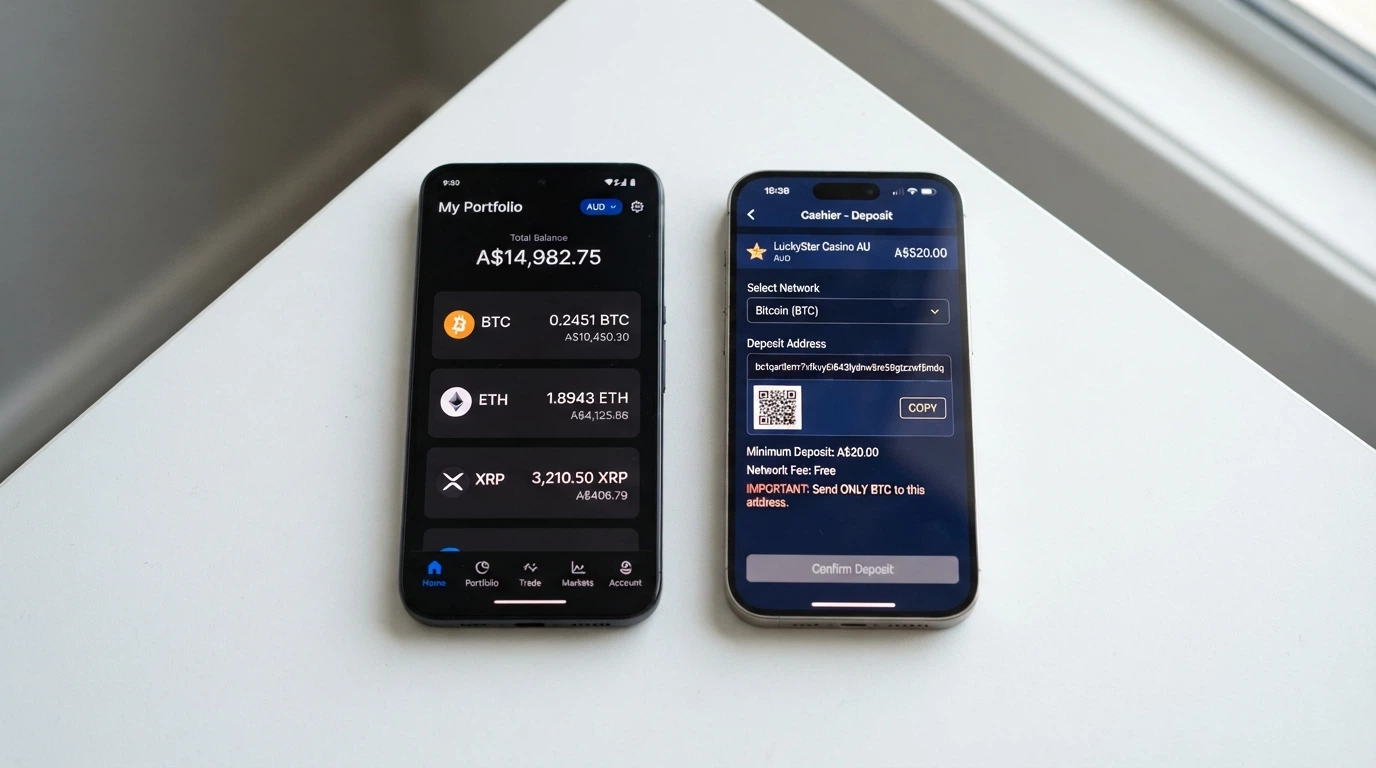
Wallet choice has its own logic. The cleanest path is a self-custody wallet the player controls — MetaMask, Trust Wallet, a hardware wallet, anything that holds the private keys locally. The player buys on an Australian exchange, withdraws to the personal wallet, and sends from the personal wallet to the casino. The exchange knows who they are; the casino does not.
The risky path is sending directly from the exchange to the casino. Some exchanges flag gambling-related wallet addresses and freeze the sending account; some do not. Either way, the player’s identity is one subpoena away from the casino’s deposit address. Sending through a personal wallet inserts a buffer the casino cannot bridge.
Monero is the on-chain privacy option that breaks the trace by design. Some brands support native Monero deposits and withdrawals for that reason; it is not the default at the featured set, but it is the clearest example of an operator building around on-chain privacy. The trade-off is that Monero’s liquidity is thinner, which makes the AUD conversion step slower on the Australian exchange side. For a player whose priority is on-chain privacy rather than speed, Monero is the coin; for a player whose priority is the AUD round trip, USDT on TRC-20 is the coin.
Instant crypto withdrawals — how fast “instant” really is
“Instant” at an offshore casino usually means the casino-side queue is short, not that the Bitcoin is in the player’s bank account. The full cycle runs from the moment the player hits “withdraw” to the moment Australian dollars land in their bank account, and it has three legs.
The first leg is the casino queue. A no-KYC casino with no fraud flags typically processes a withdrawal request in minutes; BC.Game cleared Bitcoin withdrawals in under twenty minutes during off-peak testing. The bigger operators with compliance teams run slower — anywhere from a few hours to a full working day. The casino queue is the variable the casino controls.
The second leg is the blockchain confirmation. Bitcoin takes 10 to 20 minutes per confirmation; one confirmation is typically the threshold for a credit. Ethereum clears in 12 to 30 seconds. USDT on TRC-20 confirms in about three minutes. The blockchain leg is fixed by the network, not by the casino.
The third leg is the AUD conversion. No casino on the no-KYC list pays out directly to an Australian bank account in AUD; the player must withdraw crypto to a personal wallet, sell it on an Australian exchange, and transfer the AUD to their bank. The exchange leg runs from minutes (for an existing verified account with fiat rails open) to days (for a fresh account with new-bank-account verification). Selling USDT or BTC for AUD on a CoinSpot or Swyftx account is fast; transferring the AUD via Osko to the player’s bank adds another minute or two.
The full cycle, in research-tested ranges, sits between 30 minutes and 24 hours. The fastest path is USDT on TRC-20 through a casino with a short queue, sold on a verified Australian exchange, transferred via Osko. The slowest is a first-time Bitcoin withdrawal through a casino with a fraud review, sold through an exchange that requires additional verification on a new bank account. The label “instant” describes the casino leg, not the whole trip.
The AUSTRAC catch: your name is still on the money
The single most important fact about anonymous crypto casino play from Australia is the one the marketing does not lead with: the casino does not know your name, but the Australian exchange where you bought the Bitcoin does. AUSTRAC requires every Australian cryptocurrency exchange to verify customer identity as a condition of the Digital Currency Exchange registration — the same regime that covers banks and remittance operators.
CoinSpot, Swyftx, Independent Reserve and Coinbase AU all verify identity before a customer can fund an account. The verification links the customer’s name, date of birth and address to every wallet address the exchange generates or credits. Sending crypto from that exchange to a casino carries the link with it; it is not visible to the casino, but it is visible to AUSTRAC and to the exchange itself.
The practical privacy limit this creates is the wall the “anonymous” label runs into. For a player concerned about a casino’s database being hacked or sold, the AUSTRAC link is irrelevant — the casino has no name to leak. For a player concerned about a regulator subpoenaing casino records, the AUSTRAC link is irrelevant — there is nothing to subpoena. For a player concerned about the regulator following the money back from the casino to the exchange, the link is the whole story.
What the anonymity model actually delivers, then, is casino-side privacy. It does not deliver financial privacy in the broader sense. A reader weighing the difference should hold both facts at once.
Why your 2026 casino bonus is smaller than it looks
A welcome bonus headline runs in two registers: the marketing number, which is what the player sees first, and the cleared number, which is what the player can withdraw after meeting the bonus terms. The gap between the two is the wagering multiple, the maximum bet cap, the validity window, the maximum cash-out cap and the games the bonus is locked to. Reading those terms is what turns “100% up to A$300 + 100 free spins” into a real cost.

Take Rocket Play’s first-deposit package as a worked example: A$300 at 40x wagering on the bonus only, A$7.50 max bet, A$300 max free-spin winnings, five-day validity. A A$300 bonus at 40x is A$12,000 in required turnover. At A$7.50 per spin, the clearing math runs to 1,600 spins. A five-second interval between spins — the typical pace at online pokies — puts the clearing time at about two hours and thirteen minutes of continuous play. The five-day window makes that pace generous, but the A$300 cap on free-spin winnings is the term that bounds the upside from the 100 spins the package also includes.
The wagering multiple is the headline of the headline. Forty times the bonus is the standard at the top end of the offshore market; thirty times is friendlier; five times, as Rainbet offers, is rare. The multiple determines how much real money a player must put through the casino’s games before the bonus converts from bonus money to withdrawable cash. A player who reads only the bonus amount reads the wrong number.
The validity window is the second term that quietly dominates. Rocket Play’s five days is the tightest on the featured set; Skycrown’s seven days is more forgiving; Royal Reels does not publish a window. A short window does not change the wagering math but it does change the time pressure on the player. A player with a busy week who lets the bonus expire loses the bonus and any winnings tied to it.
The maximum bet cap is the third term. Royal Reels caps at A$5 per spin, Rocket Play at A$7.50, Bizzo at A$8. The cap exists so a player cannot clear a A$12,000 wagering requirement with a single A$12,000 bet and immediately withdraw; it forces the volume through many smaller bets, which is what the casino wants. A player who ignores the cap and bets above it has the bonus voided.
The maximum cash-out cap is the fourth term. Skycrown caps withdrawals from the bonus at A$500; Rocket Play caps the free-spin portion at A$300. A player who clears the wagering and then wins a major spin above the cap is paid the cap; the rest stays with the casino. The cap is the difference between “the bonus cost me X to clear” and “the bonus cost me X to clear and capped my upside at Y”.
A reader who has read the terms before claiming will not be surprised by any of these. A reader who has not is the marketing target.
No-deposit bonuses: what you can actually claim without spending a cent
No-deposit bonuses at anonymous crypto casinos are rare. The featured set carries two: Royal Reels’ A$10 no-deposit bonus after phone verification — a notable exception because the verification step is exactly the kind of friction the no-KYC model is supposed to remove — and Bizzo’s 10 no-deposit free spins for installing the PWA app, at 40x wagering with an A$75 win cap.
The Royal Reels A$10 is a real bonus. Phone verification confirms the player has a working Australian number without asking for documents, and the bonus credits on confirmation. The wagering terms were not published at the time of review; the player who claims it should read the Terms before betting it.
The Bizzo PWA offer is a different shape. Installing the Progressive Web App adds the casino’s icon to a phone home screen; the 10 free spins are credited in return. The A$75 win cap is the ceiling on what the spins can pay out; the 40x wagering is the multiplier on the winnings. Both terms are tighter than they look: a player who wins A$75 from the free spins has A$75 × 40 = A$3,000 in turnover to clear before withdrawing, with a maximum bet cap on the way.
No-deposit offers at casinos outside the featured set exist; this page did not confirm them. A reader considering one outside the top ten should treat it the same way they would treat any other offshore offer: read the Terms, verify the licence, expect the casino to enforce the small print.
Free spins: how many you get, on which pokie, and what they are actually worth
Free spins come attached to almost every welcome package on the featured set. Rocket Play offers 100 free spins on Aztec Magic by BGaming, with winnings capped at A$300. Royal Reels offers 50 free spins on a featured pokie at A$0.20 per spin. Bizzo’s welcome package includes 175 free spins spread across four deposits. Skycrown’s welcome package spreads free spins over the first three deposits; the precise count and the game locked to them were not confirmed at review time.
The shape of a free-spin offer is fixed by three terms. The first is the spin value — A$0.20 per spin at Royal Reels, A$0.50 or higher at some competitors. The higher the value, the more each spin is worth and the more each spin’s outcome counts against the bonus cap. The second is the game restriction — the spins are usually locked to a single title, often a high-volatility pokie the casino’s marketing team has picked for visual impact. The third is the wagering on winnings — most offers apply the package’s main wagering multiple to whatever the spins pay out, which converts a 100-spin bonus into a small-clearing, large-multiplier puzzle.
A player evaluating a free-spin offer should convert the headline into the math. One hundred free spins at A$0.20 is A$20 in nominal spin value; 100 free spins at A$0.50 is A$50. The actual return depends on the game’s hit rate and volatility, neither of which the bonus page quotes. The cap on winnings, not the spin count, is what bounds the upside.
Welcome and deposit-match bonuses: the real cost of the headline number
The deposit-match offers across the featured set read as follows when laid side by side.
Rocket Play: 100% up to A$300 (40x bonus, 5-day window, A$7.50 max bet, A$300 max free-spin winnings); second deposit 200% up to A$300; high roller 50% up to A$2,500.
Skycrown: 100% up to A$200 (30x bonus, 7-day window, A$500 max cash-out).
Royal Reels: A$2,500 across three deposits at 100%, 75%, 100% (35x bonus, A$5 max bet, 50 free spins).
Fair Go: 100% up to A$200 across five deposits, total A$1,000 (30x deposit plus bonus combined, no max cash-out).
Bizzo: up to A$7,250 plus 175 free spins across four deposits (40x bonus, A$8 max bet).
Rainbet: 50% up to A$500 (5x bonus).
BC.Game: multi-tier welcome, terms vary by promotion.
Stake: no fixed welcome match; rakeback and weekly bonuses instead.
WinSpirit and Scream Casino: terms not confirmed at review time.
The cost of clearing a bonus is a function of the bonus amount, the wagering multiple and the maximum bet cap. Royal Reels’ A$2,500 at 35x is the largest headline and the largest clearing volume — A$87,500 in turnover across the three deposits, with the A$5 cap stretching the time required. Fair Go’s A$1,000 at 30x on the deposit plus bonus is the most punishing multiplier — it doubles the effective turnover compared to a bonus-only calculation. Rocket Play’s A$300 at 40x on bonus only is the tightest window.
Rainbet’s 5x bonus is the outlier. A A$500 bonus at 5x is A$2,500 in turnover, which a player can clear in minutes at modest stakes. The low multiple is the term that makes Rainbet the cheapest bonus to clear on the list.
The honest comparison across this set is not which bonus is largest but which bonus is cheapest to convert from bonus money to withdrawable cash. The answer changes with the player’s stake size, available time and tolerance for high-clearance volume. The numbers are side by side here so the reader can do that calculation themselves.
Australian law and anonymous casinos: what the IGA actually says
The Interactive Gambling Act 2001 prohibits the provision of online casino games, online pokies and in-play sports betting to a person in Australia. No licence for online casino exists anywhere in the country — not federally, not in any state or territory. The permitted and licensable products are wagering on races and sporting events placed before the event begins, lotteries and keno, all operated by state and territory-licensed bookmakers. The Northern Territory Racing and Wagering Commission, through Licensing NT, is the de facto national licensor for online wagering services.
The statute has been strengthened twice. The Interactive Gambling Amendment Act 2017 gave the ACMA the powers to issue formal warnings, refer sites for ISP blocking and pursue civil penalties; the Interactive Gambling Amendment (Credit and Other Measures) Act 2023 banned credit cards, credit-related products and digital currency as payment methods for interactive wagering services, commencing 11 June 2024 with penalties of up to A$247,500 for operators that fail to enforce it. The Interactive Gambling Amendment (Gambling Reform) Bill 2026, passed on 19 August 2026, adds a third layer with measures commencing 1 January 2027.
The prohibition targets the operator of the prohibited service. The individual player is not prosecuted under the IGA. What that distinction means in practice is that a person playing at an offshore casino from a Sydney apartment will not be arrested; the offshore casino will be the subject of an ACMA investigation, a formal warning or an ISP blocking request. The protections the licensed Australian system offers — dispute resolution, formal complaints bodies, licence-enforced standards, and the BetStop self-exclusion register — are what the player gives up. The legal risk to the player is the absence of a safety net, not the risk of prosecution.
The ACMA is watching: 1,788 blocked sites and counting
The ACMA’s enforcement numbers, published quarterly, give a measure of how seriously the regulator takes the offshore prohibition. As of August 2026, the ACMA has requested Australian ISPs block 1,788 illegal gambling and affiliate websites since its first blocking request in November 2019. Over 230 illegal gambling services have withdrawn from the Australian market since the regulator began enforcing strengthened rules in 2017.
Q4 2025 alone saw 23 investigations involving 45 gambling sites, 69 breaches of the IGA found, 10 formal warnings issued and 133 websites referred to ISPs for blocking. The numbers do not slow down quarter on quarter; they trend up.
Fair Go was the first site the ACMA ever ordered blocked, on 19 November 2019. On 5 August 2022, the operator’s master-licence holder — Proxous Advanced Solutions Limited — received a formal warning naming 13 online casino-style services provided to Australian customers in breach of subsection 15(2A) of the IGA. The named services included Fair Go Casino, Ozwin Casino, Play Croco and Uptown Pokies. The enforcement action did not stop the services; the regulator’s tool is blocking, not closure. The services continue to operate via mirror domains.
The pattern matters for a player weighing which brand to deposit with. A site on the ACMA’s blocked list is a site the regulator has formally found to be offering a prohibited service to Australians; a site not on the list has not been through that process yet. The absence of a block is not the same as a clean bill of health.
What changes on 1 January 2026: the reform that gives banks blocking powers
The Interactive Gambling Amendment (Gambling Reform) Bill 2026 passed Parliament on 19 August 2026 and commences on 1 January 2027. The reform adds four measures that reshape the offshore casino landscape, even though none of them directly creates a new offence against the player.
The first measure gives banks and payment providers express authority to block transactions to illegal gambling operators. The blocking applies at the payment-rail level — a bank that flags a gambling merchant category code can refuse to authorise a transaction, the way it might refuse a transaction to a sanctioned counterparty. For a player using a debit card or PayID at an offshore casino, this is the most direct practical threat the reform creates. The crypto route sits outside the banking rail, which is exactly why the offshore market exists; the reform narrows the fiat route without closing the crypto one.
The second measure imposes advertising restrictions. Wagering advertising during live sporting events is banned from 15 minutes before to 5 minutes after the event, between 5am and 8:30pm. Television is limited to three wagering ads per hour in that window. Radio advertising at school times is banned; online wagering ads are gated to logged-in verified-over-18 users with an opt-out. Athletes, celebrities and influencers are barred from wagering advertising. The advertising reforms target licensed operators; offshore casinos advertising to Australians are already breaking the prohibition by being reachable.
The third measure restricts direct-marketing inducements. From 1 January 2027, direct marketing of inducements is banned for 14 days after a customer signs up, for three months after a person deregisters from BetStop, and indefinitely for customers identified as at risk of gambling-related harm. The rule applies to licensed operators; offshore casinos offering bonuses to Australians have no Australian-licensed customer relationship to disrupt.
The fourth measure establishes a Wagering Advertising Opt-out Register, a one-stop opt-out for wagering advertising across a person’s online services. The register sits alongside BetStop; both are tools for the licensed market that the offshore market does not honour.
The reform’s centre of gravity is the licensed side. The bank-blocking power is the only measure that touches a transaction path an Australian player might actually use to fund an offshore casino, and even that power is constrained to the fiat rails. The crypto route, which is the entire premise of this page, sits outside the reform’s direct reach.
What you give up when you play outside the licensed market
Every protection the Australian licensed-wagering system provides stays on the licensed side of the line. There is no ACMA complaints process for an offshore casino; the ACMA can block the site, but it cannot recover a player’s money. There is no Australian statutory dispute resolution body; offshore casinos handle complaints through their own terms and their own support queues, with no obligation to respond. There is no BetStop coverage; a self-excluded Australian can fund and play at an offshore casino without the register noticing. There is no chargeback right; the debit-card and credit-card rails the licensed system provides for dispute resolution sit behind the same merchant category code that the offshore casino’s payment processor flags.

There is no guarantee the casino will pay out. The casino is bound by its own terms and by the licence conditions of the jurisdiction that issued it; the player has no third party to escalate to. If the casino voids a withdrawal, claims bonus abuse, freezes an account for “further verification” — the player has what the casino’s own terms say, and nothing more.
There is no guarantee the site will be reachable. The ACMA has blocked 1,788 sites since November 2019; the list grows every quarter. A player who holds a balance on a blocked site has lost access until they find a mirror, which the operator may or may not maintain. There is no recourse for the lost access.
| Protection Feature | Licensed Australian Wagering | Anonymous Offshore Casino |
|---|---|---|
| Identity verification | Full KYC at account opening | Email + password only; soft KYC at EUR 2,000–10,000 / A$2,000–5,000 in withdrawals |
| Complaints and dispute body | State/territory regulator and NCPF | Operator’s own support team only |
| Self-exclusion via BetStop | Yes — binds all AU-licensed wagering | No — offshore casinos not connected to the register |
| Chargeback right | Standard consumer law applies | Gambling MCC flagged; PayID more reliable |
| Guaranteed withdrawal | Statutory and licence conditions | At the operator’s discretion per its Terms |
| Activity statements | Operator obligation under NCPF | Varies by operator; not regulator-mandated |
| Customer-set deposit limits | Required by NCPF | Offered by some operators (e.g. Rainbet); not regulated |
| Site reachability | Stable; no regulator blocking | Can be blocked by ACMA at any time |
The contrast with a licensed Australian wagering account is total. State and territory-licensed bookmakers are bound by the National Consumer Protection Framework, offer dispute resolution through state regulators, accept BetStop exclusions, allow chargebacks under standard consumer law, and operate under statutory deposit limits and activity statement obligations. They also require full identity verification, charge point-of-consumption tax on net wagering revenue, and offer only the products the IGA permits — wagering, not casino.
A player choosing between the two sides is choosing between privacy plus offshore terms, or identity plus Australian recourse. The page does not recommend one over the other; the comparison is what the choice sits on.
Staying safe when nobody knows who you are
The most uncomfortable fact about anonymous crypto casino play is that the anonymity runs in one direction. The player does not have to share identity with the casino; the casino is not obligated to share identity-based safeguards with the player. Self-exclusion tools, deposit limits and time-out features exist at some offshore operators; none of them are connected to BetStop, none of them are audited by an Australian regulator, and all of them are operator-managed settings the casino can edit at any time.
The harm base the player is sitting on is real. About 2.1% of Australian adults — roughly 430,000 people — experience problem gambling; the Australian Institute of Health and Welfare put high-risk gambling at 1.8% in 2022. Legal gambling in Australia generated an estimated A$25.5 billion in losses in 2024–25, with approximately 196,000 poker machines nationwide. Those numbers describe the licensed market; the offshore market is layered on top, with no separate prevalence data and no operator-level disclosure.
Deposit limits, self-exclusion and “Take a Break” at offshore casinos
The most developed responsible-gambling stack on the featured list sits at Rainbet: self-exclusion tools, customer-set deposit limits, and a Take a Break feature that runs from 24 hours up to six months. The tools are real settings, configurable inside the player account; they are not connected to BetStop; the offshore status means the Australian National Self-Exclusion Register does not recognise the operator.
The other featured operators offer variants of the same toolkit. Some publish deposit limits and self-exclusion in their responsible-gambling pages; some publish a “take a break” button; some publish all three and add reality-check pop-ups during long sessions. The depth varies by brand; none of it has the regulatory backing the licensed system provides.
BetStop, the National Self-Exclusion Register, launched on 21 August 2023. As of 31 July 2026, it had 67,480 registrations, with 41,290 exclusions still active — more than 60% of all registrations. 78% of registrants were under 40; 38% chose lifetime exclusion. The numbers describe a tool that is reaching the people it was built for. What the numbers do not describe is the offshore gap: a BetStop registration does not stop a self-excluded Australian from opening an account at an offshore casino.
For a player who wants both deposit limits and the option to walk away for a defined period, the tools exist at Rainbet and at most of the featured brands. For a player who wants those tools to bind an operator that is not bound by Australian regulation, the choice is to use the licensed side instead.
The anonymity paradox: harder to get help when the casino does not know your name
The structural problem with anonymous play is the one responsible-gambling professionals have been raising for years: harm-reduction depends on data. Activity statements show a player their own deposit and loss history. Reality checks interrupt a long session with a prompt to consider stopping. Operator duty of care triggers on patterns a player would not see themselves — escalating deposits, late-night sessions, repeated failed self-exclusion attempts. None of these mechanisms can work when the casino has no verified identity and no ongoing relationship with a player outside the wallet address and the email address.
The crypto-only model adds a second layer. A player funding an account from a personal wallet sees a crypto balance, not an AUD figure; the distance between the number on the screen and the household budget the player is drawing it from is wider than the distance on a debit-card-funded account. A player setting a personal deposit limit at A$100 per week has to convert that to a USDT or BTC figure each time, and to monitor the conversion rather than the AUD number.
The psychological distance is not a sourced claim; it is the analyst’s reading of the structural setup. The argument is that the affordances the licensed system provides — identity-tied activity statements, identity-triggered duty of care, identity-linked self-exclusion — require identity to function, and the anonymous model removes identity by design. A player who is honest with themselves about their play history is the one who notices the gap; a player who is not is the one who needs the gap closed most.
Where to get help in Australia: helpline, chat and counselling
Australia’s National Gambling Helpline — 1800 858 858 — is free, confidential and staffed 24 hours a day, seven days a week. The number routes to Gambling Help Online at gamblinghelponline.org.au, which offers online chat and counselling. The service takes calls from anyone in Australia, regardless of whether the person has been playing at a licensed operator, an offshore casino, or both.
The helpline and the online service do not require the caller to identify themselves, do not require the caller to disclose which operator they have been using, and do not pass information to the ACMA or AUSTRAC. The call is between the person who picks up and the person who dials. For a player weighing whether to keep playing, to set a deposit limit, to take a break, or to self-exclude — the call is the place to start.
BetStop registration is the second tool, for players who want to exclude from licensed wagering services. It does not cover offshore casinos; it does cover every Australian-licensed online and phone wagering service. For a player who plays at both kinds of operator, registering with BetStop is a partial answer that takes the licensed side off the table without touching the offshore side.
How we chose and ranked these casinos
The featured set was built from three layers of evidence. The first was the published terms of each operator — the licence on the footer, the bonus structure in the promotions page, the wagering multiple and validity window in the Terms, the maximum bet cap and the maximum cash-out cap. The second was the regulator’s own records — the ACMA’s blocked-sites list, the formal warnings page, the investigations page, and the operator-sweep notes that named Fair Go, Ozwin Casino, Play Croco and Uptown Pokies in the Proxous Advanced Solutions Limited enforcement action. The third was the provider line-up and the game library — Pragmatic Play, Evolution, Hacksaw, BGaming, RTG, Wazdan, Betsoft and the in-house titles the crypto-native operators publish.
The criteria were five. Licence status and regulatory history: a Curaçao sub-licence is the realistic baseline; an Anjouan licence is the alternative; an MGA licence scoped to wagering is one step above. Bonus terms clarity and wagering fairness: the wagering multiple, the validity window, the max bet cap and the max cash-out cap were the four numbers the comparison put on the table. Game library depth and provider quality: Royal Reels’ 5,400 pokies from 40-plus providers and Bizzo’s 8,000-plus games from 70-plus studios are the depth end; Fair Go’s RTG-only catalogue is the other end. Withdrawal speed and crypto support: BC.Game’s under-20-minute BTC withdrawals, the general TRC-20 USDT confirmation time and the full cycle from casino withdrawal to AUD in bank are the numbers on this axis. Australian player accessibility: whether the brand accepts AU sign-ups at all, whether it excludes Australia in the Terms, and whether it has been the subject of an ACMA blocking request or formal warning.
The ranking is qualitative. No weighting was applied across the criteria; the comparison puts the operators side by side so the reader can weigh them against each other on the axes the reader cares about. WinSpirit and Scream Casino were included with their bonus terms not confirmed; the entry for each states what is known and what is not. Research did not carry a full launch-date table for every featured operator, so age-based comparison is partial.
What you should actually do with this information
The market exists. Australians use it. The Interactive Gambling Act 2001 prohibits the operators from offering the service; the ACMA blocks the sites it finds; the banks will gain transaction-blocking powers in 2027. None of that has stopped the supply, and none of it prosecutes the player on the other side of the screen.
The player is not prosecuted. The player is also not protected. There is no Australian complaints body for an offshore casino complaint; no BetStop coverage for an offshore self-exclusion; no chargeback right for an offshore card transaction; no guarantee of withdrawal; no guarantee of access. The site can be blocked with a balance on it. The licence is Curaçao or Anjouan. The terms are what the Terms say.
For a player who proceeds anyway, the minimum steps are these. Verify the licence yourself — the footer number should resolve to a public register. Read the bonus terms in full before claiming — the wagering multiple, the validity window, the max bet cap, the max cash-out cap. Withdraw frequently and keep your cumulative withdrawal total below the soft-KYC trigger if you want to avoid the document request. Use a personal wallet, not an exchange-to-casino transfer, to insert a buffer between your identity and the casino’s deposit address. Set your own deposit and time limits before you start playing, not after. Know the helpline number — 1800 858 858 — before you need it. Do not deposit more than you can afford to lose to a DNS block that takes the site offline while your balance is still on it.
The decision sits with the player. The page has put the operators, the terms, the law and the cost on the table; what the player does with them is the only choice that matters.
Frequently asked questions
Can the ACMA block my access to an anonymous casino site?
Yes. The ACMA has asked Australian ISPs to block 1,788 illegal gambling sites since November 2019, and the list grows every quarter. Blocking is DNS-level, so mirror domains and VPNs still work. Direct access is cut, and there is no Australian complaints body that can recover a balance left on a blocked site.
What happens to my money if an anonymous casino is blocked by an Australian ISP?
You lose access until the operator stands up a mirror domain, which it may not do. The balance stays with the operator. The ACMA can block a site but cannot recover funds for an individual player, and there is no Australian complaints body to escalate to.
Does BetStop cover anonymous offshore casino sites?
No. BetStop binds Australian-licensed wagering services only. As of 31 July 2026 it had 67,480 registrations, with 41,290 active exclusions. An offshore casino is not connected to the register, and a self-excluded Australian can still fund and play at one.
Which cryptocurrencies are accepted at anonymous casinos available to Australians?
Bitcoin and Ethereum are universal defaults. USDT on the TRC-20 network confirms in about three minutes and is the practical choice for small deposits because the fees are minimal. BC.Game accepts more than 150 cryptocurrencies. Monero is supported at some brands for on-chain privacy, though AUD conversion is slower than for the major coins.
What is the safest way to buy crypto and deposit at an anonymous casino from Australia?
Buy on an AUSTRAC-registered Australian exchange — CoinSpot, Swyftx, Independent Reserve or Coinbase AU — where identity is verified under standard AML rules. Withdraw to a self-custody wallet you control, then send from that wallet to the casino. Direct exchange-to-casino transfers carry the identity link with them.
Prepared by the Welcome Bonus Casinos AU editorial staff.